In the Israeli legal system, a single flight out of Ben Gurion Airport without the correct permissions can transform a planned move into a complex international abduction claim. It’s a heavy reality that many expats face when a career opportunity arises abroad or a marriage ends. If you’re feeling overwhelmed by the complexities of international child relocation laws israel, you aren’t alone. The fear of being legally “trapped” in the country is a common concern for those unfamiliar with how local courts handle cross-border custody and the specific requirements of the Israeli judicial system.
We understand you want to provide a stable future for your children while protecting your parental rights. This guide offers a clear, advisory roadmap to help you navigate the 2026 legal environment with confidence. You’ll gain clarity on the “Best Interests of the Child” standard, the critical role of the Hague Convention, and why obtaining “Mirror Orders” from a destination country is now a standard requirement. You can also find supplemental video guidance on these topics through the Israel Family Law YouTube channel. Understanding these frameworks before you commit to a move helps you make informed decisions for your family’s long-term interests.
This content is published on an independent advisory platform and is for informational purposes only. It does not constitute legal advice or an attorney-client relationship. Legal services are provided only by licensed attorneys under a separate engagement.
Key Takeaways
- Learn why moving a child abroad without formal consent can be legally classified as abduction under the Legal Capacity and Guardianship Law.
- Understand how Israeli courts apply the “Best Interests of the Child” standard to weigh a child’s current stability against the benefits of relocation.
- Discover the formal steps for navigating international child relocation laws israel, from obtaining notarized consent to filing a “Motion for Relocation.”
- Gain clarity on “Stay of Exit” orders and how they are used to prevent unilateral moves while a custody or relocation case is pending.
- Identify why a cross-border strategy is essential for protecting your parental rights in both Israel and your home country.
Understanding the Legal Landscape of Child Relocation in Israel
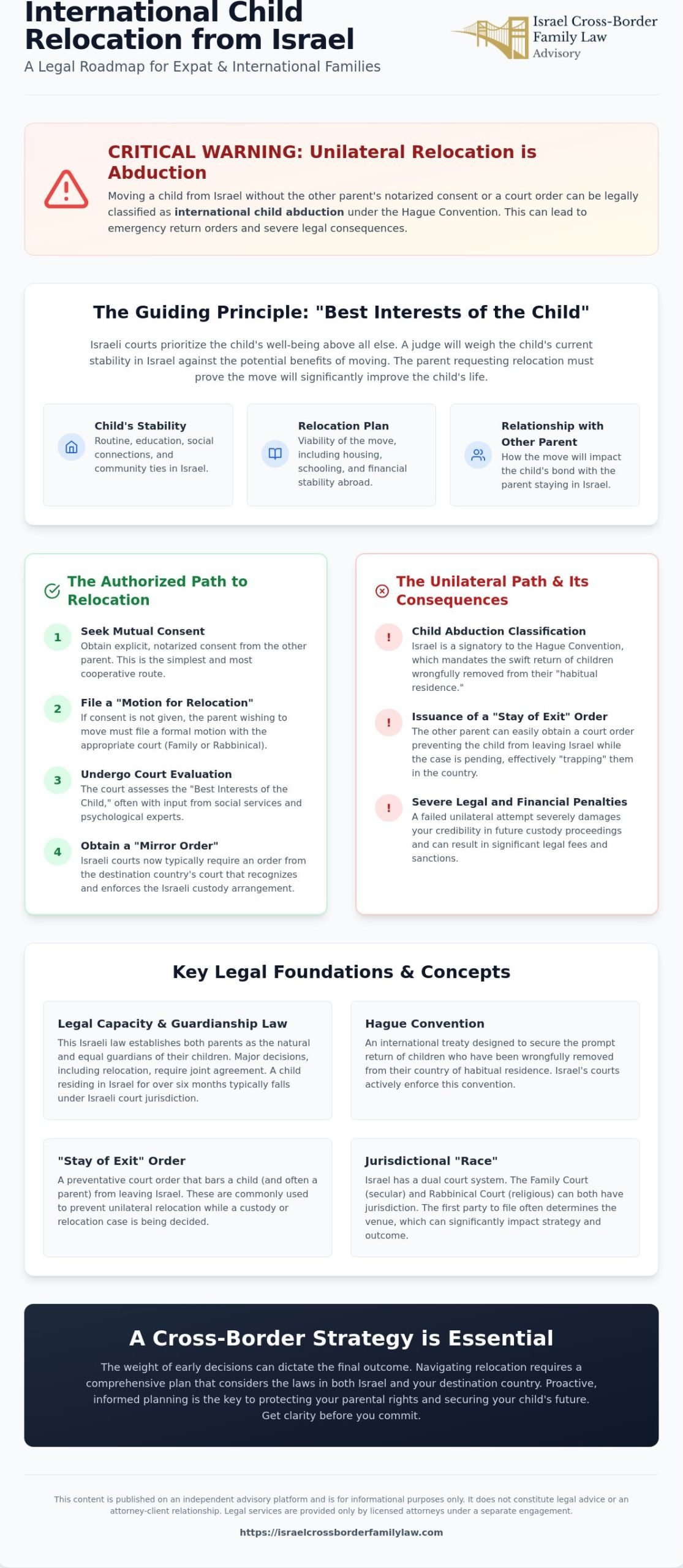
Israeli law views the relationship between parent and child through the lens of the Legal Capacity and Guardianship Law. This statute establishes that both parents are the natural guardians of their children, requiring joint decisions on all significant life changes. Relocation isn’t merely a change of address; it’s a fundamental shift in the child’s center of life. If a child has resided in Israel for at least six months, the local courts typically assume jurisdiction over their welfare, regardless of the parents’ original citizenship.
Unilateral action carries heavy risks. Moving a child across international borders without the explicit, notarized consent of the other parent or a formal court order is classified as abduction. Israel’s commitment to the Hague Convention on the Civil Aspects of International Child Abduction means that the legal system is designed to return children to their habitual residence quickly. Attempting to bypass these international child relocation laws israel through self-help strategies often results in emergency return orders and significant legal penalties.
To better understand this concept, watch this helpful video:
The Legal Definition of Relocation
Permanent relocation is legally distinct from a temporary trip or a short-term visit abroad. The court examines whether the move will disrupt the child’s education, social ties, and relationship with the non-relocating parent. Cross-border moves, such as moving from Israel to the United States, face much higher scrutiny than moves within the country. This is because international relocation often effectively ends the existing visitation routine, requiring the court to find a completely new balance for the child’s best interests. Seeking clarity before making any commitments is vital; the weight of early decisions often dictates the final outcome of a case.
Jurisdictional Complexity: Family vs. Rabbinical Courts
Expats often find the dual court system confusing. While the Family Court (Beit Mishpat LeInyanei Mishpacha) is the standard venue for secular matters, the Rabbinical Court may gain jurisdiction if a party files there first. This “race to the court” can significantly influence the procedural flow of a relocation motion. Legislative shifts in late 2025 have even expanded the Rabbinical Court’s influence over child-related financial needs for a two-year period. Establishing the correct jurisdiction early is essential for a stable international custody and relocation strategy.
This content is published on an independent advisory platform and is for informational purposes only. It does not constitute legal representation or formal legal advice. Legal services are only provided by licensed attorneys under a separate engagement.
The “Best Interests of the Child” Standard in Israeli Courts
In the Israeli court system, the “Best Interests of the Child” is the supreme guiding principle. This standard overrides all other considerations, including parental rights or previous agreements between spouses. When a parent petitions to move abroad, the judge must determine if the child will thrive more in the new environment than they currently do in Israel. This involves a deep analysis of the child’s routine, education, and social connections. According to an ICMEC legal analysis of Israeli law, the courts maintain a high threshold for relocation, as the move inherently disrupts the child’s relationship with the parent staying behind.
The court relies heavily on a specialized professional known as a “Social Worker for Legal Matters” or Pekidat Saad. This professional acts as an objective observer for the court. They conduct home visits, interview teachers, and meet with both parents to assess the family dynamic. Their final report carries significant weight in how international child relocation laws israel are applied to your specific case. For older children, usually those over the age of ten, the court also allows them to express their own feelings in a private setting. While the judge listens to the child’s voice, they ultimately decide what is best regardless of the child’s stated preference.
Factors Courts Consider in Relocation Cases
Judges look for “sincerity” in every relocation request. If the move appears to be a tactic to alienate the other parent, it’s unlikely to be approved. The court examines the quality of the child’s relationship with both parents and the educational or social opportunities available in the destination country. They also consider the relocating parent’s willingness and ability to support a meaningful relationship with the parent in Israel. It’s often helpful to discuss your strategy with an advisor before these factors are officially scrutinized by the court.
The Role of Expert Evaluations
In many international custody and relocation cases, the court appoints a psychologist to conduct a comprehensive evaluation. These experts assess parental capability and the child’s emotional state. Their findings frequently form the basis of the final ruling. Preparing for these interviews requires a calm, child-centered approach. You must be able to articulate why the move serves the child’s needs rather than just your own career or personal goals. These reports can make or break a case, so understanding the evaluator’s focus is critical to your success.
This content is published on an independent advisory platform and is for informational purposes only. It does not constitute legal representation or formal legal advice. Legal services are only provided by licensed attorneys under a separate engagement.
The Legal Process: From Parental Consent to Court Decisions
Successfully navigating international child relocation laws israel requires a strategic approach that begins long before a formal motion is filed. While many families assume that litigation is the only path, the Israeli legal system prioritizes dispute resolution. Before you can even bring a relocation case before a judge, you must participate in mandatory “Dispute Resolution” sessions, known as Mahut. These meetings are conducted by the court’s assistance unit and are designed to explore whether a settlement is possible without a prolonged legal battle. Skipping this stage is generally not an option, as the court requires a certificate of completion before moving forward with a contested claim.
If these sessions don’t lead to an agreement, the next step is the formal filing of a “Motion for Relocation” in the Family Court. This is a complex evidentiary process where the burden of proof lies with the parent wishing to move. You’ll need to present a comprehensive plan that addresses everything from housing and education to the long-term financial stability of the family in the new country. Understanding the Israeli Law on International Child Abduction is critical during this phase, as the court must be certain that the move is lawful and that the child’s rights are protected under international treaties.
Step 1: Seeking Mutual Consent
The most stable outcome for any family is a negotiated settlement. A detailed, court-approved relocation agreement provides a level of certainty that a judge’s ruling cannot. These agreements must be meticulously drafted to include “Mirror Orders” from the destination country, ensuring that visitation rights are enforceable across borders. When you structure a visitation schedule that spans continents, you must consider school holidays, travel costs, and digital communication. Seeking a clear strategy for International Custody & Relocation early in the process can help prevent the emotional and financial drain of a multi-year court case.
Step 2: Litigation and the Evidentiary Stage
When consent isn’t possible, the case enters the evidentiary stage. In 2026, the Israeli Judicial Authority updated its court fees, reflecting the significant administrative resources required for these cases. To support your move, you must provide concrete evidence such as signed job offers, confirmed school enrollment, and a clear plan for maintaining the child’s connection to the non-relocating parent. The non-relocating parent can contest the move by demonstrating that the child’s “habitual residence” in Israel provides superior stability. Once a ruling is issued, it’s considered final, though appeals to the District Court are possible if a legal error occurred during the initial trial.
This content is published on an independent advisory platform and is for informational purposes only. It does not constitute legal representation or formal legal advice. Legal services are only provided by licensed attorneys under a separate engagement.
Preventing Unilateral Relocation: Stay of Exit Orders
One of the most distinct features of international child relocation laws israel is the frequent use of the “Stay of Exit” order, known in Hebrew as Tzav Ikur Yetzia Min Ha’aretz. Unlike many Western jurisdictions where travel is assumed a right until proven otherwise, Israeli courts often issue these orders as a preventative measure. In contested divorce proceedings involving international families, these bans are frequently placed on children automatically to ensure that neither parent can unilaterally remove the child from the country while legal matters are pending. This creates a legal “freeze” on the child’s location, requiring a specific court order to lift even for short family vacations.
Violating an exit ban is a serious matter that can lead to immediate intervention by border police and potential criminal charges. If a parent attempts to leave with a child while an order is in place, they’ll likely be stopped at Ben Gurion Airport. For temporary trips, the court usually requires the traveling parent to provide “guarantors” or significant financial deposits to ensure the child returns to Israel. This system provides a robust layer of protection for the parent staying behind, though it requires careful management to avoid feeling trapped within the borders. If you are concerned about your current travel status, you should request a confidential review of your case to understand your options.
The Hague Convention on Child Abduction
Israel and the United States are both signatories to the Hague Convention, which serves as the primary international framework for resolving abduction cases. Under this treaty, the court focuses on “wrongful removal” or “wrongful retention.” Removal occurs when a child is taken out of Israel without consent; retention happens when a child is taken for a permitted vacation but isn’t returned on the agreed date. In Israel, these cases are prioritized and typically conclude within six to eight weeks. You can find more detailed guidance on these protections in our advisory on the Hague Convention and child abduction.
Emergency Measures and Protective Orders
If you suspect a parent is planning to flee with a child, time is the most critical factor. Emergency ex-parte applications can be filed to secure a Stay of Exit order within hours. Once granted, the order is electronically transmitted to all border crossings and airports instantly. Beyond court orders, practical steps include securing the child’s passports and notifying the relevant embassies. Israeli police and border control are highly experienced in enforcing these bans, but they can only act once a formal order is registered in the national system. Early strategy and clear documentation are your best defenses against a sudden, unauthorized relocation.
This content is published on an independent advisory platform and is for informational purposes only. It does not constitute legal representation or formal legal advice. Legal services are only provided by licensed attorneys under a separate engagement.
Strategic Planning for Cross-Border Families
The decisions you make in the first weeks of a relocation dispute often dictate the outcome for years to come. When families are caught between two legal systems, the impulse to act quickly can sometimes lead to unintended consequences. A successful approach to international child relocation laws israel requires a comprehensive strategy that looks beyond the immediate courtroom battle. It involves understanding how a ruling in an Israeli Family Court will be recognized and enforced in your home country, especially when dealing with complex multi-jurisdictional custody arrangements.
Maintaining a calm, advisory focus is more than just a matter of tone; it’s a strategic necessity. Israeli judges and court-appointed experts prioritize parents who demonstrate a willingness to facilitate the child’s relationship with the other parent, even across continents. By positioning yourself as a collaborative and child-centered guardian, you align your goals with the court’s “Best Interests” standard. Our role is to act as a bridge for English-speaking families, translating the cultural and procedural nuances of the Israeli system into a language you understand and can act upon with confidence.
Clarity Before Commitment
Taking legal action without a clear roadmap is a significant risk. Evaluating the strengths and weaknesses of your position requires an objective perspective that considers current 2026 processing times and recent legislative shifts. A confidential case review offers the opportunity to identify potential hurdles, such as the likelihood of a Stay of Exit order or the specific requirements for mirror orders in your destination state. Gaining this clarity early allows you to negotiate from a position of strength rather than reacting to emergency filings.
Moving Forward with Confidence
The complexities of moving abroad with children are inherent, but they don’t have to be insurmountable. Expert guidance provides the steady hand needed to navigate the intersection of US and Israeli law. By focusing on strategy and risk mitigation, you can protect your parental rights while ensuring your child’s stability remains intact. You don’t have to navigate this path alone; professional support is available to walk you through every stage of the relocation process.
Get clarity before you commit. Request a confidential consultation.
This content is published on an independent advisory platform and is for informational purposes only. It does not constitute legal representation or formal legal advice. Legal services are only provided by licensed attorneys under a separate engagement.
Securing Your Family’s Global Future
Navigating the intersection of US and Israeli legal systems requires more than just following a checklist; it demands a nuanced understanding of how local courts interpret a child’s best interests in an increasingly global context. By prioritizing early strategic planning and respecting the weight of Stay of Exit orders, you can avoid the risks of accidental abduction claims and ensure your family’s transition remains legally sound. Understanding international child relocation laws israel is the first step toward a successful cross-border move.
Our independent advisory platform serves as a vital bridge for international families facing these multi-jurisdictional complexities. We focus on providing calm, strategic guidance rooted in decades of experience with US-Israel legal conflicts. Whether you’re managing a move back to the US or defending your parental rights within Israel, seeking professional clarity ensures your decisions are based on strategy rather than anxiety. This content is for informational purposes only; legal services are only provided by licensed attorneys under a separate engagement.
Get clarity before you commit. Request a confidential consultation.
You have the strength to manage this transition, and with the right strategy, you can protect your child’s future and your own peace of mind.
Frequently Asked Questions
Can I move my child from Israel to the US without the other parent’s consent?
No, you cannot move your child out of the country without either the explicit, notarized consent of the other parent or a formal order from the Israeli Family Court. Under the Legal Capacity and Guardianship Law, both parents share natural guardianship. Any unilateral move is legally seen as abduction, even if you’re a citizen of the destination country. It’s essential to secure legal clearance before making any travel arrangements.
What happens if I take my child out of Israel without a court order?
Taking a child out of Israel without permission is considered international child abduction under the Hague Convention. Since Israel and the US are both signatories, the other parent can file for the child’s immediate return. This process is designed to return the child to their “habitual residence” quickly. Violating these international child relocation laws israel can lead to emergency return orders and significant legal penalties in both jurisdictions.
How long does a relocation case typically take in the Israeli Family Court?
While Hague Convention abduction cases are typically concluded within six to eight weeks, a contested relocation motion takes much longer. These cases often last several months or even over a year. The timeline depends on the court’s schedule and the time needed for social workers or psychologists to complete their mandatory evaluations. You should plan for a lengthy process if the other parent doesn’t agree to the move.
Does the Hague Convention apply if I am a US citizen moving back to the US?
Yes, the Hague Convention applies regardless of your citizenship. The court focuses on where the child has been living, known as “habitual residence.” If your child has lived in Israel for six months or more, Israeli courts generally assume jurisdiction. Your status as a US citizen doesn’t give you the right to bypass Israeli court procedures when moving a child who is a resident of Israel.
Can a “Stay of Exit” order be permanent for a child in Israel?
A “Stay of Exit” order remains in effect until the child turns 18 unless a judge formally cancels it. These orders are common in international divorce cases to prevent a parent from leaving the country with the child unexpectedly. While it’s not “permanent” in a literal sense, it stays on the child’s record at border control for their entire minority. You’ll need a specific court order to lift it for temporary vacations.
How does the court decide if relocation is in the child’s best interest?
The court evaluates the child’s “Best Interests” by looking at their current stability in Israel compared to the proposed opportunities abroad. Judges examine the child’s education, social ties, and primary language. They also place significant weight on whether the move will allow for a meaningful, ongoing relationship with the parent staying in Israel. The parent wishing to move must prove the child will thrive more in the new location.
What is the role of a court-appointed psychologist in an Israeli relocation case?
A court-appointed psychologist serves as an expert witness who evaluates the family dynamic and the child’s emotional health. They conduct interviews and observations to determine parental capability and the potential impact of a move. Their professional report often becomes the foundation for the judge’s final ruling. These experts provide the objective analysis the court needs to decide complex international child relocation laws israel matters.
Can I appeal a court’s decision to deny my relocation request?
Yes, you can file an appeal with the District Court if your relocation request is denied. However, an appeal isn’t a new trial. You must demonstrate that the Family Court made a specific legal error or that there was a flaw in the procedural process. Simply disagreeing with the judge’s assessment of the facts is usually not enough for a successful appeal. As of 2026, the fee for an appeal against a Family Court judgment is 775 NIS.

Article by
Gabriel Lior
A Personal Journey That Became a Mission
The advisory was founded by an American father Gabriel Lior, LLB, MBA , global entrepreneur, and cross-border advisor who spent more than a decade navigating the Israeli family court system firsthand and now lives in Singapore with his son.
As a divorced parent in a cross-border family, Gabriel faced nearly every legal challenge a foreign parent can encounter in Israel — including child custody disputes, child support proceedings, property matters in Israel and abroad, false accusations, and complex immigration and relocation proceedings.
Over the years, he learned the hard way how difficult it is for non-Israeli parents to understand the system, identify the right legal strategy, and choose the right legal representation — especially when language, culture, and jurisdictional differences are involved. He also witnessed how foreign parents and new immigrants are often disadvantaged or taken advantage of by service providers and institutions simply because they lack local knowledge or fluency.
From Client to Advisor
To truly understand — and survive — the system, Gabriel pursued formal legal education in Israel, completing two Israeli law degrees, alongside a BA and MBA earned in the United States. This was never about becoming a practicing attorney, but about gaining a deep, structural understanding of how the system works — and where it breaks down for foreign parents.
This rare combination of:
Firsthand client experience
Israeli legal and US business education
International business and negotiation training
Decades of commercial execution
created a unique perspective – one that understands both sides of the table.
After years of litigation, persistence, and at times self-representation, he ultimately succeeded in securing custody of his son and relocating abroad through a rare legal victory in the Israeli Supreme Court — becoming one of the first fathers in Israel to do so under these circumstances.
Disclaimer
Important Disclaimer:
The information provided on this website and in its content is for general informational and educational purposes only and does not constitute legal advice, legal opinion, or legal representation.
Gabriel Lior is not licensed to practice law in Israel (nor is he interested in doing so) and does not provide legal services, despite having completed 2 Law Degrees. The services offered are advisory in nature and are intended to provide general guidance, strategic insight, and information regarding cross-border family law considerations.
No attorney-client relationship is formed by accessing this website, reading its content, or communicating with us.
Any decisions made based on this information are at your own discretion and risk. For legal advice specific to your situation, you should consult a licensed attorney in the relevant jurisdiction.
Where appropriate, we may refer clients to independent, licensed attorneys or professionals. Such referrals do not constitute legal representation and no liability is assumed for services provided by third parties.