This article is published on an independent advisory platform, not a law firm. The content is for informational and advisory purposes only and does not constitute an attorney-client relationship or legal advice. Legal services are only provided by licensed attorneys under a separate engagement.
Your lawyer in Israel might be technically correct about the law while being completely wrong about your family’s long-term interests. It is natural to feel a profound loss of control when you are involved in high-stakes family matters in a foreign jurisdiction. You likely want to know what happens if i disagree with my lawyer’s strategy and whether challenging their approach will lead to a permanent loss of rights. Many international clients feel confused by the specific tactics used in the Israeli legal system, leading to a disconnect between their personal goals and the legal path being taken.
You can learn how to bridge this gap and advocate for your needs without undermining your legal position. This article provides a clear framework for navigating strategic disagreements in cross-border cases. We will discuss how to distinguish between legal “means” and your personal “ends,” the importance of seeking clarity before early decisions are set in stone, and the specific steps to realign your counsel with your desired outcomes. By understanding the cultural and systemic differences in IL, you can regain your confidence and ensure your strategy reflects your actual priorities.
Key Takeaways
- Distinguish between your role in setting the ultimate objectives and your lawyer’s role in choosing the tactical route within the Israeli legal system.
- Learn what happens if i disagree with my lawyer’s strategy and how a dedicated strategy review meeting can clarify the logic behind specific legal moves.
- Identify how cultural differences in litigation styles and jurisdictional complexities often create friction between international clients and local counsel.
- Assess the impact of shifting strategies late in a case, focusing on the financial implications and the message it sends to the opposing side.
- Understand how an independent advisory model can provide a neutral second opinion to help you make informed choices without terminating your current representation.
This article is published on an independent advisory platform, not a law firm. The content is for informational and advisory purposes only and does not constitute an attorney-client relationship or legal advice. Legal services are only provided by licensed attorneys under a separate engagement.
The Attorney-Client Relationship: Who Controls the Strategy?
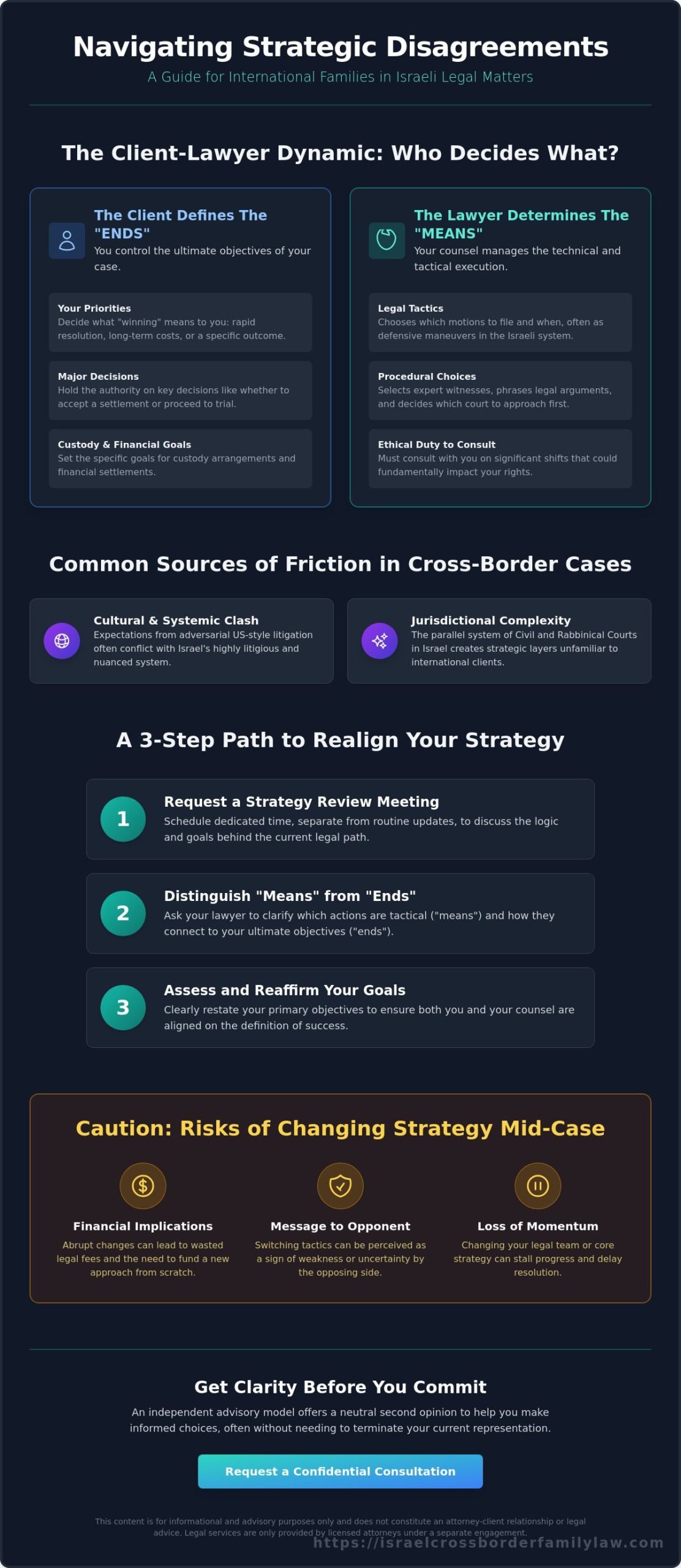
The foundation of any successful legal case is a clear division of responsibility between the client and the practitioner. In the context of cross-border family law, this relationship is defined by a simple rule: the client defines the “ends,” while the lawyer determines the “means.” You hold the ultimate authority over the objectives of your case, such as whether to settle or proceed to trial. However, your lawyer typically maintains “implied authority” over tactical decisions. This often leads to confusion for international clients who wonder what happens if i disagree with my lawyer’s strategy when a motion is filed without their direct approval.
While lawyers have the professional autonomy to choose specific legal pathways, they have an ethical obligation to consult with you on any significant strategic shifts that could impact your rights. Many practitioners look to the Model Rules of Professional Conduct as a global benchmark for these duties. In Israel, this dynamic is further complicated by the concurrent jurisdiction of Civil Family Courts and Rabbinical Courts. A decision that seems tactical, like choosing which court to approach first, can fundamentally alter your legal standing in IL.
To better understand this concept, watch this helpful video:
Defining Your Legal Objectives
Setting specific, measurable goals is the most important contribution you can make to your case. Many clients mistakenly tell their counsel they simply want to “win,” but this is not a functional objective in a complex divorce for international families. You must decide if your priority is rapid resolution, long-term cost-efficiency, or securing a very specific custody arrangement. These early decisions carry significant weight in US-Israel cases; they dictate the entire trajectory of the litigation for years to come.
Tactical Decisions Reserved for Counsel
Once your objectives are set, your lawyer manages the technical execution. This includes selecting which expert witnesses to call, determining the phrasing of legal arguments, and deciding the precise timing for filing motions. It’s common to feel that certain Israeli legal tactics are overly aggressive or unnecessarily slow. However, in the IL system, what looks like an aggressive move is often a defensive maneuver designed to prevent the opposing side from seizing a jurisdictional advantage. Understanding what happens if i disagree with my lawyer’s strategy requires recognizing that these tactical choices are often based on systemic nuances that aren’t immediately visible to those outside the local legal culture.
This article is published on an independent advisory platform, not a law firm. The content is for informational and advisory purposes only and does not constitute an attorney-client relationship or legal advice. Legal services are only provided by licensed attorneys under a separate engagement.
Why Disagreements Occur in US-Israel Cross-Border Cases
Friction between international clients and their Israeli counsel often stems from a fundamental clash of legal cultures. If you were raised in the American legal tradition, you likely expect an “adversarial” process defined by extensive discovery and clear, predictable motions. The Israeli legal landscape is highly litigious but operates under a different set of procedural rules and social norms. When you find yourself asking what happens if i disagree with my lawyer’s strategy, it is often because the local approach feels counterintuitive or even passive compared to what you might experience in a US court.
One of the most common points of contention is the “Race to Jurisdiction.” In IL, being the first to file in a specific court, whether the Civil Family Court or the Rabbinical Court (Beit Din), can dictate which laws apply to your property and alimony. Your lawyer might move with a speed that feels reckless, or they might wait for a specific tactical opening that leaves you feeling exposed. This timing is rarely about a lack of care; it is a calculated attempt to secure the most favorable forum for your specific goals.
Strategic silence is another area where disagreements frequently arise. You may want to respond to every allegation or provocation from the opposing side to set the record straight. However, your lawyer may choose not to engage. In the Israeli system, over-responding can sometimes validate weak claims or provide the other side with more information than they are entitled to receive. This silence is often a defensive shield, not a sign of weakness. If you feel your voice is being lost, it may be helpful to request a confidential review to ensure your long-term interests remain the priority.
Systemic Differences in the Israeli Legal Landscape
The Israeli court system relies heavily on interim orders and court-appointed experts rather than the party-driven discovery process common in the US. In IL, a court-appointed psychologist or social worker often carries more weight than any witness you could hire personally. Strategies are built around influencing these experts rather than “winning” a deposition. Furthermore, The Argument for Autonomy in legal decision-making suggests that while you should have a say, you must also respect the systemic reality that US-style discovery simply does not exist in the same format in Israel.
Cross-Border Complexity and Risk
The greatest risk in these cases is the “silo” effect, where a strategy that works in Israel inadvertently damages your standing in a US court. For example, a specific custody argument made in an Israeli court could be used against you in a US Hague Convention proceeding. Achieving a unified strategy requires a nuanced understanding of how these two systems interact. If you find yourself wondering what happens if i disagree with my lawyer’s strategy, the answer may involve bringing in a cross-border advisor to ensure your Israeli tactics don’t create an irreversible conflict with your US legal interests.
This article is published on an independent advisory platform, not a law firm. The content is for informational and advisory purposes only and does not constitute an attorney-client relationship or legal advice. Legal services are only provided by licensed attorneys under a separate engagement.
Immediate Steps to Resolve a Strategic Conflict
When you feel a disconnect with your legal team, the initial instinct is often to feel a loss of control. However, understanding what happens if i disagree with my lawyer’s strategy begins with a structured conversation rather than an emotional confrontation. The most effective way to address this is to request a dedicated Strategy Review meeting. This is not a standard status update; it is a formal session meant to align your personal objectives with the legal tactics being deployed in IL. By pausing the process to seek clarity, you prevent a minor disagreement from turning into a critical error that could jeopardize your case.
During this meeting, your primary tool is the “Why” question. You should ask your lawyer to explain the specific tactical benefit of the path they have chosen. In the Israeli legal system, certain moves that appear counterintuitive to an expat are often mandatory procedural steps or defensive maneuvers. Once the explanation is provided, you must evaluate whether the disagreement is about the “Means” or the “Ends.” As established earlier, you control the destination, but the lawyer generally selects the route. If the route they’ve chosen feels high-risk, documenting your disagreement in writing ensures there is no ambiguity about the path forward and protects your interests if the strategy fails to yield results.
Preparing for the Strategy Meeting
Prepare for this session by listing your specific concerns using neutral, outcome-focused language. Avoid accusatory phrasing, which can cause a lawyer to become defensive and less communicative. Instead, frame your concerns around the impact on your life. For example, you might say, “I am worried this motion will delay my ability to see my children.” This approach keeps the focus on your goals rather than the lawyer’s professional competence. To better understand how a structured, advisory-led approach handles these transitions, you can review the How it Works page for a breakdown of the process.
Questions to Ask Your Lawyer
To gain the clarity you need, use these specific questions to guide the conversation:
- What is the specific legal goal of this particular tactic within the context of the Israeli court’s current trends?
- What are the actual risks if we choose not to follow this specific strategy right now?
- Are there alternative legal paths in IL that lead to the same objective with less risk to my US-based interests?
If you still feel uneasy after hearing these answers, it may be time to consider whether your current representation truly understands the cross-border complexities of your situation. Seeking a second opinion is a common way to validate a strategy before you commit to a path you don’t fully trust.
This article is published on an independent advisory platform, not a law firm. The content is for informational and advisory purposes only and does not constitute an attorney-client relationship or legal advice. Legal services are only provided by licensed attorneys under a separate engagement.
Evaluating the Risks of Changing Strategy Mid-Case
While you have the right to change the direction of your case, doing so mid-stream involves significant risks. It’s common to wonder what happens if i disagree with my lawyer’s strategy to the point where you want to start over or completely pivot your approach. However, a sudden change can create a “Sunk Cost” reality that is difficult to overcome. In the Israeli legal system, early filings and statements often set a foundation that is legally binding. Withdrawing those claims or changing your stance can signal indecision or weakness to the opposing side, which they may use to their advantage during high-stakes negotiations.
A major risk involves the concept of “prejudice” to your case. This occurs when a sudden change in strategy makes it harder for the court to reach a fair conclusion or causes unnecessary delays. Israeli judges value consistency above almost all else. If you frequently change your legal arguments, the court may begin to view your claims with skepticism. This loss of credibility can be more damaging than following a strategy that is merely “good” rather than “perfect.” In family law, a steady hand often produces better results than a reactive one.
Financial and Temporal Costs
Pivoting late in the process carries a heavy financial burden. When you bring in new counsel or shift strategy, there is a natural duplication of legal fees. New practitioners must spend hours, or even weeks, reviewing the existing file to understand the multi-jurisdictional complexities of your specific situation. You may also face costs for amending documents that have already been filed with the court or withdrawing previous claims. For a better understanding of how these international legal costs are structured, you can refer to our pricing page. Beyond the money, a strategic change often adds months to a cross-border dispute. The Israeli court schedule is rarely flexible, and a request to delay proceedings for a strategy shift may result in financial penalties or a loss of procedural momentum.
The Impact on Judicial Perception
Israeli family law relies heavily on rules against “inconsistent pleading.” If you tell the court one thing in January and the opposite in June, the judge may discount your testimony entirely. This risk extends to court-appointed professionals, such as social workers or psychologists. These experts are the backbone of the Israeli system. If they perceive that your strategy is constantly shifting, they may report that you are unstable or uncooperative. Consistency is often the most valuable asset you have in a family law dispute. Before you make a drastic change, request a confidential consultation to evaluate the risks of a pivot versus the benefits of staying the course.
This article is published on an independent advisory platform, not a law firm. The content is for informational and advisory purposes only and does not constitute an attorney-client relationship or legal advice. Legal services are only provided by licensed attorneys under a separate engagement.
The Advisory Model: Gaining Clarity Without Conflict
Many people assume that their only choice is to follow their lawyer blindly or fire them entirely. This binary choice often leads to unnecessary stress and high legal costs. An independent strategic advisory offers a third path. Unlike legal representation, where a lawyer is focused on the daily mechanics of the IL court system, an advisor focuses on your high-level objectives. If you find yourself wondering what happens if i disagree with my lawyer’s strategy, an advisor can help you understand the logic behind specific tactics. They act as a bridge, translating complex Israeli legal maneuvers into plain English so you can make informed choices about your future.
The Value of an Independent Strategy Review
A second opinion is a standard practice in medicine; it should be the same in high-stakes family law. An independent review by a practitioner who understands both US and Israeli systems can identify cross-border blind spots. These are risks that a local IL lawyer might miss because they aren’t familiar with how their actions might impact your standing in a foreign court. You can bring these insights back to your current legal team to strengthen your case without creating a rift. Presenting a second opinion doesn’t have to be hostile. You can frame it as a collaborative effort to ensure every angle of your multi-jurisdictional matter is covered.
Next Steps for International Families
Before you take any drastic action, determine if your disagreement is a fundamental deal-breaker or simply a misunderstanding of local procedures. Seeking clarity before you commit to a path that cannot be undone is the most responsible way to manage a case of this scale. You deserve to feel confident in the route your case is taking. To explore how these dynamics play out in specific scenarios, you can learn more about Divorce & Separation for International Families. If the gap between your goals and your lawyer’s tactics remains too wide after a review, then you can move forward with replacing your team. This provides a definitive answer to what happens if i disagree with my lawyer’s strategy and allows you to proceed with total confidence.
Get clarity before you commit. Reach out for a confidential advisory call or message via WhatsApp to discuss your strategy.
This article is published on an independent advisory platform, not a law firm. The content is for informational and advisory purposes only and does not constitute an attorney-client relationship or legal advice. Legal services are only provided by licensed attorneys under a separate engagement.
Securing Your Strategic Future in IL
Navigating a family law case across borders requires a delicate balance between your personal goals and the technical demands of the Israeli legal system. You now understand that while you define the destination, your lawyer typically manages the tactics. We’ve explored the risks of changing course mid-stream and why cultural differences often lead to friction. If you’re still questioning what happens if i disagree with my lawyer’s strategy, remember that a second opinion can provide the validation or course correction you need without jeopardizing your current representation.
Our platform specializes in US-Israel cross-border family law with deep expertise in both the Civil and Rabbinical court systems. By taking an advisory-first approach, we help international families translate complex IL tactics into actionable insights. You don’t have to navigate these systemic differences alone or in a state of confusion. Get clarity before you commit. Request a confidential consultation to align your legal strategy with your long-term interests. You can regain control over your case and move forward with the confidence that your rights are protected.
This article is published on an independent advisory platform, not a law firm. The content is for informational and advisory purposes only and does not constitute an attorney-client relationship or legal advice. Legal services are only provided by licensed attorneys under a separate engagement.
Frequently Asked Questions
Can I fire my lawyer if I disagree with their strategy?
Yes, you have the absolute right to terminate your legal representation at any time. However, you should consider the timing carefully, as switching counsel mid-case can lead to significant financial costs and procedural delays. It’s often more effective to attempt a formal strategy review to see if your current lawyer can realign with your objectives before you make a final decision to move on.
What should I do if my lawyer ignores my instructions?
You should immediately request a written clarification of your case objectives to ensure there is no misunderstanding. While a lawyer has autonomy over technical tactics, they must follow your instructions regarding the ultimate goals of the case, such as settlement terms. If your practitioner continues to ignore your core objectives, it may be necessary to seek an independent advisory review to protect your interests.
Is it normal for an Israeli lawyer to have a different style than a US lawyer?
Yes, it is completely normal due to the systemic differences between the two legal landscapes. The Israeli system is highly litigious and focuses on interim orders and court-appointed experts rather than the party-driven discovery common in the US. What feels like an aggressive or unusual style is often just a reflection of the local procedural realities in IL family courts.
Can I hire a second lawyer just to review my current lawyer’s strategy?
Yes, hiring an independent advisor for a second opinion is a common way to gain peace of mind. This allows you to explore what happens if i disagree with my lawyer’s strategy without the need to fire your current team. An advisor with cross-border expertise can validate the current path or identify hidden risks that a local lawyer might not see from an international perspective.
What happens if my lawyer makes a tactical decision without telling me?
Lawyers in Israel generally have implied authority to make technical decisions, such as the specific phrasing of a motion or the timing of a filing. These moves are often made quickly to secure a jurisdictional advantage. However, your lawyer has an ethical duty to consult you on major strategic shifts. If you feel left out of the process, you must establish stricter communication protocols.
Does a strategic disagreement mean my lawyer is incompetent?
Not necessarily, as most disagreements in cross-border cases stem from a communication gap rather than a lack of skill. Your lawyer may be using a tactic that is perfectly suited for the Israeli court but feels counterintuitive to an expat. It is important to distinguish between a lawyer who is technically proficient but poor at explaining their “why” and one who is actually making errors.
How do I know if my lawyer’s strategy is actually working?
You can evaluate the strategy by checking if each tactical move brings you closer to your predefined legal objectives. Ask your lawyer to explain how their current path protects your rights in IL while also considering your standing in your home country. Understanding what happens if i disagree with my lawyer’s strategy requires a clear-eyed look at whether the results match the goals you set at the start.
Will my case be delayed if I change my legal strategy now?
Yes, changing your strategy mid-stream almost always results in a timeline impact. Israeli judges value consistency, and a sudden pivot can lead to the withdrawal of motions or the need for new filings, which adds months to the dispute. You must weigh the potential benefits of a new strategy against the risk of losing your current momentum and credibility with the court.

Article by
Gabriel Lior
A Personal Journey That Became a Mission
The advisory was founded by an American father Gabriel Lior, LLB, MBA , global entrepreneur, and cross-border advisor who spent more than a decade navigating the Israeli family court system firsthand and now lives in Singapore with his son.
As a divorced parent in a cross-border family, Gabriel faced nearly every legal challenge a foreign parent can encounter in Israel — including child custody disputes, child support proceedings, property matters in Israel and abroad, false accusations, and complex immigration and relocation proceedings.
Over the years, he learned the hard way how difficult it is for non-Israeli parents to understand the system, identify the right legal strategy, and choose the right legal representation — especially when language, culture, and jurisdictional differences are involved. He also witnessed how foreign parents and new immigrants are often disadvantaged or taken advantage of by service providers and institutions simply because they lack local knowledge or fluency.
From Client to Advisor
To truly understand — and survive — the system, Gabriel pursued formal legal education in Israel, completing two Israeli law degrees, alongside a BA and MBA earned in the United States. This was never about becoming a practicing attorney, but about gaining a deep, structural understanding of how the system works — and where it breaks down for foreign parents.
This rare combination of:
Firsthand client experience
Israeli legal and US business education
International business and negotiation training
Decades of commercial execution
created a unique perspective – one that understands both sides of the table.
After years of litigation, persistence, and at times self-representation, he ultimately succeeded in securing custody of his son and relocating abroad through a rare legal victory in the Israeli Supreme Court — becoming one of the first fathers in Israel to do so under these circumstances.
Disclaimer
Important Disclaimer:
The information provided on this website and in its content is for general informational and educational purposes only and does not constitute legal advice, legal opinion, or legal representation.
Gabriel Lior is not licensed to practice law in Israel (nor is he interested in doing so) and does not provide legal services, despite having completed 2 Law Degrees. The services offered are advisory in nature and are intended to provide general guidance, strategic insight, and information regarding cross-border family law considerations.
No attorney-client relationship is formed by accessing this website, reading its content, or communicating with us.
Any decisions made based on this information are at your own discretion and risk. For legal advice specific to your situation, you should consult a licensed attorney in the relevant jurisdiction.
Where appropriate, we may refer clients to independent, licensed attorneys or professionals. Such referrals do not constitute legal representation and no liability is assumed for services provided by third parties.