This content is published on an independent advisory platform and is not a law firm. The information provided is for educational purposes and focuses on strategy and risk management; formal legal services are only provided by licensed attorneys under a separate engagement.
You don’t have to board a flight to Ben Gurion Airport just to end your marriage. Many international families mistakenly believe they must be physically present in a courtroom to navigate the Israeli legal system, but it’s entirely possible to get divorced in israel from abroad through strategic planning. Whether you’re concerned about the 2026 expansion of Rabbinical Court powers or mandatory dispute resolution sessions, you can manage these requirements without the stress of international travel.
It’s natural to feel anxious about the dual court system when your property and custody rights are on the line. We understand that being overseas makes you feel vulnerable to jurisdictional traps or “get” refusal. This guide provides a roadmap for your remote divorce, explaining how to use a Power of Attorney and remote testimony effectively. You’ll learn how to protect your assets under the latest 2026 Supreme Court rulings and ensure your interests are protected in both the Family and Rabbinical courts from wherever you are currently living.
Key Takeaways
- Determine if you meet the residency requirements for Israeli courts to accept your case while you live overseas.
- Learn the exact steps to get divorced in israel from abroad using a specific Power of Attorney and consular authentication.
- Understand the “Race for Jurisdiction” between civil and religious courts to protect your financial and parental rights.
- Explore how 2026 regulations affect the division of your international property and the enforcement of child support.
- Identify potential risks like “Get Refusal” early so you can build a strategic roadmap before filing any paperwork.
This content is published on an independent advisory platform and is not a law firm. The information provided is for educational purposes and focuses on strategy and risk management; formal legal services are only provided by licensed attorneys under a separate engagement.
Understanding Jurisdiction: Can You File for Divorce in Israel While Living Overseas?
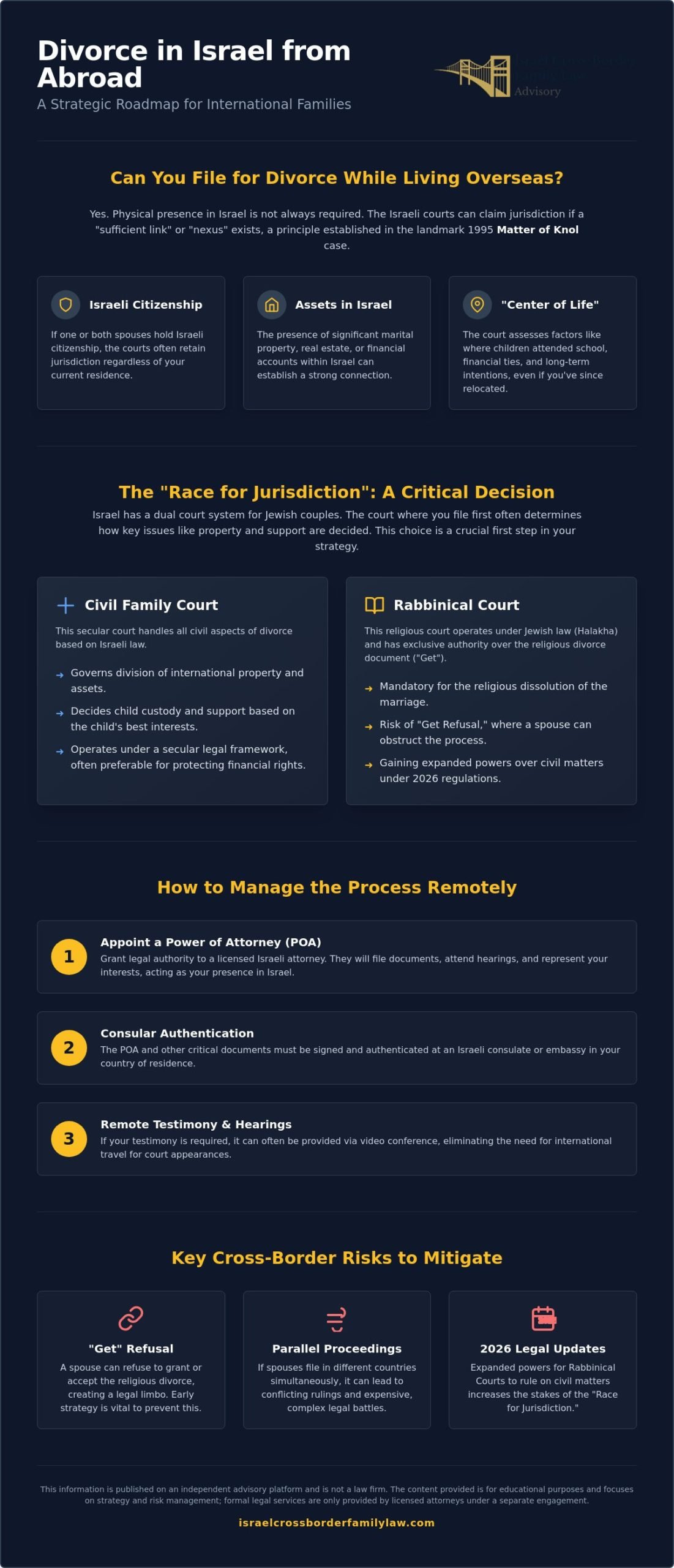
Many expats assume that moving away from Israel automatically severs their legal ties to the country’s court system. This isn’t the case. To get divorced in israel from abroad, the court must first establish a “nexus,” or a substantial connection, between the parties and the state. This connection doesn’t always require you to be physically present in a house in Tel Aviv or Jerusalem at the moment of filing.
The legal foundation for this cross-border authority was solidified in the landmark 1995 Matter of Knol case. The Supreme Court ruled that Israeli courts can hold jurisdiction if there’s a sufficient link, such as Israeli citizenship or the presence of marital assets within the country. This ruling serves as a vital bridge for those who need to resolve their marital status but have already established lives in the US, Europe, or elsewhere. It prevents a legal vacuum where a spouse might be “stuck” in a marriage because they no longer live in the jurisdiction where it was registered.
To better understand how these international dynamics affect your case, watch this helpful video:
Your location abroad can be a strategic asset. It gives you the space to coordinate with a cross-border advisory before your spouse takes action. Under the March 2026 legal updates, Rabbinical courts now have expanded powers to arbitrate civil disputes. Filing first in the Family Court while you are overseas can be a critical move to ensure your property and custody rights are handled in a secular environment rather than a religious one.
The Residency Requirement
The court evaluates your “center of life” to decide if it has the right to hear your case. This isn’t just about where you sleep; it involves your financial ties, where your children go to school, and your long-term intentions. If your marriage was registered in Israel, the courts might still claim jurisdiction even if you’ve lived abroad for years. This is especially true if one spouse remains a resident or if you still hold Israeli citizenship. The Dual Court System often complicates these residency questions because the Rabbinical and Family courts may interpret “connection” differently based on their specific mandates.
When Israel is the “Convenient Forum”
Even if a court has the power to hear a case, it might decline if another country is a more “convenient forum.” This legal principle, known as Forum Non Conveniens, focuses on where the evidence and witnesses are located. If most of your marital property or real estate is in Israel, the court is more likely to accept the case. However, you must be careful about “Parallel Proceedings.” If your spouse files for divorce in a US court while you file in Israel, you could end up in a costly legal battle in two different jurisdictions simultaneously. Seeking clarity on these risks before you commit to a filing is essential for managing your global assets.
This content is published on an independent advisory platform and is not a law firm. The information provided is for educational purposes and focuses on strategy and risk management; formal legal services are only provided by licensed attorneys under a separate engagement.
The Dual Court System: Civil Family Courts vs. Rabbinical Courts
One of the most distinctive features of the Israeli legal landscape is its parallel court system. For Jewish couples, divorce involves two separate authorities: the secular Family Court and the religious Rabbinical Court. This structure creates what is often called the “Race for Jurisdiction.” Because both courts frequently share authority over secondary matters like property division and child custody, the court where a claim is filed first typically retains the power to decide those issues. If you intend to get divorced in israel from abroad, understanding this race is vital for protecting your global interests.
Even for secular expats who have lived outside Israel for decades, the Rabbinical Court remains a factor. Under Israeli law, the actual dissolution of a Jewish marriage bond can only be performed through a religious ceremony. While a civil divorce from a foreign country might be recognized for some purposes, it does not legally end the marriage for a Jewish person in the eyes of the State of Israel. This dual requirement means your strategy must account for both civil rights and religious status simultaneously.
The Civil Family Court (Beit Mishpat Le’inyanei Mishpacha)
The Family Court operates under secular law and is generally the preferred venue for international clients with complex financial portfolios. This court prioritizes equitable distribution and modern legal principles when dividing assets. It also handles matters such as alimony and child custody with a focus on the “best interests of the child.” Since 2016, all parties must participate in a mandatory dispute resolution process before they can proceed with litigation. This “cooling off” period is designed to encourage settlement, but it requires careful management when one party is participating from overseas. For those with assets in multiple countries, the Family Court’s predictable application of civil law often provides a sense of security that religious doctrine might not.
The Rabbinical Court (Beit Din Rabani)
The Rabbinical Court holds exclusive authority over the “status” of the divorce. This centers on the delivery of the Get, the religious bill of divorce. A significant risk for those living abroad is “Get refusal,” where one spouse withholds the document to gain leverage in civil negotiations. Recent legal updates in March 2026 have expanded the Rabbinical Court’s ability to arbitrate civil disputes, such as commercial or employment matters, provided both parties give their consent. This makes it even more important to seek a strategic assessment of your case before signing any jurisdictional agreements. Without a clear roadmap, you may inadvertently grant authority to a court that applies rules very different from those in your current country of residence.
This content is published on an independent advisory platform and is not a law firm. The information provided is for educational purposes and focuses on strategy and risk management; formal legal services are only provided by licensed attorneys under a separate engagement.
Practical Steps: Managing the Divorce Process Remotely
While the jurisdictional hurdles discussed previously may seem daunting, the procedural mechanics of how to get divorced in israel from abroad have become significantly more accessible. You can manage the vast majority of your case without stepping foot in the country. The primary tool for this is a specific Power of Attorney (PoA). Unlike a general PoA, this document must be narrowly tailored to family law matters, granting your representative the authority to file claims, attend hearings, and sign settlements on your behalf. This document serves as your legal voice within the Israeli system while you remain in your current country of residence.
If your spouse is also living outside of Israel, you must follow specific rules for “service of process.” You cannot simply mail divorce papers and expect the court to accept them. Under Israeli Civil Procedure Regulations, you typically need to obtain court permission to serve a spouse abroad. This often involves international treaties like the Hague Service Convention, which ensures that legal documents are delivered in a way that the foreign country recognizes. Understanding how it works from a logistical standpoint is just as important as the legal strategy itself.
Authentication of Foreign Documents
Every foreign document you submit to an Israeli court, from a US marriage certificate to a European bank statement, must be properly authenticated. A standard local notary stamp is rarely sufficient. Most countries use the Apostille process, which is a specialized certificate issued by a government authority that verifies the document’s legitimacy for international use. If your country is not a member of the Hague Apostille Convention, you will likely need consular authentication through the Israeli embassy. Mistakes in this area are the leading cause of delays. Additionally, any document not in English or Hebrew must be translated by a certified Israeli notary to be admissible in court.
Remote Participation in Hearings
As of 2026, Israeli Family Courts have established clear protocols for remote participation. Video conferencing is now standard for preliminary hearings and mandatory “MAHUT” dispute resolution sessions. This allows you to speak directly to the court or a mediator from your home or office. However, some physical presence may still be required. While the Family Court is highly flexible, the Rabbinical Court often maintains stricter requirements for the final delivery of the Get. Although remote testimony is increasingly accepted for witness statements, the actual ceremony to dissolve the marriage bond usually requires at least one trip to Israel, or the complex appointment of a messenger (Shaliach) to act in your place.
This content is published on an independent advisory platform and is not a law firm. The information provided is for educational purposes and focuses on strategy and risk management; formal legal services are only provided by licensed attorneys under a separate engagement.
Protecting Assets and Children Across Borders
The decision to get divorced in israel from abroad carries significant weight when your financial future and parental rights are distributed across different continents. Israeli courts have the authority to issue rulings on real estate and bank accounts located in the US or Europe, but the practical enforcement of these orders depends on international treaties and local laws. Making a strategic choice about jurisdiction early in the process is not just a legal formality; it’s a necessary step to ensure long-term financial stability and to prevent a spouse from liquidating shared assets before a court can intervene.
Early decisions are critical because the court that first takes jurisdiction often sets the tone for the entire split. If your property is located in another country, you must understand how the Israeli system interacts with foreign registries. Without a clear roadmap, you risk receiving a judgment in Israel that is unenforceable in your current country of residence, leading to years of expensive litigation and jurisdictional conflict.
International Asset Division
Israeli law typically follows the “Balancing of Resources” principle. This means assets acquired during the marriage are usually split equally. However, a 2026 Supreme Court decision has made it increasingly difficult to protect pre-marital inheritances or real estate from being included in the divisible pool. If you have significant property in another country, be prepared for the court to scrutinize these holdings. Discovering hidden assets across borders remains a challenge that requires specialized expertise in multi-jurisdictional finance. You can explore these complexities further in our guide For Expats and Foreign Nationals.
Custody and Relocation Issues
In the past, the “Tender Years” doctrine often gave mothers a distinct advantage in custody cases involving young children. Today, Israeli courts are moving toward shared parenting and joint custody arrangements as the default. If you’re a parent living abroad, the court will carefully examine how visitation rights can be maintained across international lines. These cases are particularly sensitive when they intersect with the Hague Convention on Child Abduction. Any attempt to relocate a child without a clear legal agreement can trigger severe international legal consequences. You can find more information on managing these risks at International Custody and Relocation.
Enforcing child support orders across international lines is another critical area of concern. Israel is a signatory to several international conventions that allow for the collection of support even when the payer resides in another country. Because legal systems and cultures differ so significantly, you should request a confidential case review to understand how these global mechanisms will apply to your specific situation before you sign any binding documents.
This content is published on an independent advisory platform and is not a law firm. The information provided is for educational purposes and focuses on strategy and risk management; formal legal services are only provided by licensed attorneys under a separate engagement.
Strategic Planning: Seeking Clarity Before You Commit
Strategic planning is the most critical phase when you decide to get divorced in israel from abroad. While the urge to file papers quickly is understandable, early decisions regarding jurisdiction often dictate the financial and parental outcomes for years to come. A preliminary assessment helps you identify whether the Family Court or the Rabbinical Court offers the most protection for your specific circumstances. This is especially vital given the March 2026 expansion of religious court authority, which now allows these bodies to arbitrate a wider range of civil matters if both parties agree. Without a clear roadmap, you may inadvertently waive rights that are standard in your current country of residence.
Identifying the risk of “Get Refusal” is a priority for Jewish expats. If your spouse is also abroad, the leverage they hold over the religious bill of divorce can become a tool for pressure in property negotiations. Strategic planning involves building safeguards into your civil agreements to ensure the religious process follows the civil settlement without delay. Coordinating between your local lawyer and your Israeli counsel is the only way to ensure these two legal systems don’t work at cross-purposes. Your international assets and parental rights require a unified front that respects the laws of both nations.
The Advisory Approach
Strategy matters more than the act of filing. An independent advisor acts as a bridge between two divergent legal cultures, ensuring that your local legal team and your Israeli counsel are working toward the same objective. This collaborative method prevents “jurisdictional gaps” where an order from one country is ignored by the other. You can learn more about how this integrated method protects your interests by reviewing How the Advisory Works.
Next Steps for Expats
Gathering documentation is your immediate priority. This includes marriage certificates, property deeds, and financial records, all of which will require Apostille stamps or consular authentication as discussed in previous sections. Establish a secure communication channel, such as an encrypted messaging app, to discuss sensitive strategy with your team. For visual guidance on these procedures, you can watch Divorce in Israel for visual guidance on our dedicated channel. Before you move forward, use this final checklist to ensure you’re prepared:
- Is your connection to Israel clearly documented for jurisdictional purposes?
- Have you identified all marital assets located in both Israel and your country of residence?
- Is your specific Power of Attorney ready for consular authentication?
- Have you assessed the risk of “Get Refusal” and planned accordingly?
Get clarity before you commit. Request a confidential consultation.
This content is published on an independent advisory platform and is not a law firm. The information provided is for educational purposes and focuses on strategy and risk management; formal legal services are only provided by licensed attorneys under a separate engagement.
Navigating Your International Path Forward
The ability to get divorced in israel from abroad is more than a procedural convenience; it’s a strategic necessity for families with global footprints. By utilizing specific Power of Attorney documents and modern remote hearing protocols, you can protect your financial and parental rights without the disruption of international travel. Success in these matters depends on a clear understanding of the “race for jurisdiction” and the 2026 updates to religious court authority. Coordinating between your local circumstances and the Israeli legal system requires a steady, strategy-first approach that prioritizes long-term stability over quick filings.
Our advisory is built on decades of experience in cross-border litigation, with practitioners licensed in both Israel and the US. We specialize in the unique challenges facing Anglo-expats and international families, serving as a bridge between divergent legal cultures. Don’t leave your assets or your status to chance in a complex dual court system. Get clarity before you commit. Request a confidential case review. We are here to help you move forward with confidence and security.
This content is published on an independent advisory platform and is not a law firm. The information provided is for educational purposes and focuses on strategy and risk management; formal legal services are only provided by licensed attorneys under a separate engagement.
Frequently Asked Questions
Can I get divorced in Israel without ever visiting the country during the process?
Yes, it’s largely possible to manage the process remotely. Family Courts in 2026 utilize video conferencing for preliminary hearings and mandatory dispute resolution sessions. While the secular process is flexible, the Rabbinical Court may still require a physical visit for the final delivery of the Get. In some complex cases, you can appoint a messenger, known as a Shaliach, to act on your behalf during the religious ceremony.
How long does a cross-border divorce in Israel typically take?
The timeline depends heavily on whether the split is amicable or contested. An uncontested divorce typically concludes within 3 to 6 months. However, a contested case involving international assets or custody disputes can last between 2 and 4 years. Cross-border logistics, such as obtaining Apostille stamps and managing international service of process, can add several months to these standard estimates.
Do I need a separate lawyer in both Israel and my current country of residence?
It’s highly advisable to have representation in both jurisdictions to prevent conflicting legal orders. A lawyer in your current country manages domestic property and local custody issues. Meanwhile, an Israeli practitioner handles the “race for jurisdiction” and religious status requirements. Coordination between these two professionals ensures that your global assets are protected and that any Israeli judgment is enforceable where you live.
What happens if my spouse is in Israel and I am abroad?
You can still effectively defend your rights using a specific Power of Attorney. If your spouse files a claim in Israel first, you must act quickly to avoid a default judgment. You can participate in MAHUT sessions and court hearings via authorized video links. Strategic planning is essential here to ensure that your absence from the country isn’t used against you in property or custody negotiations.
Can an Israeli court divide my assets located in the United States?
Israeli courts can issue rulings on global assets based on the “Balancing of Resources” principle. This means the court calculates the value of all marital property, regardless of its location, and seeks an equal division. However, actually seizing a bank account or transferring real estate in the US requires a separate enforcement process in a American court. This underscores the need for a unified international strategy.
What is a “Get” and why do I need one if I live abroad?
A Get is a religious bill of divorce required for Jewish couples to dissolve their marriage bond under Israeli law. Even if you obtain a civil divorce in another country, the State of Israel still considers you married without this document. This can lead to “Get refusal” or status issues for future children. It’s a critical component to get divorced in israel from abroad effectively and permanently.
Are Israeli divorce decrees recognized by foreign governments and courts?
Most foreign governments recognize Israeli divorce decrees through international comity or specific treaties. To make the decree official in your country of residence, you must obtain an Apostille stamp or consular authentication from the Israeli Ministry of Foreign Affairs. This verifies the document’s legitimacy for foreign authorities. Without this authentication, you may struggle to update your marital status or enforce financial orders overseas.
How can I serve divorce papers to my spouse if they are hiding in Israel?
You can utilize specialized Israeli process servers or request “substitute service” from the court. If your spouse is intentionally avoiding service, the court may allow you to deliver the papers to a close relative or even via digital communication channels. This is a vital step to get divorced in israel from abroad when the other party is uncooperative. Proper service is required before any legal proceedings can move forward.
Get clarity before you commit. Request a confidential consultation.

Article by
Gabriel Lior
A Personal Journey That Became a Mission
The advisory was founded by an American father Gabriel Lior, LLB, MBA , global entrepreneur, and cross-border advisor who spent more than a decade navigating the Israeli family court system firsthand and now lives in Singapore with his son.
As a divorced parent in a cross-border family, Gabriel faced nearly every legal challenge a foreign parent can encounter in Israel — including child custody disputes, child support proceedings, property matters in Israel and abroad, false accusations, and complex immigration and relocation proceedings.
Over the years, he learned the hard way how difficult it is for non-Israeli parents to understand the system, identify the right legal strategy, and choose the right legal representation — especially when language, culture, and jurisdictional differences are involved. He also witnessed how foreign parents and new immigrants are often disadvantaged or taken advantage of by service providers and institutions simply because they lack local knowledge or fluency.
From Client to Advisor
To truly understand — and survive — the system, Gabriel pursued formal legal education in Israel, completing two Israeli law degrees, alongside a BA and MBA earned in the United States. This was never about becoming a practicing attorney, but about gaining a deep, structural understanding of how the system works — and where it breaks down for foreign parents.
This rare combination of:
Firsthand client experience
Israeli legal and US business education
International business and negotiation training
Decades of commercial execution
created a unique perspective – one that understands both sides of the table.
After years of litigation, persistence, and at times self-representation, he ultimately succeeded in securing custody of his son and relocating abroad through a rare legal victory in the Israeli Supreme Court — becoming one of the first fathers in Israel to do so under these circumstances.
Disclaimer
Important Disclaimer:
The information provided on this website and in its content is for general informational and educational purposes only and does not constitute legal advice, legal opinion, or legal representation.
Gabriel Lior is not licensed to practice law in Israel (nor is he interested in doing so) and does not provide legal services, despite having completed 2 Law Degrees. The services offered are advisory in nature and are intended to provide general guidance, strategic insight, and information regarding cross-border family law considerations.
No attorney-client relationship is formed by accessing this website, reading its content, or communicating with us.
Any decisions made based on this information are at your own discretion and risk. For legal advice specific to your situation, you should consult a licensed attorney in the relevant jurisdiction.
Where appropriate, we may refer clients to independent, licensed attorneys or professionals. Such referrals do not constitute legal representation and no liability is assumed for services provided by third parties.