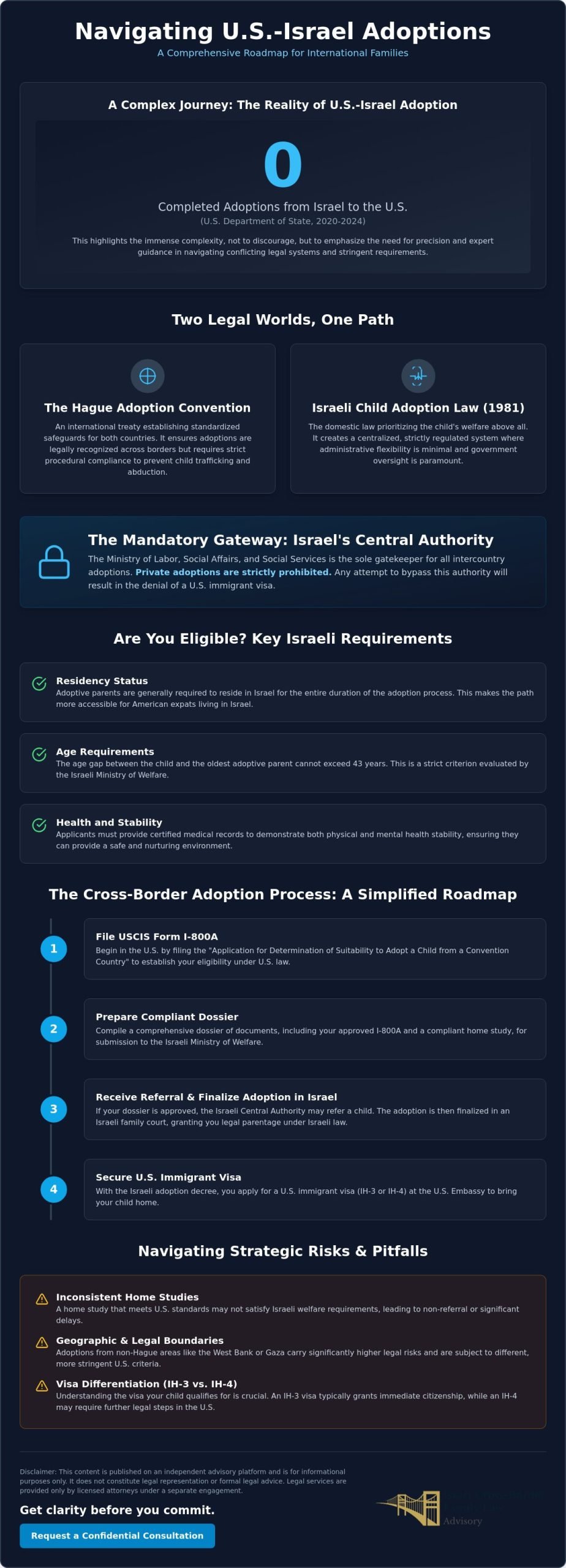
Between 2020 and 2024, the U.S. Department of State recorded zero completed adoptions from Israel to the United States. This statistic isn’t meant to discourage you, but it highlights the immense complexity of international adoption law israel us. You’re likely facing a labyrinth of conflicting paperwork between the Israeli Welfare Ministry and USCIS, compounded by stringent religious and residency requirements. It’s a path where the smallest administrative oversight can lead to years of additional waiting, and the emotional weight of these delays is significant.
We understand that your primary goal is to build a family while ensuring your child’s legal status is secure in both nations. This advisory guide, published on an independent platform, offers a comprehensive roadmap for navigating the legal bridge between Israel and the U.S. in 2026. You’ll learn about the latest National Interest Exception for adoption visas, the specific Hague Convention protocols, and the updated fee schedules, including the 2025 Visa Integrity Fee. We’ll explore how to align Israeli welfare standards with U.S. immigration demands to help you mitigate risks and gain clarity before you commit to this life-changing process.
Key Takeaways
- Understand the essential interplay between the Hague Adoption Convention and the Israeli Child Adoption Law of 1981 to ensure your process remains legally sound in both jurisdictions.
- Learn how to navigate the complexities of international adoption law israel us by meeting the specific residency, age, and religious criteria mandated by the Israeli Central Authority.
- Discover the step-by-step requirements for filing USCIS Form I-800A and preparing a compliant dossier for submission to the Israeli Ministry of Welfare.
- Gain a clear roadmap for differentiating between IH-3 and IH-4 visas to secure your child’s U.S. legal recognition and immediate citizenship eligibility.
- Identify strategic risks and decision-making pitfalls, such as inconsistent home studies, that can lead to non-referral or significant procedural delays.
The Legal Framework: Hague Convention and Israeli Adoption Law
The legal architecture governing the movement of children between nations is built upon a complex hierarchy of international treaties and domestic statutes. When exploring international adoption law israel us, it’s essential to recognize that both countries are signatories to the Hague Adoption Convention. This treaty establishes a standardized set of safeguards designed to prevent the abduction, sale, or trafficking of children. By providing a formal framework for cooperation, the Convention ensures that an adoption finalized in one country is legally recognized in the other, provided every procedural requirement is met with precision.
In Israel, the primary domestic authority is the Child Adoption Law of 1981. This law grants the Israeli government significant oversight, prioritizing the welfare of the child above all other considerations. Unlike the U.S. system, which allows for more private agency involvement, the Israeli system is centralized and strictly regulated. This means that any adoption process must align with Israeli welfare standards before it can even be considered under U.S. immigration rules. While this dual layer of oversight adds security, it also creates a rigid environment where administrative flexibility is nearly non-existent.
To better understand the complexities of cross-border legal frameworks in Israel, watch this helpful video:
This content is published on an independent advisory platform and is intended for informational purposes. It does not constitute legal representation or formal legal advice. Understanding the inherent complexity of these cross-border issues is the first step in mitigating the risks associated with such a significant life decision.
The Role of the Central Authority
The Ministry of Labor, Social Affairs, and Social Services serves as the Israeli Central Authority. This government body is responsible for monitoring all intercountry cases and ensuring they meet both domestic and international standards. Private adoptions are strictly prohibited in the US-Israel corridor to prevent ethical breaches and legal inconsistencies. The Central Authority acts as the mandatory gatekeeper for all legal adoptions, and any attempt to bypass this entity will result in the denial of a U.S. immigrant visa.
Hague vs. Non-Hague Areas
Prospective parents must distinguish between the legal jurisdiction of the State of Israel and areas such as the West Bank and Gaza. Because the Palestinian Authority is not a signatory to the Hague Convention, adoptions from these regions are treated as non-Hague cases. These adoptions carry significantly higher legal risks, as the U.S. government applies different, often more stringent, criteria for children coming from non-signatory jurisdictions. Navigating international adoption law israel us requires a clear understanding of these geographic and legal boundaries to avoid a situation where a child is legally adopted in one jurisdiction but ineligible for entry into the United States.
Eligibility Criteria for US Citizens Adopting from Israel
Prospective parents often assume that meeting U.S. federal requirements is the only hurdle. However, the Israeli Ministry of Welfare applies its own rigorous standards that must be satisfied before a child is even considered for referral. While the process is infrequent, mastering the intersection of international adoption law israel us begins with a clear-eyed assessment of your eligibility. One of the most significant factors is residency. Israeli law generally requires that adoptive parents reside in Israel for the entire duration of the adoption process. This makes the path significantly more accessible for American expats living in Israel than for families based entirely in the United States.
If you are currently living in Israel as an American citizen, our guide for expats and foreign nationals explains how your local residency status impacts the legal timeline. Beyond location, the Ministry of Welfare evaluates age and health with precision. The age gap between the child and the oldest adoptive parent cannot exceed 43 years. Additionally, applicants must demonstrate physical and mental health stability through certified medical records. Throughout every stage, the Israeli family court relies on the “Best Interests of the Child” standard. This isn’t just a phrase; it’s a legal mandate that allows judges to scrutinize every aspect of your life to ensure the placement is optimal for the child’s long-term welfare.
The Religious Matching Requirement
Israeli law contains a strict mandate regarding religious affiliation: the adoptive parents must share the same religion as the child. This requirement creates different procedural paths for Jewish, Christian, and Muslim U.S. citizens. You’ll need to provide verified documentation, such as letters from religious leaders or certificates of faith, to prove your affiliation to the court’s satisfaction. For a detailed breakdown of federal requirements that run parallel to these Israeli rules, you should consult the latest U.S. government eligibility and procedures. Proving this connection is often one of the most document-heavy portions of the dossier.
Marital Status and Personal Stability
Stability is the cornerstone of a successful application. While single applicants are legally permitted to adopt under certain circumstances, Israeli welfare officers often prioritize married couples who have been together for several years. If you have a history of divorce, be prepared to provide a transparent narrative regarding those transitions. The “Home Study” is the primary tool used to communicate your suitability to both nations. It must be prepared by a licensed professional who understands how to bridge the gap between U.S. home study standards and Israeli welfare expectations. If you’re unsure how your specific family history will be viewed by the Ministry of Welfare, it’s helpful to discuss your situation with a professional who understands the nuances of international adoption law israel us before you submit official paperwork.
The Procedural Bridge: From Application to Decree
Moving from eligibility to the actual machinery of the process requires a synchronized effort between U.S. federal agencies and the Israeli Ministry of Welfare. While the Department of State recorded zero completed adoptions from Israel to the U.S. between 2020 and 2024, the legal pathway remains open for those who follow the “Hague” protocol. This advisory content is published on an independent platform and focuses on strategy, risks, and decision-making guidance rather than formal legal representation. Navigating the nuances of international adoption law israel us involves five distinct phases:
- Step 1: USCIS Suitability: Filing Form I-800A to prove you are fit to adopt under U.S. standards.
- Step 2: Dossier Submission: Sending your approved U.S. documents to the Israeli Central Authority for review.
- Step 3: Matching: Receiving a referral and the required “Article 16” report from the Israeli government.
- Step 4: Court Decree: Finalizing the adoption in an Israeli Family Court.
- Step 5: Post-Placement: Completing required follow-up reports for both nations to ensure the child’s continued welfare.
The US Dossier and I-800 Process
Matching cannot legally occur before USCIS suitability approval. This is a critical rule in international adoption law israel us that many families overlook. You must first obtain a determination of suitability from U.S. Citizenship and Immigration Services by filing Form I-800A, which currently carries a fee of $775. For American expats living in Israel, this step is often the most difficult because the home study must be conducted by a provider authorized by both the U.S. government and the Israeli Ministry of Welfare. If your home study doesn’t meet the specific technical requirements of the Hague Convention, your dossier will be rejected before it even reaches the Israeli Central Authority.
Israeli Court Finalization
Once a match is accepted and the Article 16 report is issued, the legal focus shifts to the Israeli Family Court. According to Israeli adoption law, the court must confirm that the child is legally free for adoption and that the placement serves the child’s best interests. Most families begin with a supervised “foster care” period. During this time, social workers from the Ministry of Welfare monitor the child’s adjustment before recommending a final decree. The hearing for the final decree is a formal proceeding that officially transitions your status from foster parents to legal parents. This decree serves as the foundation for the Hague Adoption Certificate, which you’ll need to secure the child’s U.S. immigrant visa. If you’re trying to understand the timeline for these hearings, reviewing how the advisory process works can help you plan your strategy effectively.
Securing US Legal Recognition and Immigration Visas
The finalization of an adoption in an Israeli court is a significant milestone, but it doesn’t automatically grant the child entry into the United States. To bridge this gap, you must navigate the federal immigration requirements that form the second half of international adoption law israel us. This phase involves a rigorous review by the U.S. Department of State to ensure the adoption complies with the Hague Convention. The primary document required for this is the Hague Adoption Certificate (HAC), which is issued by the Israeli Central Authority only after the court decree is final. This content is published on an independent advisory platform and is intended for informational purposes rather than formal legal representation.
The IH-3 vs. IH-4 Visa Decision
Because Israeli law typically requires the adoption to be fully finalized before the child leaves the country, most families will apply for an IH-3 visa. The IH-3 is reserved for children whose adoptions are finalized in a Hague Convention country before they enter the U.S. One of the most significant benefits of this visa is that the child automatically acquires U.S. citizenship under the Child Citizenship Act of 2000 the moment they enter the country. For families living abroad, our Guidance for Expats & Foreign Nationals provides more detail on how these federal rules apply when you aren’t immediately returning to a U.S. residence. In rare cases where the adoption isn’t finalized in Israel, an IH-4 visa is used, which requires the parents to finalize the adoption in their home state after arrival.
Before the visa is issued, you must attend a mandatory consular interview at the U.S. Embassy in Jerusalem. This is a technical review where a consular officer verifies all documentation, including the Article 16 report and the final decree. You’ll need to pay several fees at this stage, including the $325 immigrant visa processing fee and the $250 Visa Integrity Fee, which took effect in October 2025. It’s a precise process where even a missing signature on a translated document can cause a delay of several weeks.
Obtaining the Israeli Passport and Exit Permit
Before you can attend the consular interview, the child must have a valid Israeli passport. This requires a visit to the Israeli Ministry of Interior (Misrad HaPnim). The Ministry will register the child under your name based on the court decree. Additionally, the Israeli Central Authority must issue an official exit permit. This permit is a mandatory requirement for intercountry adoptions and confirms that all Israeli legal obligations have been met. The timeline for this final travel phase can vary, but most families should allow several weeks for the Ministry of Interior to process the new registration and travel documents. If you’re feeling overwhelmed by these administrative layers, it’s wise to secure a comprehensive case review to ensure your timeline is realistic and your strategy is sound.
Navigating Risks and Strategy in Cross-Border Adoptions
The journey through international adoption law israel us is defined by its rigorous procedural demands and the weight of early administrative choices. Small errors in the initial stages, particularly within the home study, often have cascading effects that can derail a dossier months or even years later. Because both the U.S. and Israeli governments require specific, non-negotiable standards for suitability, a flawed home study is not just a minor setback. It can lead to a formal rejection by the Israeli Central Authority, effectively closing the door on a potential referral. Success in these matters depends on a synchronized strategy that addresses both nations’ welfare and immigration standards simultaneously.
A successful strategy requires an honest assessment of the inherent risks. As previously noted, the number of completed adoptions from Israel to the U.S. has been minimal in recent years, which reflects the tightening of domestic placement priorities in Israel. Prospective parents must be prepared for extended timelines and the very real possibility of non-referral. Costs are also a factor. Beyond the USCIS fees and the $250 Visa Integrity Fee, families must account for travel, translation, and the mandatory post-placement reporting. Bridging the gap between the U.S. Department of State and the Israeli Ministry of Welfare requires a proactive approach that anticipates conflicts between the two legal systems before they arise.
Seeking Clarity Before Commitment
Before you submit a single document or commit to a specific agency, you should seek a comprehensive understanding of your own eligibility. Every family’s situation is unique, especially for expats whose residency status may complicate their U.S. suitability determination. A confidential case review allows you to identify potential red flags in your background or financial history that might concern an Israeli welfare officer. You can learn more about how the advisory process works to help you build a roadmap that prioritizes risk mitigation over speed. Understanding the practical steps helps you avoid the confusion often caused by dense legal terminology.
The Role of Independent Advisory
This content is published on an independent advisory platform and does not constitute a law firm or formal legal representation. Our focus is on providing strategic decision-making guidance rather than just document filing. Legal services are only provided by licensed attorneys under a separate, formal engagement. By focusing on the broader strategy, you can navigate the cross-border complexities with greater confidence. For ongoing updates and professional perspectives on these matters, you can explore the Adoption and Family Law Insights channel. Building a family through international adoption is a profound commitment; gaining clarity on the legal landscape is the first step toward a secure future.
Get clarity before you commit. Request a confidential consultation.
Strategic Planning for Your Cross-Border Adoption Journey
Successfully navigating the legal intersection of two distinct nations requires more than just administrative diligence. It demands a strategic understanding of how the Hague Convention integrates with the Israeli Child Adoption Law of 1981. You’ve seen that the path involves rigorous religious matching, specific residency mandates for expats, and a synchronized effort between the Israeli Ministry of Welfare and U.S. federal agencies. Every early decision, from the home study to the initial dossier submission, carries significant weight in determining your eventual success.
Mastering international adoption law israel us is about mitigating risks before they become roadblocks. Whether you’re an Anglo family living in Israel or a U.S. citizen navigating the consular interview in Jerusalem, specialized expertise in cross-border family law is essential. Our advisory platform focuses on the unique needs of international families, offering a physical presence and local engagement in both jurisdictions. Get clarity before you commit. Request a confidential consultation to discuss your specific roadmap. While the legal bridge is complex, it’s a journey that leads to the ultimate goal of building your family.
Frequently Asked Questions
Is it possible for US citizens to adopt a child from Israel in 2026?
Yes, it remains legally possible for U.S. citizens to adopt from Israel in 2026, though the occurrence is exceptionally rare. All such cases must be processed through the Israeli Central Authority for International Adoption. While the U.S. Department of State reported no completed adoptions from Israel between 2020 and 2024, the 2026 National Interest Exception allows for visa processing on a case-by-case basis even during broader visa pauses.
Can US expats living in Israel adopt locally through the Israeli system?
American expats residing in Israel have a distinct advantage as residency is a core requirement for the local adoption process. Living in Israel allows you to work directly with the Ministry of Welfare, though you must still meet all religious matching and suitability criteria. This path is often more practical than attempting an intercountry adoption from a U.S. base, as it aligns more closely with the Israeli government’s preference for domestic placement.
How much does the US-Israel international adoption process typically cost?
There are no Israeli government processing fees for adoption, but several U.S. federal fees are mandatory. You should budget for the $775 Form I-800A filing fee, the $325 immigrant visa processing fee, and the $220 USCIS immigrant fee for green card issuance. Additionally, the $250 Visa Integrity Fee introduced in October 2025 applies at the time of visa issuance at the consulate.
What happens if the child I am adopting is not the same religion as me?
Israeli law is very strict regarding religious matching; the adoptive parents must be the same religion as the child. This is a foundational element of international adoption law israel us that cannot be bypassed. If a religious match isn’t established, the Israeli Central Authority will not refer the child for adoption to those specific parents, making this one of the most significant hurdles for international families.
How long does the intercountry adoption process take between the US and Israel?
The timeline for a US-Israel adoption is generally measured in years rather than months. Because Israeli law prioritizes placing children with families within Israel, international applicants often face long waiting periods for a referral. The complexity of coordinating between USCIS and the Israeli Ministry of Welfare, along with the required post-placement supervision, naturally extends the duration of the legal process.
Will my child automatically become a US citizen after the adoption is finalized?
Can I adopt a child from the West Bank or Gaza as a US citizen?
Adopting from the West Bank or Gaza is extremely difficult because the Palestinian Authority is not a party to the Hague Adoption Convention. These cases are handled as non-Hague adoptions, which involves different legal standards and significantly higher risks. The U.S. government applies separate criteria for visa eligibility in these jurisdictions, often leading to complicated immigration hurdles that differ from the standard Israeli process.
What is the role of the Hague Convention in a US-Israel adoption?
The Hague Convention serves as the primary legal bridge between the two nations, ensuring that international adoption law israel us follows a standardized set of protections. Because both countries are signatories, every step of the process must comply with the Convention’s rigorous transparency and welfare requirements. This framework is designed to protect the best interests of the child and provide legal certainty for the adoptive parents across international borders.

Article by
Gabriel Lior
A Personal Journey That Became a Mission
The advisory was founded by an American father Gabriel Lior, LLB, MBA , global entrepreneur, and cross-border advisor who spent more than a decade navigating the Israeli family court system firsthand and now lives in Singapore with his son.
As a divorced parent in a cross-border family, Gabriel faced nearly every legal challenge a foreign parent can encounter in Israel — including child custody disputes, child support proceedings, property matters in Israel and abroad, false accusations, and complex immigration and relocation proceedings.
Over the years, he learned the hard way how difficult it is for non-Israeli parents to understand the system, identify the right legal strategy, and choose the right legal representation — especially when language, culture, and jurisdictional differences are involved. He also witnessed how foreign parents and new immigrants are often disadvantaged or taken advantage of by service providers and institutions simply because they lack local knowledge or fluency.
From Client to Advisor
To truly understand — and survive — the system, Gabriel pursued formal legal education in Israel, completing two Israeli law degrees, alongside a BA and MBA earned in the United States. This was never about becoming a practicing attorney, but about gaining a deep, structural understanding of how the system works — and where it breaks down for foreign parents.
This rare combination of:
Firsthand client experience
Israeli legal and US business education
International business and negotiation training
Decades of commercial execution
created a unique perspective – one that understands both sides of the table.
After years of litigation, persistence, and at times self-representation, he ultimately succeeded in securing custody of his son and relocating abroad through a rare legal victory in the Israeli Supreme Court — becoming one of the first fathers in Israel to do so under these circumstances.
Disclaimer
Important Disclaimer:
The information provided on this website and in its content is for general informational and educational purposes only and does not constitute legal advice, legal opinion, or legal representation.
Gabriel Lior is not licensed to practice law in Israel (nor is he interested in doing so) and does not provide legal services, despite having completed 2 Law Degrees. The services offered are advisory in nature and are intended to provide general guidance, strategic insight, and information regarding cross-border family law considerations.
No attorney-client relationship is formed by accessing this website, reading its content, or communicating with us.
Any decisions made based on this information are at your own discretion and risk. For legal advice specific to your situation, you should consult a licensed attorney in the relevant jurisdiction.
Where appropriate, we may refer clients to independent, licensed attorneys or professionals. Such referrals do not constitute legal representation and no liability is assumed for services provided by third parties.