Could a single cultural misunderstanding or a misread reaction during a home visit decide the future of your relationship with your child? It’s natural to feel a deep sense of anxiety when an outside professional enters your private life to judge your parenting, especially when your family spans two different legal cultures. This guide will help you understand exactly what does a custody evaluator look for when assessing international families, moving beyond surface-level checklists to the core behavioral markers that influence court decisions in both the US and Israel.
You’ll gain a clear understanding of the specific criteria used in cross-border disputes, including how evaluators view a parent’s ability to facilitate a long-distance relationship across oceans. We’ll examine the differences between American standards and the Israeli “Pekidat Sa’ad” approach, while providing practical steps to help you prepare for psychological testing and home visits with confidence. This content is published on an independent advisory platform and is intended for informational purposes. It doesn’t constitute legal representation or formal legal advice, which is only provided by licensed attorneys under a separate engagement.
Key Takeaways
- Understand the specialized role of the custody evaluator, often referred to in Israel as the “Pekidat Sa’ad,” and how they serve as the court’s primary investigative tool in cross-border disputes.
- Identify exactly what does a custody evaluator look for regarding parental fitness, child-centric decision-making, and the strength of the child’s bond with each parent across two countries.
- Recognize critical behavioral red flags, such as disparaging the other parent or poor boundary setting, that can significantly influence an evaluator’s final recommendations to the court.
- Learn practical methods to prepare for high-stakes interviews and home visits to ensure your family dynamics are accurately represented despite cultural or linguistic differences.
- Discover why seeking strategic clarity before the evaluation process begins is essential for navigating the complexities and inherent risks of international family law.
Understanding the Role of a Custody Evaluator in Cross-Border Cases
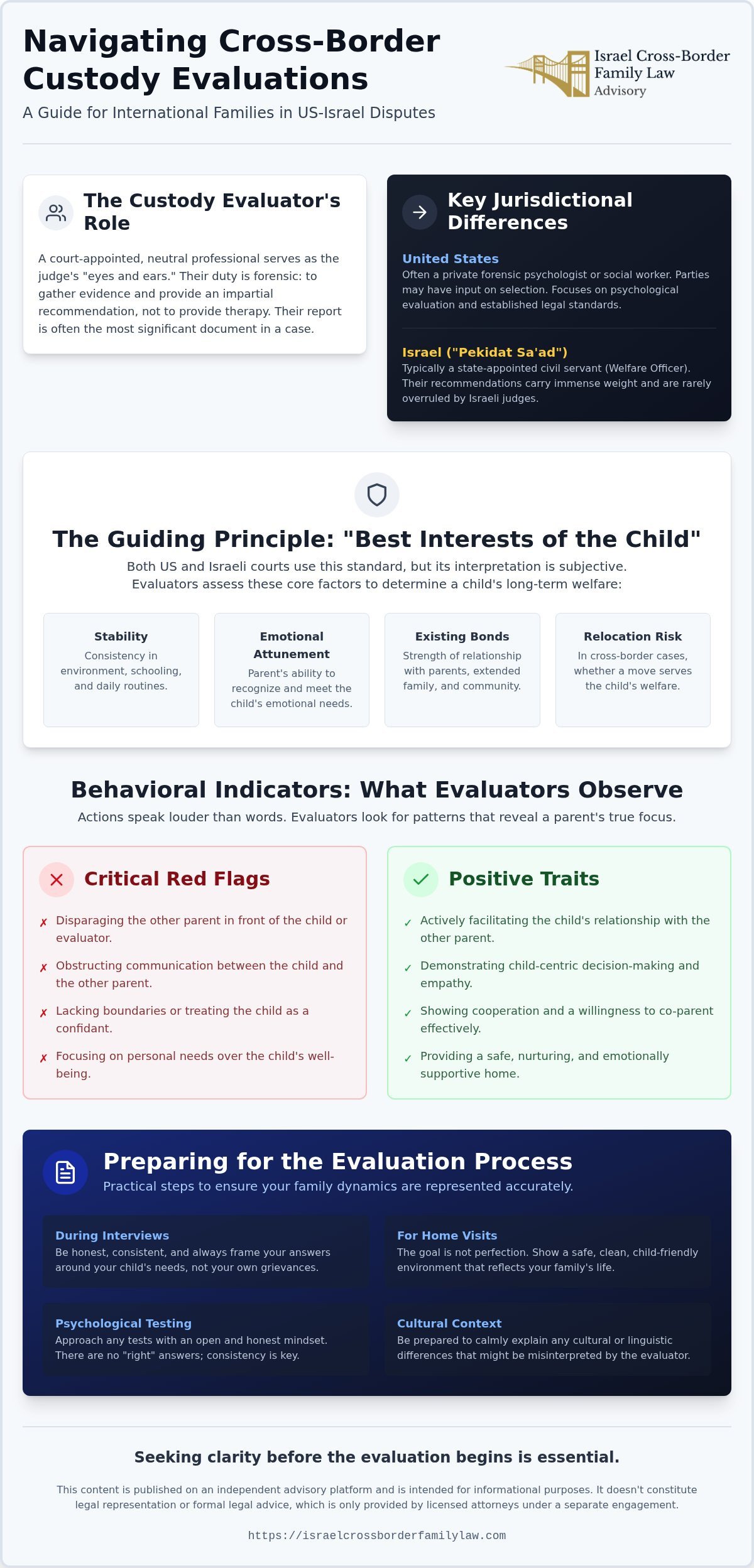
A custody evaluator is a neutral mental health professional, typically a psychologist or a highly trained social worker, appointed by the court to conduct an impartial investigation. It’s vital to distinguish this role from a clinical therapist. While a therapist focuses on emotional support and healing, a forensic evaluator’s duty is to gather evidence and provide a recommendation to the judge. In complex US-Israel disputes, these professionals serve as the court’s “eyes and ears” on the ground. Understanding the Role of a Custody Evaluator is crucial because they bridge the gap between legal arguments and the daily reality of the child’s life.
The evaluator’s report is often the most significant document in a case. It summarizes interviews, home visits, and sometimes psychological testing into a single set of recommendations. Because judges have limited time and lack specialized psychological training, they rely heavily on these reports. In many instances, the evaluator’s findings effectively determine the outcome of the case before a trial even begins. Understanding what does a custody evaluator look for is the first step in ensuring your family’s story is told accurately. This content is published on an independent advisory platform, not a law firm, and focuses on strategy and risk guidance. Legal services are only provided by licensed attorneys under a separate engagement.
Who are the evaluators in Israel (Pekidat Sa’ad)?
In the Israeli family court system, the primary evaluator is often a social worker known as a “Pekidat Sa’ad” (Welfare Officer). These individuals are civil servants who work specifically within the court’s framework. Unlike the US, where parties might hire private forensic psychologists, the Israeli system leans heavily on these state-appointed officers. Their training is focused on social welfare and family dynamics within the local cultural context. While their approach may feel less formal than a private US evaluation, the weight given to their recommendations is absolute. Israeli judges rarely rule against the advice of a Pekidat Sa’ad.
The ‘Best Interests of the Child’ Standard
Both American and Israeli courts operate under the “best interests of the child” standard. This sounds straightforward, but it is deeply subjective. The evaluator’s job is to interpret this standard through the lens of your specific family situation. They look for stability, emotional attunement, and the child’s existing bonds with extended family. In international custody and relocation matters, the standard shifts to include the “relocation risk.” The evaluator must decide if moving to a new country serves the child’s long-term welfare more than staying in their current environment. Knowing what does a custody evaluator look for in these high-stakes scenarios helps parents focus on the factors that truly matter to the court.
The Primary Criteria: What Evaluators Prioritize Most
The core objective of an evaluation is to assess a parent’s ability to meet the child’s evolving needs. While we’ve established the professional role of the investigator, it’s essential to understand the specific benchmarks they use to measure parental success. When asking what does a custody evaluator look for, the answer begins with fundamental parental fitness. This isn’t a search for the “perfect” parent. Instead, it’s an assessment of physical, mental, and emotional capability. They examine how you handle stress, your history of caregiving, and whether you can provide a safe, nurturing environment despite the pressures of a legal dispute.
Attached to this is the child’s existing bond with each parent and the broader family network. In Israel, where family ties are culturally central, an evaluator will look closely at the child’s relationship with grandparents, aunts, uncles, and cousins. They also weigh the child’s own preferences, provided the child has reached an appropriate age and maturity level, typically starting around age 10 to 12. However, the child’s “choice” is rarely the final word. It’s simply one piece of the puzzle that the evaluator must interpret within the context of the child’s overall development.
Parental Cooperation and Co-Parenting
Evaluators view the ability to co-parent as a primary indicator of a child’s future well-being. “Gatekeeping,” or the act of preventing the child from having a healthy relationship with the other parent, is perhaps the most significant red flag. In cross-border cases, this often manifests as a parent blocking video calls or disparaging the other parent’s home country. Demonstrating a proactive willingness to facilitate the child’s relationship across borders is vital. Adhering to international custody evaluation guidelines ensures that the assessment remains focused on evidence-based parenting traits rather than personal grievances.
Stability and the Relocation Factor
For international families, stability isn’t just about a daily routine; it’s about the child’s “center of life.” Evaluators assess where the child has the strongest social, educational, and emotional roots. Moving a child between the US and Israel involves significant disruption. Therefore, evaluators look for a realistic, detailed parenting plan that addresses international travel, time-zone differences, and school schedules. If you are facing a potential move, understanding international relocation risks is a necessary step before the evaluation begins.
Navigating these criteria requires a strategic approach that accounts for the nuances of both legal systems. If you’re concerned about how your family dynamics will be perceived by an official, you may want to discuss your situation with an advisor to gain clarity on your specific risks and options.
Behavioral Indicators: Red Flags vs. Positive Traits
When assessing family dynamics, professionals move beyond the logistics of housing or income to focus on the psychological health of the parent-child relationship. Understanding what does a custody evaluator look for requires a shift in perspective toward long-term behavioral patterns rather than isolated incidents. Evaluators prioritize traits like flexibility and child-centric decision-making, especially in cross-border cases where parents must navigate complex travel schedules and time-zone differences. They look for parents who view the other parent as a necessary part of the child’s life rather than a hurdle to be cleared. This perspective is vital because the evaluator is trained to follow professional guidelines for custody evaluators that emphasize objective behavioral evidence over subjective claims.
Negative red flags can derail a case quickly. Disparaging the other parent, failing to set appropriate age-related boundaries, or exhibiting erratic communication are high-priority concerns. Evaluators also pay close attention to your digital footprint. Social media posts that discuss the legal case, criticize the other parent, or show a lifestyle inconsistent with stable parenting are often included in the final report. This content is published on an independent advisory platform and is intended for informational and strategy guidance. Legal services are only provided by licensed attorneys under a separate engagement. For those navigating these complexities, understanding the advisory process can provide much-needed clarity on how these behaviors are documented.
Demonstrating Emotional Attunement
Emotional attunement is the parent’s demonstrated ability to perceive, process, and respond appropriately to their child’s unique emotional states and developmental milestones. Evaluators distinguish between being a “fun” parent who provides entertainment and a “functional” parent who provides structure and emotional safety. During interviews, they look for your ability to describe your child’s specific fears, strengths, and needs without centering your own emotional experience. They want to see that you understand how the conflict is affecting the child and that you are taking active steps to mitigate that stress.
Identifying and Avoiding Parental Alienation
Parental alienation is a critical concern in international disputes. Evaluators are trained to identify signs of a “coached” child, such as a child using adult language to describe the other parent or expressing “all-or-nothing” feelings of hate. To avoid these suspicions, you must remain neutral when discussing the other parent. Focus on the facts of the child’s care rather than the other parent’s character flaws. Being labeled an “alienating” parent carries severe legal consequences in both US and Israeli courts, often leading to a recommendation for reduced parenting time or supervised visitation. Maintaining a professional, child-focused stance is the most effective way to protect your relationship with your child during this high-stakes process.
Navigating the Evaluation Process: Practical Steps for Expats
The actual mechanics of an evaluation can feel intrusive, yet understanding the structure of the process helps reduce anxiety. When you consider what does a custody evaluator look for during the initial interview, the answer is consistency and focus. Evaluators are trained to identify discrepancies between your stated values and your actual parenting history. It’s best to approach these meetings with honesty, brevity, and a strict focus on the child. Oversharing personal grievances about the other parent often backfires; it suggests you’re unable to separate your own emotional needs from the best interests of your child.
Home visits are another source of significant stress, but they’re rarely the “white-glove” inspections parents fear. The evaluator wants to see a safe, age-appropriate environment where the child feels comfortable. “Clean enough” means the home is sanitary and organized, but it should still look lived-in. They’ll observe your interactions with the child to see if there’s a natural, healthy bond. This is published on an independent advisory platform, and the following guidance is for informational purposes only. Formal legal representation is provided exclusively by licensed attorneys under a separate agreement.
In many US-Israel cases, psychological testing is a standard requirement. You might be asked to complete the MMPI-2 (Minnesota Multiphasic Personality Inventory) or similar assessments. These tests aren’t designed to “trick” you, but rather to ensure there are no underlying mental health issues that could impair your parenting. Staying calm and answering truthfully is the most effective strategy. If you try to provide the “right” answer rather than the honest one, the test’s built-in validity scales will likely flag your results as defensive or unreliable.
Cultural Nuances: US vs. Israeli Parenting Styles
Cultural misunderstandings are a genuine risk for expats. Israeli parenting often emphasizes independence and community involvement, which can contrast with the more structured or “protective” styles common in some American circles. If your parenting choices differ from local Israeli norms, be prepared to explain the reasoning behind them calmly. Showing cultural sensitivity toward the evaluator’s background while maintaining your own family values demonstrates a high level of parental maturity.
Managing Logistical Challenges in Cross-Border Cases
If you are currently residing outside of the country where the evaluation is taking place, you may face virtual home visits or interviews across time zones. It’s essential to document all international communication with your child, including Zoom calls and messaging apps, to show a consistent presence in their life. Managing these details is a core part of international custody and relocation strategy. If you’re unsure how to handle the logistics of a multi-jurisdictional evaluation, you can request a confidential case review to gain clarity on your next steps.
Seeking Clarity in International Custody Disputes
Decisions made at the onset of a cross-border dispute carry immense weight. If you wait until the evaluation report is finalized to build your strategy, you’ve likely waited too long. Understanding what does a custody evaluator look for is only half the battle; the other half is ensuring your daily actions reflect the traits the court values. This is especially true in cases involving the Hague Convention on the Civil Aspects of International Child Abduction. Because both the US and Israel are signatories, the “habitual residence” of the child often dictates which court has the final say. If an evaluator perceives a parent as a flight risk or as someone who won’t respect “Mirror Orders,” the legal consequences can be swift and permanent.
If a report is released and the findings are unfavorable, the instinct is often to react emotionally. However, an effective response requires a clinical, measured review of the evaluator’s methodology. You must look for factual inaccuracies or instances where cultural nuances were misinterpreted. For example, an evaluator might misinterpret a parent’s desire for a child to attend a specific religious school as “inflexibility” rather than a cultural priority. This content is published on an independent advisory platform and is intended for informational and strategy guidance. Legal services are only provided by licensed attorneys under a separate engagement.
The Role of Strategic Guidance
Your overall legal strategy must align with the evaluator’s likely findings from day one. This involves more than just preparing for interviews; it’s about making informed choices regarding housing, schooling, and communication before the professional investigation begins. To understand the full scope of this approach, you can learn more about how it works when navigating these multi-jurisdictional complexities. Preparing for the “day after” the report is released means having a strategic plan for both a positive and a challenging outcome, ensuring you aren’t caught off guard by the court’s reliance on the professional’s advice.
Next Steps for Your Case
Navigating the remainder of your legal proceedings requires a calm, deliberate mindset. It’s easy to feel overwhelmed by the differences between US and Israeli standards, but focusing on the “best interests of the child” remains the most reliable path forward. When you understand what does a custody evaluator look for, you can present your case with the clarity the court requires. For more visual guides and in-depth discussions on these topics, you can visit the Israel Family Law YouTube channel.
Get clarity before you commit. Request a confidential case review.
Securing Your Family’s Future Across Borders
Success in a cross-border custody dispute depends on your ability to present a stable, child-centric narrative that transcends legal systems. We’ve explored how professionals assess parental fitness and why emotional attunement is a critical benchmark for both US and Israeli officials. By maintaining a deep understanding of what does a custody evaluator look for, you can ensure that your parenting choices are viewed through a lens of cooperation rather than conflict. This content is published on an independent advisory platform and is intended for informational and strategy guidance; legal services are only provided by licensed attorneys under a separate engagement.
Navigating these complexities requires a steady hand and authoritative expertise tailored for the Anglo-Israeli community. Our advisory specializes in high-conflict family law and is licensed in both the US and Israel, providing the strategic bridge needed for international families. You don’t have to face this high-stakes process without a clear roadmap. Get clarity before you commit. Request a confidential consultation to discuss your specific risks and options. You have the power to protect your child’s well-being and your own parental rights with the right preparation.
Frequently Asked Questions
Can a custody evaluator talk to my child’s teacher or doctor?
What should I avoid saying to a custody evaluator?
You should avoid disparaging the other parent or focusing on your personal grievances rather than the child’s specific needs. When considering what does a custody evaluator look for, remember that they prioritize your ability to support the child’s relationship with both parents. Speaking excessively about the other parent’s character flaws often suggests a lack of parental maturity or a potential risk of alienation.
How much weight does an Israeli judge give to the evaluator’s report?
Israeli judges give immense weight to the recommendations of the Pekidat Sa’ad, also known as the Welfare Officer. While the judge technically has the final authority, it’s rare for an Israeli family court to rule against the professional’s findings. This is why it’s essential to seek strategic clarity before the evaluation process begins, as the report often sets the course for the entire case.
Do I have to let the evaluator into my home for a visit?
Yes, a home visit is a standard and typically mandatory part of the investigative process in both the US and Israel. The evaluator needs to see the child’s living environment and observe your natural interactions within the home to assess the bond. Refusing a visit can be interpreted as a lack of cooperation or a sign that you are hiding an unstable living situation.
What happens if the custody evaluator’s report is biased or unfair?
If a report appears biased, you have the right to challenge it through a formal rebuttal or by cross-examining the evaluator during a court hearing. However, successfully overturning a professional recommendation is legally complex and requires specific evidence of procedural errors or significant factual mistakes. This content is published on an independent advisory platform, and strategic guidance should not be confused with formal legal representation.
How long does a custody evaluation typically take in Israel?
A custody evaluation in Israel typically takes between three to six months to complete, though international complexities can extend this timeline. The process includes multiple interviews, home visits, and the collection of external records before the final written report is submitted to the court. Decisions made early in your case will often carry weight throughout this entire investigative period.
Can I choose my own custody evaluator in a cross-border case?
In the Israeli system, you generally cannot choose the state-appointed Welfare Officer, as they are assigned based on the child’s place of residence. In some US jurisdictions or private Israeli evaluations, you may have a say in selecting a private forensic psychologist if both parties agree. If you’re involved in a cross-border dispute, it’s vital to understand which system’s rules apply to your specific situation.
What is the difference between a custody evaluation and a home study?
A home study focuses primarily on the physical safety and logistics of the living environment, while a custody evaluation is a deeper forensic investigation into psychological health and family dynamics. When asking what does a custody evaluator look for, the focus is on emotional attunement and the long-term parent-child bond rather than just the physical layout of the house. Evaluations involve more intensive psychological testing and behavioral observation.

Article by
Gabriel Lior
A Personal Journey That Became a Mission
The advisory was founded by an American father Gabriel Lior, LLB, MBA , global entrepreneur, and cross-border advisor who spent more than a decade navigating the Israeli family court system firsthand and now lives in Singapore with his son.
As a divorced parent in a cross-border family, Gabriel faced nearly every legal challenge a foreign parent can encounter in Israel — including child custody disputes, child support proceedings, property matters in Israel and abroad, false accusations, and complex immigration and relocation proceedings.
Over the years, he learned the hard way how difficult it is for non-Israeli parents to understand the system, identify the right legal strategy, and choose the right legal representation — especially when language, culture, and jurisdictional differences are involved. He also witnessed how foreign parents and new immigrants are often disadvantaged or taken advantage of by service providers and institutions simply because they lack local knowledge or fluency.
From Client to Advisor
To truly understand — and survive — the system, Gabriel pursued formal legal education in Israel, completing two Israeli law degrees, alongside a BA and MBA earned in the United States. This was never about becoming a practicing attorney, but about gaining a deep, structural understanding of how the system works — and where it breaks down for foreign parents.
This rare combination of:
Firsthand client experience
Israeli legal and US business education
International business and negotiation training
Decades of commercial execution
created a unique perspective – one that understands both sides of the table.
After years of litigation, persistence, and at times self-representation, he ultimately succeeded in securing custody of his son and relocating abroad through a rare legal victory in the Israeli Supreme Court — becoming one of the first fathers in Israel to do so under these circumstances.
Disclaimer
Important Disclaimer:
The information provided on this website and in its content is for general informational and educational purposes only and does not constitute legal advice, legal opinion, or legal representation.
Gabriel Lior is not licensed to practice law in Israel (nor is he interested in doing so) and does not provide legal services, despite having completed 2 Law Degrees. The services offered are advisory in nature and are intended to provide general guidance, strategic insight, and information regarding cross-border family law considerations.
No attorney-client relationship is formed by accessing this website, reading its content, or communicating with us.
Any decisions made based on this information are at your own discretion and risk. For legal advice specific to your situation, you should consult a licensed attorney in the relevant jurisdiction.
Where appropriate, we may refer clients to independent, licensed attorneys or professionals. Such referrals do not constitute legal representation and no liability is assumed for services provided by third parties.