For expatriates residing abroad, the dissolution of a marriage introduces a layer of legal complexity that transcends personal distress. The critical question of which country’s laws will govern asset division, spousal support, and child custody becomes paramount, particularly when contemplating the strategic possibility of getting divorced in a third country. This decision is far from a simple procedural choice; it is a multi-jurisdictional determination that can profoundly influence financial outcomes and the future of your family, creating significant uncertainty and fear of making a costly mistake. This strategic guide is engineered to provide clarity amidst this confusion. We will navigate the intricate rules governing jurisdiction, domicile, and the applicable law, equipping you with the essential knowledge to identify the most advantageous legal forum for your unique circumstances. Our objective is to empower you to make informed decisions, ensuring your divorce is not only favorable but also legally binding and enforceable, both in Israel and internationally.
Key Takeaways
- The initial and most critical step is establishing jurisdiction; expats often have multiple countries where they can legally file, each with profoundly different outcomes.
- Moving beyond mere eligibility, the strategic selection of a jurisdiction is paramount, as the chosen country’s laws can dramatically impact asset division, spousal support, and child custody.
- Navigating the complexities of getting divorced in a third country requires understanding that jurisdiction and applicable law are distinct; a court in one nation may be required to apply the family law of another.
- Ensuring the final divorce decree is recognized in your home country and other relevant nations necessitates the guidance of a cross-border specialist familiar with international legal principles.
Understanding Jurisdiction: Where Can You Legally File for Divorce?
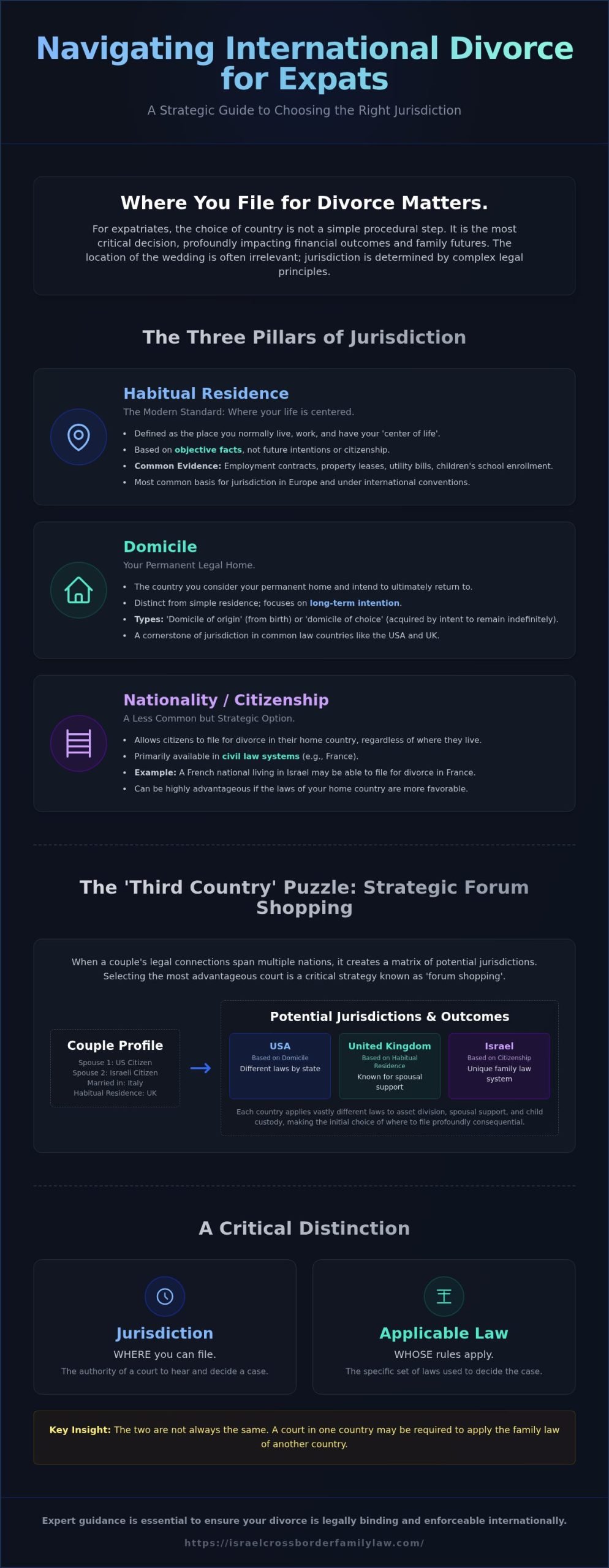
For US expats contemplating the dissolution of a marriage, the foundational and most critical question is that of jurisdiction. In legal terms, jurisdiction is the authority of a court to hear and decide a case. It is a common misconception that a divorce must be filed in the country where the marriage was celebrated; in reality, the location of the wedding ceremony is often irrelevant. The determination of which court has the power to grant a divorce rests on a far more complex framework of international legal principles. The process of getting divorced in a third country requires a sophisticated analysis of which nation’s courts may rightfully preside over your case. Navigating this multi-jurisdictional landscape necessitates a deep understanding conflict of divorce laws, as different countries base their authority on distinct legal concepts. Primarily, jurisdiction is established through one of three pillars: habitual residence, domicile, or nationality. To better understand these complex international considerations, the following video provides a helpful overview:
Habitual Residence: The Modern Standard
Habitual residence is defined as the place where you normally live, work, and have your center of life. Unlike other concepts, it is based on objective facts rather than a person’s future intentions or citizenship. Courts will examine evidence such as employment contracts, property leases, utility bills, and the enrollment of children in local schools to determine your habitual residence. This has become the most common basis for establishing jurisdiction in many countries, particularly throughout Europe and under international conventions.
Domicile: Your Permanent Legal Home
Domicile is a distinct legal concept that must not be confused with simple residence. It refers to the country that you consider your permanent legal home and to which you intend to ultimately return. An individual has a ‘domicile of origin’ (typically from birth) and can acquire a ‘domicile of choice’ by moving to a new country with the clear intention of remaining there indefinitely. This concept remains a cornerstone of jurisdiction in common law countries, including the United States and the United Kingdom, and is critical for many US expats.
Nationality/Citizenship: A Less Common Basis
Certain countries, particularly those with civil law systems, permit their citizens to file for divorce in their courts regardless of where they currently live. This provides an alternative jurisdictional avenue for expats. For instance, a French national who is a long-term resident of Israel may still have the legal right to initiate divorce proceedings in France based solely on their citizenship. This option can be strategically advantageous when the laws of one’s home country are more favorable.
The ‘Third Country’ Scenario: Navigating a Multi-Jurisdictional Puzzle
For expatriates, the process of dissolving a marriage is rarely confined to a single legal system. The ‘third country’ scenario arises when a couple’s legal connections-such as citizenship, place of marriage, and current residence-span multiple nations. Consider a common example: a US citizen and an Israeli citizen, married in Italy, who are now habitual residents of the United Kingdom. This situation creates a complex matrix of potential jurisdictions for a divorce, including the US, Israel, and the UK, each with vastly different laws governing asset division, spousal support, and child custody. This multi-jurisdictional reality introduces the strategic concept of ‘forum shopping’-the deliberate process of selecting the most advantageous court in which to file for divorce. The decision of where to initiate proceedings can have profound and lasting financial consequences, making expert legal guidance essential when considering getting divorced in a third country.
Common Scenarios for Expatriate Couples
The complexities of international divorce manifest in several common fact patterns, each presenting unique legal challenges:
- A couple sharing the same nationality (e.g., both US citizens) but residing together in a foreign country like Israel.
- A couple of different nationalities (e.g., one US and one Israeli citizen) living together in a third country.
- A couple living in separate foreign countries from one another at the time of separation.
The ‘Race to the Courthouse’: Why Filing First Can Matter
In cross-border family law, a strategic urgency often exists due to the ‘first to file’ rule, or lis pendens. In many legal systems, including those within the EU and other key jurisdictions, the court that is first properly seized of the divorce case will retain exclusive jurisdiction to hear it. This principle can trigger a “race to the courthouse,” where the spouse who files first effectively locks in the governing law and legal venue for the entire proceeding. This strategic decision is paramount, as the chosen jurisdiction’s laws on asset division and spousal support will apply. Furthermore, ensuring the final decree is valid is critical; the Recognition of a foreign divorce in the United States is governed by individual state laws, not a universal international treaty, adding another layer of complexity. However, rushing to file without sophisticated legal counsel is a significant risk. An improperly filed petition can be dismissed, ceding the strategic advantage and potentially locking you into a far less favorable jurisdiction.
Choosing Your Jurisdiction: Key Strategic Factors to Consider
For US expats facing the end of a marriage, the initial question is often “Where can I file for divorce?” However, the more critical, strategic question is “Where should I file?” The decision of where you initiate proceedings is one of the most consequential you will make. The legal framework of the chosen country will profoundly influence every aspect of the outcome, from financial settlements to parental rights. Navigating the complexities of getting divorced in a third country requires a sophisticated analysis of multi-jurisdictional law, a process that must be undertaken with experienced international legal counsel.
Financial and Property Division Outcomes
The financial ramifications of a divorce vary dramatically across borders. A primary distinction lies in how marital assets are divided. Some jurisdictions, like many US states, adhere to community property principles, mandating a near 50/50 split of assets acquired during the marriage. Others, including Israel, follow an equitable distribution model, which aims for a fair, but not necessarily equal, division based on numerous factors. Furthermore, the enforceability of prenuptial agreements and the treatment of inherited or gifted assets can differ substantially, as can the laws governing the amount and duration of spousal support (alimony). Understanding these nuances is fundamental to protecting your financial future when considering divorce and separation in international families.
Child Custody and Support Implications
When children are involved, the choice of jurisdiction becomes even more critical. Countries have divergent approaches to awarding sole versus joint legal and physical custody, and their standards for determining the “best interests of the child” can be culturally and legally distinct. A significant challenge in cross-border cases is the enforcement of child support orders; an order issued in one nation may not be automatically recognized in another. For parents concerned about a spouse relocating with a child, understanding the framework of The Hague Convention on the Civil Aspects of International Child Abduction is paramount. A careful review of international custody and relocation laws is essential before any legal action is taken.
Procedural and Practical Considerations
Beyond substantive law, practical factors can heavily influence your decision when getting divorced in a third country. The efficiency and cost of the legal process are primary concerns. A divorce in one jurisdiction may be resolved in months for tens of thousands of shekels, while the same case elsewhere could take years and incur substantially higher costs. Other critical considerations include:
- Language Barriers: The availability of court proceedings and documentation in English, along with access to qualified bilingual legal representation.
- Evidence Disclosure: The scope of the discovery process, which can range from the extensive, US-style disclosure to more limited requirements in other legal systems.
- Legal Process: The nature of the court system, whether it is adversarial or more inquisitorial, and the general timeline for reaching a resolution.
Applicable Law vs. Jurisdiction: A Critical Distinction
Navigating the complexities of an international divorce requires a sophisticated understanding of a critical legal principle: the court that hears your case (jurisdiction) may not necessarily apply its own local laws to decide the outcome. This concept, known as “choice of law” or “conflict of laws,” is a frequent and challenging feature when getting divorced in a third country. A court in one nation may be compelled by international treaties or its own legal doctrines to apply the matrimonial laws of another state, creating a multi-jurisdictional legal matrix that demands expert guidance. For instance, a U.S. expat couple residing in London might file for divorce in an English court. However, if both parties are French nationals with deep connections to France, the English court could be required to apply French matrimonial property law to divide their assets. This distinction is paramount, as the choice of applicable law can dramatically alter the final settlement.
How is the Applicable Law Determined?
The determination of which country’s law will govern your divorce is a complex analysis guided by several factors. Courts do not make this decision arbitrarily; they are bound by a hierarchy of rules, including:
- International Treaties: In the European Union, for example, the Rome III Regulation provides a clear framework for member state courts to determine the applicable law in cross-border divorce cases.
- Contractual Agreements: A valid prenuptial or postnuptial agreement that contains a “choice of law” clause can be determinative, allowing couples to specify in advance which legal system will apply to their marital assets.
- Default Legal Principles: In the absence of an agreement, courts will apply a set of default rules. These often look to factors such as the parties’ last common habitual residence, their shared nationality, or the country with which the couple has the closest connection.
The Impact on Your Divorce Settlement
The selection of the applicable law is not a mere academic exercise; it has profound and direct financial consequences. This single determination will govern the most contentious aspects of your separation, including the division of property, the calculation and duration of spousal support, and potentially even aspects of child custody. Strategic planning for getting divorced in a third country must therefore account for both jurisdiction and applicable law. A jurisdiction that appears favorable due to its efficient procedures may become strategically disadvantageous if its choice of law rules point to a legal system that is unfavorable to your financial interests. Advising clients on this interplay is a core component of effective cross-border divorce representation.
Recognition of Foreign Divorces: Will It Be Valid Back Home?
A primary concern for any expatriate is whether a divorce finalized abroad will be legally binding in their home country or country of citizenship. The apprehension that you might remain legally married in one jurisdiction while being divorced in another is a valid one. The legal principle governing this complex area is known as “comity,” which is the practice of courts in one country or jurisdiction respecting the laws and judicial decisions of others. Generally, a foreign divorce decree will be recognized, provided that fundamental legal standards were met during the proceedings. Successfully getting divorced in a third country hinges on adherence to proper legal procedure. If the foreign court had proper jurisdiction over the marriage and both parties received adequate notice and an opportunity to be heard, recognition is highly probable. However, failure to meet these due process requirements can render a foreign judgment unenforceable.
The Role of The Hague Convention
The 1970 Hague Convention on the Recognition of Divorces and Legal Separations was established to simplify the recognition process among signatory nations. For a divorce to be recognized under the Convention, certain conditions must be met, including:
- The respondent must have received proper notice of the proceedings.
- The divorce must not be contrary to the public policy of the recognizing state.
- The decree must be final and legally effective in the country where it was granted.
It is critical to note, however, that neither the United States nor Israel are signatories to this specific convention, meaning they rely on their own domestic laws and the principle of comity rather than this international treaty.
Recognition in the United States and Israel
In the United States, the recognition of a foreign divorce is governed by individual state law under the doctrine of comity. A U.S. court will typically recognize the divorce if at least one spouse was domiciled in the foreign country at the time of the divorce and if both parties were afforded due process. The key is establishing that the foreign court had legitimate jurisdictional authority. In Israel, the process is more complex and multi-layered. A foreign civil divorce judgment must first be formally recognized and declared enforceable by the Israeli Family Court. For Jewish couples, however, this civil recognition is insufficient for the purposes of remarriage. The couple must also obtain a religious divorce, known as a get, through the Rabbinical Court system. Navigating the dual requirements of both the civil and religious courts when getting divorced in a third country is a sophisticated legal challenge. Ensuring your foreign divorce is valid across all relevant jurisdictions requires precise, cross-border legal strategy. For guidance on these intricate matters, our team provides expert counsel to navigate the complexities of international family law.
Why You Need a Cross-Border Divorce Specialist
The process of dissolving a marriage as a US expat involves a complex legal matrix of competing jurisdictions, conflicting laws, and intricate financial regulations. Attempting to navigate this terrain with counsel equipped only for domestic matters is a significant risk. A local lawyer, while proficient in their own country’s statutes, may not grasp the international implications for your assets, tax liabilities, or child custody rights. The complexities inherent in getting divorced in a third country demand a sophisticated, multi-jurisdictional approach. An international divorce specialist acts as the central coordinator, bridging the legal and cultural gaps between the United States, Israel, and your country of residence. They ensure that every action taken in one jurisdiction is strategically aligned with your global objectives. This comprehensive oversight is not merely an advantage; it is essential for protecting your long-term interests and can save you significant time, stress, and financial resources.
Strategic Planning and Forum Selection
The initial decision of where to file for divorce is the most critical strategic move you will make. A cross-border specialist meticulously analyzes all potential jurisdictions-your home state in the US, your current country of residence, and even your spouse’s country of origin-to determine which legal forum offers the most favorable outcome for property division, spousal support, and child custody. This analysis informs the crucial advice on whether to file first, setting a proactive and advantageous course for the entire case.
Navigating Legal and Cultural Nuances
International family law requires a deep understanding of different legal traditions, from the common law systems of the US to the civil law and religious court systems found in Israel and other nations. Our cross-border attorneys are adept at navigating these divergent frameworks. Furthermore, we leverage a robust global network of trusted legal professionals, ensuring seamless and expert representation on the ground wherever it is needed. Discover more about our advisory and our unique approach to these sophisticated matters.
Ensuring a Globally Enforceable Outcome
The ultimate goal when getting divorced in a third country is to secure a final decree that is recognized and enforceable across all relevant jurisdictions. A judgment that cannot be enforced is merely a symbolic victory. We focus on achieving practical, binding results, ensuring that court orders for property transfers, support payments, and custody arrangements are respected and can be executed internationally. Take the first step toward a secure and final resolution by requesting a confidential case review.
Strategic Counsel for Your Complex Cross-Border Divorce
The complexities of international divorce for expats cannot be overstated. As we have explored, the strategic selection of jurisdiction is a foundational decision with profound consequences for asset division, spousal support, and child custody arrangements. Understanding the critical distinction between the court’s jurisdiction and the substantive law it applies, alongside the vital importance of ensuring your decree’s international recognition, are paramount. The process of getting divorced in a third country is not merely a legal procedure; it is a multi-jurisdictional puzzle that demands sophisticated, forward-thinking legal strategy. Navigating this intricate landscape requires more than general legal advice; it demands specialized expertise. As a dedicated advisory for expats and foreign nationals with focused experience in US-Israel cross-border family law, our firm provides the strategic guidance necessary for these multi-jurisdictional cases. We invite you to Schedule a Confidential Consultation to Discuss Your International Divorce Strategy. Taking this decisive step can provide the clarity and confidence needed to secure a favorable outcome and protect your future.
Frequently Asked Questions About International Divorce
Do I have to get divorced in the country where I was married?
No. The jurisdiction for a divorce is not determined by the location of the marriage ceremony. Instead, it is established based on factors such as the habitual residence or nationality of one or both spouses. For U.S. expats, this means you may have the option to file for divorce in your current country of residence, your spouse’s country of residence, or potentially even in your home state in the U.S., depending on the specific circumstances of your case.
What happens if my spouse files for divorce in a different country before I do?
This situation initiates a “jurisdictional race,” where the first court to be validly seized of the matter typically retains jurisdiction. The outcome can have profound implications for asset division, spousal support, and child custody, as family law varies dramatically between countries. If you are served with divorce papers from a foreign jurisdiction, it is imperative to seek immediate, strategic legal counsel to protect your interests and navigate this complex multi-jurisdictional conflict.
How long do I need to live in a country before I can file for divorce there?
Residency requirements for filing a divorce petition are jurisdiction-specific and vary considerably worldwide. For example, some European nations may require as little as six months of habitual residence, while others may demand a longer period or a different type of connection to the state. Ascertaining the proper jurisdiction and meeting its statutory requirements is a foundational step in any cross-border divorce proceeding, requiring a detailed analysis of your international footprint.
Will my US or Israeli prenuptial agreement be recognized in a third country?
The enforceability of a prenuptial agreement across borders is not guaranteed. A third-country court will apply its own legal standards to assess the validity of a U.S. or Israeli agreement, scrutinizing factors like full financial disclosure, independent legal advice, and whether its terms violate local public policy. While a well-drafted international agreement has a stronger chance of being upheld, its recognition remains a complex matter of private international law requiring expert evaluation.
What is the difference between a legal separation and a divorce in an international context?
A divorce legally terminates the marital bond, permitting the parties to remarry. In contrast, a legal separation formalizes the division of assets and custody while the parties remain legally married. In a cross-border context, this distinction is critical, as not all jurisdictions recognize legal separation. Furthermore, your status as legally separated versus divorced can have disparate impacts on immigration status, tax liabilities, and inheritance rights across different legal systems.
Can I get divorced in a third country if my spouse has never lived there?
Yes, this is frequently possible. Jurisdiction can often be established based on the residency of only one spouse-the petitioner. If you meet the statutory residency requirements of a country, you may initiate divorce proceedings there even if your spouse has never resided in that jurisdiction and lives in the U.S. or Israel. This is a significant strategic component to consider when evaluating the potential forums for getting divorced in a third country.
How are assets located in other countries divided in a third-country divorce?
A court adjudicating a divorce can issue orders concerning worldwide assets, from real estate in Tel Aviv to investment accounts in the United States. However, enforcing these orders internationally is a complex, secondary process. It often requires initiating ancillary proceedings in the jurisdictions where the assets are physically located. The successful division of a global marital estate demands sophisticated cross-border legal coordination to ensure the foreign judgment is recognized and executed effectively.

Article by
Gabriel Lior
A Personal Journey That Became a Mission The advisory was founded by an American father Gabriel Lior, LLB, MBA , global entrepreneur, and cross-border advisor who spent more than a decade navigating the Israeli family court system firsthand and now lives in Singapore with his son.
As a divorced parent in a cross-border family, Gabriel faced nearly every legal challenge a foreign parent can encounter in Israel — including child custody disputes, child support proceedings, property matters in Israel and abroad, false accusations, and complex immigration and relocation proceedings. Over the years, he learned the hard way how difficult it is for non-Israeli parents to understand the system, identify the right legal strategy, and choose the right legal representation — especially when language, culture, and jurisdictional differences are involved. He also witnessed how foreign parents and new immigrants are often disadvantaged or taken advantage of by service providers and institutions simply because they lack local knowledge or fluency. From Client to Advisor To truly understand — and survive — the system, Gabriel pursued formal legal education in Israel, completing two Israeli law degrees, alongside a BA and MBA earned in the United States. This was never about becoming a practicing attorney, but about gaining a deep, structural understanding of how the system works — and where it breaks down for foreign parents. This rare combination of: Firsthand client experience Israeli legal and US business education International business and negotiation training Decades of commercial execution created a unique perspective – one that understands both sides of the table. After years of litigation, persistence, and at times self-representation, he ultimately succeeded in securing custody of his son and relocating abroad through a rare legal victory in the Israeli Supreme Court — becoming one of the first fathers in Israel to do so under these circumstances.
Disclaimer
Important Disclaimer: The information provided on this website and in its content is for general informational and educational purposes only and does not constitute legal advice, legal opinion, or legal representation. Gabriel Lior is not licensed to practice law in Israel (nor is he interested in doing so) and does not provide legal services, despite having completed 2 Law Degrees. The services offered are advisory in nature and are intended to provide general guidance, strategic insight, and information regarding cross-border family law considerations. No attorney-client relationship is formed by accessing this website, reading its content, or communicating with us. Any decisions made based on this information are at your own discretion and risk. For legal advice specific to your situation, you should consult a licensed attorney in the relevant jurisdiction. Where appropriate, we may refer clients to independent, licensed attorneys or professionals. Such referrals do not constitute legal representation and no liability is assumed for services provided by third parties.