What if the most significant decision regarding your child’s future is determined not by your personal preferences, but by a court-appointed official you have never met? For many international families, the child relocation evaluation process in israel feels like an opaque and intimidating hurdle that threatens to keep them rooted in the country indefinitely. It’s understandable to feel a sense of unease when your global mobility and your child’s welfare are subject to the scrutiny of a foreign legal framework. This information is published by an independent advisory platform and does not constitute formal legal advice or an attorney-client relationship.
Our goal is to provide the strategic clarity you need to move forward with confidence. You’ll learn exactly how Israeli courts apply the “best interests of the child” standard and what specific criteria can lead a judge to approve a move abroad. We will explore the critical role of the welfare officer, known as the Pkidat Saad, and explain how to prepare for professional evaluations. Finally, we will outline the procedural steps necessary to navigate this complex multi-jurisdictional landscape while protecting your parental rights.
Key Takeaways
- Understand why the Israeli Family Court views relocation as a fundamental change in a child’s life that requires either formal mutual consent or a court order.
- Navigate the child relocation evaluation process israel by learning the specific role of the Welfare Officer and the typical four to eight month assessment timeline.
- Discover the criteria used to determine the “best interests of the child,” with a focus on maintaining meaningful relationships with both parents across borders.
- Identify the significant legal risks associated with the Hague Convention and why moving a child without court permission is legally classified as abduction.
- Learn how to build a strategic “Relocation Portfolio” to demonstrate a concrete plan for your child’s education, housing, and support system in a new country.
Understanding the Legal Framework for Child Relocation in Israel
In the eyes of the Israeli legal system, moving a child is a profound change to their status quo. Whether you are moving from Tel Aviv to Haifa or from Jerusalem to London, the court prioritizes stability and the maintenance of existing parental bonds. The child relocation evaluation process israel begins with the understanding that both parents are natural guardians with equal rights. Under the Legal Capacity and Guardianship Law of 1962, a parent cannot unilaterally decide to change a child’s residence without the other’s consent. The Family Court, or Beit Mishpat LeInyanei Mishpacha, oversees these transitions to ensure the child’s welfare remains protected. This platform provides informational guidance and is not a law firm; specific legal strategy should be discussed with a licensed attorney.
The court distinguishes between internal relocation within Israel and international moves. While internal moves may only require consent if they disrupt existing custody orders or visitation schedules, international relocation is treated with much higher scrutiny. The burden of proof rests entirely on the parent seeking to move. You must justify why the relocation is necessary and provide evidence that the child’s life will be measurably better in the new location. As of January 1, 2026, the Israeli Judicial Authority updated its court fees, which applies to any new claims filed in the Family Court.
To gain a broader perspective on how these types of cases are analyzed, watch this helpful video:
The Requirement of Mutual Parental Consent
Even when parents are on good terms, a verbal agreement is insufficient for international moves. You must have a written agreement ratified by the court to ensure it is legally binding and recognized by border authorities. Moving without this formal approval can trigger the Hague Convention on the Civil Aspects of International Child Abduction. This international treaty protects children from wrongful removal across borders and can lead to a court ordering the child’s immediate return to Israel. Mediation often serves as an effective tool to draft a comprehensive plan that covers travel logistics, time-zone differences, and financial responsibilities for visitation.
When Consent is Absent: Filing a Relocation Motion
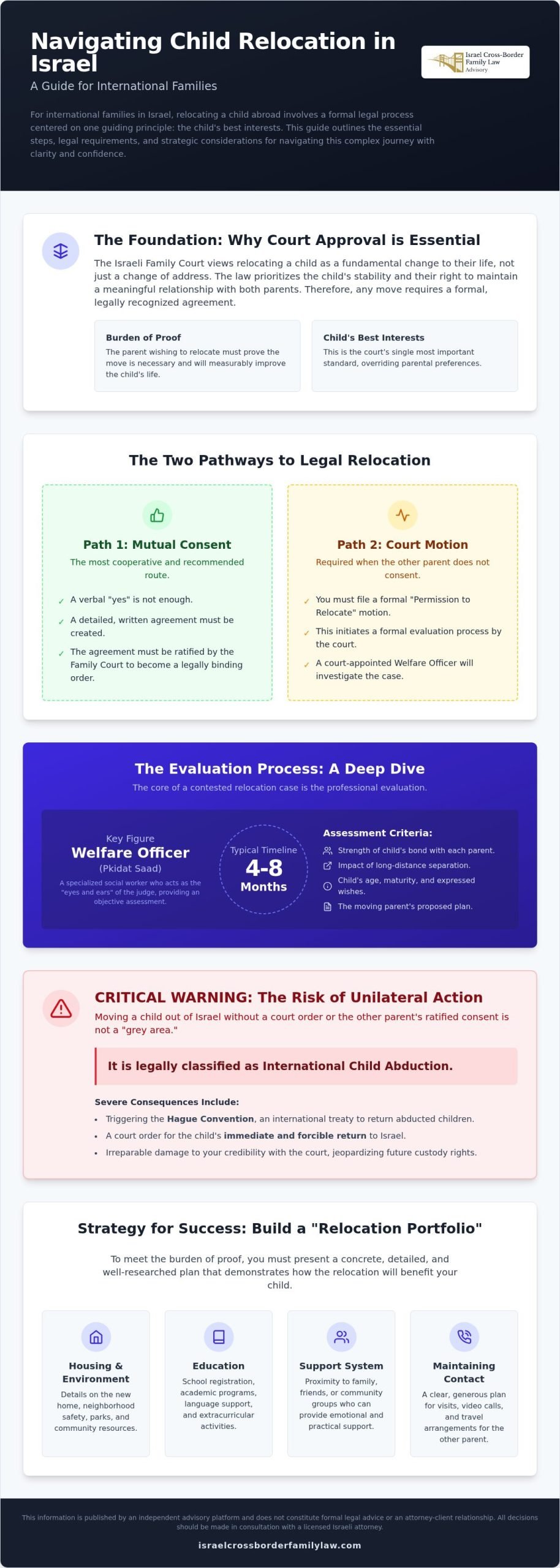
If the other parent refuses to consent, you must file a formal motion for “Permission to Relocate.” Taking unilateral action, such as leaving the country without a court order, is viewed severely by Israeli judges and can jeopardize your future custody rights. Once you file the motion, the court begins the child relocation evaluation process israel by appointing a welfare officer, or Pkidat Saad. This professional acts as an objective investigator, conducting interviews and home visits to determine if the move truly aligns with the child’s best interests. Their report is a cornerstone of the court’s eventual decision, and the international custody and relocation strategy you prepare early on will be vital during this stage.
The Evaluation Phase: The Role of the Welfare Officer and Experts
The child relocation evaluation process israel centers on the findings of the Pkidat Saad, a specialized social worker appointed by the court. This individual acts as the ‘eyes and ears’ of the judge, providing an objective assessment of the family’s reality that a courtroom setting cannot reveal. Because relocation involves a permanent shift in the child’s environment, this phase is thorough and deliberate. It typically requires four to eight months to complete. During this time, the officer evaluates the depth of the child’s bond with each parent and the potential impact of a long-distance separation. For more complex cases, the court may order a secondary evaluation through a ‘Machon,’ a psychological institute that provides clinical diagnostic reports on parental fitness and child attachment.
Understanding the international context of these evaluations is vital, particularly regarding the HCCH Child Abduction Section, which provides the framework for how Israeli courts view the risks of cross-border moves. High-stakes decisions often hinge on how well a parent communicates their long-term vision for the child’s stability. If you are feeling overwhelmed by the bureaucratic nature of these requirements, you may find it helpful to speak with a strategy advisor to map out your next steps before your first interview.
Step-by-Step Breakdown of the Evaluation Process
The process begins with separate interviews for each parent. The welfare officer explores your reasons for moving and your plan for maintaining the child’s relationship with the parent staying in Israel. If the child is old enough, the officer will speak with them privately in a sensitive, age-appropriate manner. Following these discussions, the officer conducts a home visit. This is not a “white-glove” inspection; rather, it is an observation of the child’s interaction with their current environment. The culmination of this investigation is the Tazkir, a comprehensive written report. This document carries significant weight, as judges rarely deviate from the welfare officer’s professional recommendation regarding international custody and relocation.
Preparing for the Evaluation as an Anglo Parent
Cultural and language barriers can sometimes lead to misunderstandings during the child relocation evaluation process israel. You have the right to request a translator or an English-speaking officer if you feel your nuances are being lost in translation. When discussing your plans, focus on the concrete details of your international support network. Mention specific family members abroad, school registrations, and community ties that will help the child transition. It is also critical to avoid disparaging the other parent. Israeli courts are highly sensitive to “parental alienation.” Demonstrating a sincere desire to facilitate frequent contact between the child and the non-relocating parent is often the most persuasive evidence of your commitment to the child’s best interests.
The ‘Best Interests of the Child’ Criteria in Relocation
The “Best Interests of the Child” is the absolute cornerstone of the child relocation evaluation process israel. Unlike some jurisdictions where a primary custodial parent might have a presumptive right to move, Israeli courts start from a neutral position. The judge asks one primary question: will this move enhance or diminish the child’s overall well-being? This assessment includes a detailed comparison of the current lifestyle in Israel against the proposed lifestyle abroad. The court looks at specific factors such as educational standards, access to specialized healthcare, and the strength of the child’s social environment. The goal is to ensure the child doesn’t just survive the move but has the potential to thrive in the new location.
Special consideration is given to younger children. The “Tender Years Doctrine” traditionally suggests that children under the age of six should remain in the custody of their mother. While modern Israeli legal trends are moving toward more gender-neutral shared parenting, this doctrine still carries weight in relocation disputes. If a move would significantly disrupt the child’s attachment to the non-relocating parent during these formative years, the court may be more hesitant to grant permission. Judges often rely on the expertise of Israel’s Central Authority on International Child Abduction to understand the legal safeguards that will remain in place once the child leaves the country.
The Three-Pronged Relocation Test
Israeli case law has established a specific framework for evaluating these motions. First, the court examines the parent’s motive. A move must be driven by a genuine opportunity, such as a career advancement or a return to a supportive family network, rather than a desire to alienate the other parent. Second, the court assesses the child’s adaptability. This involves looking at the child’s personality, language skills, and how easily they can integrate into a new culture. Finally, a realistic visitation plan is mandatory. The moving parent must prove that a frequent and meaningful relationship can be maintained through digital communication and physical travel. This is why having a clear international custody and relocation strategy is essential before the evaluation begins.
The Child’s Voice: When Does the Court Listen?
As children grow older, their preferences are given more weight in the child relocation evaluation process israel. While there is no fixed age, the court generally begins to consider a child’s expressed wishes more seriously around age ten to twelve. To facilitate this, Israel uses a specialized “Hearing the Child” unit. These are trained professionals who interview the child in a neutral, non-threatening setting. The goal is to understand the child’s perspective without exposing them to the pressure of choosing between parents. Protecting the child from being caught in the middle of parental conflict is a priority, and the court will carefully filter the child’s statements to ensure they haven’t been coached or influenced by either party.
International Nuances: Hague Convention and Cross-Border Safeguards
For international families, the child relocation evaluation process israel involves navigating not only local statutes but also rigorous international treaties. The most critical of these is the Hague Convention on the Civil Aspects of International Child Abduction. Israel is a committed signatory to this treaty, which establishes that a child cannot be removed from their “habitual residence” without the consent of both guardians or a court order. Even if you are the primary caregiver, taking the child abroad permanently without following these formal steps is legally defined as abduction. This information is published on an independent advisory platform and is intended for educational purposes only; it does not constitute legal representation.
To mitigate the risks of non-compliance once a child leaves the country, Israeli courts frequently utilize “Mirror Orders.” These are legal decrees issued in the destination country, such as the US or UK, that exactly replicate the Israeli court’s custody and visitation rulings. This ensures that the orders are enforceable in the new jurisdiction. Additionally, the court may require the relocating parent to post a financial bond or provide a bank guarantee. This money serves as a security deposit to ensure the child is brought back to Israel for scheduled visits as promised.
Safeguarding Visitation Across Borders
Structuring a long-distance schedule requires significant foresight. Instead of traditional weekend visits, plans usually focus on extended periods during summers and winter holidays. Digital contact is also a standard requirement to maintain the bond with the non-relocating parent. The court will also address logistical details, including:
- Travel Costs: Determining who pays for international flights and whether costs are shared or borne by the relocating parent.
- Right of First Refusal: Ensuring the non-relocating parent is offered care time if the custodial parent is away for more than a set number of hours.
- Communication Mandates: Setting specific times for video calls that account for time-zone differences.
Jurisdictional Challenges for US-Israel Families
One of the most complex aspects of International Custody & Relocation is determining which country’s law applies after the move is complete. While the Israeli court may grant the move, the destination country might eventually claim jurisdiction over future disputes once the child is settled. This can lead to conflicting orders between the Israeli Family Court and US State Courts, particularly regarding child support or custody modifications. Navigating these multi-jurisdictional layers requires a clear strategy before you commit to a move. If you are concerned about how your specific destination might affect your existing orders, it is wise to request a confidential case review to discuss cross-border enforcement.
Strategy and Strategy: Navigating the Relocation Journey
Successful relocation is rarely the result of a sudden decision; it’s a calculated strategic path that begins months before you enter a courtroom. The child relocation evaluation process israel is not just a series of interviews, but a comprehensive test of your ability to present a stable, superior alternative to the child’s current life. Waiting until a move is imminent to begin your legal journey is a common error that can lead to significant court delays or unfavorable initial rulings. This information is published on an independent advisory platform and provides strategic risk guidance rather than formal legal representation. Legal services are only provided by licensed practitioners under a separate engagement.
One of the most effective tools in your strategy is the development of a ‘Relocation Portfolio.’ This document should go beyond vague intentions. It needs to include concrete evidence of the child’s prospective life abroad, such as school brochures, local healthcare providers, and detailed descriptions of the community where you intend to live. Demonstrating a robust support network of family and friends in the destination country helps alleviate the court’s concern about the child’s potential isolation. Providing this level of detail early on shows the welfare officer that the move is well-conceived and focused on the child’s development.
The first 90 days of the legal process are often the most critical for your case. This is the window when the court sets the evaluation schedule and appoints the welfare officer. The initial statements you make during this period carry significant weight and are difficult to modify later. A cross-border advisory perspective is essential here to ensure your Israeli filings don’t inadvertently conflict with the legal requirements of your destination country, particularly regarding the enforcement of future custody orders.
Decision-Making Guidance for Parents
Before committing to a potentially lengthy legal battle, it’s vital to assess the objective strength of your case. You should consider whether the move is truly the only way to achieve your family’s goals. Sometimes, alternatives like temporary moves for specific educational opportunities or modified visitation schedules can achieve a similar outcome with significantly less conflict. Understanding the weight of these early decisions is key to a successful transition. To see how this strategic assessment fits into the broader timeline, you can review how it works on our platform.
Seeking Professional Clarity
Navigating the child relocation evaluation process israel requires a specialized approach that differs from local Israeli divorce proceedings. While a standard lawyer understands local statutes, a cross-border specialist understands the multi-jurisdictional complexity of moving between different legal cultures. This distinction is the difference between simply filing papers and building a functional bridge between your life in Israel and your future abroad. Remember that relocation is a marathon, not a sprint. Preparation and strategic clarity are your most valuable assets in protecting your child’s future. For a deeper look into these dynamics, you can watch our insights on International Family Law.
Get clarity before you commit. Request a confidential consultation.
Securing Your Family’s International Future
Successfully relocating from Israel is a complex journey that demands a deep understanding of both local welfare standards and international treaties. By prioritizing the “best interests of the child” and preparing a comprehensive relocation portfolio, you demonstrate a commitment to your child’s long-term stability. Navigating the child relocation evaluation process israel is a marathon that rewards early preparation and a clear, cross-border strategy. This content is published on an independent advisory platform, not a law firm. It focuses on strategy, risks, and decision-making guidance rather than an attorney-client relationship. Legal representation is only provided by licensed attorneys under a separate engagement.
While the path may feel opaque, focusing on the quality of life and maintaining parental bonds will help ground your case in the criteria the court values most. Strategic clarity is your best defense against the inherent complexity of cross-border issues. Get clarity before you commit. Request a confidential consultation. We provide the calm, authoritative guidance international families need to transition into their next chapter with peace of mind.
Frequently Asked Questions
What is the ‘Tender Years Doctrine’ and how does it affect relocation in Israel?
The Tender Years Doctrine is a legal principle suggesting that children under the age of six should generally remain in their mother’s custody. While Israeli courts are shifting toward a model of shared parental responsibility, this doctrine still influences the child relocation evaluation process israel by creating a higher burden of proof for moves that would separate a young child from their primary caregiver. Judges remain cautious about disrupting these foundational bonds during a child’s early development.
How long does a child relocation evaluation process typically take in Israeli courts?
A standard evaluation by a court-appointed welfare officer typically takes between four and eight months to complete. This timeline accounts for the time needed to conduct multiple interviews, perform home visits, and draft the final Tazkir report. If the court determines that a more complex clinical assessment from a psychological institute is necessary, the process can extend well beyond this initial window.
Can the non-relocating parent block a move even if I have sole custody?
Yes, a non-relocating parent can challenge a move because Israeli law views both parents as natural guardians with equal rights regarding major life decisions. Even if you have primary physical custody, you don’t have the unilateral right to move the child to another country. You must obtain either the other parent’s written consent or a formal order from the Family Court before departing.
What happens if I move with my child without the other parent’s consent?
Moving a child out of Israel without formal consent or a court order is legally defined as international child abduction. Because Israel is a signatory to the Hague Convention, the non-relocating parent can petition for the child’s immediate return. Such actions can lead to severe legal penalties and will likely negatively impact your standing in any future child relocation evaluation process israel.
Will the Israeli court consider the quality of schools in the US during the evaluation?
The court will conduct a comparative analysis of the child’s quality of life, which includes evaluating educational standards in the proposed destination. You should provide concrete evidence of specific schools, including their rankings and available support services, within your relocation portfolio. The judge uses this information to determine if the move offers a genuine benefit to the child’s emotional and intellectual growth.
Do I need to hire a psychologist for my child during the relocation process?
You aren’t required to hire a private psychologist, as the court typically relies on its own appointed welfare officers or clinical experts. While some parents seek private consultations to help their child process the transition, these private reports often carry less weight than court-ordered evaluations. It’s usually more effective to focus on cooperating fully with the court’s chosen professionals during the assessment phase.
How are travel costs for visitation usually split in international relocation cases?
Travel costs are typically allocated based on the financial standing of both parents and the specific circumstances of the move. In many instances, the parent who is relocating bears a significant portion, if not all, of the international flight expenses. The court often requires a bank guarantee or financial bond to ensure that these travel obligations and visitation schedules are consistently honored.
Can a relocation decision be appealed if the welfare officer’s report is negative?
You can file an appeal against a Family Court judgment, and the current fee for this process is 775 NIS as of January 2026. However, winning an appeal is difficult because the District Court usually focuses on whether the lower court made a legal error. It’s rare for an appellate court to overturn a decision based solely on a disagreement with the welfare officer’s professional findings.

Article by
Gabriel Lior
A Personal Journey That Became a Mission
The advisory was founded by an American father Gabriel Lior, LLB, MBA , global entrepreneur, and cross-border advisor who spent more than a decade navigating the Israeli family court system firsthand and now lives in Singapore with his son.
As a divorced parent in a cross-border family, Gabriel faced nearly every legal challenge a foreign parent can encounter in Israel — including child custody disputes, child support proceedings, property matters in Israel and abroad, false accusations, and complex immigration and relocation proceedings.
Over the years, he learned the hard way how difficult it is for non-Israeli parents to understand the system, identify the right legal strategy, and choose the right legal representation — especially when language, culture, and jurisdictional differences are involved. He also witnessed how foreign parents and new immigrants are often disadvantaged or taken advantage of by service providers and institutions simply because they lack local knowledge or fluency.
From Client to Advisor
To truly understand — and survive — the system, Gabriel pursued formal legal education in Israel, completing two Israeli law degrees, alongside a BA and MBA earned in the United States. This was never about becoming a practicing attorney, but about gaining a deep, structural understanding of how the system works — and where it breaks down for foreign parents.
This rare combination of:
Firsthand client experience
Israeli legal and US business education
International business and negotiation training
Decades of commercial execution
created a unique perspective – one that understands both sides of the table.
After years of litigation, persistence, and at times self-representation, he ultimately succeeded in securing custody of his son and relocating abroad through a rare legal victory in the Israeli Supreme Court — becoming one of the first fathers in Israel to do so under these circumstances.
Disclaimer
Important Disclaimer:
The information provided on this website and in its content is for general informational and educational purposes only and does not constitute legal advice, legal opinion, or legal representation.
Gabriel Lior is not licensed to practice law in Israel (nor is he interested in doing so) and does not provide legal services, despite having completed 2 Law Degrees. The services offered are advisory in nature and are intended to provide general guidance, strategic insight, and information regarding cross-border family law considerations.
No attorney-client relationship is formed by accessing this website, reading its content, or communicating with us.
Any decisions made based on this information are at your own discretion and risk. For legal advice specific to your situation, you should consult a licensed attorney in the relevant jurisdiction.
Where appropriate, we may refer clients to independent, licensed attorneys or professionals. Such referrals do not constitute legal representation and no liability is assumed for services provided by third parties.