This article is published on an independent advisory platform and does not constitute a law firm or an attorney-client relationship. Legal services are only provided by licensed attorneys under a separate engagement.
Why does a legal matter that might take months in a domestic court often stretch into years when it crosses an ocean? The answer lies in jurisdictional friction, which is the time required for the legal systems of Israel and the United States to communicate and acknowledge one another. If you are currently understanding the timeline of my international case, you’ve likely realized that cross-border family law or estate matters don’t follow a standard calendar. It’s natural to feel frustrated by the uncertainty of the next steps or the high costs that stem from unexpected procedural delays between different legal cultures.
This guide provides a transparent look at the milestones and strategic variables that will define your legal journey in 2026. We will examine how recent shifts, such as the March 2026 expansion of religious court jurisdiction in Israel, could influence your specific strategy and timeline. You’ll gain a realistic expectation of the process and learn how to avoid unnecessary delays through proactive, risk-based decision-making. For further insights, you can explore our resources on the Israel Family Law YouTube channel. Get clarity before you commit. Request a confidential consultation.
Key Takeaways
- Understand how “jurisdictional friction” creates inherent delays when the legal systems of Israel and the US interact, requiring extra time for mutual recognition.
- Identify the major bottlenecks in international service of process and learn how to navigate these stages to maintain momentum throughout 2026.
- Gain a realistic perspective on understanding the timeline of my international case by analyzing the impact of the “Race for Jurisdiction” between Israeli civil and religious courts.
- Discover how a comprehensive pre-filing strategy can bridge cultural gaps and prevent the high costs associated with procedural misunderstandings or party obstructionism.
This article is published on an independent advisory platform and does not constitute a law firm or an attorney-client relationship. Legal services are only provided by licensed attorneys under a separate engagement.
Why International Legal Timelines Differ from Domestic Cases
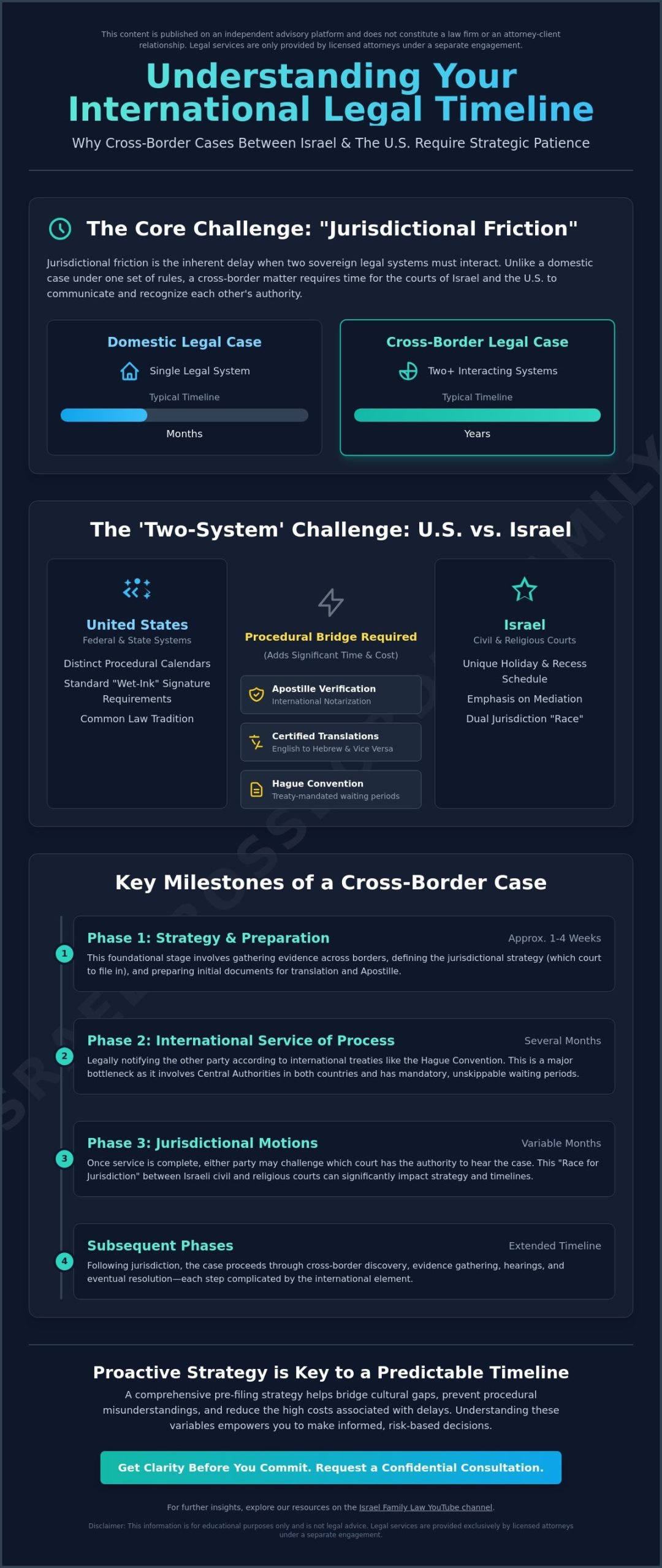
Jurisdictional friction is the natural resistance encountered when two sovereign legal systems must interact. Unlike a domestic case where a single set of procedural rules applies, a cross-border matter involves a constant dialogue between different courts. Understanding the timeline of my international case starts with acknowledging that this friction is a structural reality. It isn’t necessarily a sign of a failing case. It represents the time required for a court in Israel to recognize a document from the US, or vice versa. This interaction is governed by the principles of private international law, which dictate how different jurisdictions respect each other’s rules and authority.
Geography imposes physical constraints on communication and document verification. Even in a digital age, certain legal acts require physical presence or original wet-ink signatures. International treaties, such as the Hague Convention, introduce mandatory waiting periods. These are often designed to protect the rights of parties living abroad. For example, service of process via the Central Authority under the Hague Convention can take several months. These timelines are fixed by international law and cannot be bypassed. This is why a simple divorce or estate matter becomes complex the moment assets or parties span borders.
The ‘Two-System’ Challenge: US vs. Israel
Israel and the US operate on vastly different procedural calendars. Israeli courts observe a unique schedule of holidays and recesses that don’t align with American court dates. Every piece of evidence, from bank statements to affidavits, must undergo a specific verification process called an Apostille. This is a form of international notarization. Additionally, Hebrew-English certified translations are mandatory. These steps don’t just add costs; they add weeks of administrative lead time. Cultural differences in legal practice, such as the emphasis on mediation in Israeli family law, further shape the pace of the proceedings. Understanding the timeline of my international case requires looking at these two systems as a single, integrated challenge.
Clarifying the Advisory Role
This article is published on an independent advisory platform, not a law firm. Our goal is to provide education on the structural aspects of procedural timelines. We don’t provide legal representation or specific legal advice. Legal services are only provided by licensed attorneys under a separate engagement. Distinguishing between general procedural milestones and case-specific legal strategy is vital. Early strategy sessions focus on identifying timeline risk. This helps you understand where delays might occur before you file any documents. If you’re managing divorce or separation for international families, seeking clarity on these risks is the first step toward a predictable outcome. Get clarity before you commit. Request a confidential consultation.
This article is published on an independent advisory platform and does not constitute a law firm or an attorney-client relationship. Legal services are only provided by licensed attorneys under a separate engagement.
Key Milestones: From Initial Filing to Final Resolution
A cross-border legal matter moves through specific stages that differ significantly from local litigation. Understanding the timeline of my international case involves mapping out five distinct phases. While every situation is unique, these milestones provide a framework for managing your expectations throughout the process. You aren’t just waiting on one court; you’re waiting on the coordination between two nations.
- Phase 1: Preparation (Weeks 1-4): This involves gathering evidence and defining the jurisdictional strategy.
- Phase 2: International Service: The process of legally notifying the other party according to international treaties.
- Phase 3: Jurisdictional Motions: Resolving which court has the authority to hear the case.
- Phase 4: Cross-Border Discovery: Exchanging evidence and obtaining records from foreign entities.
- Phase 5: Final Resolution: Reaching a conclusion through mediation, settlement, or a court ruling.
Phase 1 & 2: Setting the Foundation
The first month is dedicated to gathering essential documents from both IL and US institutions. This includes bank statements, school records, and health provider reports. Accuracy here is vital to prevent future delays. Once the case is filed, the “service” hurdle begins. Simply mailing a letter is rarely enough for an international court to recognize the case. Most matters involve the Hague Service Convention. This treaty requires specific forms and often involves a central government authority. It’s common for this phase alone to add three to six months to the start of your timeline. Without proper service, any future judgment may be unenforceable in the other country.
Phase 3 & 4: The ‘Middle’ of the Case
The middle of the case is often the most complex. Parties frequently argue over Forum Non Conveniens. This is a legal concept where a court decides if it’s the right venue or if the other country’s court is more appropriate. This is a common occurrence in divorce or separation for international families. Discovery then follows, where you must obtain records from US entities for use in IL courts. This often requires expert witnesses who can testify about foreign law to the judge. Since these experts must be cross-qualified, scheduling their testimony adds another layer to the calendar. You can request a confidential case review to better understand how these milestones apply to your specific situation.
Final resolution is the last milestone. Whether through settlement or trial, the international nature of the case means the final paperwork must be carefully drafted. It must be recognized by both systems to be truly effective. Understanding the timeline of my international case means preparing for these phases well in advance. Strategy is your best tool for keeping the process moving.
This article is published on an independent advisory platform and does not constitute a law firm or an attorney-client relationship. Legal services are only provided by licensed attorneys under a separate engagement.
Variables That Influence the Speed of Your Case in Israel and Abroad
The pace of a cross-border matter is rarely linear. Several specific variables dictate whether a case moves steadily or stalls. Understanding the timeline of my international case requires an analysis of both jurisdictional strategy and the nature of the assets involved. For instance, valuing a US 401k against an Israeli pension requires specialized actuarial work that adds weeks to the process. If children are involved, the need for international custody evaluations adds significant time. Experts must often coordinate across borders to provide a comprehensive report to the court. The responsiveness of the other party is the most unpredictable variable. While cooperation can lead to a resolution in months, obstructionism can double that timeframe.
Israeli-Specific Speed Factors
In Israel, the “Race for Jurisdiction” is a critical variable. A party may choose between the Family Court and the Rabbinical Court. These systems operate at different speeds. As of March 2026, a significant law change allows religious courts to arbitrate civil matters, including commercial and employment disputes, provided both parties give their consent. This provides an alternative path but requires careful strategic timing. Additionally, mandatory mediation sessions, known as “Mahut,” must occur before litigation can proceed. This adds a fixed waiting period of several weeks at the start. You must also account for “Pagra,” the Israeli court vacations. During these periods, most legal deadlines are paused. This can extend a case by a month or more during the summer or holiday seasons.
US-Based Delays for International Clients
Coordination with the US legal system introduces its own set of bottlenecks. Obtaining state court orders or responses from federal agencies often involves long wait times. When assets are located in both countries, US-based forensic accountants may need months to analyze international transfers. Understanding the timeline of my international case involves anticipating these administrative hurdles before they arise. The final stage often requires “mirror orders.” These are identical orders issued in both jurisdictions to ensure enforcement. Aligning the language between two different legal cultures takes precision. If you are dealing with international custody or relocation, these delays must be factored into your early planning. Get clarity before you commit. Request a confidential consultation.
This article is published on an independent advisory platform and does not constitute a law firm or an attorney-client relationship. Legal services are only provided by licensed attorneys under a separate engagement.
The Role of Strategy in Reducing Jurisdictional Friction
Rushing to file a case in the heat of a dispute often feels like the most proactive move. In cross-border matters, however, a “race to the courthouse” without a coordinated plan can trigger immediate jurisdictional counter-strikes. This often leads to parallel litigation in both Israel and the US, which can stall your progress for years. Understanding the timeline of my international case requires a shift toward strategic patience. By anticipating jurisdictional challenges before they are raised by the other party, you can address potential bottlenecks in your initial filings. This proactive approach reduces the friction that occurs when two systems stop to figure out which one has the authority to act.
Mediation and collaborative law are increasingly effective tools for bypassing court backlogs. While the Israeli legal system has integrated mandatory mediation sessions, utilizing these as a genuine strategic path rather than a procedural hurdle can save months of litigation. Digital evidence management also plays a vital role. Creating clear, bilingual chronologies and organizing financial records early prevents the discovery phase from becoming an endless cycle of requests and motions. When both sides have a transparent view of the facts, the “middle” of the case moves significantly faster.
Managing Your Expectations
There is a distinct difference between legal time and real-world time. Legal time accounts for mandatory waiting periods, treaty requirements, and court recesses that don’t exist in daily life. Because of this, it’s impossible to provide a guaranteed end date for cross-border matters. A “healthy pause” in a case often occurs when waiting for a response from a Central Authority or an international bank. This is different from actual stagnation, where a case stops moving due to a lack of strategy. Recognizing these phases helps maintain a calm perspective while understanding the timeline of my international case.
What You Can Control
Efficiency is often determined by how you manage your own data. We recommend being “Anglo-organized” by providing all requested documents in a digital, searchable format immediately. Early disclosure of all assets, whether they are US-based 401ks or Israeli pensions, prevents mid-case discovery delays that often arise when “new” information is discovered. Seeking clarity before making commitments, such as moving funds or changing a child’s school, prevents the creation of new legal hurdles that could reset your timeline. To align your goals with a realistic timeframe, you should request a strategic consultation to discuss your specific circumstances.
This article is published on an independent advisory platform and does not constitute a law firm or an attorney-client relationship. Legal services are only provided by licensed attorneys under a separate engagement.
Securing Clarity: How Professional Guidance Shapes Your Timeline
The complexity of a cross-border matter means that your choice of guidance directly impacts the speed of your resolution. Understanding the timeline of my international case requires more than just patience; it demands a professional who can bridge the gap between two divergent legal worlds. A local-only lawyer in either country may be an expert in their domestic statutes but often lacks the perspective to see how a decision in one country triggers a secondary legal crisis in the other. Bridging these legal cultures is a specialized skill. It prevents the misunderstandings and procedural errors that lead to unnecessary litigation and administrative stalls.
A unified strategy ensures that an IL court ruling on child support or estate distribution is drafted with an eye toward US enforcement. Without this coordination, you risk obtaining a judgment that is technically valid in one jurisdiction but practically useless in the other. Professionals who understand the transnational landscape can synchronize the movements of both systems. This alignment reduces the jurisdictional friction discussed earlier and keeps the case moving toward a definitive conclusion.
The Importance of Specialized Expertise
Proceeding with a domestic-only approach carries significant risks. Communication gaps between disconnected legal teams in different countries are a leading cause of delays. Multi-qualified practitioners serve as a vital link. They understand the nuances of both systems and can translate procedural requirements into actionable steps. Without this oversight, you may find yourself winning a motion in Israel only to discover it’s unenforceable in the United States. This jurisdictional disconnect is exactly what a comprehensive strategy aims to avoid. It allows for a smoother transition between phases and ensures that discovery and evidence gathering remain focused and efficient.
Taking the First Step Toward Resolution
The ultimate goal is to move from a state of uncertainty to a calculated, informed path forward. Understanding the timeline of my international case involves more than just looking at a calendar. It requires a risk-based assessment of your specific family and financial situation. A confidential review can identify the unique timeline risks you face, such as complex asset valuations or contested custody issues. By identifying these hurdles early, you can develop a strategy that prioritizes efficiency and clarity.
Expats and international families often struggle with the inherent complexity of cross-border situations. Whether you’re dealing with divorce or separation for international families or planning an international estate, the first step is always the same: seek clarity. An informed choice today prevents a procedural nightmare in 2026. Get clarity before you commit. Request a confidential consultation.
This article is published on an independent advisory platform and does not constitute a law firm or an attorney-client relationship. Legal services are only provided by licensed attorneys under a separate engagement.
Moving Toward a Predictable Resolution in 2026
Managing a cross-border legal matter requires a shift from reactive filing to proactive strategy. Jurisdictional friction and the specific procedural rules of Israeli courts define the pace of your case. Success in 2026 depends on recognizing that these delays are structural rather than accidental. By prioritizing organized documentation and early disclosure, you can effectively manage the middle phases of litigation. Understanding the timeline of my international case allows you to replace uncertainty with a calculated plan that protects your long-term interests.
Our advisory provides specialized expertise in US-Israel family law and extensive experience with Hague Convention cases. We serve as a bridge for expats and international families who need to align two different legal cultures. A unified strategy ensures that your decisions in Israel remain enforceable and recognized in the United States. You don’t have to manage this complexity alone. Get clarity before you commit. Request a confidential consultation. Taking this step ensures that your path forward is based on strategy rather than guesswork.
This article is published on an independent advisory platform and does not constitute a law firm or an attorney-client relationship. Legal services are only provided by licensed attorneys under a separate engagement.
Frequently Asked Questions
How long does a typical US-Israel divorce take?
A typical cross-border divorce between the US and Israel often spans 12 to 24 months. This timeframe varies based on whether the parties are cooperative or if there are contested issues regarding assets and children. Understanding the timeline of my international case means preparing for administrative steps, such as document translation and Apostille certification, that domestic cases don’t require.
Why does the Hague Convention add time to my case?
The Hague Convention provides a formal, globally recognized method for serving legal papers across borders. While it ensures that a judgment is enforceable in both countries, the process involves government central authorities and typically adds three to six months to the start of a case. It’s a mandatory procedural step that prevents the case from being dismissed later due to improper service.
Can I speed up my case by filing in the US instead of Israel?
Filing in the US isn’t always faster and depends on the specific state’s laws and the location of the family’s “center of life.” If the children or most assets are in Israel, a US court might eventually decline jurisdiction. This can lead to months of parallel litigation and high costs before the case is forced to start over in the correct Israeli court.
Does the Israeli Rabbinical Court move faster than the Family Court?
The speed of the Rabbinical Court versus the Family Court depends on the complexity of the civil issues involved. Religious courts can sometimes resolve the actual divorce decree quickly, but property or custody matters may take longer. Since March 2026, religious courts can also arbitrate civil matters if both parties consent, which adds a new strategic variable to your timeline planning.
What happens if the other party refuses to sign documents in another country?
If the other party is uncooperative, you must proceed with formal international service of process under the Hague Convention. This ensures the court can move forward even without their signature, though it typically adds four to eight months to the process. Courts generally won’t grant default judgments in international cases until you prove that the other party was served according to treaty rules.
How often should I receive updates on my international case timeline?
You should expect updates after major milestones or at least once a month during active litigation phases. Understanding the timeline of my international case involves recognizing that there are “quiet” periods where the case is waiting on a foreign agency or a central authority. During these months, your strategy should focus on preparing for the next phase rather than expecting weekly court activity.
Will my US prenuptial agreement speed up the process in Israel?
A US prenuptial agreement provides a clear roadmap for asset division but doesn’t bypass Israeli procedural requirements. An Israeli court must still review the document to ensure it meets local standards for fairness and execution. Additionally, a prenup doesn’t exempt you from the mandatory mediation sessions required by Israeli law before you can proceed with a trial.
How do Israeli court holidays (Pagra) affect my case dates?
Israeli court holidays, or Pagra, effectively pause the legal calendar for several weeks at a time. The summer recess during July and August and the major holiday periods in the spring and fall mean that no hearings are scheduled and most deadlines are frozen. You must factor these breaks into your expectations to avoid frustration when the case seems to stop moving.
For more detailed explanations on these procedures, you can visit the Israel Family Law YouTube channel. Get clarity before you commit. Request a confidential consultation.

Article by
Gabriel Lior
A Personal Journey That Became a Mission
The advisory was founded by an American father Gabriel Lior, LLB, MBA , global entrepreneur, and cross-border advisor who spent more than a decade navigating the Israeli family court system firsthand and now lives in Singapore with his son.
As a divorced parent in a cross-border family, Gabriel faced nearly every legal challenge a foreign parent can encounter in Israel — including child custody disputes, child support proceedings, property matters in Israel and abroad, false accusations, and complex immigration and relocation proceedings.
Over the years, he learned the hard way how difficult it is for non-Israeli parents to understand the system, identify the right legal strategy, and choose the right legal representation — especially when language, culture, and jurisdictional differences are involved. He also witnessed how foreign parents and new immigrants are often disadvantaged or taken advantage of by service providers and institutions simply because they lack local knowledge or fluency.
From Client to Advisor
To truly understand — and survive — the system, Gabriel pursued formal legal education in Israel, completing two Israeli law degrees, alongside a BA and MBA earned in the United States. This was never about becoming a practicing attorney, but about gaining a deep, structural understanding of how the system works — and where it breaks down for foreign parents.
This rare combination of:
Firsthand client experience
Israeli legal and US business education
International business and negotiation training
Decades of commercial execution
created a unique perspective – one that understands both sides of the table.
After years of litigation, persistence, and at times self-representation, he ultimately succeeded in securing custody of his son and relocating abroad through a rare legal victory in the Israeli Supreme Court — becoming one of the first fathers in Israel to do so under these circumstances.
Disclaimer
Important Disclaimer:
The information provided on this website and in its content is for general informational and educational purposes only and does not constitute legal advice, legal opinion, or legal representation.
Gabriel Lior is not licensed to practice law in Israel (nor is he interested in doing so) and does not provide legal services, despite having completed 2 Law Degrees. The services offered are advisory in nature and are intended to provide general guidance, strategic insight, and information regarding cross-border family law considerations.
No attorney-client relationship is formed by accessing this website, reading its content, or communicating with us.
Any decisions made based on this information are at your own discretion and risk. For legal advice specific to your situation, you should consult a licensed attorney in the relevant jurisdiction.
Where appropriate, we may refer clients to independent, licensed attorneys or professionals. Such referrals do not constitute legal representation and no liability is assumed for services provided by third parties.