A single procedural error in notifying your spouse can invalidate months of legal work and leave you stuck in a jurisdictional limbo between two countries. It’s a common fear for expats and international families who worry that their Israeli divorce won’t be recognized in their home country. If you’re wondering how to serve divorce papers internationally from israel, you aren’t just looking for a delivery method; you’re establishing the legal foundation for your future.
You likely feel overwhelmed by the complexity of the Hague Service Convention and the language barriers inherent in Israeli court forms. It’s stressful to manage these requirements while trying to minimize delays in the Israeli Family Court. This article provides a strategic roadmap to help you understand the essential legal procedures and international treaties required to validly serve your spouse abroad.
We’ll explore the specific translation requirements, the typical four month timeline for international service, and how to ensure your final decree is enforceable in both Israel and the United States. By the end of this guide, you’ll have the clarity needed to move forward with confidence and avoid the high costs of procedural mistakes.
Key Takeaways
- Understand why Israeli courts require strict proof of service to ensure your divorce decree remains valid and enforceable in multiple jurisdictions.
- Discover how to serve divorce papers internationally from israel through the Hague Service Convention, which is the primary treaty for countries like the US and UK.
- Compare formal service methods through the Central Authority with potential informal routes to determine the most strategic approach for your specific situation.
- Learn the necessary procedural steps within the Israeli system, such as filing a “Request for Service Outside the Jurisdiction” and drafting a supporting affidavit.
- Identify the risks associated with default judgments and learn how to time your service to protect your interests in both Israeli and foreign courts.
The Critical Role of ‘Due Process’ in International Divorce
In the Israeli legal system, your divorce case cannot proceed until the court receives verifiable proof that your spouse has been properly notified. This requirement, known as due process, ensures that both parties have a fair opportunity to respond to the claims filed against them. If you’re determining how to serve divorce papers internationally from israel, you must understand that the court’s authority to rule on your assets and custody depends entirely on the validity of this initial step. Without a court-approved method of service, any judgment obtained may be considered void or unenforceable in a foreign jurisdiction.
There’s a vital distinction between your spouse simply knowing about the divorce and being legally served. Even if you’ve shared the filing via email or text, these informal methods don’t meet the strict standards required by the Israeli Family Court unless specific permission has been granted. To explore the strategic nuances of cross-border legal actions, you can find detailed explainers on the Israel Family Law YouTube channel, which offers guidance for international families navigating these complexities.
Service as a Jurisdictional Anchor
Service acts as the legal anchor that gives an Israeli court the right to rule on your case. While the “Territorial Rule” historically limited a court’s power to those physically present in the country, 2026 legal standards allow for broader international jurisdiction. However, this power is only activated once the papers are delivered according to recognized treaties. In the context of Israeli family law, constructive presence is the legal theory that allows a court to exercise authority over a person located abroad once they have been served according to the specific international protocols required by the court. Failing to establish this anchor correctly invites the risk of “forum shopping,” where your spouse might file a competing case in another country to gain a tactical advantage.
Enforceability in the United States and Beyond
For many expats, the primary goal is a divorce decree that is recognized in both Israel and the United States. US courts look closely at whether the method of service used in Israel respected the defendant’s rights. This recognition is based on “Comity,” a principle where one country’s legal system voluntarily respects the decisions of another. If a US judge finds that the service method was procedurally flawed, they may refuse to recognize the Israeli decree, leading to a situation where you are divorced in one country but still legally married in another. This complexity is why strategic planning is essential for expats and foreign nationals before they commit to a specific legal path.
This content is published on an independent advisory platform (not a law firm) and focuses on strategy, risks, and decision-making guidance rather than an attorney-client relationship. Legal services are only provided by licensed attorneys under a separate engagement.
Navigating the Hague Service Convention from Israel
When your spouse resides in a country that is a member of the Hague Conference on Private International Law, such as the United States, United Kingdom, or Canada, the Hague Service Convention becomes the mandatory legal framework for your case. This international treaty standardizes the process for delivering judicial documents across borders, ensuring that the service is recognized by both the sending and receiving nations. Understanding how to serve divorce papers internationally from israel requires a clear grasp of this treaty to prevent your case from being dismissed on procedural grounds.
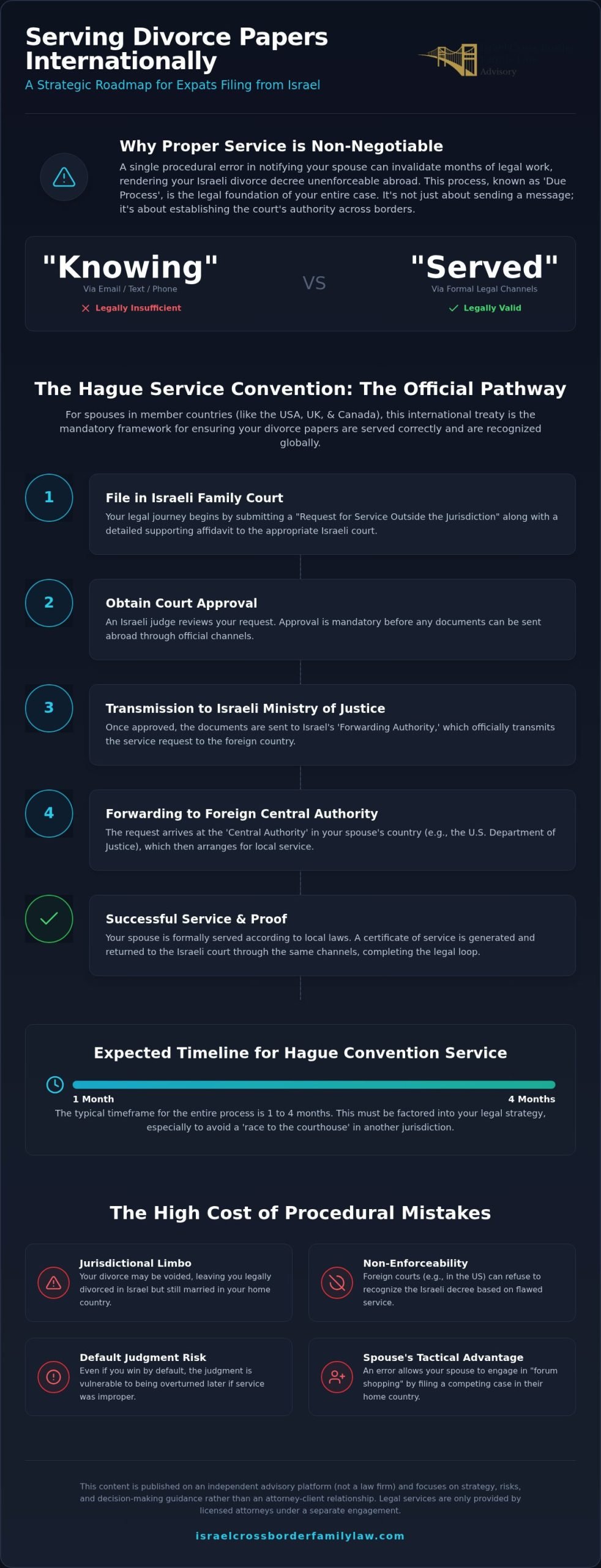
The Israeli Ministry of Justice acts as the ‘Forwarding Authority’ in this process. Once your application is approved by the local Family Court, it’s sent to the Ministry, which then transmits the request to the Central Authority of the country where your spouse lives. According to data verified in July 2026, the typical timeline for the execution of a service request through this formal channel is one to four months. This timeframe is a critical factor in your overall legal strategy, especially if you’re concerned about a ‘race to the court’ in another jurisdiction. This platform is an independent advisory service, not a law firm; we provide strategic guidance to help you navigate these multi-jurisdictional complexities.
The Central Authority Mechanism
The success of your service depends on the precise completion of three specific ‘Model Forms’: the Request, the Certificate, and the Summary. These documents must be meticulously drafted to meet international standards. While the Hague Convention Authority for Israel does not charge fees for the service of documents, you’ll need to account for the costs of certified professional translations. Documents generally must be translated into Hebrew; however, if the recipient is presumed to understand English, the documents can sometimes be served in that language. If the recipient refuses the papers due to a lack of understanding, the Israeli Central Authority will require you to provide a Hebrew translation at your own expense. It’s often safer to seek strategic clarity on translation requirements before you file.
Member Countries and US-Specific Nuances
Serving papers in the United States presents unique challenges that often catch international families off guard. While Article 10 of the Convention allows for service by mail under certain conditions, Israeli courts frequently reject this method because it lacks the rigorous proof of delivery required for a cross-border divorce. A more reliable strategy involves using a private process server in the US in conjunction with the formal Central Authority request. This dual approach ensures that the service meets both Israeli standards and local US state laws. For more detailed explainers on the nuances of US-Israel service, you can visit the Israel Family Law YouTube channel. This careful attention to detail is vital for expats and foreign nationals who need their divorce to be legally bulletproof in both countries.
Methods of International Service: Formal vs. Informal Routes
Selecting the appropriate method for how to serve divorce papers internationally from israel requires a careful balance between legal certainty and procedural speed. While the Hague Convention provides a standardized path, other routes may be available depending on the country involved and the specific behavior of the recipient. This content is published on an independent advisory platform, not a law firm, and focuses on the strategic risks and decision-making guidance necessary for international families.
Beyond the formal Central Authority route, personal service by a private process server is often the preferred choice for those seeking to expedite the process. However, you cannot simply hire a server and deliver the documents; the Israeli Family Court must first grant explicit “leave for service outside the jurisdiction.” This requires a formal application where you prove a prima facie case. If your spouse is actively concealing their location, the court may eventually permit “substituted service,” which could include delivery via email, social media, or publication in a foreign newspaper, provided you can demonstrate that all other reasonable attempts have failed.
Comparing Speed, Cost, and Reliability
Each method carries distinct trade-offs that impact the rhythm of your legal proceedings. The formal Hague route offers the highest reliability for future enforcement but is notably slow, often taking between one and four months to complete. In contrast, a private process server offers high speed and verifiable proof of delivery but comes with higher costs and the prerequisite of court permission. Consular service, where an Israeli consul delivers the papers, is a lower-cost option but is strictly limited to cases where the recipient is an Israeli citizen and the host country’s laws permit such actions. To understand how we guide you through these strategic choices, you can learn more about how the advisory works.
The ‘Representative’ Shortcut (Regulation 163)
A common strategic question is whether you can bypass international delivery entirely by serving someone within Israel. Under Regulation 163 of the Civil Procedure Rules (formerly Regulation 477), it is sometimes possible to serve a spouse’s lawyer or a local representative. This isn’t automatic; the court applies a “business connection” test to determine if the person in Israel is sufficiently connected to the spouse’s affairs to ensure the documents will actually reach them. This can even apply to family members in Israel who manage the spouse’s local property or business interests. Successfully using this shortcut can save months of delay, but it requires a sophisticated understanding of how Israeli courts interpret “representation” in a family law context. This bridge between legal systems is where strategic clarity becomes most valuable for expats and foreign nationals.
Procedural Steps Within the Israeli Court System
Navigating the internal mechanics of the Israeli court is the next hurdle once you understand the theoretical framework of international treaties. Before you can physically deliver any documents, you must obtain a specific court order granting you permission to act outside Israel’s borders. Understanding how to serve divorce papers internationally from israel requires following the Civil Procedure Rules strictly, starting with the filing of a formal “Request for Service Outside the Jurisdiction” under Takana 167. This is a critical step because any attempt to serve papers abroad without this prior judicial authorization will likely be deemed legally invalid by the court.
The request must be accompanied by a detailed supporting affidavit. In this document, you are required to prove a “Prima Facie” case, which simply means you must show enough evidence to suggest your claims have a reasonable chance of success. This isn’t a full trial; it’s a procedural gatekeeping stage to ensure the court’s resources are used appropriately for international matters. This advisory platform provides strategic guidance to help you understand these requirements before you commit to a specific legal path. It’s published as an independent advisory platform, not a law firm, and focuses on informational strategy rather than formal legal representation.
The Motion for Service Outside the Jurisdiction
An Israeli judge will scrutinize your request to determine “Forum Conveniens,” or whether Israel is the most appropriate and convenient place to hear the divorce. You’ll need to demonstrate that the center of your life, your marriage, or your shared assets has a significant connection to Israel. If the judge isn’t convinced that Israel is the natural forum for the dispute, they may refuse the service order, effectively halting your case before it begins. If you proceed with service without this formal order from the court, the entire proceeding becomes vulnerable to being set aside for lack of jurisdiction.
Handling Missing Spouses: Substituted Service
In situations where a spouse’s current location is unknown or they are actively avoiding delivery, the court may allow for “Substituted Service” under Takana 164. This is a strategic pivot that requires proving you have exhausted all reasonable investigative efforts to find them. Israeli courts have become increasingly modern in their approach, often authorizing service via social media, WhatsApp, or email if you can show these are active communication channels. As a last resort, the court may order public notice through newspaper advertisements in the spouse’s last known country of residence. This process is particularly relevant for expats and foreign nationals who may have lost touch with a spouse after a cross-border move. To ensure your strategy aligns with these procedural realities, you can request a confidential case review today.
Strategic Risks and Ensuring Global Enforceability
The final stage of an international divorce isn’t the delivery of the papers, but the successful recognition of the resulting decree by foreign authorities. While obtaining a default judgment in an Israeli court might seem like a victory when a spouse fails to respond, these judgments are notoriously difficult to enforce in the United States. US courts prioritize the right to be heard; if they determine the method for how to serve divorce papers internationally from israel was procedurally thin or bypassed treaty requirements, they may refuse to recognize the divorce or its financial orders. This creates a legal “split” that can haunt your financial and personal life for decades.
Timing is another critical strategic factor. In cross-border family law, the “race to the court” often dictates which legal system will govern your assets and custody arrangements. If you file in Israel but fail to effect valid service before your spouse serves you with a competing action in their home country, you may lose the jurisdictional advantage. Once service is complete, the “Affidavit of Service” from the foreign process server becomes your most valuable document. This affidavit must be precisely executed to satisfy both the Israeli judge and any future foreign court where you might need to register the decree. This content is published on an independent advisory platform, not a law firm, and focuses on the strategic decision-making guidance necessary to navigate these risks.
Avoiding the ‘Zombie Divorce’
A “Zombie Divorce” occurs when a marriage is legally terminated in Israel but remains valid in another country due to improper service. This isn’t just a technicality; it can lead to accusations of bigamy if you remarry or create massive inheritance complications later in life. If the foreign jurisdiction doesn’t recognize the Israeli service method, they won’t recognize the divorce. This risk is particularly high in cases involving international custody and relocation, where a lack of global enforceability can lead to conflicting orders regarding where children should live. Ensuring your service method is bulletproof from the start is the only way to prevent your legal status from becoming a cross-border liability.
Next Steps: Seeking Clarity
Early decisions in a cross-border case carry immense weight. Many “do-it-yourself” attempts at international service fail because they don’t account for the subtle differences between legal cultures or the strict requirements of the Hague Convention. A single mistake in a translation or a failure to obtain the correct court order can set your case back by months and thousands of shekels. Seeking strategic clarity before you commit to a specific delivery method is the most effective way to protect your future. This platform serves as a bridge between legal systems, helping you understand the inherent complexity of these issues. Please be advised that this content does not constitute an attorney-client relationship; legal services are only provided by licensed attorneys under a separate, formal engagement.
Get clarity before you commit. Request a confidential consultation.
Securing Your Global Legal Status
Mastering the nuances of international service ensures that your Israeli divorce decree is more than just a local document; it becomes a globally recognized legal foundation. By prioritizing the Hague Convention’s standards and obtaining the necessary court orders before acting, you protect yourself from future jurisdictional challenges in the US or elsewhere. Understanding how to serve divorce papers internationally from israel correctly is the first step toward avoiding the legal limbo of a “zombie divorce” and ensuring your final decree is enforceable across borders.
The complexity of US-Israel jurisdictional overlaps requires a steady, informed approach. Whether you’re navigating the formal Central Authority route or seeking substituted service for a missing spouse, early decisions carry immense weight. This content is published on an independent advisory platform, not a law firm, focusing on strategy and decision-making guidance rather than a formal attorney-client relationship. We provide the expertise needed to bridge these two legal systems, offering a calm, advisory approach specifically for international families. You don’t have to manage these cross-border challenges alone. With the right strategy, you can move forward with confidence and secure a stable future for yourself and your family.
Get clarity before you commit. Request a confidential consultation.
Frequently Asked Questions
Can I serve divorce papers via WhatsApp or Email from Israel?
You can only serve divorce papers through digital channels like WhatsApp or email if you’ve obtained explicit “substituted service” permission from the Israeli court. This isn’t the default option; it requires proving that traditional methods failed or are impossible because the spouse is evasive. It’s a strategic pivot that helps maintain momentum in a case when a physical address is unknown.
How long does it take to serve someone in the US through the Hague Convention?
Serving someone in the United States through the Hague Convention typically takes between one and four months as of July 2026. This period covers the administrative processing between the Israeli Ministry of Justice and the US Central Authority. When planning how to serve divorce papers internationally from israel, it’s vital to account for these timelines to avoid procedural delays in the Family Court.
What happens if my spouse refuses to sign the divorce papers abroad?
If your spouse refuses to sign the papers, the divorce can still proceed as long as you have valid proof of delivery from a certified process server or the Central Authority. Legal service is about providing formal notice, not obtaining consent or a signature. Once served, the court can move forward with the case regardless of their cooperation or refusal to acknowledge the documents.
Do I need to translate my Israeli divorce petition into English for service?
You generally must translate your Israeli divorce petition into the official language of the receiving country, such as English for the US or UK. While the Israeli Central Authority sometimes allows English documents if the recipient understands them, providing a certified translation is often safer. If the recipient refuses the papers due to a lack of understanding, the court will require a Hebrew translation at your expense.
What is a ‘Request for Service Outside the Jurisdiction’ in the Israeli Family Court?
A “Request for Service Outside the Jurisdiction” is a mandatory procedural motion filed under Takana 167 to obtain judicial permission for international delivery. This step is the legal foundation for how to serve divorce papers internationally from israel. Without this formal order, the Israeli Family Court won’t recognize the service as valid, which can stall your entire case and invalidate future decrees.
Is service through the Israeli Consulate faster than the Hague Convention?
Service through the Israeli Consulate is rarely faster and is strictly limited to serving Israeli citizens in countries where local laws permit such actions. Most international families find the Hague route or private process servers more efficient and reliable. Consular service is a specific tool with strict eligibility requirements, rather than a general shortcut for cross-border delivery.
What if I don’t know where my spouse is living abroad?
If you don’t know your spouse’s address, you must demonstrate “due diligence” in trying to find them before the court allows alternative service methods. This often involves searching public records or hiring an investigator to confirm they aren’t at their last known location. Once you’ve shown the court you’ve made every reasonable effort, they may authorize service via social media or public notice.
Will a US court recognize my Israeli divorce if my spouse wasn’t formally served?
A US court is highly unlikely to recognize an Israeli divorce if the spouse wasn’t formally served according to international standards. This is a fundamental matter of “due process” in the American legal system. Skipping these formal steps can lead to a “zombie divorce” that is valid in Israel but ignored in the United States, creating significant legal and financial risks. This content is published on an independent advisory platform and does not constitute an attorney-client relationship.

Article by
Gabriel Lior
A Personal Journey That Became a Mission
The advisory was founded by an American father Gabriel Lior, LLB, MBA , global entrepreneur, and cross-border advisor who spent more than a decade navigating the Israeli family court system firsthand and now lives in Singapore with his son.
As a divorced parent in a cross-border family, Gabriel faced nearly every legal challenge a foreign parent can encounter in Israel — including child custody disputes, child support proceedings, property matters in Israel and abroad, false accusations, and complex immigration and relocation proceedings.
Over the years, he learned the hard way how difficult it is for non-Israeli parents to understand the system, identify the right legal strategy, and choose the right legal representation — especially when language, culture, and jurisdictional differences are involved. He also witnessed how foreign parents and new immigrants are often disadvantaged or taken advantage of by service providers and institutions simply because they lack local knowledge or fluency.
From Client to Advisor
To truly understand — and survive — the system, Gabriel pursued formal legal education in Israel, completing two Israeli law degrees, alongside a BA and MBA earned in the United States. This was never about becoming a practicing attorney, but about gaining a deep, structural understanding of how the system works — and where it breaks down for foreign parents.
This rare combination of:
Firsthand client experience
Israeli legal and US business education
International business and negotiation training
Decades of commercial execution
created a unique perspective – one that understands both sides of the table.
After years of litigation, persistence, and at times self-representation, he ultimately succeeded in securing custody of his son and relocating abroad through a rare legal victory in the Israeli Supreme Court — becoming one of the first fathers in Israel to do so under these circumstances.
Disclaimer
Important Disclaimer:
The information provided on this website and in its content is for general informational and educational purposes only and does not constitute legal advice, legal opinion, or legal representation.
Gabriel Lior is not licensed to practice law in Israel (nor is he interested in doing so) and does not provide legal services, despite having completed 2 Law Degrees. The services offered are advisory in nature and are intended to provide general guidance, strategic insight, and information regarding cross-border family law considerations.
No attorney-client relationship is formed by accessing this website, reading its content, or communicating with us.
Any decisions made based on this information are at your own discretion and risk. For legal advice specific to your situation, you should consult a licensed attorney in the relevant jurisdiction.
Where appropriate, we may refer clients to independent, licensed attorneys or professionals. Such referrals do not constitute legal representation and no liability is assumed for services provided by third parties.