Note: This content is published on an independent advisory platform and does not constitute legal representation or formal legal advice. Legal services are only provided by licensed attorneys under a separate engagement.
What if a single document, written by a professional who may not fully grasp your family’s international lifestyle, could decide where your child lives for the next decade? For many parents navigating the Israeli legal system from abroad, learning how to challenge a custody evaluator’s report is the first step toward reclaiming their narrative. You likely feel that your words were misinterpreted or that the evaluator missed critical details about your child’s life in another country. It’s natural to worry that these errors will dictate your family’s future, but you have the right to ensure the court sees the full picture.
This guide provides the strategic steps needed to contest a flawed report with professional composure. We’ll explore how to identify procedural inconsistencies, correct factual mistakes, and work with cross-border experts to provide a necessary second opinion. We will also look at how to protect your international relocation and travel rights, ensuring that the final parenting plan respects the multi-jurisdictional reality of your family’s life.
Key Takeaways
- Understand why these professional assessments carry significant weight in both Israeli and US court decisions and how they influence your child’s future.
- Learn how to challenge a custody evaluator’s report by pinpointing factual inaccuracies and procedural errors that undermine the report’s validity.
- Identify common blind spots where local evaluators may overlook critical international factors like dual citizenship and cross-border relocation ties.
- Explore the strategic use of rebuttal experts to provide a professional second opinion and a thorough review of the original evaluator’s work.
- Discover how a specialized advisory bridge between legal systems can help you navigate the complexity of international custody disputes with confidence.
Understanding the Role and Weight of Custody Evaluations
A Custody evaluation serves as a professional assessment designed to help the court determine a child’s psychological needs and each parent’s ability to meet those needs. In cross-border cases, these reports carry immense weight because judges often lack firsthand knowledge of the family’s dynamic in another country. Understanding the specific function of these evaluations is a prerequisite for anyone learning how to challenge a custody evaluator’s report effectively. It’s vital to remember that while these documents are highly influential, they remain recommendations rather than final court orders.
To better understand how these assessments function and what happens when they miss the mark, watch this helpful video:
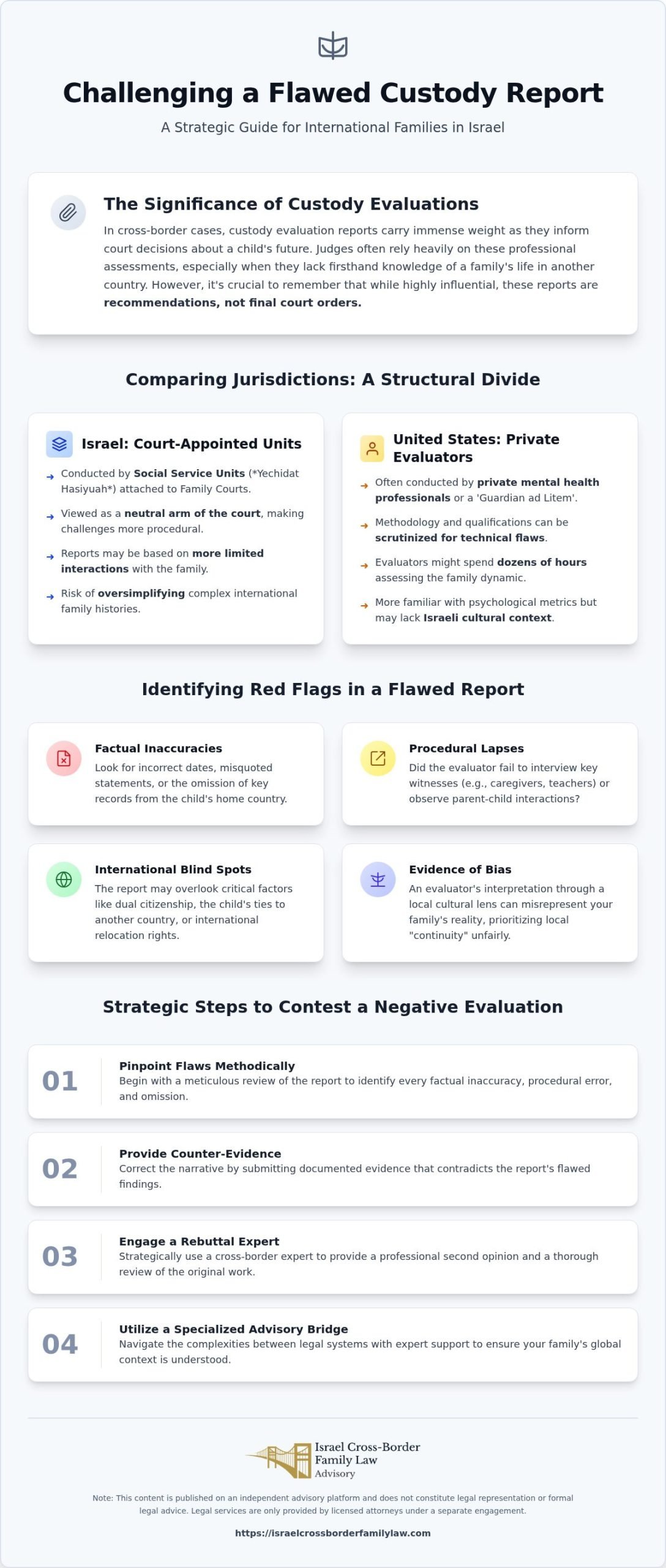
In Israel, these assessments are frequently conducted by the Yechidat Hasiyuah, which are Social Service Units attached to the Family Courts. This system differs significantly from the United States, where parents often hire private mental health professionals to conduct the study. While US evaluators might spend dozens of hours with a family, an Israeli social worker’s report may be based on more limited interactions. This structural difference creates unique risks for international families who might feel their complex history is being oversimplified by a local official who lacks experience with international custody and relocation issues.
Court-Appointed vs. Private Evaluators
The selection process for an evaluator varies by jurisdiction, and the source of the report will dictate your strategy. In many US states, a ‘Guardian ad Litem’ or a private psychologist is appointed to represent the child’s interests. In Israel, the court typically relies on its own ‘Appointed Expert’ or the social service unit. These professionals are viewed as neutral arms of the court. A private evaluator’s methodology can often be scrutinized for technical flaws, while challenging a court-appointed official in Israel requires a nuanced understanding of local administrative procedures. Knowing who holds the pen is the first step in identifying potential bias or procedural gaps.
The Weight of the ‘Best Interests of the Child’ Standard
Every evaluator uses the ‘best interests of the child’ as their guiding principle, but this standard isn’t a fixed mathematical formula. It’s interpreted through the lens of local culture and legal tradition. An evaluator in Israel might prioritize ‘continuity’ within the local community, while a US evaluator might focus more on ‘parental access’ or specific psychological metrics. For international families, these divergent interpretations can lead to recommendations that ignore dual citizenship or the child’s ties to a home country. Early decisions in the evaluation process often set the trajectory for long-term custody outcomes. Ensuring your family’s global context is accurately represented is a critical priority for maintaining narrative control.
Identifying Red Flags in a Flawed Custody Report
Recognizing the specific flaws in a report is the foundation of a successful contest. A custody evaluation is a complex professional document, but it remains subject to human error and personal bias. When families look at how to challenge a custody evaluator’s report, they should begin with a meticulous review of factual accuracy. Incorrect dates of residence, misquoted statements from teachers, or the total omission of medical records from a child’s home country are significant red flags. If an evaluator ignores evidence because it originated outside of Israel, the report’s integrity is compromised.
Procedural lapses also provide grounds for a challenge. These occur when an evaluator fails to interview key collateral witnesses, such as long-term caregivers or extended family members who play a vital role in the child’s life. Similarly, if the professional recommends a specific custody arrangement without ever observing the child in both parents’ homes, the recommendation lacks a factual basis. These gaps often lead to unsupported conclusions where the final advice doesn’t logically follow the data collected during the interviews.
Cultural Misunderstandings and Language Barriers
For expats and foreign nationals, the risk of cultural misinterpretation is high. An evaluator may view a parent’s direct communication style or their insistence on maintaining specific cultural traditions as “uncooperative” or “rigid.” Language gaps often exacerbate these issues. A parent speaking English as a first language might find their nuanced explanations “lost in translation” when summarized in a Hebrew report. It’s essential to ensure the evaluator understands that a parent’s support network abroad is just as valid as a local one. If you suspect your cultural context was ignored, you may want to request a strategy session to review your options.
Psychological Testing and Methodological Errors
Methodological errors often occur when evaluators use outdated psychological tests or fail to follow established protocols. In forensic psychology, a methodological error refers to a flaw in the design, implementation, or analysis of an evaluation that compromises the reliability and validity of the final findings. Many professionals look to the APA’s professional guidelines for custody evaluations to ensure the process remains ethical and scientifically sound. If an evaluator uses tests that aren’t validated for cross-cultural populations, or if they deviate from the Association of Family and Conciliation Courts (AFCC) standards, the entire report may be vulnerable to a professional rebuttal.
The Cross-Border Challenge: When Evaluators Miss International Context
Local evaluators often operate with a domestic mindset, which can lead to significant gaps when assessing international families. While a professional in Israel may be highly skilled in local family dynamics, they often struggle with the nuances of a life lived across borders. They might view a child’s environment through a strictly local lens, failing to recognize that for an expat, stability involves maintaining deep connections to their home country. This narrow focus is a primary reason why parents seek to understand how to challenge a custody evaluator’s report, as an assessment that ignores a child’s global heritage is fundamentally incomplete.
One critical area where evaluations often fail is in the consideration of dual citizenship and the child’s ties to their secondary home. An evaluator might overlook the importance of the child’s relationship with extended family in the US or the educational opportunities available there. Additionally, the logistics of long-distance visitation and international travel are frequently misunderstood. Local professionals may suggest visitation schedules that are physically or financially impossible to maintain over thousands of miles. Perhaps most importantly, many evaluators don’t fully grasp the implications of the Hague Convention, which governs the jurisdictional aspects of international child custody. A recommendation that doesn’t account for these legal frameworks can inadvertently create high-risk situations for both parents.
Relocation and ‘Move-Away’ Analysis
In many cases, evaluators default to a status quo recommendation, assuming that staying in the current location is always in the child’s best interest. However, this often ignores the substantial benefits of International Custody & Relocation. If an evaluator fails to analyze the educational, financial, or emotional support systems waiting in the US, their report lacks a comprehensive move-away analysis. Challenging a report involves highlighting these missed opportunities and demonstrating that a relocation could actually enhance the child’s quality of life rather than detract from it.
Dual-System Complexity: US vs. Israel
International families live under the jurisdiction of two distinct legal systems, yet reports often ignore a parent’s legal rights in their home country. This oversight creates a risk of conflicting court orders, where an Israeli court order might be difficult to enforce or recognize in a US state. Cross-border counsel can help provide the necessary context to an evaluator, ensuring they understand the multi-jurisdictional reality. When an evaluation fails to account for how these two systems interact, it leaves the family in a state of legal uncertainty that can persist for years.
Strategic Steps to Contest a Negative Evaluation
If you receive a report that feels biased or inaccurate, it is essential to remember that you have procedural options to address these concerns before the court. Understanding how to challenge a custody evaluator’s report involves moving from an emotional reaction to a systematic, evidence-based strategy. This process requires a high level of coordination between your legal team and forensic experts who understand the complexities of cross-border family life. By following a structured approach, you can highlight the report’s weaknesses and ensure the court has a more balanced view of your child’s best interests.
The following steps outline the professional path for contesting a flawed evaluation:
- Step 1: Factual Review. Conduct a meticulous, line-by-line review of the report with your advisors. Document every date, quote, or event that is factually incorrect or taken out of context.
- Step 2: Work Product Review. Engage a specialized rebuttal expert to analyze the evaluator’s methodology and investigative process.
- Step 3: Formal Objections. Work with your legal counsel to file a formal objection or a motion to strike specific parts of the report that lack evidentiary support.
- Step 4: Cross-Examination Preparation. Develop a strategy to question the evaluator in court, focusing on their investigative gaps and lack of international expertise.
- Step 5: Request a Second Opinion. In cases of significant bias or error, propose a supplemental evaluation by a professional with experience in multi-jurisdictional family matters.
The Role of the Rebuttal Expert
A rebuttal expert, also known as a work product reviewer, does not conduct a new evaluation of the family. Instead, they provide a professional critique of the original evaluator’s work. They examine whether the professional followed standard protocols, such as the APA or AFCC guidelines, and whether the conclusions logically follow the data collected. For international families, these experts are particularly effective because they can point out where an evaluator failed to consider the logistical realities of international travel or the benefits of a child’s support network in another country. This objective critique carries significant weight when the court decides how much trust to place in the original report.
Effective Cross-Examination Strategies
Cross-examination is a critical tool for exposing the limitations of a flawed report. The goal is to highlight gaps in the evaluator’s investigative process. For example, your counsel might question the evaluator on their specific knowledge of the legal and educational systems in the child’s home country. If the evaluator failed to interview key witnesses abroad or ignored the dual-citizenship rights of the child, these omissions must be brought to the court’s attention. Using the evaluator’s own interview notes to contradict their final recommendations can be a powerful way to demonstrate inconsistency. If you are concerned about the impact of a negative report on your case, you should schedule a strategy review to discuss these procedural steps.
Navigating the Path Forward with Expert Support
Receiving a negative or biased report can feel like losing your voice in the legal process. While the initial reaction is often one of distress, it’s important to recognize that a professional assessment is simply one piece of evidence the court considers. To successfully regain narrative control, you must move beyond the findings and focus on the strategy. For international families, a general family lawyer who handles local Israeli cases may not have the multi-jurisdictional experience required to point out why a report fails to meet global standards. Understanding how to challenge a custody evaluator’s report requires a professional who can bridge the gap between two very different legal cultures.
A cross-border specialist looks at your case through a wider lens. They don’t just see a domestic custody dispute; they see the implications of dual citizenship, the complexities of the Hague Convention, and the logistical hurdles of international visitation. This high-level perspective allows you to present a more comprehensive picture to the judge. By seeking strategic clarity before you commit to a lengthy and expensive court battle, you can determine if a rebuttal or a supplemental evaluation is the most effective path forward for your family’s specific needs.
The Value of a Cross-Border Advisory
Many expats and “Anglos” living in Israel find that their parenting styles or communication methods are misinterpreted by local social workers. A specialized advisor understands this specific cultural friction and can help translate your experience into terms the Israeli court system respects. This advisory role is less about aggressive litigation and more about creating a calm, strategic plan to address the emotional toll of a damaging report. By focusing on the procedural flaws and investigative gaps identified in earlier sections, you can methodically dismantle a flawed recommendation. You can learn more about this process by reviewing how it works for international families.
Next Steps: Consultation and Case Review
If you are currently facing a report that ignores your child’s ties to their home country or misrepresents your capacity as a parent, your first step is a thorough document review. Prepare all relevant communications, previous court orders, and the evaluator’s notes for a professional assessment. A multi-jurisdictional review can identify if the evaluator followed the correct protocols or if their conclusions lack a scientific basis. This level of preparation is what allows parents to go into a hearing with confidence rather than fear. Get clarity before you commit. Request a confidential consultation.
Note: This content is published on an independent advisory platform and does not constitute legal representation or formal legal advice. Legal services are only provided by licensed attorneys under a separate engagement.
Note: This content is published on an independent advisory platform and does not constitute legal representation or formal legal advice. Legal services are only provided by licensed attorneys under a separate engagement.
Advancing Your Strategy with Confidence
A custody report doesn’t have to be the final word on your child’s future. By identifying factual inaccuracies and highlighting missed international context, you can ensure the court sees the full picture of your family’s life. We have discussed the strategic importance of using rebuttal experts and the value of a multi-jurisdictional perspective in cross-border cases. Success in these matters depends on moving beyond the initial shock of a negative report toward a structured, professional response. Learning how to challenge a custody evaluator’s report is a vital step in regaining narrative control and protecting your parental rights across borders.
Navigating the intersection of US and Israeli legal systems requires specialized guidance. Our bilingual and multi-qualified practitioners offer deep expertise in Hague Convention cases and a specialized focus on Anglo-Israeli family law. This expertise acts as a bridge; it ensures that cultural nuances and international relocation benefits are never ignored by the court. We focus on providing the clarity needed to handle these complexities with steady, authoritative direction.
Get clarity before you commit. Request a confidential consultation.
Your family’s international journey is unique, and with the right strategic support, you can navigate these complex legal systems with peace of mind.
Note: This content is published on an independent advisory platform and does not constitute legal representation or formal legal advice. Legal services are only provided by licensed attorneys under a separate engagement.
Frequently Asked Questions
Can I record my interviews with the custody evaluator in Israel?
Recording an evaluation interview in Israel is a sensitive matter that requires careful consideration. While Israel generally follows one-party consent laws for recordings, doing so secretly in a clinical or social service setting can be interpreted as a lack of cooperation or a sign of deep-seated distrust. It is often more effective to request a professional observer or ensure that a summary of the interview is provided for your review to confirm accuracy before the final report is filed.
What happens if the evaluator is clearly biased against me as a foreigner?
If you suspect bias, you must document specific instances where the evaluator relied on cultural stereotypes or ignored the practicalities of your international lifestyle. This documentation is a primary component of learning how to challenge a custody evaluator’s report. You can use these documented errors to support a legal motion for a rebuttal expert, who can then provide the court with a neutral, professional critique of the original evaluator’s biased methodology.
How much does it typically cost to challenge a custody report?
The financial cost of a challenge depends largely on the complexity of the cross-border issues and the experts involved. Research into industry standards shows that rebuttal experts or expert witnesses often charge between $350 and $1,000 per hour. Depending on whether the expert needs to conduct a full work product review or testify in court, total costs for an expert challenge can range from $2,500 to over $25,000.
Can I request a second evaluation if I disagree with the first one?
A second evaluation is not granted automatically just because a parent is unhappy with the recommendations. You must prove to the court that the initial report is fundamentally flawed due to procedural lapses, factual errors, or a failure to follow professional standards. If the court determines the first report is unreliable or incomplete, it may order a supplemental evaluation or permit a second opinion from a different court-appointed expert.
Does the judge always follow the evaluator’s recommendation in Israel?
Judges in Israel follow the recommendations of social service units or court-appointed experts in a high majority of cases, with some estimates suggesting they do so over 90% of the time. While the report carries significant weight, it remains a recommendation rather than a binding order. If your legal team can demonstrate that the evaluator’s conclusions don’t align with the child’s best interests, the judge has the full authority to reach a different decision.
What if the evaluator doesn’t speak English fluently?
Language barriers are a significant red flag that can undermine the validity of a custody assessment. If an evaluator is not fluent in your primary language, there is a high risk that nuanced explanations about your child’s history or your support network abroad will be lost in translation. You have a right to a fair process, which includes the use of a qualified translator or the appointment of an evaluator who can communicate with you effectively.
Can I show the evaluator’s report to my family or friends for advice?
No, you should not share the report with anyone outside of your legal and advisory team. Custody evaluation reports are strictly confidential documents protected by privacy laws and court regulations in Israel. Sharing the contents with family, friends, or the public can be seen as a violation of court rules. This behavior can damage your credibility and may even be used as evidence of poor judgment or parental alienation during the proceedings.
How long do I have to file an objection to a custody report?
The timeline to file an objection is usually quite narrow, often between 15 and 30 days from the date the report is released. The exact deadline is typically set by the judge in the original appointment order or determined by local court rules. Because this window is brief, it’s vital to begin a line-by-line factual review with your advisors the moment you receive the document to ensure your challenge is filed on time.

Article by
Gabriel Lior
A Personal Journey That Became a Mission
The advisory was founded by an American father Gabriel Lior, LLB, MBA , global entrepreneur, and cross-border advisor who spent more than a decade navigating the Israeli family court system firsthand and now lives in Singapore with his son.
As a divorced parent in a cross-border family, Gabriel faced nearly every legal challenge a foreign parent can encounter in Israel — including child custody disputes, child support proceedings, property matters in Israel and abroad, false accusations, and complex immigration and relocation proceedings.
Over the years, he learned the hard way how difficult it is for non-Israeli parents to understand the system, identify the right legal strategy, and choose the right legal representation — especially when language, culture, and jurisdictional differences are involved. He also witnessed how foreign parents and new immigrants are often disadvantaged or taken advantage of by service providers and institutions simply because they lack local knowledge or fluency.
From Client to Advisor
To truly understand — and survive — the system, Gabriel pursued formal legal education in Israel, completing two Israeli law degrees, alongside a BA and MBA earned in the United States. This was never about becoming a practicing attorney, but about gaining a deep, structural understanding of how the system works — and where it breaks down for foreign parents.
This rare combination of:
Firsthand client experience
Israeli legal and US business education
International business and negotiation training
Decades of commercial execution
created a unique perspective – one that understands both sides of the table.
After years of litigation, persistence, and at times self-representation, he ultimately succeeded in securing custody of his son and relocating abroad through a rare legal victory in the Israeli Supreme Court — becoming one of the first fathers in Israel to do so under these circumstances.
Disclaimer
Important Disclaimer:
The information provided on this website and in its content is for general informational and educational purposes only and does not constitute legal advice, legal opinion, or legal representation.
Gabriel Lior is not licensed to practice law in Israel (nor is he interested in doing so) and does not provide legal services, despite having completed 2 Law Degrees. The services offered are advisory in nature and are intended to provide general guidance, strategic insight, and information regarding cross-border family law considerations.
No attorney-client relationship is formed by accessing this website, reading its content, or communicating with us.
Any decisions made based on this information are at your own discretion and risk. For legal advice specific to your situation, you should consult a licensed attorney in the relevant jurisdiction.
Where appropriate, we may refer clients to independent, licensed attorneys or professionals. Such referrals do not constitute legal representation and no liability is assumed for services provided by third parties.