What if the biggest obstacle to claiming your family’s assets in Israel isn’t a legal dispute, but a Hebrew-only digital portal you can’t access? For many US expats and beneficiaries, the israeli probate procedure feels like an impenetrable wall of language barriers, Apostille requirements, and unfamiliar bureaucratic steps. It’s natural to feel a sense of high stress when you’re asked for a “foreign legal opinion” or told that land registration has moved to a digital-first platform you can’t navigate from abroad.
You aren’t alone in this frustration; most international families find the transition between US testamentary intent and Israeli procedural law to be deeply complex. This guide offers a clear, strategic framework designed to help you navigate these hurdles with confidence. You’ll learn how to validate a foreign will, manage the mandatory digital filings required as of May 2026, and successfully transfer assets without the need to travel to Israel. We’ll walk through the specific roadmap of probate steps so you can gain clarity before making any major commitments.
This content is published on an independent advisory platform and is for informational purposes only. It doesn’t constitute legal representation or formal legal advice. Legal services are only provided by licensed attorneys under a separate engagement.
Key Takeaways
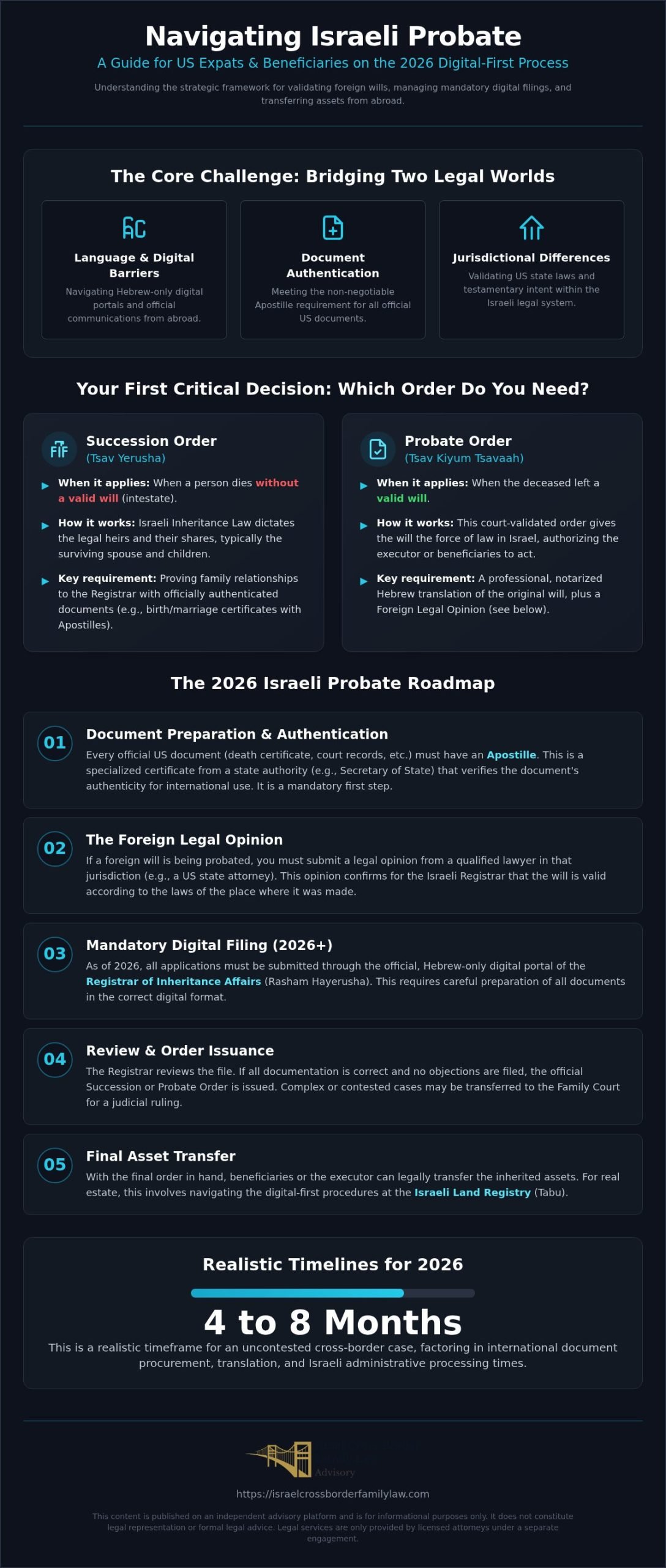
- Identify whether your situation requires a Succession Order or a Probate Order to avoid filing errors with the Registrar of Inheritance Affairs.
- Navigate the updated 2026 israeli probate procedure, including mandatory digital portal submissions and the non-negotiable requirements for document authentication.
- Understand the necessity of a Foreign Legal Opinion to validate US state laws within the Israeli legal system for cross-border estates.
- Prepare for realistic 2026 timelines of 4 to 8 months by accounting for international documentation and Israeli administrative backlogs.
- Develop a clear strategy for the final transfer of inherited assets, including navigating the digital-first reforms at the Israeli Land Registry.
Understanding the Israeli Probate Framework: Succession vs. Probate Orders
Israeli law maintains strict jurisdiction over all real estate and tangible assets physically located within its borders. This remains true even if the deceased was a US citizen who never lived in the country. The primary authority managing these files is the Registrar of Inheritance Affairs, known in Hebrew as the Rasham Hayerusha. While most cases are settled through this administrative body, complex or contested cross-border estates are often referred to the Family Court for a judicial ruling.
To better understand how these proceedings function in practice, watch this helpful video:
Initiating the israeli probate procedure requires a strategic approach to documentation. The Registrar doesn’t simply accept foreign documents at face value. Because the legal systems differ significantly, you must first determine which type of legal “order” matches your specific circumstances. This decision is the foundation of your strategy and dictates how assets will eventually be distributed. Understanding the Land and Property Laws in Israel is vital here, as the classification of the asset often influences the method of the filing.
What is a Succession Order (Tsav Yerusha)?
A Succession Order is a legal declaration issued when a person dies without leaving a valid will. In these cases, Israeli law determines the legal heirs. Typically, the estate is divided between the surviving spouse and children according to fixed statutory percentages. For foreign residents, this process involves proving the family connection to the Registrar’s satisfaction through authenticated certificates. Without a will, you’re bound by the specific rules of the Inheritance Law, which might differ from what the deceased intended in their home country.
What is a Probate Order (Tsav Kiyum Tsavaah)?
When a valid will exists, you apply for a Probate Order. This document validates the will and gives it the force of law in Israel. If the will was written in English, the israeli probate procedure requires a professional Hebrew translation certified by a notary. This is a standard step For Expats and Foreign Nationals who hold assets in multiple jurisdictions. The Registrar ensures the document meets Israeli formal requirements before authorizing the executor or beneficiaries to manage the estate.
This content is published on an independent advisory platform and is for informational purposes only. It doesn’t constitute legal representation or formal legal advice. Legal services are only provided by licensed attorneys under a separate engagement.
The Step-by-Step Israeli Probate Procedure for 2026
Executing a successful israeli probate procedure requires more than just submitting a will; it involves a precise series of administrative actions that bridge the gap between US and Israeli jurisdictions. Because the system has moved toward a digital-first model as of 2026, understanding the sequence of these steps is vital for beneficiaries living abroad. The process begins with documentation and ends with a formal order that allows for the transfer of assets.
Document Preparation and the Apostille Requirement
The first hurdle for many US families is document authentication. A standard US death certificate or a notarized copy of a will isn’t legally recognized in Israel on its own. You must obtain an Apostille for every official US document. An Apostille is a specialized certificate issued by a state authority, such as the Secretary of State, that verifies the signature and seal on your document for international use. It acts as a global validation stamp that tells the Israeli Registrar the document is authentic.
For those managing these requirements for expats and foreign nationals, it’s also necessary to provide certified Hebrew translations for any document not written in Hebrew or English. Even English documents often require a formal translation to ensure the Israeli authorities process the file without delays. Once these are gathered, the petition can be prepared for the digital portal.
The Filing Process and Public Notice
As of May 2026, all probate petitions involving foreign residents must be submitted through a mandatory digital portal. This system is overseen by the Israeli Guardian General and Director of Inheritance Affairs. The filing process includes several key components:
- Digital Submission: The application is uploaded to the Registrar’s portal, which requires an Israeli ID or representation by a licensed attorney.
- The Notice to Heirs: You must formally notify all potential heirs listed in the will or under law. Providing proof of this notice is a safeguard against future litigation.
- Public Advertisement: Israeli law requires a notice of the application to be published in a daily newspaper. This allows unknown creditors or objectors a window of 14 days to file an opposition.
- Review by the Administrator General: The Apotropos Haklali (Administrator General) reviews the file to ensure it complies with Israeli public policy and legal standards.
Errors during these early stages often lead to significant backlogs. If you’re unsure about the specific requirements for your state’s documentation, it’s helpful to discuss your situation with a professional who understands both systems. Once the Administrator General approves the file, the Registrar issues the final Probate or Succession Order.
This content is published on an independent advisory platform and is for informational purposes only. It doesn’t constitute legal representation or formal legal advice. Legal services are only provided by licensed attorneys under a separate engagement.
The Foreign Will Hurdle: The Mandatory Legal Opinion
The israeli probate procedure treats any will signed outside of Israel as a “foreign will.” This classification triggers a specific requirement that often catches US beneficiaries by surprise: the mandatory Foreign Legal Opinion (FLO). This document isn’t a simple letter of recommendation. It’s a formal legal brief drafted by an expert in the law of the deceased’s domicile, such as New York or California, designed to prove to the Israeli Registrar that the will is valid under that specific state’s laws.
According to the International Bar Association on Israeli Succession Law, Israel does not automatically recognize foreign probate orders. Even if a US court has already validated the will, you must still go through the local process in Israel. The FLO acts as the essential bridge between these two divergent legal systems, ensuring the Israeli Registrar doesn’t reject the application due to technicalities in foreign law.
Why is a Foreign Legal Opinion Necessary?
The primary purpose of the FLO is to address the question of “domicile.” In international law, domicile refers to the place where a person had their permanent home and centered their life. The Israeli Registrar needs to be certain that the will complies with the rules of that specific jurisdiction. For example, if a resident of Florida passes away, the expert must explain Florida’s requirements for witnesses and signatures. This prevents the Registrar from applying Israeli standards to a document that was legally executed under different rules. Without this expert clarification, the israeli probate procedure can grind to a halt, as the authorities won’t guess at foreign statutes.
Addressing US Trusts in Israeli Probate
A significant point of friction arises when US wills contain “Trust” provisions. The Israeli Inheritance Law of 1965 doesn’t mirror the broad US concept of a Living Trust. When assets are held in a trust, the Israeli authorities may struggle to categorize the legal owner. This often leads to a “clash” where the Registrar is unsure how to transfer land or bank accounts to a trustee rather than a direct heir. Strategic guidance on International Asset Protection and Trusts is vital in these cases. The expert drafting the FLO must carefully explain how the trust functions under US law and how it should be interpreted within the Israeli framework to ensure the assets actually reach the intended beneficiaries.
This content is published on an independent advisory platform and is for informational purposes only. It doesn’t constitute legal representation or formal legal advice. Legal services are only provided by licensed attorneys under a separate engagement.
Timelines, Costs, and Overcoming Common Probate Challenges
Managing expectations regarding time and capital is the first step toward a successful outcome. For cross-border estates, the israeli probate procedure typically spans between four and eight months in 2026. This window accounts for the added complexity of international document verification and the mandatory review by the Administrator General. It’s also vital to consider the Israeli holiday calendar. During periods like Passover or the High Holidays, government offices and courts often operate on a reduced schedule or close entirely; this can add several weeks to the processing time for any pending application.
Managing Expectations: Fees and Timelines
Statutory requirements involve several fixed costs that beneficiaries must prepare for early in the process. These include the online application fee for the Registrar of Inheritance Affairs and the mandatory publication fees for daily newspapers. Beyond these government charges, you should anticipate costs for professional Hebrew translations and notarizations, which are non-negotiable for foreign documents. Filing early is a strategic necessity. Delaying the process can lead to assets being classified as “abandoned property” by the state, which makes recovery significantly more difficult and expensive for the heirs.
Dealing with Missing Wills or Lost Documents
If you only have a photocopy of a will, the israeli probate procedure allows for a “Motion to Prove a Will.” This is a specific legal request where you must explain why the original cannot be produced and provide evidence that the copy is a true reflection of the deceased’s final wishes. Similarly, if an original death certificate is lost, you must obtain a certified copy with a fresh Apostille from the issuing US state. These challenges are common in international estates, but they require a methodical approach to satisfy the Registrar’s evidentiary standards. If you are dealing with incomplete documentation, a Confidential Case Review can help you evaluate the strength of your evidence.
Once the final order is issued, the work shifts to the physical transfer of assets. Transferring bank funds or updating a title at the Land Registry requires the original probate order and, often, a specific power of attorney. If you are concerned about the specific timelines or costs associated with your family’s assets, you can request a consultation to discuss your strategy. This proactive step helps you avoid the common pitfalls that lead to multi-year delays.
This content is published on an independent advisory platform and is for informational purposes only. It doesn’t constitute legal representation or formal legal advice. Legal services are only provided by licensed attorneys under a separate engagement.
Strategic Guidance: Moving from Probate to Asset Transfer
Obtaining a formal order from the Registrar is a significant milestone, but it doesn’t automatically put assets into your hands. The issuance of the order marks the transition from the legal israeli probate procedure to the operational phase of asset management. This stage requires a proactive approach to bridge the gap between the Israeli legal system and your financial life in the US. Without a clear implementation strategy, a valid probate order can sit dormant while assets remain locked in the deceased’s name.
Registering Real Estate and Accessing Bank Accounts
For inherited real estate, the probate order must be registered with the Israeli Land Registry, commonly known as the Tabu. As of February 15, 2026, many of these registration processes have moved to digital-first platforms. You don’t simply “own” the property because a will says so; the state records must be updated to reflect the new ownership. This is a critical step if you intend to sell the property or manage it as a rental asset.
Accessing liquid funds presents a different set of challenges. Israeli banks maintain strict compliance protocols for releasing funds to foreign accounts. They often require the original probate order along with specific documentation verifying the beneficiaries’ identities and tax residencies. Because these institutions rarely accept foreign instructions via mail or standard email, many US beneficiaries find it necessary to use a local Power of Attorney. This allows a representative in Israel to handle the bureaucratic hurdles at the bank branch without requiring you to travel.
Final Decision Making: To Sell or to Hold?
The weight of early decisions regarding the estate can have long-term financial consequences. If you decide to sell inherited real estate, you must account for the Israeli capital gains tax, known as Mas Shevach, which is 25% as of 2026. It’s vital to remember that Israel uses a “step-in-the-shoes” principle. This means the tax is calculated based on the original purchase price paid by the deceased, not the market value at the time of inheritance. This differs significantly from the US “step-up in basis” rule and can result in a substantial tax liability upon sale.
US residents also face reporting requirements at home. If the value of the foreign inheritance exceeds $100,000, you’re generally required to file IRS Form 3520. Failing to report this can lead to significant penalties, even if no US tax is actually owed on the inheritance itself. A comprehensive cross-border strategy ensures that you aren’t caught between conflicting tax laws or legal frictions. Get clarity before you commit. Request a confidential consultation.
This content is published on an independent advisory platform and is for informational purposes only. It doesn’t constitute legal representation or formal legal advice. Legal services are only provided by licensed attorneys under a separate engagement.
Securing Your Family’s Israeli Legacy
The israeli probate procedure is more than a bureaucratic filing; it’s a strategic bridge between your family’s US history and their Israeli future. Success depends on early decisions regarding document authentication and the mandatory foreign legal opinion. By addressing these cross-border complexities now, you can avoid the multi-year delays that often plague unmanaged estates. Proactive planning ensures that assets are not only legally recognized but also successfully transferred to the next generation.
This content is published on an independent advisory platform focused on US-Israel strategy. We provide authoritative guidance for international families dealing with cross-border litigation and family law. It’s essential to understand the risks and procedural differences between jurisdictions before taking action. Clarity in the beginning prevents costly errors during the final asset transfer phase.
Get clarity before you commit. Request a confidential consultation to discuss your specific estate strategy. You can successfully manage this process from abroad with the right framework in place.
Frequently Asked Questions
How long does the Israeli probate procedure take for US citizens?
For cross-border cases involving US citizens, the typical timeframe for an uncontested order is four to nine months. This duration is longer than local cases because of the additional scrutiny applied to foreign documentation. Backlogs during the Israeli holiday seasons or issues with Hebrew translations can further extend this period. It’s best to plan for these administrative delays when managing expectations for asset distribution.
Do I need to travel to Israel to complete the probate process?
You don’t need to travel to Israel to complete any stage of the probate process. An Israeli lawyer holding a power of attorney can manage every step, from filing the petition through the mandatory digital portal to the final transfer of assets. This remote capability is a standard feature of the modern israeli probate procedure, allowing beneficiaries to remain in the US while the estate is settled.
Is a US will valid for assets located in Israel?
A US will is generally valid in Israel, but it has no legal standing until an Israeli court or Registrar issues a Probate Order. The Registrar must verify that the document meets formal requirements under the law of the place it was signed. While a US will works, many practitioners recommend a separate Israeli will for local assets to simplify and expedite the eventual transfer process.
What is a Foreign Legal Opinion and why is it mandatory?
A Foreign Legal Opinion is a formal brief drafted by an expert to prove that a will is valid under the laws of the deceased’s domicile. This is mandatory because the Israeli Registrar doesn’t have the authority to interpret US state laws. The opinion confirms that the signature, witnesses, and legal capacity met the standards of jurisdictions like New York or California, preventing the file’s rejection.
Are there inheritance taxes in Israel for US beneficiaries?
Israel doesn’t impose an inheritance or estate tax; however, beneficiaries must account for capital gains tax. When you sell inherited real estate, you’ll likely face a 25% capital gains tax on the profit. It’s important to remember that this tax is calculated from the deceased’s original purchase price, not the value at the time of their death, which can create a significant liability.
Can I access an Israeli bank account before the probate order is issued?
Israeli banks typically freeze all accounts immediately upon the owner’s death, and funds can’t be accessed until a formal Probate or Succession Order is presented. There are very few exceptions for immediate family expenses, but these are difficult to obtain from abroad. The israeli probate procedure must be completed before any significant funds can be released, transferred, or managed by the heirs.
What happens if my late relative died without a will in Israel?
If a relative dies without a will, the estate is distributed according to the Israeli Law of Succession through a Succession Order. In this scenario, the law dictates specific percentages for the surviving spouse and children. For foreign residents, this process requires proving family relationships through authenticated birth and marriage certificates to the Registrar’s satisfaction before any asset distribution can occur.
How do I get an Apostille for my US documents to be used in Israel?
You must obtain an Apostille from the Secretary of State in the specific US state where the document was issued. For example, a Florida death certificate requires a Florida Apostille. This certificate acts as a global authentication stamp, confirming that the document is genuine. It’s a non-negotiable requirement for any US document to be legally recognized by the Israeli authorities.
This content is published on an independent advisory platform and is for informational purposes only. It doesn’t constitute legal representation or formal legal advice. Legal services are only provided by licensed attorneys under a separate engagement.

Article by
Gabriel Lior
A Personal Journey That Became a Mission
The advisory was founded by an American father Gabriel Lior, LLB, MBA , global entrepreneur, and cross-border advisor who spent more than a decade navigating the Israeli family court system firsthand and now lives in Singapore with his son.
As a divorced parent in a cross-border family, Gabriel faced nearly every legal challenge a foreign parent can encounter in Israel — including child custody disputes, child support proceedings, property matters in Israel and abroad, false accusations, and complex immigration and relocation proceedings.
Over the years, he learned the hard way how difficult it is for non-Israeli parents to understand the system, identify the right legal strategy, and choose the right legal representation — especially when language, culture, and jurisdictional differences are involved. He also witnessed how foreign parents and new immigrants are often disadvantaged or taken advantage of by service providers and institutions simply because they lack local knowledge or fluency.
From Client to Advisor
To truly understand — and survive — the system, Gabriel pursued formal legal education in Israel, completing two Israeli law degrees, alongside a BA and MBA earned in the United States. This was never about becoming a practicing attorney, but about gaining a deep, structural understanding of how the system works — and where it breaks down for foreign parents.
This rare combination of:
Firsthand client experience
Israeli legal and US business education
International business and negotiation training
Decades of commercial execution
created a unique perspective – one that understands both sides of the table.
After years of litigation, persistence, and at times self-representation, he ultimately succeeded in securing custody of his son and relocating abroad through a rare legal victory in the Israeli Supreme Court — becoming one of the first fathers in Israel to do so under these circumstances.
Disclaimer
Important Disclaimer:
The information provided on this website and in its content is for general informational and educational purposes only and does not constitute legal advice, legal opinion, or legal representation.
Gabriel Lior is not licensed to practice law in Israel (nor is he interested in doing so) and does not provide legal services, despite having completed 2 Law Degrees. The services offered are advisory in nature and are intended to provide general guidance, strategic insight, and information regarding cross-border family law considerations.
No attorney-client relationship is formed by accessing this website, reading its content, or communicating with us.
Any decisions made based on this information are at your own discretion and risk. For legal advice specific to your situation, you should consult a licensed attorney in the relevant jurisdiction.
Where appropriate, we may refer clients to independent, licensed attorneys or professionals. Such referrals do not constitute legal representation and no liability is assumed for services provided by third parties.