Achieving a fast divorce in Israel is rarely a matter of luck or speed in filing; it is the result of deliberate, strategic planning that prioritizes mutual consent over litigation. You likely feel the weight of the “race of jurisdictions” between Rabbinical and civil courts, especially if you are balancing international assets or dual citizenship. It is natural to feel anxious about how these complexities, combined with mandatory mediation periods, might stall your life for years. This guide will show you how to navigate the legal landscape to secure a clear, expedited timeline that protects your future.
We will explore the mechanics of uncontested filings and the impact of the mandatory 45 to 60-day “cooling off” period required by the 2016 regulations. You will gain strategic clarity on how to manage cross-border jurisdiction issues and bypass the traditional multi-year court process. By understanding the “Balancing of Resources” principle and the role of the court assistance unit, you can move from uncertainty toward a structured resolution. This informational overview provides the foundational knowledge you need to make informed decisions before committing to a specific legal path.
Key Takeaways
- Understand why “fast” in the Israeli legal system is defined by mutual agreement rather than litigation, which can often span several years.
- Learn how a comprehensive Mutual Divorce Agreement serves as the most effective vehicle for a fast divorce in Israel by resolving property and custody issues outside the courtroom.
- Navigate the mandatory 60-day “cooling off” period and the role of the court’s Assistance Unit to ensure your process remains on track.
- Identify common administrative hurdles for international families, such as Hebrew filing requirements and the necessity of apostilled documentation.
- Discover why strategic planning before your first filing is the most critical step in protecting cross-border assets and avoiding the “race of jurisdictions.”
Disclaimer: This content is published on an independent advisory platform, not a law firm. It focuses on strategy, risks, and decision-making guidance. Legal services are only provided by licensed attorneys under a separate engagement.
Is a “Fast Divorce” Possible in Israel? Reality vs. Myth
In the Israeli legal system, the term “fast” is often misunderstood by those coming from different legal cultures. A fast divorce in Israel is not a product of aggressive litigation or a quick court hearing. Instead, it is almost exclusively achieved through an uncontested process finalized by a mutual agreement. When both parties reach a consensus before entering the courtroom, the legal system acts as a rubber stamp for their pre-negotiated terms. This path is the only reliable way to ensure a timeline measured in months rather than years.
The Divorce process in Israel is governed by a dual-court system involving both civil Family Courts and religious Rabbinical Courts. This structure often leads to the “Race of Jurisdictions,” where the spouse who files first can dictate which court handles specific issues like property division or alimony. If this race begins without a prior agreement, it creates immediate procedural delays and deepens the conflict. For Jewish couples, the process only concludes with the “Get,” which is the final religious act of delivering the divorce decree in the Rabbinical Court.
To better understand how long these proceedings typically take, watch this helpful video:
The Timeframe for Uncontested vs. Contested Divorce
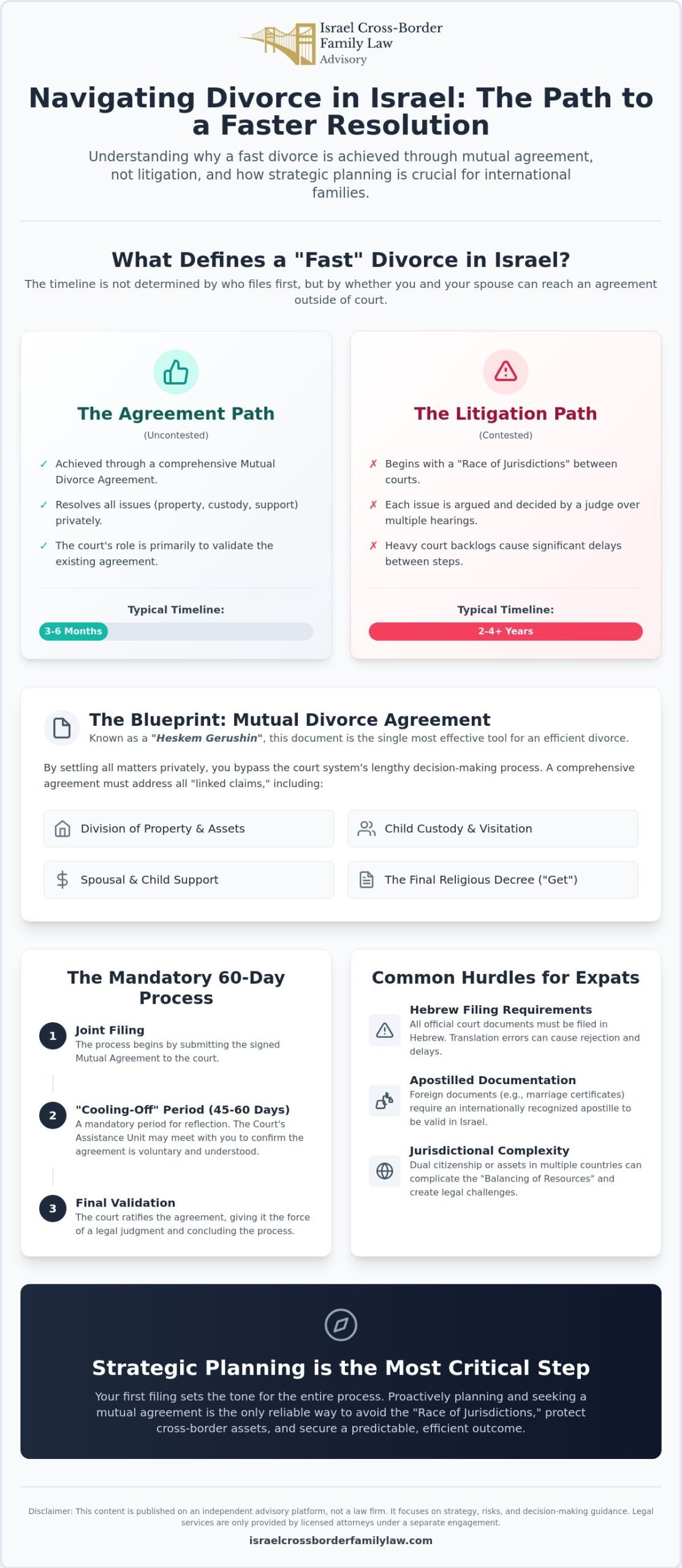
Statistics and court records show a stark contrast between agreed and contested paths. A mutual agreement process typically concludes within 3 to 6 months. This timeline includes the mandatory cooling-off period and the final validation by the court. Conversely, contested cases often drag on for 2 to 4 years. Disputes over child custody or the “Balancing of Resources” for complex assets significantly extend these timelines. Furthermore, heavy court backlogs in districts like Tel Aviv and Central Israel mean that even simple procedural hearings can be scheduled months apart, adding layers of frustration to an already tense situation.
Why Foreigners and Expats Often Face Unique Delays
International families and expats in Israel often encounter hurdles that local couples don’t face. If one spouse is currently residing abroad, the international service of process can take months to complete. Dual citizenship also introduces jurisdictional claims that might be challenged in foreign courts, potentially halting the Israeli process. Additionally, all official filings must be in Hebrew. Translating complex financial documents and ensuring they meet Israeli notarization standards requires precision; any error can result in the court rejecting the filing and resetting the clock on your fast divorce in Israel.
Disclaimer: This content is published on an independent advisory platform, not a law firm. It focuses on strategy, risks, and decision-making guidance. Legal services are only provided by licensed attorneys under a separate engagement.
The Fastest Route: The Mutual Divorce Agreement (Heskem Gerushin)
The Mutual Divorce Agreement, known in Hebrew as the Heskem Gerushin, is the most effective tool for those seeking a fast divorce in Israel. While the previous section highlighted the risks of the “Race of Jurisdictions,” this agreement effectively renders that race irrelevant. By settling all matters privately, you remove the power of the courts to impose decisions on your family. This document acts as a comprehensive settlement that addresses all “linked claims.” These typically include the division of property, child custody arrangements, and spousal or child support.
A well-drafted agreement provides a sense of finality that litigation cannot offer. When a judge validates the document, it receives the status of a court judgment. This makes it significantly harder for either party to “re-open” the case later. To ensure your agreement stands the test of time and different legal cultures, it’s wise to seek strategic clarity on your specific circumstances before you begin drafting.
Step-by-Step: From Negotiation to Final Judgment
The process begins with interest-based negotiation. This isn’t about winning or losing but about finding a sustainable middle ground that both parties can live with. Once the draft is finalized, both parties file a “Joint Petition for Divorce” at either the Family Court or the Rabbinical Court. This filing signals to the system that there is no conflict for the court to resolve, which is the primary driver of a fast divorce in Israel.
The final step is the validation hearing. You will meet with a judge who will review the agreement to ensure both parties understand the terms and are signing of their own free will. The judge will specifically check that the arrangements for any children are in their best interest. Once the judge signs off, the agreement is legally binding. For Jewish couples, this is often followed by a brief proceeding in the Rabbinical Court to arrange the Get ceremony.
Essential Clauses for Cross-Border Families
For international families, a standard Israeli template is often insufficient. Your agreement must account for assets located outside of Israel. This includes US-based 401(k)s, IRAs, and foreign real estate. If these aren’t explicitly detailed, you may face tax complications or enforcement issues in your home country. Specificity is your best defense against future legal friction.
Child-related clauses are equally complex in a cross-border context. You must define “Relocation” precisely to prevent future disputes over moving back to a country of origin. It’s also vital to establish protocols for international travel, including which parent holds the passports and how notice is given. Finally, don’t overlook currency logistics. Since exchange rates fluctuate, stipulating whether support payments are tied to the Shekel or the Dollar can prevent significant financial friction in the years to come.
Disclaimer: This content is published on an independent advisory platform, not a law firm. It focuses on strategy, risks, and decision-making guidance. Legal services are only provided by licensed attorneys under a separate engagement.
Understanding the Mandatory 60-Day “Cooling Off” Period
Since July 2016, the Israeli legal system has prioritized settlement over litigation through a mandatory “cooling off” period. This process begins when one party files a “Request for Settlement of Dispute.” Once this is filed, a 60-day stay of proceedings is triggered. During this time, neither spouse can file lawsuits regarding property division, child custody, or support. While this might feel like a delay, it’s actually the most critical window for achieving a fast divorce in Israel. It forces a pause in the conflict, allowing both parties to meet with the court’s Assistance Unit, known as Yechidat HaSiyuah.
The Assistance Unit consists of social workers and legal professionals who facilitate up to four meetings. Their goal isn’t to provide legal advice, but to help families determine if they can reach an agreement without a judge’s intervention. For international families, this period is a vital time to audit your cross-border financial footprint. If you have US-based assets like a 401(k) or an IRA, you should use these 60 days to ensure any proposed settlement aligns with both Israeli law and foreign tax regulations. Preparing these details during the stay of proceedings prevents the mediation sessions from stalling due to missing financial data.
Can You Skip the Mandatory Mediation?
There are very specific exceptions where the court might waive the waiting period. These usually involve domestic urgency, such as cases of violence or a spouse attempting to smuggle assets or children out of the country. However, attempting to “short-circuit” the process without a valid reason often backfires. Judges generally expect parties to participate in good faith. If you bypass these sessions and move straight to litigation, the court may view your actions as uncooperative, which can lead to longer, more expensive court battles later. It’s important to distinguish these mandatory sessions from private mediation, which can happen simultaneously to speed up the drafting of your final agreement.
The “First to File” Rule and Its Impact on Speed
The act of filing the Request for Settlement of Dispute does more than just start a clock. It also secures your choice of court for a period of 90 days. This is a strategic move in the “race of jurisdictions” mentioned earlier. By being the first to file, you effectively freeze the other party’s ability to choose a different venue. However, rushing to file without a clear cross-border strategy can be risky for expats. You need to understand how it works before making that first move. If you file in a court that isn’t equipped to handle the nuances of dual citizenship or international property, you might find yourself stuck in a procedural loop that is anything but fast.
Disclaimer: This content is published on an independent advisory platform, not a law firm. It focuses on strategy, risks, and decision-making guidance. Legal services are only provided by licensed attorneys under a separate engagement.
Common Speed Bumps for Anglos and Expats in Israel
For many seeking a fast divorce in Israel, the administrative reality of being an expat can cause unexpected friction. The most immediate barrier is the language requirement. All formal court filings, supporting evidence, and final agreements must be submitted in Hebrew. If your marriage certificate or children’s birth records were issued in the US, UK, or elsewhere, they require an Apostille and a certified Hebrew translation. Collecting these documents from foreign government offices often takes longer than anticipated, stalling your case before it truly begins.
Concerns regarding the Hague Convention also play a significant role in cross-border cases. If one parent expresses a fear of abduction or hints at an unauthorized move abroad, the court may issue emergency orders freezing international travel for the children. This can lead to a prolonged legal stalemate while the court evaluates the risk of relocation. Understanding the nuances of international custody and relocation early on is essential to prevent these defensive measures from derailing your timeline. To navigate these specific hurdles effectively, you should discuss your cross-border strategy with an experienced advisor before making any formal moves.
The Complexity of “Civil Divorce” for Non-Jewish Couples
For interfaith couples or those with no religious affiliation, the process is known as the “Dissolution of Marriage.” This takes place exclusively in the Family Court. While this avoids the religious requirements discussed in previous sections, it involves a preliminary step to determine which law applies to the marriage. Depending on your country of origin and its specific legal treaties with Israel, this stage can either streamline the process or introduce complex jurisdictional questions. In some cases, the court must wait for expert opinions on foreign law, which can add several months to the proceedings.
Financial Disclosure and International Assets
Transparency is the primary driver of speed. If one party attempts to hide or delay the disclosure of US-based assets, such as stock options, 401(k) plans, or foreign real estate, the court will likely appoint a forensic accountant. These experts are tasked with cross-border asset valuation, a process that can add six months or more to the litigation. For those managing complex portfolios, reviewing guidance specifically for expats and foreign nationals can help identify potential financial friction points. Addressing these international assets openly in the initial negotiation phase is the only way to maintain the momentum of an expedited process.
Disclaimer: This content is published on an independent advisory platform, not a law firm. It focuses on strategy, risks, and decision-making guidance. Legal services are only provided by licensed attorneys under a separate engagement.
Strategic Planning: Getting Clarity Before You Commit
The foundation of a fast divorce in Israel is not found in the courtroom, but in the preparation that occurs before the first document is filed. Speed is a byproduct of strategic clarity. When you understand the interplay between Israeli statutes and your home country’s legal requirements, you eliminate the friction that causes procedural delays. Choosing between Israeli and US jurisdictions, for example, requires a careful analysis of where your primary assets are held and which system offers a more favorable timeline for your specific needs. Decisions made in haste during the initial emotional surge of a separation often lead to years of corrective litigation.
For international families, the decision to file in Israel versus a US state is rarely straightforward. While Israeli courts might offer a faster path for an uncontested agreement, a US court might be more efficient for dividing specific retirement accounts or business interests located in America. Balancing these competing factors is essential. A strategy that integrates both legal systems ensures that once you move forward, there are no jurisdictional challenges to halt your progress. Before taking action, it’s vital to assess the weight of early decisions, as the first filing often sets a permanent course for the entire process.
The Role of an International Family Law Advisor
Moving beyond a litigation-first mentality is the most significant step you can take toward a resolution. An international advisor focuses on strategy-led outcomes rather than adversarial positioning. This approach helps you understand the long-term impact of support and custody decisions that might otherwise be overlooked in the rush to finish. Agreements signed quickly just to “get it over with” often contain flaws that lead to future disputes over international enforcement. Learning more about the advisory process can help you shift your focus from short-term relief to sustainable, cross-border stability.
Next Steps for Expats in Israel
Your immediate priority should be gathering documentation from both the US and Israel. This includes financial statements, property deeds, and any existing prenuptial agreements. You should consult with a professional who understands the nuances of both jurisdictions to ensure your Israeli agreement is enforceable abroad. Taking these steps now creates the “clean” case file that judges prefer, facilitating a fast divorce in Israel. Remember that the goal is a resolution that protects your interests in every country you call home.
This content is published on an independent advisory platform, not a law firm. It is informational and advisory in nature and does not constitute formal legal representation or an attorney-client relationship. Legal services are only provided by licensed attorneys under a separate engagement.
Get clarity before you commit. Request a confidential consultation.
Disclaimer: This content is published on an independent advisory platform, not a law firm. It focuses on strategy, risks, and decision-making guidance. Legal services are only provided by licensed attorneys under a separate engagement.
Securing Your Future Through Strategic Clarity
Navigating the dissolution of a marriage in a foreign legal system requires more than just speed; it demands a deep understanding of how early decisions impact your long-term stability. As we have explored, the only reliable path to a fast divorce in Israel is through a well-negotiated mutual agreement that addresses the specific needs of international families. By using the mandatory mediation period as a strategic window to resolve cross-border asset and custody issues, you can avoid the years of litigation that often plague contested cases.
Success in these matters depends on specialized expertise in the intersection of US and Israeli family law. Our advisory provides strategy-led guidance that accounts for the multi-jurisdictional complexity of your life, ensuring you move forward with confidence. We focus on identifying risks and providing decision-making clarity before you make permanent commitments to the court system. Get clarity before you commit. Request a confidential consultation. Your path to a new beginning starts with an informed and deliberate first step.
Disclaimer: This content is published on an independent advisory platform, not a law firm. It focuses on strategy, risks, and decision-making guidance. Legal services are only provided by licensed attorneys under a separate engagement.
Frequently Asked Questions
How long does a divorce in Israel typically take if both parties agree?
A divorce by mutual consent typically concludes within 3 to 6 months. This timeline includes the drafting of the settlement and the mandatory waiting period required by law. While contested cases can last years, the agreed-upon path is the most reliable way to achieve a fast divorce in Israel.
Can I get a civil divorce in Israel if I was married in the US?
Yes, you can obtain a divorce in Israel even if you were married in the US. If you are Jewish, the Rabbinical Court handles the divorce decree, while civil matters go to Family Court. Non-Jewish or interfaith couples use the “Dissolution of Marriage” process in the Family Court, which applies civil law principles to the marriage dissolution.
What is the mandatory mediation period in Israeli divorce law?
The mandatory mediation period lasts between 45 and 60 days following the filing of a Request for Settlement of Dispute. During this stay of proceedings, you meet with the court’s Assistance Unit to explore settlement options. You cannot file substantive legal claims until this period concludes or the unit releases the case for litigation.
Does a US prenuptial agreement speed up a divorce in Israel?
A US prenuptial agreement doesn’t automatically apply in Israel. To be enforceable, it usually needs to be ratified by an Israeli court. While it provides a helpful framework for negotiation, it won’t bypass procedural requirements like the cooling-off period unless it is formally recognized and validated by the local judiciary.
What happens if my spouse refuses to give me a “Get”?
If a spouse refuses to grant a “Get,” the Rabbinical Court has the authority to intervene. The court can impose various sanctions to encourage compliance, though this can significantly delay the final religious decree. This risk highlights the importance of including specific clauses in your initial agreement to address potential refusal early in the process.
Can I file for divorce in the US while living in Israel to make it faster?
You may be able to file in the US if you maintain residency or a legal “nexus” in a specific state. However, doing so requires careful coordination to avoid conflicting orders between the two countries. Choosing the right jurisdiction is a strategic decision that depends on where your assets and children are primarily located.
How much does an uncontested divorce in Israel cost?
The total cost includes court filing fees and professional advisory or legal fees. Each case varies based on the complexity of international assets and the depth of the agreement required to protect your future. For a detailed breakdown of costs for our advisory services, please visit our pricing page.
Do I need to be physically present in Israel for the entire divorce process?
You aren’t required to be in Israel for every step, but physical presence is usually necessary for the final validation hearing. Jewish couples must also appear in person at the Rabbinical Court for the delivery of the Get. Many preliminary meetings and negotiations can be handled remotely through secure digital communication tools.

Article by
Gabriel Lior
A Personal Journey That Became a Mission
The advisory was founded by an American father Gabriel Lior, LLB, MBA , global entrepreneur, and cross-border advisor who spent more than a decade navigating the Israeli family court system firsthand and now lives in Singapore with his son.
As a divorced parent in a cross-border family, Gabriel faced nearly every legal challenge a foreign parent can encounter in Israel — including child custody disputes, child support proceedings, property matters in Israel and abroad, false accusations, and complex immigration and relocation proceedings.
Over the years, he learned the hard way how difficult it is for non-Israeli parents to understand the system, identify the right legal strategy, and choose the right legal representation — especially when language, culture, and jurisdictional differences are involved. He also witnessed how foreign parents and new immigrants are often disadvantaged or taken advantage of by service providers and institutions simply because they lack local knowledge or fluency.
From Client to Advisor
To truly understand — and survive — the system, Gabriel pursued formal legal education in Israel, completing two Israeli law degrees, alongside a BA and MBA earned in the United States. This was never about becoming a practicing attorney, but about gaining a deep, structural understanding of how the system works — and where it breaks down for foreign parents.
This rare combination of:
Firsthand client experience
Israeli legal and US business education
International business and negotiation training
Decades of commercial execution
created a unique perspective – one that understands both sides of the table.
After years of litigation, persistence, and at times self-representation, he ultimately succeeded in securing custody of his son and relocating abroad through a rare legal victory in the Israeli Supreme Court — becoming one of the first fathers in Israel to do so under these circumstances.
Disclaimer
Important Disclaimer:
The information provided on this website and in its content is for general informational and educational purposes only and does not constitute legal advice, legal opinion, or legal representation.
Gabriel Lior is not licensed to practice law in Israel (nor is he interested in doing so) and does not provide legal services, despite having completed 2 Law Degrees. The services offered are advisory in nature and are intended to provide general guidance, strategic insight, and information regarding cross-border family law considerations.
No attorney-client relationship is formed by accessing this website, reading its content, or communicating with us.
Any decisions made based on this information are at your own discretion and risk. For legal advice specific to your situation, you should consult a licensed attorney in the relevant jurisdiction.
Where appropriate, we may refer clients to independent, licensed attorneys or professionals. Such referrals do not constitute legal representation and no liability is assumed for services provided by third parties.