You might assume your US Will serves as a global passport for your assets, but the Israeli Inheritance Registrar often views foreign documents with significant scrutiny. For many US citizens and expats, the realization that a valid American legal instrument isn’t automatically accepted in Israel comes as a stressful surprise. Mastering the israeli probate process is essential because the local legal system operates on distinct principles of succession that don’t always align with common law traditions like joint tenancy or automatic survivorship.
It’s natural to feel concerned about language barriers or the rigid requirements of Israeli bank bureaucracy. We understand the need for a steady, knowledgeable guide when managing an estate from thousands of miles away. This article provides a clear roadmap to navigate these complexities, from validating a foreign will to the final distribution of cross-border assets. You’ll gain a thorough preview of the 2026 digital filing mandates, the role of foreign law expert opinions, and the strategic steps necessary to secure the transfer of real estate and financial holdings. This information is published on an independent advisory platform for educational purposes and doesn’t constitute legal representation or formal legal advice.
Key Takeaways
- Understand why a US probate order isn’t automatically recognized and how to properly initiate the israeli probate process through the Ministry of Justice.
- Learn the critical differences between a Probate Order used for US-drafted wills and a Succession Order required for those who pass away without a legal document.
- Discover why common American estate planning tools, such as trusts and joint tenancy, often fail to transfer Israeli real estate or bank accounts.
- Identify the essential documents and authentication steps required to manage the entire legal procedure remotely from the United States.
- Gain clarity on the strategic risks of cross-border inheritance, including potential will contests and the current 2026 tax landscape for foreign residents.
Understanding the Israeli Probate Process for Cross-Border Estates
The israeli probate process is the formal legal procedure required to validate a deceased person’s will or legally identify their heirs according to the laws of Israel. This process is overseen by the Registrar of Inheritance Affairs, a department within the Ministry of Justice. For US citizens and expats, this is rarely a simple filing because the Israeli system requires specific local orders to release assets held within its borders. This content is published on an independent advisory platform and is intended for informational purposes only; it doesn’t establish an attorney-client relationship.
Probate is strictly mandatory for any estate containing Israeli real estate or local bank accounts. Unlike some US jurisdictions where small estates might avoid court oversight, Israeli institutions like the Land Registry (Tabu) and commercial banks can’t legally transfer titles or funds without a certified Israeli Probate or Succession Order. This creates a significant hurdle for international families who often expect their US court orders to be accepted at face value by Israeli officials.
To better understand the unique challenges faced by Americans with assets in Israel, watch this educational overview:
The Role of the Succession Law, 1965
The Succession Law 1965 is the primary statute for all Israeli inheritance matters. This foundational law applies the principle of “lex rei sitae,” which dictates that the law of the location where property is situated governs its distribution. Because of this, Israeli law holds exclusive jurisdiction over any land or tangible property located in Israel, regardless of where the owner lived or died. It’s a critical distinction that often requires a reconciliation between US estate planning and Israeli statutory requirements.
Probate vs. Succession: Which Do You Need?
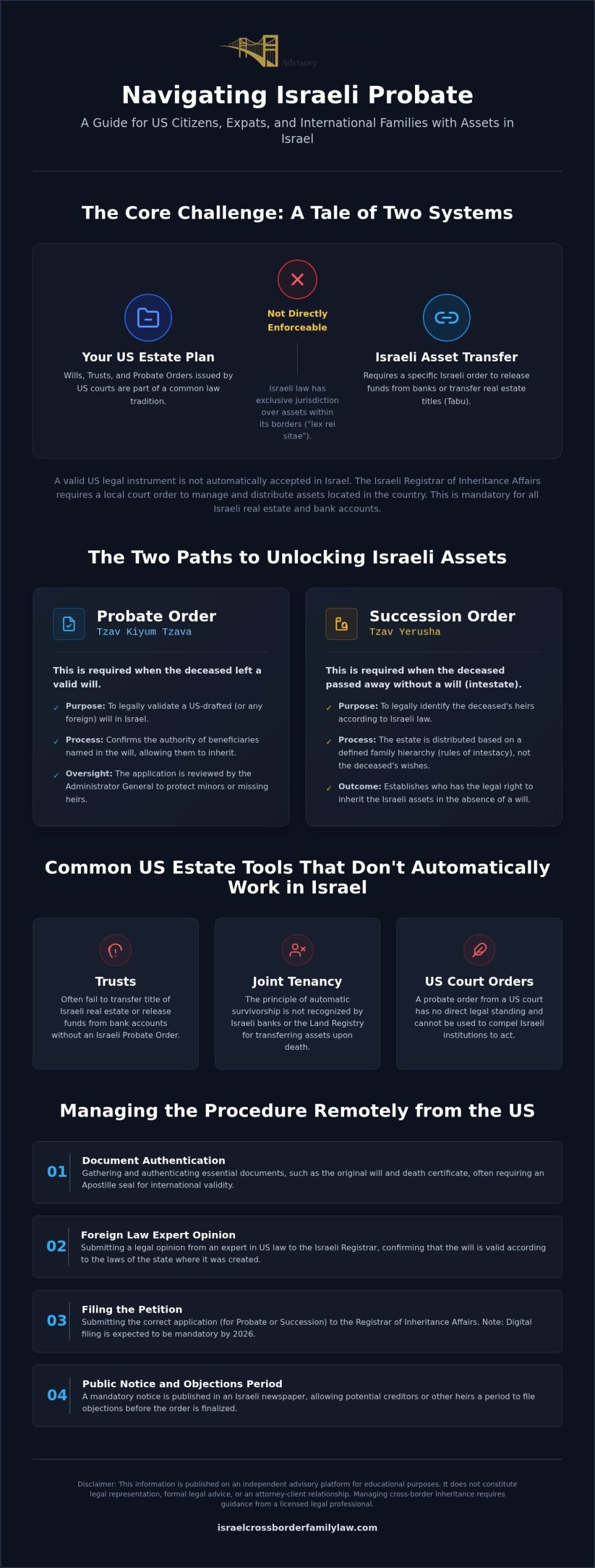
The path you take depends entirely on whether a valid will exists. A Probate Order (Tzav Kiyum Tzava) is necessary to validate a will, whereas a Succession Order (Tzav Yerusha) is required when someone dies without a will. In cases of the latter, the estate follows the rules of intestacy, which are specific legal defaults that determine heirship based on family hierarchy. Each path has different documentation requirements, and choosing the wrong one early in the process can lead to significant delays and additional costs at the Registrar’s office. You can learn more about strategic considerations for expats and foreign nationals to help determine which order fits your family’s specific situation.
The Core Legal Orders: Tzav Kiyum Tzava and Tzav Yerusha
Every israeli probate process begins with a petition for one of two specific legal instruments. These orders serve as the definitive keys to unlocking local assets. If the deceased left a valid will, the family must apply for a Tzav Kiyum Tzava (Probate Order). This document validates the will and confirms the authority of the beneficiaries named within it. For US citizens, this often involves an additional layer of complexity, as the Israeli Registrar must ensure the foreign document meets local standards of validity. This content is published on an independent advisory platform and is intended for informational purposes; it doesn’t establish an attorney-client relationship.
A central figure in this procedure is the Administrator General. This official reviews every single application submitted to the Registrar of Inheritance Affairs. Their role is to protect the interests of those who cannot represent themselves, such as minors, individuals under guardianship, or missing heirs. Additionally, a mandatory public notice is published in an Israeli daily newspaper for every case. This transparency ensures that any potential creditors or undisclosed heirs have an opportunity to come forward before the assets are distributed. You can find more details on how the process works to better prepare for these procedural steps.
Intestate Succession: Who Inherits if There is No Will?
When no will is present, the estate follows the “Order of Precedence” established by Israeli law through a Tzav Yerusha (Succession Order). This hierarchy typically prioritizes the surviving spouse and children first. It’s important to understand that Israeli law handles these rights differently than many US jurisdictions. For instance, the concept of “Common Law” marriage, or Yeduim BeTzibur, is highly developed in Israel. An unregistered partner may be legally recognized as an heir if they can prove a shared life and household, a scenario that often surprises international families who are used to stricter marital definitions.
The Application Process with the Registrar
As of May 2026, the Ministry of Justice has implemented a mandatory digital filing portal for all probate petitions involving foreign residents. Paper filings are largely obsolete for these cases. Once the digital submission is complete and the newspaper notice is published, a 90-day objection period begins. During this time, the application is stagnant to allow for any legal challenges. If the Administrator General identifies discrepancies or if a family member contests the filing, the case may be transferred from the Registrar’s office to the Family Court for a more intensive judicial review. This shift can significantly impact the timeline and the complexity of the estate’s resolution.
Why US Estate Planning Tools Often Fail in Israel
Many US citizens operate under the assumption that a comprehensive estate plan drafted in their home state will seamlessly govern their assets worldwide. However, US estate planning tools often encounter significant friction when applied to assets located within Israel. This content is published on an independent advisory platform and is intended for informational purposes only; it doesn’t constitute legal representation or formal legal advice. A primary example is the common US revocable living trust. While these trusts are designed to bypass the probate court in the United States, they don’t have the same effect in Israel. Israeli land registries and financial institutions generally don’t recognize a foreign trust as a vehicle for automatic title transfer. Consequently, beneficiaries must still engage with the israeli probate process to obtain a local order that confirms the transfer of property from the deceased to the trust’s heirs.
Another area of frequent confusion involves “Joint Tenancy with Right of Survivorship.” This legal concept, which allows a property to pass automatically to a surviving owner, doesn’t exist in Israeli law. In Israel, if a property is owned by two people and one passes away, the deceased’s portion is considered part of their individual estate. It doesn’t automatically “jump” to the survivor. Similarly, “Transfer on Death” (TOD) or “Payable on Death” (POD) designations on US brokerage accounts aren’t recognized by Israeli banks. These institutions require a formal Israeli court order before they’ll release funds to named beneficiaries, regardless of any designations made on foreign documents.
The Problem with Joint Accounts in Israeli Banks
Israeli banks often freeze accounts immediately upon the death of one account holder, even if the account was held jointly with a spouse. While many accounts include a “Survival Clause,” known as Seif Arichut Yamim, this clause only grants the survivor the technical ability to perform basic management of the account. It doesn’t grant them legal ownership of the deceased’s share of the funds. A US joint account status does not override the need for an Israeli probate order. Without this order, the bank will eventually restrict access to the funds until the legal heirs are formally identified through the Registrar of Inheritance Affairs.
Enforcing a Foreign Will in Israel
If you’re using a US will to claim assets, the Israeli Registrar requires an “Opinion on Foreign Law.” This is a specialized affidavit from a qualified legal expert confirming that the will is valid under the laws of the jurisdiction where it was signed. Additionally, all US-issued documents, including death certificates and the will itself, must receive an Apostille to validate the signatures for Israeli authorities. Notarized Hebrew translations are also non-negotiable. These administrative hurdles highlight why early strategic planning is essential for expats and foreign nationals who hold assets in both countries.
Step-by-Step: Navigating the Israeli Probate Procedure Remotely
Managing an inheritance from abroad requires a structured logistical approach. The israeli probate process can be completed without the heirs ever setting foot in Israel, provided the documentation is prepared with precision. The initial phase involves gathering the original US death certificate, the original will, and valid identification for all heirs. This content is published on an independent advisory platform and is intended for informational purposes only; it doesn’t establish an attorney-client relationship.
Every US-issued document must be authenticated with an Apostille. This is a specialized certification obtained from the Secretary of State in the state where the document was issued. Without this, the Israeli Ministry of Justice won’t recognize the validity of American signatures or seals. Once authenticated, these documents are translated into Hebrew by a recognized Israeli notary to meet the Registrar’s strict submission standards. After filing, the case enters a mandatory publication phase in an Israeli newspaper, followed by a waiting period to allow for potential objections before the final Order is issued.
Logistics for US Heirs: The Remote Workflow
US residents have two primary options for signing the necessary petitions and powers of attorney. You can schedule an appointment at an Israeli consulate, or more commonly, sign before a local US notary followed by an Apostille. Using an Israeli legal representative provides a mandatory “address for service” within Israel, allowing the Registrar to communicate directly with a local professional who understands the 2026 digital portal requirements. You can explore more about these specific requirements for expats and foreign nationals.
Dealing with Israeli Banks and the Land Registry
Navigating the final stages of the israeli probate process requires patience when dealing with bank bureaucracy. Presenting the final Order to an Israeli bank is the only way to release frozen funds. Even with the Order, banks often request additional KYC (Know Your Customer) documentation from US heirs to comply with international anti-money laundering regulations. For real estate, the Order must be submitted to the Land Registry, known as the “Tabu,” to update the property title. This step is now largely digitized, but it requires meticulous attention to detail to ensure the new title reflects the correct ownership shares.
To ensure your documentation meets the current standards for remote filing, consult with a cross-border specialist.
Strategic Risks and Protecting the Cross-Border Estate
The final stages of the israeli probate process involve addressing potential legal challenges and tax obligations that span two different jurisdictions. While the technical filing of a petition is a procedural step, the strategic management of the estate requires a broader perspective. One significant risk involves the presence of multi-jurisdictional debt. Creditors in both the United States and Israel may have claims against the estate’s assets; these must be resolved before any distribution occurs. This content is published on an independent advisory platform and is intended for informational purposes only; it doesn’t establish an attorney-client relationship.
Taxation is a primary concern for US citizens inheriting Israeli assets. As of July 2026, Israel does not levy an inheritance or estate tax. However, US citizens remain subject to the US federal estate tax on their worldwide assets. For 2026, the federal estate tax exemption is approximately $13.99 million per individual. Estates valued above this threshold may face a 40% tax rate from the US government, even on property located in Israel. Navigating this requires a clear understanding of how these two systems interact to avoid unexpected financial liabilities.
Will Contests and Inheritance Disputes
Disputes often arise when Israeli-based heirs feel excluded by a US-drafted will. Common grounds for a will contest in Israel include claims of “undue influence” or a lack of testamentary capacity at the time the document was signed. Defending a foreign will against such claims requires proving that the document meets the legal standards of the jurisdiction where it was executed. If an objection is filed during the mandatory waiting period, the case is typically transferred from the Registrar of Inheritance Affairs to the Family Court for a formal trial. This shift significantly increases both the timeline and the emotional weight of the proceedings.
Final Steps: Distribution and Closure
Before the first document is filed, it’s vital to have a complete map of all global assets and liabilities. Making early decisions without this clarity can lead to costly procedural errors. You should account for the total investment required, including court fees, mandatory publication costs, and professional fees for foreign law opinions. You can review more about pricing and costs to help build a realistic budget for the estate’s resolution. Successful closure of the israeli probate process depends on a measured approach that balances local legal requirements with long-term financial goals. Get clarity before you commit. Request a confidential consultation.
Securing Your Legacy Across Borders
Success in the israeli probate process requires reconciling two very different legal systems. You’ve learned that standard US estate planning tools, like revocable trusts or joint tenancy, don’t bypass Israeli requirements for local probate or succession orders. It’s also clear that while the 2026 digital filing mandates and Apostille requirements add layers of bureaucracy, the entire procedure can be managed successfully from abroad with the right strategic preparation. This content is published on an independent advisory platform and is intended for informational purposes only; it doesn’t constitute formal legal representation.
Protecting a cross-border estate involves more than just filing paperwork. It’s about understanding the nuances of the Succession Law 1965 and managing the interplay between Israeli assets and US federal estate taxes. By seeking specialized guidance for international families early, you can avoid the risks of will contests and ensure a smooth transfer of real estate or bank funds. Our calm, advisory-first approach is designed to provide you with the expertise needed to navigate these multi-jurisdictional complexities with confidence.
Get clarity before you commit. Request a confidential case review.
We’re here to help you bridge the gap between US and Israeli law, ensuring your family’s assets are protected and transferred with minimal friction.
Frequently Asked Questions
This content is published on an independent advisory platform and is intended for informational purposes only; it doesn’t constitute legal representation or formal legal advice. Legal services are only provided by licensed attorneys under a separate engagement.
How long does the Israeli probate process take for a US resident?
The typical timeline for a US resident to complete the israeli probate process is between 8 and 12 months. This duration accounts for the mandatory digital filing requirements, the required newspaper publication, and the 90-day objection period overseen by the Registrar of Inheritance Affairs. If the estate is complex or involves contested claims, the timeline can extend beyond a year as the case may move to the Family Court for review.
Do I need to travel to Israel to handle a probate case?
You don’t need to travel to Israel to manage a probate or succession case. Most procedural steps, including signing petitions and powers of attorney, can be handled at an Israeli consulate in the US or through a local notary with an Apostille. This remote workflow allows international families to resolve estate matters efficiently without the expense of international travel or a physical presence in the country.
Is there an inheritance tax in Israel for US beneficiaries?
Israel does not currently levy an inheritance or estate tax on beneficiaries, as this tax was abolished in 1981. However, US citizens must still consider their worldwide tax obligations; the US federal government may apply estate taxes to assets located in Israel if the total estate value exceeds the 2026 exemption threshold. It’s essential to coordinate with tax professionals in both jurisdictions to manage these multi-jurisdictional complexities.
Can I use a US-notarized power of attorney for Israeli probate?
A US-notarized power of attorney is generally acceptable for the israeli probate process provided it is accompanied by an Apostille from the Secretary of State. Alternatively, you can sign documents at an Israeli consulate to meet authentication standards. This authorization allows your local representative to manage digital filings and interact with the Ministry of Justice, ensuring the procedure continues without requiring your personal appearance in an Israeli court.
What happens if the original will is lost but a copy exists?
If an original will is lost, you must petition the Israeli Family Court to validate a certified copy. This is a more intensive judicial process compared to a standard application; you’ll need to provide evidence that the original document existed and wasn’t intentionally revoked. This scenario moves the case from the Registrar’s administrative track to a formal courtroom setting, which requires a more detailed evidentiary review to establish the copy’s validity.
Will my US trust avoid probate for my apartment in Tel Aviv?
A US trust does not bypass the requirement for an Israeli probate order when transferring real estate like an apartment in Tel Aviv. The Israeli Land Registry (Tabu) and local banks require a local court order to recognize the legal transfer of title from the deceased to the beneficiaries. While a trust is a valuable tool in the US, it doesn’t replace the statutory probate procedure required for assets located within Israel.
How much does it cost to complete the probate process in Israel?
The total cost depends on several factors, including mandatory government filing fees, newspaper publication costs, and the necessity of notarized Hebrew translations. Additionally, foreign residents are required to provide a specialized expert opinion on foreign law to validate a US will. Because every cross-border estate is unique, it’s best to seek a clear breakdown of all administrative and professional requirements before committing to the first legal filing.
Can I sell an inherited Israeli property before the probate order is issued?
You cannot legally sell an inherited Israeli property until the title has been formally transferred into the heirs’ names via a probate or succession order. Potential buyers and financial institutions will require an updated deed from the Land Registry before a transaction can be finalized. Obtaining the legal order is a non-negotiable first step that must be completed before you can enter into a binding real estate contract.

Article by
Gabriel Lior
A Personal Journey That Became a Mission
The advisory was founded by an American father Gabriel Lior, LLB, MBA , global entrepreneur, and cross-border advisor who spent more than a decade navigating the Israeli family court system firsthand and now lives in Singapore with his son.
As a divorced parent in a cross-border family, Gabriel faced nearly every legal challenge a foreign parent can encounter in Israel — including child custody disputes, child support proceedings, property matters in Israel and abroad, false accusations, and complex immigration and relocation proceedings.
Over the years, he learned the hard way how difficult it is for non-Israeli parents to understand the system, identify the right legal strategy, and choose the right legal representation — especially when language, culture, and jurisdictional differences are involved. He also witnessed how foreign parents and new immigrants are often disadvantaged or taken advantage of by service providers and institutions simply because they lack local knowledge or fluency.
From Client to Advisor
To truly understand — and survive — the system, Gabriel pursued formal legal education in Israel, completing two Israeli law degrees, alongside a BA and MBA earned in the United States. This was never about becoming a practicing attorney, but about gaining a deep, structural understanding of how the system works — and where it breaks down for foreign parents.
This rare combination of:
Firsthand client experience
Israeli legal and US business education
International business and negotiation training
Decades of commercial execution
created a unique perspective – one that understands both sides of the table.
After years of litigation, persistence, and at times self-representation, he ultimately succeeded in securing custody of his son and relocating abroad through a rare legal victory in the Israeli Supreme Court — becoming one of the first fathers in Israel to do so under these circumstances.
Disclaimer
Important Disclaimer:
The information provided on this website and in its content is for general informational and educational purposes only and does not constitute legal advice, legal opinion, or legal representation.
Gabriel Lior is not licensed to practice law in Israel (nor is he interested in doing so) and does not provide legal services, despite having completed 2 Law Degrees. The services offered are advisory in nature and are intended to provide general guidance, strategic insight, and information regarding cross-border family law considerations.
No attorney-client relationship is formed by accessing this website, reading its content, or communicating with us.
Any decisions made based on this information are at your own discretion and risk. For legal advice specific to your situation, you should consult a licensed attorney in the relevant jurisdiction.
Where appropriate, we may refer clients to independent, licensed attorneys or professionals. Such referrals do not constitute legal representation and no liability is assumed for services provided by third parties.