What if the first court you step into in Israel determines the fate of assets you’ve held in New York or London for decades? For international families, the Israeli legal landscape isn’t just about local rules; it’s a high-stakes crossroads where religious tradition meets civil law. You likely feel the pressure of the “race for jurisdiction” between Rabbinical and Family Courts. Securing a jewish family lawyer who understands these cross-border nuances is the first step toward reclaiming control over your legal journey.
It’s natural to feel overwhelmed by the prospect of managing a divorce or estate across two continents. This guide, published by an independent advisory platform, clarifies how to protect your global assets while adhering to Israeli requirements. You’ll learn how to handle the “Get” process and the 2026 updates to Rabbinical Court authority. We’ll provide a roadmap for choosing an advisor who acts as a bridge between legal systems, ensuring you have clarity before you make any permanent commitments.
Key Takeaways
- Learn why a specialized jewish family lawyer must navigate both civil and Rabbinical courts to secure a valid divorce and protect your interests.
- Understand the “race for jurisdiction” and how filing first in the correct court can fundamentally change the outcome of your property division.
- Discover strategies for managing international assets and cross-border custody issues while ensuring compliance with the Hague Convention.
- Identify specific qualifications to look for in an advisor, including dual-jurisdiction experience and the ability to explain complex procedures in plain English.
- Recognize the importance of strategic mapping and seeking professional clarity before filing any legal documents to avoid irreversible mistakes.
What Defines a Jewish Family Lawyer in the Israeli Legal Context?
A jewish family lawyer in Israel operates at the critical intersection of civil statutes and religious tradition. This content is published by an independent advisory platform to provide strategic guidance; it doesn’t constitute legal representation or formal legal advice. In the Israeli system, a practitioner must possess deep expertise in both the civil Family Court system and the Rabbinical Courts, which operate according to Halakha, or Jewish law. Understanding this distinction is vital for international families who are accustomed to the unified court systems found in the US or the UK.
Relying on a general practitioner who lacks specific experience in religious proceedings can lead to significant complications. While a civil lawyer can draft a property settlement, they can’t finalize the actual divorce decree for a Jewish couple in Israel. This unique legal landscape, rooted in the historical framework of Marriage in Israel, requires an advisor who acts as a strategic translator between your civil rights and your religious obligations.
To better understand the complexities of international proceedings in this system, watch this helpful video:
The Intersection of Religious and Civil Authority
Every Jewish divorce in Israel must eventually pass through the Rabbinical Court to be finalized. However, the system is split between “Personal Status” and “Civil” issues. Personal status covers the marriage and the divorce itself. Civil issues include the division of global assets, child custody, and support payments. A skilled jewish family lawyer navigates these systems by understanding which court is more likely to provide a fair outcome based on the specific facts of your case. They manage the procedural differences, such as the Rabbinical Court’s specific evidentiary rules, while protecting the rights you hold under civil law.
Cultural Competency for Anglo and Expat Families
For families moving between the US and Israel, the bureaucracy can feel impenetrable. An advisor with cross-border experience understands that Anglo families value transparency and plain English explanations. This cultural bridge is essential when discussing sensitive religious requirements. For example, the “Get” is the essential religious divorce document required under Jewish law to permit both parties to remarry. Without this document, a person may be considered still married under religious law, even if a civil court has divided their assets. Seeking clarity through an independent advisory before filing can prevent these two systems from working against each other.
The Race for Jurisdiction: Rabbinical vs. Family Courts
The Israeli legal system features a unique “Race for Jurisdiction,” known in Hebrew as Merotz HaSamchuyot. This dynamic exists because both the Rabbinical Courts and the civil Family Courts share authority over many aspects of a divorce. For international families, the court that hears the case first can significantly alter the outcome regarding alimony, property division, and child custody. This section is published on an independent advisory platform to help you understand these strategic risks rather than providing specific legal representation.
When a spouse files for divorce in the Rabbinical Court, they can “bind” (Kricha) civil matters like asset division to the religious suit. If this filing is done correctly and in good faith, the Rabbinical Court assumes exclusive authority over those issues. This is why acting without a clear strategy can be a permanent mistake. Decisions made in the first 48 hours often dictate the legal trajectory for years. A jewish family lawyer helps you evaluate which venue aligns with your specific goals before any papers are submitted.
When the Rabbinical Court Assumes Authority
The Rabbinical Court traditionally focuses on religious law, but it can handle financial matters if they are properly “bound” to the divorce claim. Recent updates, such as the March 2026 Religious Courts Arbitration Law, have expanded their ability to act as arbitrators in civil disputes if both parties consent. However, for an expat with US-based assets, the religious court’s approach to discovery and valuation may differ from Western standards. A qualified jewish family lawyer can explain how the 2016 Family Dispute Settlement Law impacts your filing timeline and protects your rights if a spouse initiates proceedings in this venue first.
The Family Court Alternative
The Family Courts operate under secular law and are often preferred by international families for complex property division. These courts are generally more equipped to handle international asset discovery and apply the principle of “Best Interests of the Child” in custody disputes. As of January 2026, the mandatory “Settlement of Dispute” application fee is 119 NIS. This initial step is designed to encourage mediation, but it also marks the start of the jurisdictional timeline. Choosing the right venue requires a deep understanding of how your international status interacts with Israeli law.
You should understand how the advisory process works before committing to a specific court. If you are unsure which path protects your global interests, it is wise to seek a confidential strategic review.
Cross-Border Challenges for International Jewish Families
International families often assume that assets held outside of Israel are shielded from local divorce proceedings. This is rarely the case. Israeli law generally presumes an equal division of all assets accumulated during the marriage, regardless of where they are located globally. A jewish family lawyer with cross-border expertise is essential for navigating the discovery process across multiple jurisdictions. This content is published by an independent advisory platform focusing on strategy and risks; it’s not legal representation or formal legal advice.
The interaction between US prenuptial agreements and Israeli law is a frequent source of friction. An agreement signed in New York or California isn’t automatically binding in an Israeli court. It often requires a formal validation process to be recognized by either the Family Court or the Rabbinical Court. Without this validation, you risk your global estate being subject to Israeli default rules. Strategic mapping helps you understand these risks before you find yourself in a contested proceeding.
International Custody and Relocation
Relocation suits are among the most sensitive cross-border issues. When one parent wishes to return to the US with children, the court applies the “Best Interests of the Child” standard alongside the legal concept of “Habitual Residence.” If a child has established a life in Israel, moving them back to the US requires a specific legal authorization. You can learn more about the complexities of international custody and relocation through our specialized guides. The Hague Convention provides the framework for these disputes. It’s strictly applied in Israel to prevent international child abduction, making early strategic advice crucial for parents considering a move.
Enforcement of Foreign Support Orders
Enforcing a US child support order in Israel involves a process known as Exequatur. This procedure makes a foreign judgment enforceable by the Israeli Bureau of Enforcement, or Hotsaa LaPoal. It’s a technical process that requires a jewish family lawyer to demonstrate that the original order was issued by a competent court and doesn’t contradict Israeli public policy. Our platform provides insights on child support cross-border enforcement to help you understand how these decrees are treated locally. Ensuring your US-based support orders are recognized is vital for maintaining financial stability after an international transition.
How to Evaluate and Select Your Legal Advisor
Selecting a jewish family lawyer is a decision that carries long-term consequences for your family and your global assets. This content is published by an independent advisory platform to assist with strategic decision-making; it does not constitute legal representation. For international families, the ideal advisor is more than a local representative. They must act as a bridge between two distinct legal cultures. You need a professional who understands the weight of early decisions in the Israeli system while respecting the procedural standards of your home country.
Dual qualification or significant experience in both US and Israeli jurisdictions is a primary factor to consider. A lawyer who is familiar with both systems can anticipate how a ruling in an Israeli Rabbinical Court might impact your financial standing or tax obligations in the United States. Transparency is also vital. You should look for a clear, structured approach to fees that accounts for the complexity of cross-border discovery and multi-jurisdictional filings.
The advisor’s approach to conflict is equally important. While litigation is sometimes necessary, a strategic advisor often prioritizes mediation or structured negotiation. This approach can prevent the “race for jurisdiction” from becoming an expensive, multi-year battle that depletes international assets. Ensure your advisor has a physical presence or an established professional network in both countries to handle local filings and evidence collection efficiently.
Questions to Ask During a Consultation
- How do you manage assets that fall under both US and Israeli tax laws during a property division?
- What is your specific experience with the Rabbinical Court in my region, and how do they view international prenuptial agreements?
- How will you coordinate with my existing legal team or financial advisors in the United States?
Red Flags in International Family Law
Be cautious of any professional who guarantees a specific outcome in the Rabbinical Court. These courts operate with a high degree of judicial discretion, and no outcome is ever certain. Another red flag is a lack of experience with the Hague Convention on Child Abduction. If a firm cannot explain the nuances of “Habitual Residence” or the risks of the jurisdictional race, they may not be equipped for a complex cross-border case. Vague communication regarding the timeline or the costs of international enforcement is also a sign to look elsewhere.
Before you commit to a legal path, it’s essential to have a clear view of your risks. You can request a confidential consultation to begin mapping your strategy today.
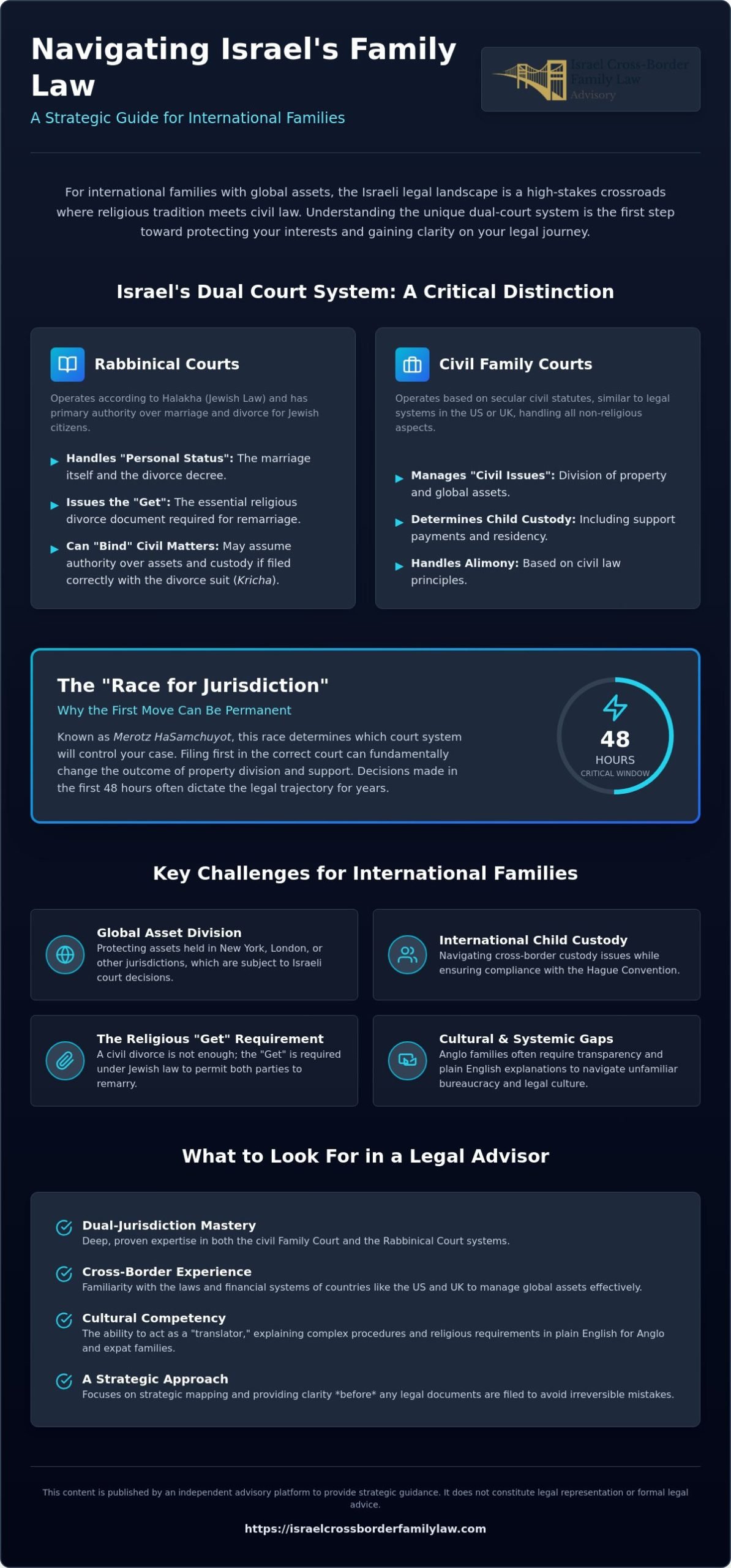
The Cross-Border Advisory Approach: Clarity Before Commitment
Unlike a traditional high-conflict law firm that may prioritize immediate litigation, an independent advisory platform focuses on the strategic architecture of your case. For international families, the goal isn’t just to file papers, but to ensure that every move aligns with your long-term global interests. This content is published on an independent advisory platform and doesn’t constitute an attorney-client relationship. Working with a jewish family lawyer as a strategic advisor allows you to map out the consequences of the dual-court system before you step into a courtroom.
Strategic mapping is the process of evaluating how decisions made in Israel will echo in your home country. As we discussed in previous sections, the jurisdictional race is a reality that requires immediate attention, but acting without a plan can lead to irreversible financial or parental losses. Early planning helps you mitigate these risks by providing a roadmap for asset discovery, custody arrangements, and religious requirements. A confidential case review serves as the foundation for this roadmap, giving you the space to ask questions without the pressure of an ongoing trial.
Strategy vs. Litigation
In the high-stakes environment of international family law, the loudest lawyer is rarely the most effective. A calm, authoritative approach is often more successful in navigating the sensitivities of the Rabbinical Courts and the technical requirements of the Family Courts. Strategy involves knowing when to negotiate and when to stand firm on jurisdictional grounds. For those who prefer visual guidance on these complex topics, the Israel Family Law Channel offers a wealth of educational resources that explain these concepts in plain English. This steady, advisory-led method ensures that your decisions are based on logic rather than the emotional exhaustion that often accompanies cross-border disputes.
Next Steps for International Families
The first step toward a stable future is seeking professional clarity. You should understand how the advisory process works so you can make informed choices about your representation and your strategy. A jewish family lawyer with a cross-border focus can help you navigate the 2026 updates to Israeli law while protecting your rights in both the US and Israel. Don’t let the complexity of the system force you into a reactive position.
Get clarity before you commit. Request a confidential consultation to begin building a strategy that protects your family and your future.
Securing Your Family’s Global Future
Managing a family transition across borders requires more than just local legal representation; it demands a comprehensive strategy that bridges the gap between different legal cultures. You’ve seen how the “race for jurisdiction” and the complexities of the Rabbinical Court system can significantly impact your global assets and parental rights. Choosing a jewish family lawyer with specific experience in international matters ensures that your interests are protected in both the civil and religious spheres while adhering to the 2026 procedural updates.
Get clarity before you commit. Request a confidential consultation.
Frequently Asked Questions
Disclaimer: This content is published on an independent advisory platform and does not constitute legal representation or formal legal advice. Legal services are only provided by licensed attorneys under a separate engagement.
What is the difference between the Family Court and the Rabbinical Court in Israel?
The Family Court is a secular civil institution, while the Rabbinical Court operates under Jewish religious law, or Halakha. While both courts can handle matters like property division and child custody, the Rabbinical Court has exclusive authority over the actual divorce decree, known as the Get. Decisions made in one court can often bind the other, which makes the initial choice of where to file a critical strategic step.
Do I need a Jewish family lawyer if I am a US citizen living in Israel?
Yes, if you are a Jewish resident of Israel, your marriage and divorce fall under the jurisdiction of the Rabbinical Courts regardless of your secondary citizenship. A specialized jewish family lawyer is necessary to navigate the intersection of Israeli civil law and religious requirements. This expertise ensures that your US citizenship and international interests are considered within the framework of the Israeli legal system.
Can a US prenuptial agreement be enforced by an Israeli Jewish family lawyer?
A US prenuptial agreement isn’t automatically enforceable in Israel and typically requires a formal validation process by a local court. To be recognized by either the Family or Rabbinical Courts, the agreement must meet specific Israeli legal standards, which often involves a hearing to confirm both parties understood the terms. An advisor can help you map out the risks of your specific agreement before you begin any formal proceedings.
How long does a cross-border divorce typically take in Israel?
The timeline varies significantly based on whether the case is contested or amicable. A simple, uncontested agreement may be finalized in a few months, but complex cases involving international assets or custody can last several years. The 2016 Family Dispute Settlement Law mandates an initial period of mediation, which adds several weeks to the start of any legal process in Israel.
What happens if my spouse files for divorce in Israel while I am in the US?
If your spouse files in Israel first, the Israeli courts may assume jurisdiction over the entire case, including property held in the US. This is a central risk in the “race for jurisdiction,” as it may force you to litigate under Israeli law rather than the laws of your home state. You should seek a strategic review immediately to understand your options for responding or challenging the venue.
Is it possible to get a Jewish divorce (Get) without going to court in Israel?
No, a valid Jewish divorce can only be finalized through the Rabbinical Court in Israel. While you can reach a private settlement through mediation, the final religious ceremony and the delivery of the Get must occur under the supervision of rabbinical judges. This ensures your divorce is legally recognized for personal status records and permits you to remarry within the Jewish community.
How are international assets divided by an Israeli family lawyer?
Israeli courts apply the principle of “balance of resources,” which presumes an equal division of all assets accumulated during the marriage, including those in the US. A jewish family lawyer coordinates international discovery to ensure that bank accounts, real estate, and pensions located abroad are properly valued. This process requires a nuanced understanding of how Israeli law views foreign holdings and tax implications.
What should I look for in a cross-border family law advisor?
Prioritize an advisor who maintains a physical presence in both Israel and your home country, such as New York or London. You need a professional who understands the Hague Convention and has experience coordinating with international legal teams. Look for someone who can explain complex religious procedures in plain English and focuses on strategic planning to mitigate risks before litigation begins.

Article by
Gabriel Lior
A Personal Journey That Became a Mission
The advisory was founded by an American father Gabriel Lior, LLB, MBA , global entrepreneur, and cross-border advisor who spent more than a decade navigating the Israeli family court system firsthand and now lives in Singapore with his son.
As a divorced parent in a cross-border family, Gabriel faced nearly every legal challenge a foreign parent can encounter in Israel — including child custody disputes, child support proceedings, property matters in Israel and abroad, false accusations, and complex immigration and relocation proceedings.
Over the years, he learned the hard way how difficult it is for non-Israeli parents to understand the system, identify the right legal strategy, and choose the right legal representation — especially when language, culture, and jurisdictional differences are involved. He also witnessed how foreign parents and new immigrants are often disadvantaged or taken advantage of by service providers and institutions simply because they lack local knowledge or fluency.
From Client to Advisor
To truly understand — and survive — the system, Gabriel pursued formal legal education in Israel, completing two Israeli law degrees, alongside a BA and MBA earned in the United States. This was never about becoming a practicing attorney, but about gaining a deep, structural understanding of how the system works — and where it breaks down for foreign parents.
This rare combination of:
Firsthand client experience
Israeli legal and US business education
International business and negotiation training
Decades of commercial execution
created a unique perspective – one that understands both sides of the table.
After years of litigation, persistence, and at times self-representation, he ultimately succeeded in securing custody of his son and relocating abroad through a rare legal victory in the Israeli Supreme Court — becoming one of the first fathers in Israel to do so under these circumstances.
Disclaimer
Important Disclaimer:
The information provided on this website and in its content is for general informational and educational purposes only and does not constitute legal advice, legal opinion, or legal representation.
Gabriel Lior is not licensed to practice law in Israel (nor is he interested in doing so) and does not provide legal services, despite having completed 2 Law Degrees. The services offered are advisory in nature and are intended to provide general guidance, strategic insight, and information regarding cross-border family law considerations.
No attorney-client relationship is formed by accessing this website, reading its content, or communicating with us.
Any decisions made based on this information are at your own discretion and risk. For legal advice specific to your situation, you should consult a licensed attorney in the relevant jurisdiction.
Where appropriate, we may refer clients to independent, licensed attorneys or professionals. Such referrals do not constitute legal representation and no liability is assumed for services provided by third parties.