What if a planned move back home or a simple visit abroad turned into a legal crisis that kept your children grounded in Israel indefinitely? For many expats and international families, the fear of a “Stay of Exit” order or the confusion over how Israeli custody laws differ from those in the West is a constant source of anxiety. Managing Child Relocation Cases Involving Israel requires more than just a desire to move. It demands a precise understanding of a legal system where the “Best Interests of the Child” is the ultimate deciding factor.
You’re right to be cautious, as the weight of early decisions in these matters can’t be overstated. Moving a child across borders without formal permission can trigger severe consequences under the Hague Convention. In 2026, while the goal for a final Hague decision is six weeks, the practical timeline often ranges from 45 to 90 days. This article provides a roadmap to help you navigate these complexities with confidence. We’ll examine how to build a robust relocation plan and how to avoid jurisdictional traps that could impact your family’s future. You can also find more detailed explanations on our YouTube channel, @IsraelFamilyLaw.
This content is published on an independent advisory platform and isn’t formal legal advice. We focus on strategy and risk management to help you gain clarity before you commit to a specific legal path.
Key Takeaways
- Understand why moving a child’s “center of life” requires either mutual parental consent or a formal court order to avoid being flagged for wrongful removal.
- Learn how Israeli courts apply the “Best Interests of the Child” standard in 2026 to evaluate Child Relocation Cases Involving Israel with a focus on active parental responsibility.
- Identify the significant risks associated with the Hague Convention and why “self-help” moves can lead to a court-mandated return of the child within 45 to 90 days.
- Discover how to build a comprehensive relocation plan that serves as your primary tool for proving a move supports your child’s long-term stability and well-being.
- Recognize why the first 30 days of a relocation dispute are critical for setting a strategy that avoids expensive and lengthy jurisdictional traps.
Understanding the Legal Landscape of Relocation in Israel
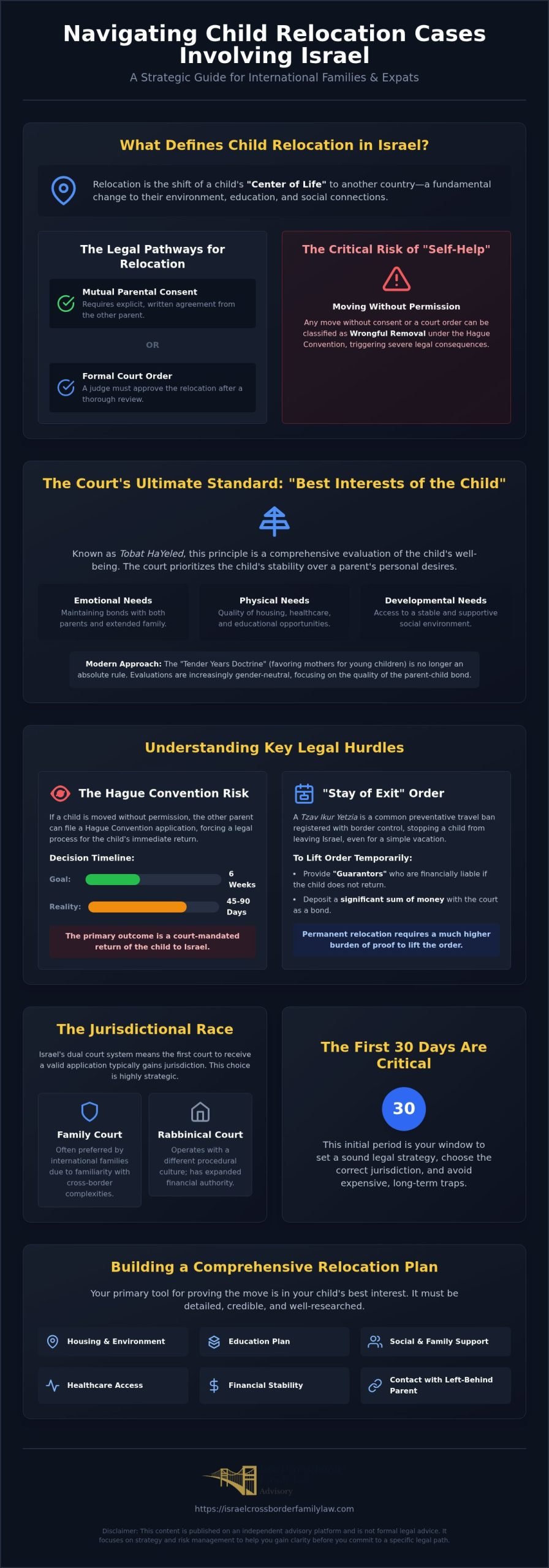
In Israel, child relocation is defined by the shift of a child’s “center of life” from one jurisdiction to another. It’s not a simple change of address; it’s a fundamental alteration of the child’s environment, education, and social support systems. Because both parents are considered natural guardians under Israeli law, neither parent can unilaterally decide to move a child abroad. You must obtain either the explicit, written consent of the other parent or a formal order from the court. Without these, any move may be classified as a wrongful removal under the Hague Convention on the Civil Aspects of International Child Abduction.
Israeli law views Child Relocation Cases Involving Israel as a modification of existing custody and guardianship arrangements. This means the court doesn’t just look at the move itself, but re-examines how the child’s needs will be met in a completely different legal and cultural context. Taking a proactive, advisory approach is essential. Understanding the rules before you make any commitments, such as signing a lease or a job contract in a new country, can prevent costly legal battles and emotional distress for your family.
To better understand this concept, watch this helpful video:
The “Stay of Exit” Order (Nechpach) Explained
A “Stay of Exit” order, or Tzav Ikur Yetzia, is a common feature in Israeli family law. It’s a preventative measure registered with border control that stops a child from leaving the country. For expats and dual citizens, these orders can be particularly stressful, as they often apply even if the child holds a foreign passport. If an order is in place, you cannot take the child on a simple vacation without a court’s permission. Usually, this involves providing “guarantors”, people who stay in Israel and agree to be financially liable if the child doesn’t return, or depositing a significant sum of money with the court. Permanent relocation requires a much higher burden of proof to lift the order permanently.
Family Court vs. Rabbinical Court Jurisdiction
Israel operates a dual court system, which creates a “race to the courthouse” scenario. The court where the first valid application is filed, either the civil Family Court or the religious Rabbinical Court, generally gains jurisdiction over the matter. While both courts are bound by the “best interests of the child” principle, their procedural cultures differ. Many international families prefer the Family Court, known as Beit Mishpat LeInyanei Mishpacha, because its judges are often more familiar with the multi-jurisdictional complexities of international custody and relocation. As of late 2025, Rabbinical courts have seen expanded authority over child-related financial matters, making the choice of forum even more strategic for parents in Child Relocation Cases Involving Israel.
The “Best Interests of the Child” Standard in Cross-Border Moves
In 2026, the central pillar of all Child Relocation Cases Involving Israel is the “Best Interests of the Child,” known as Tobat HaYeled. This principle isn’t a fixed rule but a comprehensive evaluation of what will best serve the child’s emotional, physical, and developmental needs. Israeli courts consistently prioritize the child’s stability over a parent’s desire to move for personal reasons. While the “Tender Years Doctrine,” the presumption that children under six should remain with their mother, still exists, it’s no longer an absolute rule. Modern evaluations are increasingly gender-neutral, focusing on the quality of the bond between the child and each parent rather than traditional roles.
A child’s own opinion also holds significant weight, provided they have the maturity to express a reasoned preference. Judges don’t typically allow children to testify in open court. Instead, a trained professional or a judge in chambers might interview the child to understand their perspective. This process ensures the child’s voice is heard without exposing them to the direct conflict of the litigation. If you’re feeling overwhelmed by these requirements, you might want to reach out for a confidential strategy session to clarify your next steps.
The Role of Court-Appointed Experts
The court heavily relies on the “Siyua” (Social Services) unit to gather objective data. These social workers conduct deep-dive investigations into the family dynamic, often performing home visits and interviews with teachers or doctors. Their report is a critical document that can sway a judge’s final decision. Beyond Siyua, the court may appoint a child psychologist to conduct a more intensive evaluation. Preparing for these meetings is essential. You should focus on presenting a child-centered narrative rather than using the interview as a platform to air grievances about the other parent. A 2022 legal analysis of child relocation cases highlights how these professional assessments often form the backbone of the court’s final ruling in complex international matters.
Evaluating the Parents’ “Relocation Motivation”
The court must distinguish between a legitimate move and one made in “bad faith.” Legitimate motivations usually involve career advancement, returning to a primary support network of family, or a significantly better educational environment. Conversely, if the court suspects the move is intended to alienate the other parent, the relocation is likely to be denied. You must demonstrate a genuine commitment to maintaining the child’s relationship with the non-relocating parent. This requires a detailed “good faith” proposal that includes specific dates for summer visits, holiday rotations, and a structured plan for virtual visitation. In 2026, virtual visitation is legally recognized as a fundamental right of the child, making it a mandatory component of any successful relocation plan.
Navigating Parental Consent and the Hague Convention
Attempting to relocate a child without formal consent is known in legal circles as “self-help,” but it carries the weight of a potential international abduction charge. In Child Relocation Cases Involving Israel, moving a child across borders without a signed agreement or a court order is a high-risk strategy that rarely ends well for the parent who leaves. The primary mechanism for resolving these disputes is the Hague Convention on the Civil Aspects of International Child Abduction. This treaty is designed to return children to their country of “habitual residence” so that the local courts can decide on custody matters.
Israel and the United States maintain a robust cooperative relationship regarding Hague Convention applications. As of 2026, Israeli law mandates that an initial hearing for such a petition must occur within 15 days of filing. While the treaty aims for a final decision within six weeks, the practical timeline for resolution typically ranges from 45 to 90 days. It’s a common misconception that a parent can easily claim a “grave risk” to the child to prevent their return. Israeli courts set an exceptionally high bar for this exception. They usually require evidence of severe physical harm or an intolerable situation that the receiving state cannot mitigate. General claims of psychological distress or a preference for a different lifestyle are rarely sufficient to block a return order.
Formalizing Relocation Agreements
A simple email, a text message, or a verbal “yes” from the other parent isn’t enough to secure your legal position. For an international move to be truly protected, you must formalize the terms in a written agreement. In Israel, this document should be “validated” by the Family Court to give it the status of an enforceable judgment. This process ensures that both parents understand the long-term implications of the move. A well-drafted agreement should include specific clauses for cross-border enforcement, detailing how visitation will be handled and which court retains jurisdiction if a dispute arises after the move. This level of detail provides the legal certainty needed to build a stable life in a new country.
Preventing International Custody Disputes
If you suspect the other parent might move the child unilaterally, you need to act quickly to protect your rights. Utilizing professional Hague Convention guidance can help you understand the immediate steps required to secure a “Stay of Exit” order. One of the most effective tools for international families is the “mirror order.” This involves obtaining identical court orders in both Israel and the United States. Mirror orders ensure that custody and visitation schedules are recognized and enforceable in both jurisdictions, closing the gaps that often lead to multi-jurisdictional litigation. Recent events, such as the authorized departure of non-emergency U.S. personnel in February 2026, have influenced how courts view habitual residence, making early strategic planning more important than ever in Child Relocation Cases Involving Israel.
Building a Comprehensive Relocation Plan for the Court
In the Israeli legal system, a relocation plan isn’t just a supporting document; it’s the primary evidence used to prove that a move serves the child’s best interests. When judges review Child Relocation Cases Involving Israel, they look for a granular level of detail that demonstrates the parent has considered every aspect of the child’s future. You shouldn’t just state that the child will attend a “good school.” Instead, you must provide specific school names, registration requirements, and a comparison of the curriculum to the child’s current Israeli education. The court wants to see a blueprint for stability that minimizes the disruption caused by moving across borders.
For many international families, a significant concern is maintaining the child’s “Anglo” or Israeli identity while living in the United States or elsewhere. A successful plan addresses this cultural nuance directly. You might include details about local Hebrew immersion programs, proximity to Jewish community centers, or enrollment in Israeli scouts (Tzofim) chapters. Showing the court that you’ve researched the local community and identified healthcare providers who accept your insurance helps build a narrative of preparedness and care. In 2026, Israeli courts also view digital communication as a fundamental right of the child. Your plan should outline a structured schedule for video calls and messaging to ensure the non-relocating parent remains an active presence in the child’s daily life.
Essential Elements of a Successful Motion
A motion for relocation must be backed by concrete evidence rather than aspirations. To strengthen your position, your plan should include:
- Educational Continuity: Letters from prospective schools or detailed brochures showing how the new environment supports the child’s specific learning needs.
- Family Support Networks: Evidence of nearby relatives, such as grandparents or cousins, who can provide emotional and practical support.
- Financial Stability: Documentation of a secured job offer or sufficient savings to maintain the child’s current standard of living abroad.
Managing Long-Distance Visitation
The court’s primary hesitation in relocation cases is often the potential loss of the relationship with the parent staying behind. You must propose a “block” visitation schedule that maximizes quality time while minimizing travel stress. This usually involves long summer stays, alternating winter breaks, and spring holidays. A critical part of the negotiation is determining travel logistics and costs. Common models include the relocating parent covering all flight costs or a proportional split based on income. Leveraging specialized international custody resources can help you draft a visitation schedule that is both fair and enforceable. If you need help structuring these logistics, you can request a strategy review to ensure your proposal meets the court’s standards.
Strategic Decision-Making: Seeking Clarity Before Committing
In the heat of a family dispute, the impulse is often to hire the most aggressive trial lawyer available. However, in Child Relocation Cases Involving Israel, the first 30 days are the most critical for setting a long-term strategy. Decisions made during this initial window, such as how you communicate your intent to the other parent or the timing of your first court filing, can dictate the outcome of a case that might take 18 to 24 months to resolve in the Israeli Family Court. Taking the wrong step early on can lead to a “Stay of Exit” order that keeps your children grounded for years.
Seeking an independent advisory perspective differs significantly from engaging a trial attorney. A trial lawyer’s primary role is to win a specific litigation battle within a single jurisdiction. An advisor, conversely, focuses on the broader multi-jurisdictional landscape. They help you evaluate the risks and costs honestly before you enter the Israeli legal system. This is especially vital for expats and dual citizens who may not realize how a “race to the courthouse” in Israel could permanently trap them in a jurisdiction they didn’t intend to reside in long-term. A confidential case review allows you to map out your options without the immediate pressure of a courtroom battle.
The Cross-Border Advisory Model
Our approach centers on providing a bridge between Western legal expectations and the practical realities of Israeli family law. You can learn more about how the advisory process works for international families by exploring our strategic framework. We prioritize risk management and conflict de-escalation over aggressive litigation. By focusing on a comprehensive relocation plan first, families can often avoid the trauma and expense of a Hague Convention dispute. This model is designed to give you clarity on your rights and obligations while maintaining a focus on family stability.
Next Steps for Families Considering a Move
If you’re considering a move, it’s essential to gather all necessary documentation before you notify the other parent. This includes secured employment offers, detailed school research, and evidence of a support network in the destination country. Understanding the pricing and engagement for cross-border strategy allows you to budget for the legal journey ahead. Please be aware that this content is published on an independent advisory platform, not a law firm, and does not constitute formal legal representation. Strategic planning today is the most effective way to manage Child Relocation Cases Involving Israel and prevent jurisdictional traps tomorrow.
Get clarity before you commit. Request a confidential consultation.
Securing Your Family’s Future Across Borders
Successfully managing Child Relocation Cases Involving Israel requires a blend of legal precision and strategic foresight. You’ve seen that the “Best Interests of the Child” is the paramount standard and that a detailed, child-centered relocation plan is your most effective tool in the Israeli Family Court. We’ve also highlighted the significant risks of unilateral moves under the Hague Convention, where even temporary departures can lead to long-term legal complications if handled without formal consent or a validated court order.
This platform operates as an independent advisory service, not a law firm. We provide specialized US-Israel cross-border expertise and a reassuring, Anglo-focused advisory approach for families who need a deep understanding of international family law. Our role is to act as a bridge between legal systems, ensuring you have the clarity needed to make informed decisions for your children’s long-term stability. By focusing on strategy and risk management before engaging in litigation, you protect your family from unnecessary jurisdictional traps.
Get clarity before you commit. Request a confidential consultation to discuss your specific strategy. With the right framework and early guidance, you can navigate these cross-border complexities with confidence.
Frequently Asked Questions
Can I take my child out of Israel without the other parent’s consent?
No, you cannot legally relocate a child or even take them for a short trip abroad without the explicit written consent of the other parent or a court order. Because both parents are natural guardians under Israeli law, unilateral action is viewed as a breach of parental rights. Doing so can trigger a Hague Convention application for the child’s immediate return. It’s essential to formalize any agreement in writing to avoid potential abduction charges.
How long does a relocation case typically take in the Israeli Family Court?
A contested relocation case in the Israeli Family Court typically takes between 18 and 24 months to reach a final decision. This timeframe includes mandatory mediation attempts, social worker investigations, and expert evaluations. Because the court prioritizes a thorough review of the child’s future stability, these proceedings are rarely fast. Families should plan their move well in advance to account for these significant procedural durations.
What is the “Stay of Exit” order and how do I know if one exists for my child?
A “Stay of Exit” order, known as a Tzav Ikur Yetzia, is a preventative measure registered with border control to stop a child from leaving Israel. You can check if an order exists by contacting the Population and Immigration Authority or through a legal inquiry. These orders are common in Child Relocation Cases Involving Israel and often require the parent to provide financial guarantors before the court will temporarily lift them for travel.
Does the US-Israel tax treaty affect child support during relocation?
The US-Israel tax treaty doesn’t directly set child support rates, but it significantly impacts the net income used for support calculations. Since Israeli courts look at the actual disposable income of both parents, tax obligations in both jurisdictions must be considered. As of November 2025, Rabbinical courts also have expanded jurisdiction over child-related financial needs. This makes a cross-border financial strategy vital for maintaining the child’s standard of living after relocation.
What happens if I move to the US and the other parent files a Hague Convention claim?
If a Hague Convention claim is filed, the US court will focus on whether the child was “wrongfully removed” from their habitual residence in Israel. In 2026, the practical timeline for resolving these disputes ranges from 45 to 90 days. The court’s primary goal isn’t to decide custody, but to determine if the child should be returned to Israel so the local courts can resolve the relocation dispute properly.
How does the court decide if a move is in the “best interests of the child”?
The court uses a holistic standard called Tobat HaYeled to evaluate the child’s future quality of life. Judges rely on reports from the “Siyua” social services unit to assess the child’s emotional bond with each parent and the strength of the proposed support network abroad. They prioritize continuity in education and social environment. The burden is on the moving parent to prove the child’s life will be better or equal in the new location.
Can a teenager choose which country they want to live in?
While a teenager doesn’t have an absolute right to choose, their opinion carries significant weight in Child Relocation Cases Involving Israel once they reach an age of maturity. Judges often meet with older children in chambers or through a professional interviewer to hear their preferences. However, the court still makes the final decision based on the child’s overall best interests, rather than just granting the teenager’s specific wish.
Is a US custody order automatically enforceable in Israel?
No, a US custody order isn’t automatically enforceable in Israel. It must go through a formal process of “recognition and enforcement” in the Israeli Family Court. To avoid gaps in protection, international families often use “mirror orders,” which are identical rulings issued in both countries. This ensures that visitation schedules and guardianship rights are recognized by border control and local authorities in both the US and Israel.

Article by
Gabriel Lior
A Personal Journey That Became a Mission
The advisory was founded by an American father Gabriel Lior, LLB, MBA , global entrepreneur, and cross-border advisor who spent more than a decade navigating the Israeli family court system firsthand and now lives in Singapore with his son.
As a divorced parent in a cross-border family, Gabriel faced nearly every legal challenge a foreign parent can encounter in Israel — including child custody disputes, child support proceedings, property matters in Israel and abroad, false accusations, and complex immigration and relocation proceedings.
Over the years, he learned the hard way how difficult it is for non-Israeli parents to understand the system, identify the right legal strategy, and choose the right legal representation — especially when language, culture, and jurisdictional differences are involved. He also witnessed how foreign parents and new immigrants are often disadvantaged or taken advantage of by service providers and institutions simply because they lack local knowledge or fluency.
From Client to Advisor
To truly understand — and survive — the system, Gabriel pursued formal legal education in Israel, completing two Israeli law degrees, alongside a BA and MBA earned in the United States. This was never about becoming a practicing attorney, but about gaining a deep, structural understanding of how the system works — and where it breaks down for foreign parents.
This rare combination of:
Firsthand client experience
Israeli legal and US business education
International business and negotiation training
Decades of commercial execution
created a unique perspective – one that understands both sides of the table.
After years of litigation, persistence, and at times self-representation, he ultimately succeeded in securing custody of his son and relocating abroad through a rare legal victory in the Israeli Supreme Court — becoming one of the first fathers in Israel to do so under these circumstances.
Disclaimer
Important Disclaimer:
The information provided on this website and in its content is for general informational and educational purposes only and does not constitute legal advice, legal opinion, or legal representation.
Gabriel Lior is not licensed to practice law in Israel (nor is he interested in doing so) and does not provide legal services, despite having completed 2 Law Degrees. The services offered are advisory in nature and are intended to provide general guidance, strategic insight, and information regarding cross-border family law considerations.
No attorney-client relationship is formed by accessing this website, reading its content, or communicating with us.
Any decisions made based on this information are at your own discretion and risk. For legal advice specific to your situation, you should consult a licensed attorney in the relevant jurisdiction.
Where appropriate, we may refer clients to independent, licensed attorneys or professionals. Such referrals do not constitute legal representation and no liability is assumed for services provided by third parties.