What if the court that decides your divorce or custody arrangement is determined not by your location, but by which spouse files a single document first? For international residents, the “race for jurisdiction” between Israel’s civil Family Courts and religious Rabbinical Courts is often the first and most jarring hurdle in a legal dispute. You’ve likely felt the weight of confusion as you try to reconcile your life in the United States with the unique legal landscape of your new home. Finding a specialized family lawyer for expats Tel Aviv is often the only way to bridge this gap without losing your peace of mind.
We understand that protecting your family and your assets requires more than just local knowledge; it requires a strategic understanding of how two different legal systems interact. This article provides a clear roadmap for navigating these multi-jurisdictional challenges, from protecting US-based retirement accounts to understanding the 2026 reporting requirements for foreign income. We will examine the risks of early legal decisions and how to secure your interests across borders, including resources from the Israel Family Law YouTube channel. This content is published on an independent advisory platform and is intended for informational purposes; legal services are only provided by licensed attorneys under a separate engagement.
Key Takeaways
- Understand how the “race for jurisdiction” between Israeli civil and religious courts can fundamentally change the legal rules governing your case.
- Learn how international treaties like the Hague Convention impact child custody and the specific process for enforcing US support orders within Israel.
- Discover why consulting a family lawyer for expats Tel Aviv is essential for protecting complex assets, such as US-based retirement accounts and Israeli real estate.
- Identify the inherent risks of using standard legal documents that fail to account for the unique tax and inheritance laws of two different countries.
- Gain a strategic framework for managing cross-border disputes through an integrated advisory approach that prioritizes long-term clarity and risk mitigation.
Understanding Family Law for Expats in Tel Aviv
The legal framework governing family life in Israel is rooted in a combination of modern civil statutes and long standing religious traditions. For international residents, this intersection creates a level of complexity that is rarely encountered in North America or Europe. Marriage laws in Israel, for instance, fall under the exclusive authority of religious courts, which can have profound implications if a relationship ends. Because your life spans multiple jurisdictions, a standard legal approach often fails to address the friction between these different systems.
To better understand this concept, watch this helpful video:
Expats living in the city often find that their legal status is a mix of Israeli residency and foreign citizenship. This dual identity means that a simple divorce or custody matter can quickly involve international treaties like the Hague Convention. Seeking a specialized family lawyer for expats Tel Aviv is not just about finding someone who speaks English. It’s about finding a professional who understands that a decision made in a Tel Aviv courtroom can trigger tax consequences or enforcement issues in the United States. Early clarity is essential because the first steps you take often dictate which legal system will govern your future.
The Role of an International Family Law Advisor
Effective cross-border planning requires more than just local representation. It requires a strategic bridge between your Anglo expectations and the specific realities of the Israeli court system. An advisor identifies risks before they become crises, such as the new January 2026 reporting requirements for foreign assets. This approach focuses on long term stability rather than immediate conflict. You can learn more about how this strategy protects your interests by visiting our page About the Advisory.
Common Legal Issues for Expats in Tel Aviv
Foreign nationals frequently face obstacles that local residents do not. These include:
- Divorce proceedings: Dividing assets like 401(k) plans or US real estate must be handled carefully to avoid the 10% early withdrawal penalty or unexpected capital gains tax.
- International custody: Relocation requests must comply with both Israeli law and global standards to prevent accusations of international child abduction.
- Financial agreements: Prenuptial and postnuptial agreements need to be drafted so they are enforceable in both Tel Aviv and your home state.
A general practitioner may understand Israeli law, but they often lack the multi-jurisdictional perspective needed to manage these complex moving parts effectively. This content is published on an independent advisory platform, not a law firm. Our focus is on strategy, risks, and decision-making guidance. Legal representation is provided only by licensed attorneys under a separate engagement.
The Dual Jurisdictional System: Rabbinical vs. Civil Courts
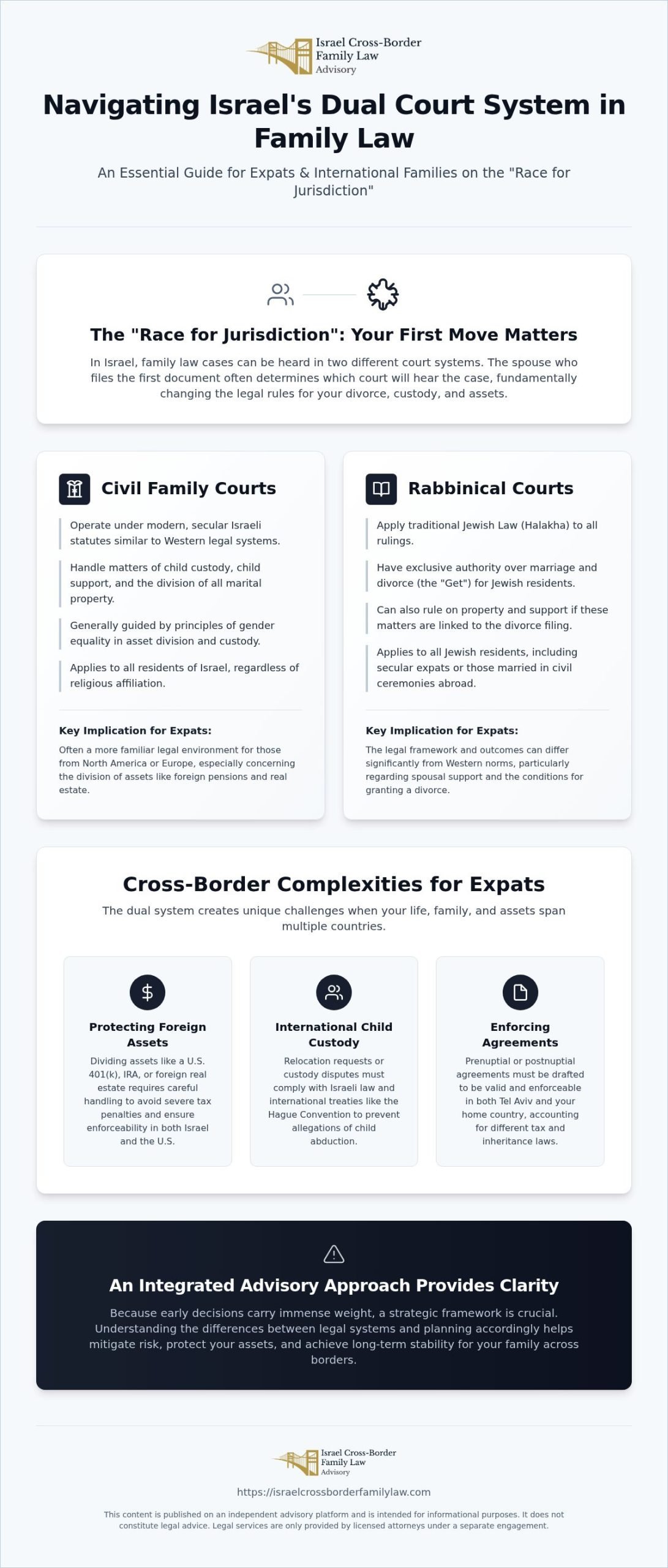
Israel maintains a unique legal structure where two separate court systems share authority over family matters. For many international residents, the existence of parallel jurisdiction between civil Family Courts and religious Rabbinical Courts is a significant source of stress. While the civil courts operate under modern statutes, the Rabbinical Courts apply Jewish law. This dual system applies to all Jewish residents, including secular expats and those who were married in civil ceremonies outside of Israel. The person who files first typically determines which court will hear the case, a phenomenon known as the “race for jurisdiction.” This choice is not merely a matter of location; it dictates the fundamental rules that will govern your divorce, property division, and financial future.
Working with a family lawyer for expats Tel Aviv is often necessary to navigate this “race” effectively. If one spouse files for divorce in the Rabbinical Court and “attaches” matters like property or alimony to that claim, the religious court gains the authority to decide those issues. Conversely, if the other spouse files first in the civil Family Court, the civil system takes the lead. Because the two systems can reach very different conclusions on the same set of facts, the timing and location of your initial filing are perhaps the most consequential decisions you’ll make. Being “trapped” in a jurisdiction that doesn’t align with your interests can lead to outcomes that are difficult to reverse.
How the System Affects Non-Jewish Expats
For interfaith couples, non-Jewish expats, or those with no religious affiliation, the Family Court serves as the primary legal venue. The process for the dissolution of marriage for these couples involves specific procedures to determine which religious or civil authority has the right to dissolve the union. Even in these cases, the weight of early decisions remains high. Foreigners often assume their home country’s laws will automatically apply; however, Israeli courts will generally apply local law unless a specific strategy is implemented to argue for the application of foreign statutes. If you need to clarify your standing within this system, you may request a confidential discussion to explore your specific circumstances.
Strategic Considerations for Filing
Strategic venue selection requires a deep understanding of how each court views specific issues. For example, the civil Family Courts strictly follow the Spouses (Property Relations) Law of 1973, which generally mandates a 50/50 split of assets accumulated during the marriage. Religious courts may apply different standards regarding the behavior of the parties or the nature of the marital home. Furthermore, the impact of international treaties on local decisions must be considered when assets or children are located across borders. Understanding how it works for international clients allows you to make informed choices rather than reacting to a spouse’s legal maneuvers. This content is published on an independent advisory platform and does not constitute legal representation; formal legal services are provided only by licensed attorneys under a separate engagement.
Resolving Cross-Border Divorce and Custody Challenges
When a marriage dissolves within an expat community, the most sensitive issues usually involve the children. Unlike domestic cases, international custody requires a deep understanding of the Hague Convention on the Civil Aspects of International Child Abduction. This treaty is designed to prevent the unilateral removal of a child from their country of habitual residence. In Tel Aviv, courts are increasingly sophisticated in handling these disputes, but the stakes remain high. Identifying a family lawyer for expats Tel Aviv who is well-versed in both Israeli procedure and international treaty law is vital for protecting your parental rights.
The Israeli court’s primary benchmark is the “best interests of the child.” In a global context, this includes assessing the child’s social ties, educational stability, and the potential impact of moving between cultures. Decisions regarding relocation are rarely straightforward; they require a strategy that addresses both the emotional and legal realities of international living. It’s essential to seek clarity before making any changes to a child’s living arrangements, as early choices can have permanent legal consequences.
Hague Convention and International Relocation
Relocation cases often arise when one parent wishes to return to their home country after a separation. Under Israeli law, you can’t permanently remove a child from the country without the other parent’s written consent or a specific court order. Attempting to do so can trigger a Hague Convention claim, which aims to return the child to Israel for a custody determination. These proceedings move quickly and focus on where the child was “habitually resident” before the move. For a detailed look at these requirements, see our guide on International Custody & Relocation.
Cross-Border Support Enforcement
Financial obligations don’t stop at the border. US child support orders are enforceable in Israel, but they require a formal recognition process under the Foreign Judgments Enforcement Law of 1958. This often involves cooperation with the Office of the Israeli Official Receiver. Managing alimony expectations is equally complex, especially when income is earned in US dollars but expenses are paid in Shekels. Strategic advisors help clarify the mechanisms for enforcing child support while ensuring financial discovery covers assets in both jurisdictions. This content is published on an independent advisory platform and focuses on decision-making guidance; legal representation is provided only by licensed attorneys under a separate engagement.
Strategic Asset Protection and Estate Planning
Managing wealth across two countries requires a strategy that looks beyond the local horizon. Expats in Tel Aviv often hold a diverse portfolio, including Israeli real estate, US-based retirement accounts like 401(k)s, and interests in international businesses. A standard Israeli will, while valid for local property, is frequently insufficient for managing the probate process or the tax implications of assets held in the United States. Engaging a family lawyer for expats Tel Aviv ensures that your estate plan addresses the inherent friction between these two legal systems and prevents administrative gridlock for your heirs.
The importance of seeking clarity before making financial commitments cannot be overstated. For example, dividing a US retirement account in an Israeli divorce requires a Qualified Domestic Relations Order (QDRO) issued by a US court to avoid a 10% early withdrawal penalty. Without this specific cross-border instrument, an Israeli court order alone won’t suffice for ERISA-governed plans. Protecting your interests requires a proactive approach that recognizes these technical boundaries early in the process.
Financial Agreements for International Couples
Financial agreements, whether signed before or after marriage, serve as a critical tool for protecting pre-marital global wealth. For those in the tech sector, these agreements must specifically address the division of “future” assets, such as stock options, RSU grants, or potential tech exits. It’s vital that these documents are drafted to be enforceable in both Tel Aviv civil courts and relevant US state courts. You can find more information on how these protections apply specifically to expats and foreign nationals.
Cross-Border Wills and Trusts
Effective estate planning for international families requires coordinating your Israeli documents with your US-based trusts or wills. Without a bilingual and multi-jurisdictional review, your estate may be subject to conflicting rules. For instance, while Israel has no inheritance tax, US citizens are subject to US estate tax on their worldwide assets, including Israeli real estate. As of 2026, the US federal estate tax exemption is approximately $13.99 million per individual. Business owners should also consider how these plans interact with corporate structures, as discussed in our guide on navigating US-Israel M&A.
Decisions regarding global assets carry significant weight and should be made with a clear understanding of the long-term risks. If you are managing property or retirement funds in both countries, you should consult with an advisor to review your cross-border strategy. This content is published on an independent advisory platform and focuses on strategy and risk mitigation; legal services are only provided by licensed attorneys under a separate engagement.
How an Integrated Advisory Approach Provides Clarity
Successfully managing a cross-border legal matter requires more than just local representation; it demands a unified strategy that accounts for your interests on both sides of the Atlantic. Many families make the mistake of hiring a local practitioner who focuses solely on the immediate dispute in Tel Aviv. While they may understand the nuances of the Israeli court system, they often lack the perspective to see how those decisions impact your US-based retirement accounts, tax obligations, or future relocation plans. A specialized family lawyer for expats Tel Aviv acts as a critical link, ensuring that your legal steps in Israel don’t create unintended liabilities in your home country.
This integrated approach prioritizes strategy and risk mitigation over immediate litigation. By looking at the “big picture” before filing a single document, you can avoid the common pitfalls of the Israeli dual-court system. Whether you’re navigating a divorce or planning an estate, the goal is to create a roadmap that provides stability. This involves working in tandem with your existing professional teams in the US to ensure that every agreement is enforceable and tax-efficient in both jurisdictions. It’s about finding a calm path through a period that often feels chaotic.
Working with Israel Cross Border Law Firm
Our role is to serve as an independent advisory platform that focuses on high-level strategy and informed decision-making. We provide a bridge between legal systems, helping you understand the cultural and procedural differences you’ll encounter in Israel. We maintain a transparent environment regarding our pricing and the scope of our engagement, so you always know what to expect. This content is published as part of our advisory mission; it isn’t legal representation, and formal legal services are only provided by licensed attorneys under a separate agreement.
Next Steps for Expats in Tel Aviv
The first step toward clarity is gathering a comprehensive list of your global assets, including real estate, bank accounts, and retirement funds. Understanding the full scope of your “marital estate” allows for a more accurate assessment of your risks. For those who are still in the early stages of research, the Israel Family Law YouTube channel offers a wealth of educational videos on topics like alimony and the Hague Convention. These resources are designed to help you build a foundation of knowledge before you commit to a specific legal course of action.
Every international family has a unique set of circumstances that requires a tailored approach. Before making any formal legal commitments that could impact your future in both Israel and the US, it’s helpful to establish a clear plan. You can request a confidential case review to discuss your specific situation and begin building a strategy that protects your interests across borders. Get clarity before you commit.
Securing Your Future Across Borders
Navigating family law in a foreign country is a complex undertaking that requires a specialized perspective. You’ve seen how the “race for jurisdiction” can dictate the fundamental rules of your case and why coordinating US-based assets like retirement accounts is vital for long-term financial health. By understanding these friction points early, you can move from a position of uncertainty to one of strategic control. The weight of early decisions in the Israeli legal system means that seeking clarity is your most effective tool for risk mitigation.
Finding the right family lawyer for expats Tel Aviv is about more than local representation; it’s about building a bridge between two distinct legal systems. Our specialized US-Israel cross-border strategy provides the calm, expert guidance international families need during periods of transition. This content is published on an independent advisory platform and does not constitute an attorney-client relationship; formal legal services are provided only by licensed attorneys under a separate engagement.
Get clarity before you commit. Request a confidential consultation to discuss your specific situation. You don’t have to face these multi-jurisdictional complexities alone. With a proactive strategy, you can protect your global interests and provide a stable, secure future for your family.
Frequently Asked Questions
Do I need a lawyer licensed in both the US and Israel for my divorce?
While it is not a strict legal requirement, consulting a family lawyer for expats Tel Aviv with a deep understanding of both systems is highly beneficial. This integrated perspective ensures that your Israeli legal strategy doesn’t inadvertently trigger tax penalties or enforcement issues in the United States. Coordinating with practitioners who understand multi-jurisdictional complexity helps bridge the gap between divergent legal cultures.
Can a US prenuptial agreement be enforced in an Israeli court?
A US prenuptial agreement is generally enforceable in Israel, provided it meets specific legal criteria under the Spouses (Property Relations) Law of 1973. It’s essential to have the agreement reviewed and approved by an Israeli Family Court to ensure its local validity. Without this formal validation, the agreement may face challenges if a dispute arises regarding the division of global assets.
How does the Israeli court determine child custody for expat families?
Israeli courts determine custody based on the “best interests of the child” principle. For expat families, this involves evaluating the child’s social and educational integration in Israel versus their ties to their home country. The court often appoints professional social workers to provide recommendations on the most stable environment for the child’s long-term development.
What is the “Race for Jurisdiction” in Israeli family law?
The “Race for Jurisdiction” refers to the parallel authority of the civil Family Courts and the religious Rabbinical Courts. The spouse who files first in one system generally determines which court will hear related matters like property division or alimony. This choice is a critical strategic decision that significantly impacts the legal rules applied to the case.
Will my US-based assets be divided in an Israeli divorce?
Yes, Israeli courts generally claim jurisdiction over all assets accumulated during the marriage, regardless of where they are located. However, dividing US retirement accounts like a 401(k) requires a Qualified Domestic Relations Order (QDRO) issued by a US court. An Israeli order alone is not sufficient to divide these funds without incurring significant tax penalties.
Can I move back to the US with my children after a divorce in Tel Aviv?
Moving children back to the US requires either the written consent of the other parent or a specific relocation order from the Israeli court. Unilateral removal without these permissions can trigger a claim under the Hague Convention on Child Abduction. The court will weigh the benefits of the move against the child’s right to maintain a relationship with both parents.
How long does the family law process typically take for foreigners in Israel?
The timeline for family law proceedings varies depending on whether the parties choose mediation or litigation. While mediation can resolve issues in a few months, contested cross-border cases may take a year or longer. Establishing a clear strategy before taking formal legal action is the most effective way to manage both the timeline and the associated risks.
What is the difference between the Family Court and the Rabbinical Court for non-religious people?
The civil Family Court is the primary venue for secular expats and interfaith couples. However, for Jewish residents, the Rabbinical Court maintains exclusive authority over the actual act of granting a divorce. Strategic filing allows non-religious parties to keep financial and custody matters within the civil system while still obtaining the necessary religious decree.
Disclaimer: This content is published on an independent advisory platform and does not constitute an attorney-client relationship. We focus on strategy, risks, and decision-making guidance; legal representation is provided only by licensed attorneys under a separate engagement.

Article by
Gabriel Lior
A Personal Journey That Became a Mission
The advisory was founded by an American father Gabriel Lior, LLB, MBA , global entrepreneur, and cross-border advisor who spent more than a decade navigating the Israeli family court system firsthand and now lives in Singapore with his son.
As a divorced parent in a cross-border family, Gabriel faced nearly every legal challenge a foreign parent can encounter in Israel — including child custody disputes, child support proceedings, property matters in Israel and abroad, false accusations, and complex immigration and relocation proceedings.
Over the years, he learned the hard way how difficult it is for non-Israeli parents to understand the system, identify the right legal strategy, and choose the right legal representation — especially when language, culture, and jurisdictional differences are involved. He also witnessed how foreign parents and new immigrants are often disadvantaged or taken advantage of by service providers and institutions simply because they lack local knowledge or fluency.
From Client to Advisor
To truly understand — and survive — the system, Gabriel pursued formal legal education in Israel, completing two Israeli law degrees, alongside a BA and MBA earned in the United States. This was never about becoming a practicing attorney, but about gaining a deep, structural understanding of how the system works — and where it breaks down for foreign parents.
This rare combination of:
Firsthand client experience
Israeli legal and US business education
International business and negotiation training
Decades of commercial execution
created a unique perspective – one that understands both sides of the table.
After years of litigation, persistence, and at times self-representation, he ultimately succeeded in securing custody of his son and relocating abroad through a rare legal victory in the Israeli Supreme Court — becoming one of the first fathers in Israel to do so under these circumstances.
Disclaimer
Important Disclaimer:
The information provided on this website and in its content is for general informational and educational purposes only and does not constitute legal advice, legal opinion, or legal representation.
Gabriel Lior is not licensed to practice law in Israel (nor is he interested in doing so) and does not provide legal services, despite having completed 2 Law Degrees. The services offered are advisory in nature and are intended to provide general guidance, strategic insight, and information regarding cross-border family law considerations.
No attorney-client relationship is formed by accessing this website, reading its content, or communicating with us.
Any decisions made based on this information are at your own discretion and risk. For legal advice specific to your situation, you should consult a licensed attorney in the relevant jurisdiction.
Where appropriate, we may refer clients to independent, licensed attorneys or professionals. Such referrals do not constitute legal representation and no liability is assumed for services provided by third parties.