A Hague Convention hearing is not an inquiry into who is the better parent; it is a high-speed jurisdictional mechanism designed to return a child to their country of habitual residence. For international families in Israel, the sudden realization that a court may order a child’s immediate return to a foreign jurisdiction creates a level of stress that is difficult to quantify. You likely feel that the legal system is moving too fast to consider the nuances of your family’s life. It’s critical to recognize that successful Defenses to Hague Convention Claims are not based on general custody arguments but on specific, narrow exceptions defined by international treaty.
This article is published on an independent advisory platform, not a law firm, to provide strategic clarity on the legal frameworks governing cross-border disputes. You’ll learn about the high evidentiary threshold required for Article 13 “grave risk” claims and the complexities of the “well-settled” defense, which remains a point of significant judicial uncertainty following the U.S. Supreme Court’s 2026 decision to let circuit splits stand. We will preview the essential evidence needed to challenge a return order and explore how early strategic decisions can help you manage these multi-jurisdictional complexities without a summary order of return.
Key Takeaways
- Learn why successful Defenses to Hague Convention Claims focus on narrow jurisdictional exceptions rather than a standard “best interests of the child” custody analysis.
- Identify the high evidentiary threshold required to prove “grave risk” under Article 13(b) and how Israeli courts interpret “intolerable situations” in domestic cases.
- Understand the criteria used to determine a child’s “habitual residence,” which serves as the legal foundation for whether the Convention applies to your specific situation.
- Discover how the 12-month filing window impacts the “well-settled” defense and what factors, such as school and community ties, demonstrate a child’s integration into life in Israel.
- Explore strategic alternatives to a contested court hearing, including mediation and voluntary return agreements, to find a resolution that prioritizes long-term family stability.
The Hague Convention Framework: Why Defenses Are Narrowly Construed
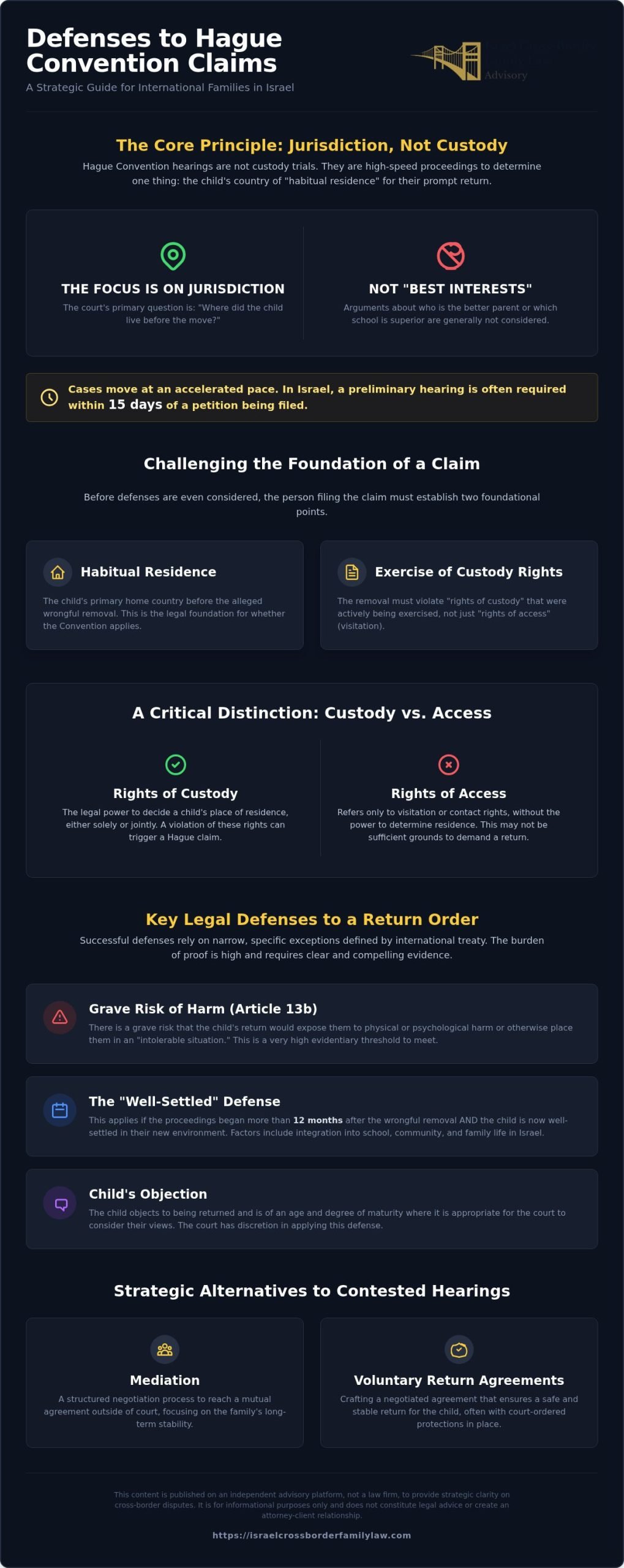
The primary objective of the Hague Convention on the Civil Aspects of International Child Abduction is to ensure the prompt return of children who have been wrongfully removed or retained across international borders. It operates on a restorative principle. The treaty assumes that the courts in the child’s home country are best equipped to handle long-term custody disputes. Because of this, Hague proceedings are strictly jurisdictional. They are not custody trials. The court will not weigh which parent provides a better home or which school is superior. Instead, it focuses on where the child lived before the move.
This focus on jurisdiction leads to the “Summary Return” principle. Cases move at an accelerated pace compared to standard family law litigation. In Israel, family courts are often required to hold a preliminary hearing within 15 days of a petition being filed. The court generally presumes that return is mandatory. To stop this process, you must prove one of the few Defenses to Hague Convention Claims with clear and compelling evidence.
To better understand this concept, watch this helpful video:
The Role of Central Authorities in the US and Israel
This advisory platform is an independent resource, not a law firm, focusing on the strategic intersection of the US and Israeli legal systems. When a claim begins, the US State Department and the Israeli Ministry of Justice act as the Central Authorities. They facilitate the communication and transmission of the application. In many cases, the first 48 hours are critical. This is when the applicant parent often initiates a “stop order” to prevent further travel. Because the timeline is so compressed, getting strategic clarity before making legal commitments is vital. You can read more about how this process works on our page regarding Hague Convention child abduction.
Custody Rights vs. Rights of Access
Not every parent with a visitation schedule can file a Hague claim. Under Article 3, a removal is only “wrongful” if it violates “rights of custody” that were actually being exercised at the time. Rights of Custody refers to the legal power to decide a child’s residence, either solely or jointly. This is distinct from “rights of access,” which usually refers only to visitation. If a parent only has a right to see the child but no say in where they live, they may not have the standing to demand a return under the Convention. Understanding these definitions is a cornerstone of building successful Defenses to Hague Convention Claims. Decisions made in the early stages of a cross-border dispute often carry significant weight in how these rights are interpreted by the court.
The Six Legal Defenses to a Hague Convention Return Order
This advisory platform provides strategic information on the risks inherent in cross-border disputes; it is not a law firm and does not provide legal representation. When evaluating Defenses to Hague Convention Claims, you must recognize that these are strictly interpreted exceptions to a mandatory return rule. Courts generally begin with the presumption that the child should be returned to their home country. There are six primary pathways to challenge this, ranging from the child’s own objections to the specific conduct of the parent seeking the return. Because the legal threshold is high, understanding the evidence required for each defense is the first step toward achieving a resolution that protects your child’s stability.
Proving Grave Risk of Harm (Article 13b)
The evidentiary bar for Article 13(b) is exceptionally high. It requires more than a showing that one parent is better suited for custody or that the child prefers life in Israel. You must demonstrate a grave risk that the return would expose the child to physical or psychological harm or otherwise place the child in an intolerable situation. In 2021, the overall rate of return for children in Hague cases was 39%, a figure that underscores how difficult these exceptions are to meet. Courts often evaluate whether the foreign jurisdiction has the capacity to protect the child from the alleged harm. If the home country is a stable legal system, such as the US, Israeli courts may assume that US authorities can manage safety concerns upon the child’s arrival. A detailed legal analysis of Hague Convention defenses reveals that successful Article 13(b) claims usually involve documented patterns of severe domestic violence or active war zone conditions.
Consent and Acquiescence: The Paper Trail
Article 13(a) focuses on the communication and actions of the left-behind parent. Consent occurs before the move; acquiescence occurs after the child has been removed or retained. The court will look for a clear paper trail, such as emails, text messages, or signed agreements, to determine if the other parent agreed to a permanent relocation. Consent must be unequivocal to be a valid defense. Even if there was no initial consent, a parent might waive their right to a return order through their subsequent actions. For example, if a parent helps enroll a child in an Israeli school or waits an unreasonable amount of time to object to the move, the court may find they acquiesced to the new arrangement. To understand how these strategies apply to your specific family history, you may wish to request a confidential consultation.
Additional Exceptions and the 2026 Legal Landscape
The remaining defenses include the “Age and Maturity” exception, where a child of sufficient age objects to the return, and Article 20, which addresses violations of fundamental human rights. The “Well-Settled” defense is also critical but only applies if the petition is filed more than one year after the removal. This area of law remains complex; in April 2026, the U.S. Supreme Court declined to resolve a deep circuit split regarding whether “well-settled” status is a factual or legal determination. This uncertainty highlights why early strategic clarity is more valuable than reactive litigation.
Challenging the Foundation: Habitual Residence and Custody Exercise
Before a court evaluates specific Defenses to Hague Convention Claims, it must first confirm that the Convention actually applies to your situation. This requires the applicant parent to prove that the child was “habitually resident” in the country they were taken from immediately before the removal. If the child was already habitually resident in Israel, the petition for return must be dismissed without the need to examine Article 13 exceptions. This threshold is often where the most significant strategic battles occur, as it defines the entire legal landscape of the case.
Determining Habitual Residence in US-Israel Cases
Courts use a fact-intensive inquiry to determine where a child is truly at home. Following the US Supreme Court decision in Monasky v. Taglieri (2020), this analysis looks at the “totality of the circumstances” rather than a single rigid formula. For expats and international families, this can be particularly complex. You might spend summers in the US and the school year in Israel, or you may have moved to Israel with the intention of a “trial period” that eventually became permanent. The court examines objective facts: where the child attends school, where their medical records are kept, and where their social ties are strongest.
Judges also consider parental intent through the “Settled Purpose” test. Did the family intend to make Israel their permanent home? Temporary stays for holidays or extended family visits don’t usually create a new habitual residence. However, once a family integrates into Israeli life, the foundation for a US-based Hague claim begins to erode. Learn more about international custody and relocation to see how these factors might apply to your family’s specific history.
Was the Left-Behind Parent Exercising Custody?
Even if habitual residence in the foreign country is established, the applicant parent must show they were actually exercising “rights of custody” at the time of removal. Article 13(a) provides a defense if the parent seeking return was not actually acting as a parent. In the 2026 case of Queiroz v. Schuenck, the court clarified that even consistent video calls and involvement in the child’s activities can constitute an “exercise” of rights. A total lack of involvement in school meetings, doctor visits, and daily care can serve as a valid defense.
The burden of proof initially rests with the applicant to show they were involved in the child’s life. If they cannot meet this burden, or if their legal “rights of custody” are found to be non-existent under the law of the home country, the return order may be denied. It’s vital to gather evidence of the other parent’s level of engagement long before a hearing begins. This advisory platform helps you identify these strategic risks early, ensuring you have clarity before making legal commitments. Building successful Defenses to Hague Convention Claims requires a deep understanding of how these daily facts translate into international legal standards.
The 12-Month Rule and the “Well-Settled” Defense
The Hague Convention is built on the premise of speed to minimize the disruption to a child’s life. However, Article 12 introduces a critical temporal boundary known as the one-year rule. If a parent files a petition for return within one year of the wrongful removal or retention, the court must order the child’s return unless a narrow exception like grave risk is proven. Once that one-year clock expires, the legal landscape shifts fundamentally. If the applicant waits even 366 days to file, the court is no longer mandated to return the child if it’s demonstrated that the child is now “well-settled” in their new environment. This timing makes the one-year mark one of the most significant Defenses to Hague Convention Claims.
It’s a common misconception that a child’s integration can be used as a defense at any time. In reality, the “well-settled” exception is completely unavailable to a taking parent if the petition is filed within the first 11 months of the move. The court only gains the discretion to consider the child’s new life in Israel if the left-behind parent has allowed a full year to pass before seeking judicial intervention. This advisory platform focuses on helping families identify these strategic windows before they close, ensuring you have clarity before making legal commitments.
Factors Courts Use to Measure Integration
Integration is an objective analysis of the child’s daily life, looking for deep, permanent roots rather than mere temporary comfort. Israeli courts typically examine several key indicators to determine if a child is well-settled:
- Proficiency in Hebrew and successful academic progress in the Israeli school system.
- Active participation in local social structures, such as youth movements, religious communities, or sports teams.
- The stability of the child’s residence; frequent moves since arriving in Israel may suggest a lack of settlement.
- The parent’s financial stability and the child’s legal immigration status in Israel.
While a lack of permanent residency isn’t always fatal to the defense, it can suggest to a judge that the child’s stay is precarious rather than settled. The presence of a broad extended family network in Israel also carries significant weight in demonstrating that the child has moved beyond a transitional phase.
The Risk of Delay in Filing
For the parent seeking a return, the risk of delay cannot be overstated. Parents often “wait and see” if a partner will return voluntarily, but this hesitation can inadvertently waive the right to a mandatory return order. If you’re navigating these waters, understanding the Hague Convention child abduction framework is essential. However, the one-year period isn’t always absolute. If the taking parent actively hid the child’s location, the court may apply “equitable tolling,” which essentially pauses the clock until the child’s whereabouts could reasonably be discovered. If you’re concerned about how these timelines affect your family’s future, request a confidential case review to explore your strategic options.
Strategic Decision-Making: Navigating the US-Israel Legal Divide
Strategic decision-making in cross-border family law requires a significant shift in perspective. You aren’t just managing a local dispute; you’re navigating a conflict between two distinct legal cultures and judicial systems. Decisions made in the first 48 hours often carry more weight than months of subsequent litigation. For instance, an email sent in a moment of anger or a text message regarding a “return date” can inadvertently undermine valid Defenses to Hague Convention Claims. These early communications are frequently used as evidence of parental intent or acquiescence, making it vital to seek strategic clarity before making any written commitments.
The “Clarity before Commitment” philosophy is essential because of the speed of the Israeli family court system. Once a petition is filed, the timeline moves so rapidly that there is little room for reactive strategy. You must evaluate the strength of your position, such as the viability of a “habitual residence” challenge or a “well-settled” argument, before the first hearing occurs. Understanding the inherent complexity of these multi-jurisdictional issues is the first step toward a resolution that protects your family’s long-term stability.
Mediation as an Alternative to Litigation
Mediation offers a way to resolve disputes without the trauma of a summary return order. In Israel, the “Unit for International Child Abduction” within the Legal Aid Office often facilitates these discussions. One effective tool is the use of “Safe Harbor” agreements. These allow a parent to return to the home country for a full custody trial without the fear of immediate criminal charges or losing all access to the child.
Another common resolution involves “Zablocki” type settlements, which are frequently used in US-Israel cases. These agreements allow for a voluntary return under very specific, court-approved conditions that ensure the child’s needs are met upon arrival. By finding a middle ground, families can avoid the “all-or-nothing” nature of a Hague judgment and maintain more control over the outcome. This collaborative approach is often more effective than relying solely on technical Defenses to Hague Convention Claims in a contested hearing.
The Advisory Approach to Cross-Border Strategy
This content is published on an independent advisory platform, not a law firm. Our role is to act as a bridge between the US and Israeli legal systems, focusing on strategy, risk assessment, and decision-making guidance. Legal representation is only provided by licensed attorneys under a separate engagement. When choosing a legal team, it’s critical to ensure they can coordinate seamlessly between hubs like New York and Tel Aviv. A fragmented approach often leads to conflicting legal arguments that can damage your case in both jurisdictions.
To better understand the nuances of the Israeli system, you can watch more insights on the Israel Family Law YouTube Channel. Navigating these waters requires an advisor who understands the cultural and legal differences between the two countries. Get clarity before you commit. Request a confidential consultation.
Securing Your Family’s Future in Cross-Border Disputes
Navigating an international child abduction claim requires a shift from emotional custody arguments to technical legal strategy. You’ve seen that the courts focus on jurisdiction and habitual residence rather than a standard “best interests” test. Successfully raising Defenses to Hague Convention Claims involves meeting high evidentiary bars, such as proving a grave risk of harm or demonstrating that a child is well-settled after a year has passed. Because the Israeli legal system moves with such speed, these decisions can’t be made in a vacuum.
This independent advisory platform provides specialized US-Israel expertise to help you manage strategic risks before they escalate into irreversible court orders. We act as a bridge between two complex legal cultures, offering authoritative cross-border guidance focused on clarity and foresight. Every early decision, from an email sent to a partner to the timing of a filing, carries significant legal weight.
Get clarity before you commit. Request a confidential consultation. You don’t have to face these multi-jurisdictional complexities alone. Taking the right steps today provides the stability your family needs for tomorrow.
Frequently Asked Questions
What is the most common defense used in Hague Convention cases?
Article 13(b), which addresses a grave risk of harm, and Article 13(a), involving consent or acquiescence, are the most frequently litigated Defenses to Hague Convention Claims. While each case is unique, these two exceptions form the core of most legal challenges because they focus on the immediate safety of the child or the prior agreements between the parents. Success in these areas requires high-quality documentary evidence rather than just verbal testimony.
Can I refuse to return my child if I believe the other parent is abusive?
You can raise a defense based on a grave risk of harm, but the legal threshold is much higher than in a standard custody case. You must prove that returning the child to the home country would expose them to physical or psychological danger or an intolerable situation. Israeli courts will also examine whether the courts in the home country, such as those in the US, are capable of protecting the child once they return.
How old does a child have to be for their objection to be considered by the court?
There is no fixed age in the treaty, but courts typically look for children who have reached a stage of maturity where their views are independent and reasoned. In practice, Israeli judges often give significant weight to the objections of children aged 10 to 12 and older. The court must be satisfied that the child’s objection is not simply a preference or the result of influence from the taking parent.
Does the Hague Convention apply if we are both Israeli citizens living in the US?
Yes, the Convention applies based on the child’s “habitual residence” rather than the parents’ citizenship. If your family was living in the US and the child was integrated into a community there, a move to Israel without the other parent’s consent is considered a wrongful removal. Your status as Israeli citizens does not grant an automatic right to relocate the child to Israel without following the proper legal channels.
What happens if I moved the child to Israel but the other parent waited 14 months to file?
Waiting more than 12 months to file a petition fundamentally changes the legal landscape by allowing you to raise the “well-settled” defense. If the left-behind parent misses the one-year window, the court is no longer mandated to return the child if you can prove they are integrated into their new life in Israel. This is why timing is often the most critical factor in determining the outcome of Defenses to Hague Convention Claims.
Can a US court order be enforced in Israel under the Hague Convention?
Israel enforces the principles of the Hague Convention through its own family court system rather than through the direct enforcement of a foreign order. While an Israeli judge will respect the findings of a US court regarding custody rights, they will conduct their own hearing to determine if the child should be returned. The Israeli court acts as the final decision-maker regarding the child’s physical return from Israeli territory.
Is “Habitual Residence” the same as citizenship?
Habitual residence and citizenship are entirely different legal concepts. Citizenship refers to your nationality and the passport you hold, while habitual residence is a fact-based determination of where the child actually lives. A child can be an Israeli citizen but have a habitual residence in the US if they attend school, have social ties, and receive medical care there. The Hague Convention protects the child’s residence, not their nationality.

Article by
Gabriel Lior
A Personal Journey That Became a Mission
The advisory was founded by an American father Gabriel Lior, LLB, MBA , global entrepreneur, and cross-border advisor who spent more than a decade navigating the Israeli family court system firsthand and now lives in Singapore with his son.
As a divorced parent in a cross-border family, Gabriel faced nearly every legal challenge a foreign parent can encounter in Israel — including child custody disputes, child support proceedings, property matters in Israel and abroad, false accusations, and complex immigration and relocation proceedings.
Over the years, he learned the hard way how difficult it is for non-Israeli parents to understand the system, identify the right legal strategy, and choose the right legal representation — especially when language, culture, and jurisdictional differences are involved. He also witnessed how foreign parents and new immigrants are often disadvantaged or taken advantage of by service providers and institutions simply because they lack local knowledge or fluency.
From Client to Advisor
To truly understand — and survive — the system, Gabriel pursued formal legal education in Israel, completing two Israeli law degrees, alongside a BA and MBA earned in the United States. This was never about becoming a practicing attorney, but about gaining a deep, structural understanding of how the system works — and where it breaks down for foreign parents.
This rare combination of:
Firsthand client experience
Israeli legal and US business education
International business and negotiation training
Decades of commercial execution
created a unique perspective – one that understands both sides of the table.
After years of litigation, persistence, and at times self-representation, he ultimately succeeded in securing custody of his son and relocating abroad through a rare legal victory in the Israeli Supreme Court — becoming one of the first fathers in Israel to do so under these circumstances.
Disclaimer
Important Disclaimer:
The information provided on this website and in its content is for general informational and educational purposes only and does not constitute legal advice, legal opinion, or legal representation.
Gabriel Lior is not licensed to practice law in Israel (nor is he interested in doing so) and does not provide legal services, despite having completed 2 Law Degrees. The services offered are advisory in nature and are intended to provide general guidance, strategic insight, and information regarding cross-border family law considerations.
No attorney-client relationship is formed by accessing this website, reading its content, or communicating with us.
Any decisions made based on this information are at your own discretion and risk. For legal advice specific to your situation, you should consult a licensed attorney in the relevant jurisdiction.
Where appropriate, we may refer clients to independent, licensed attorneys or professionals. Such referrals do not constitute legal representation and no liability is assumed for services provided by third parties.