The prospect of a child relocation case presents one of the most complex and emotionally charged challenges a parent can face. The stakes are profoundly high, with the fear of losing daily contact with your child overshadowed only by the intricacies of a legal system that can feel both unfamiliar and unforgiving. Navigating this sophisticated legal landscape requires more than hope; it demands a comprehensive, strategic approach. Understanding how to win a child relocation case in Israel is not about finding a loophole, but about meticulously building a compelling argument grounded in the fundamental principle of the child’s best interest-the paramount consideration for the Israeli Family Court. This definitive guide is engineered to provide that strategic clarity. We will deconstruct the intricate legal standards, illuminate the types of evidence the court prioritizes, and provide a clear framework for building your case from the ground up. Whether you are the parent seeking permission to relocate or the one opposing the move, you will gain the critical insights needed to confidently navigate the process, avoid costly mistakes, and effectively advocate for your child’s future.
The Legal Standard in Israel: The ‘Best Interest of the Child’ Principle
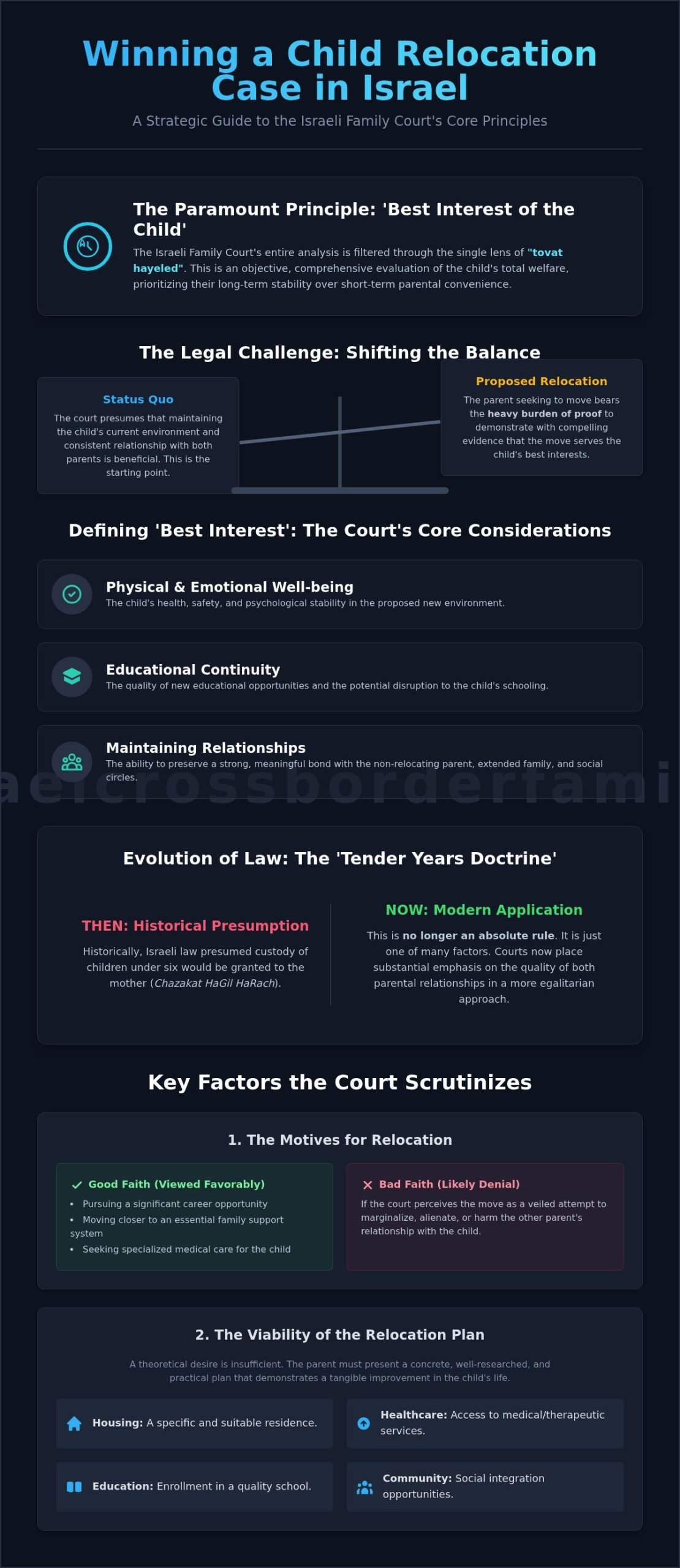
In any complex, cross-border family law matter in Israel, particularly those involving the relocation of a minor, the Israeli Family Court is governed by a single, paramount principle: the ‘best interest of the child’ (tovat hayeled). This legal standard is not a subjective assessment of parental rights or desires; rather, it is an objective and comprehensive evaluation of the child’s total welfare. The court’s entire judicial analysis is filtered through this lens, making a deep understanding of its application fundamental for any parent navigating this challenging process. To better understand the core considerations in these cases, the following analysis provides valuable insight:
The court operates from the foundational presumption that it is beneficial for a child to maintain a meaningful and consistent relationship with both parents. Consequently, the status quo-the child’s current living arrangement and environment-is given significant weight. The burden of proof lies squarely on the parent seeking to relocate to demonstrate, with compelling evidence, that uprooting the child and altering the existing custody arrangement serves the child’s best interests. This is the central challenge in determining how to win a child relocation case israel.
What Does ‘Best Interest’ Mean in Practice?
The court’s determination of ‘best interest’ is a holistic inquiry into numerous factors affecting the child’s life. It is a forward-looking analysis that prioritizes long-term stability over short-term parental convenience. Key considerations include:
- Physical and Emotional Well-being: The child’s health, safety, and psychological stability in the proposed new environment.
- Educational Continuity: The quality of educational opportunities and the potential disruption to the child’s schooling.
- Maintaining Relationships: The ability to preserve a strong bond with the non-relocating parent, extended family, and social circles.
The ‘Tender Years Doctrine’ and Its Modern Application
Historically, Israeli law adhered to the ‘Tender Years Doctrine’ (Chazakat HaGil HaRach), which created a legal presumption that custody of children under the age of six would be granted to the mother. While this doctrine has not been formally abolished, its application has been significantly curtailed by modern jurisprudence. It is no longer an absolute rule but one of several factors considered. Courts now place substantial emphasis on the father’s involvement and the quality of the paternal relationship, reflecting a more egalitarian approach aligned with international standards such as the Hague Convention on International Child Abduction, which prioritizes the child’s habitual residence and relationships over outdated presumptions.
Key Factors the Israeli Court Scrutinizes in Relocation Cases
The Israeli Family Court approaches child relocation matters not with a simple checklist, but with a comprehensive and nuanced analysis centered on one paramount principle: the best interest of the child (tovat ha’yeled). This guiding standard, deeply embedded in Israeli law and detailed in documents such as Israel’s Report on the Convention on the Rights of the Child, requires the court to weigh a complex matrix of factors. No single element is decisive. Instead, the court evaluates the totality of the family’s circumstances. Understanding these key areas of judicial scrutiny is the foundational first step in structuring a compelling argument and learning how to win a child relocation case israel.
The Motives for the Relocation
The court will rigorously assess the motivations behind the proposed move. A petition grounded in ‘good faith’-such as pursuing a significant career opportunity, moving closer to an essential family support system, or seeking specialized medical care for the child-is viewed favorably. Conversely, if the court perceives the relocation as a veiled attempt to marginalize or alienate the other parent, it will almost certainly be denied. The burden is on the relocating parent to prove the move is for legitimate, child-centric reasons.
The Quality of the Child’s Relationship with Each Parent
A central consideration is the existing nature and strength of the child’s bond with both parents. The court will examine evidence of each parent’s active and consistent involvement in the child’s daily life, from school activities to medical appointments. A primary concern is the potential damage the move could inflict on the child’s relationship with the non-relocating parent. The court must be convinced that a meaningful connection can be maintained despite the geographical distance, a foundational concept in all matters of international custody and relocation.
The Viability of the Relocation Plan
A theoretical desire to move is insufficient; the petitioning parent must present a concrete, well-researched, and practical relocation plan. This is a critical component for those seeking to understand how to win a child relocation case israel. The plan must meticulously detail arrangements for:
- Housing: A specific and suitable residence.
- Education: Enrollment or acceptance into a quality school.
- Healthcare: Access to medical and therapeutic services.
- Community: Opportunities for social integration and extracurricular activities.
The court needs to be persuaded that the move will tangibly improve or, at a minimum, maintain the child’s quality of life.
The Child’s Wishes and Preferences
In accordance with their age and level of maturity, the child’s own views are taken into account. This is not achieved by putting the child on the stand to “choose” a parent. Instead, the court typically appoints a social worker or child psychologist to meet with the child and prepare a professional report. This expert assessment provides the court with impartial insight into the child’s preferences, fears, and overall perspective on the potential move, ensuring their voice is heard in a supportive, non-adversarial manner.
Strategy for the Parent Seeking Relocation: Building a Compelling Case
To succeed in a relocation petition, your central task is to prove to the Israeli Family Court that the proposed move offers a significant, tangible benefit to your child’s well-being. A mere advantage for the parent is insufficient. Understanding how to win a child relocation case in Israel requires a strategic approach centered on meticulous preparation and a demonstrated commitment to the child’s relationship with both parents. Your case must proactively address the court’s potential concerns, presenting a compelling narrative that the relocation is not just a parental wish, but a carefully considered plan for a better future for the child.
Crafting a Detailed and Persuasive Relocation Plan
Your relocation plan is the cornerstone of your legal argument. It must be comprehensive, fact-based, and tailored to your child’s specific needs. Go beyond generalities and provide concrete details supported by research:
- Educational and Social Environment: Identify specific schools, providing brochures or curriculum details. Research neighborhoods, highlighting their safety, parks, and proximity to community centers. Detail extracurricular activities, from sports teams to music lessons, that align with your child’s interests.
- Financial Stability: Present a formal job offer letter stating your salary and benefits. Create a detailed monthly budget, converting projected expenses into Israeli Shekels (₪) to demonstrate financial viability and an improved standard of living.
- Support Network: Clearly identify family members and friends at the destination. Explain their relationship with the child and how they will provide emotional, social, and practical support.
Proposing a Realistic and Generous Contact Schedule
Demonstrating your unwavering commitment to preserving the child’s bond with the other parent is paramount. The court must be convinced that you are not seeking to diminish the other parent’s role. Propose a contact schedule that is both generous and practical, including specific arrangements for video calls, a clear outline for visits during school holidays and summer vacations, and a fair allocation of major religious and secular holidays. Offering to cover a significant portion of the travel costs, such as 50% of flights up to a certain amount in ILS, is a powerful gesture of good faith.
Gathering Supporting Evidence and Documentation
A well-argued plan must be substantiated with concrete evidence. Your assertions hold little weight without official documentation to back them up. This documentation demonstrates your diligence and preparedness, aligning with the principles that underpin Israeli family law. For a deeper understanding of the legal framework the courts reference, particularly concerning cross-border child matters, the Israeli Government Guide to International Child Abduction provides authoritative context. Key documents to assemble include:
- Letters of acceptance from schools.
- Signed employment contracts or formal offer letters.
- A draft lease agreement or proof of secured housing.
- Sworn affidavits from family members in the destination country, confirming their support.
- Evidence of your historical role as a primary caregiver, such as school and medical records.
[ Download ](https://getautoseo.com/screenshots/getautoseocom_1769566031_xqHi5iJG.jpg) Feedback & Recreate Delete 
Strategy for the Parent Opposing Relocation: Protecting Your Child’s Stability
When facing a child relocation request, your primary objective is to demonstrate to the Israeli Family Court that a move would be detrimental to your child’s well-being and stability. The burden of proof lies with the parent proposing the move, but your role is to present a compelling, evidence-based case that maintaining the current environment is in the child’s best interests. Success hinges on meticulously illustrating the child’s deep connections to Israel and exposing the weaknesses in the proposed relocation plan.
Demonstrating the Child’s Strong Ties to Israel
The foundation of your opposition is proving that your child is not just living in Israel, but is thriving here. This requires documenting their integration into the fabric of Israeli life. You must provide concrete evidence of the child’s established world, which includes:
- Educational and Social Networks: School records, reports from teachers, and testimonials about their friendships and social standing.
- Community Involvement: Active participation in sports teams, youth movements like Tzofim, local clubs, or religious and community activities.
- Extended Family Bonds: Evidence of a meaningful and consistent relationship with grandparents, aunts, uncles, and cousins who reside in Israel.
Challenging the Feasibility of the Relocation Plan
A critical component of how to win a child relocation case israel is to rigorously scrutinize the relocating parent’s plan. The court will not approve a move based on vague aspirations. You must identify and highlight inconsistencies, lack of research, and unrealistic expectations. Question the financial viability of the move, such as a budget in ₪ that fails to account for the true cost of living abroad. Argue that the proposed contact schedule is logistically impractical or emotionally insufficient to maintain your strong parent-child bond.
Emphasizing the Harm of Disrupting the Parent-Child Bond
You must clearly document your consistent and integral role in your child’s daily life-from school pickups and homework assistance to medical appointments and extracurricular activities. Explain to the court how the proposed distance would fundamentally and negatively alter the nature of your relationship. It is also crucial to understand that Israeli courts are highly sensitive to actions that sever a child’s connection to one parent. While distinct from abduction, the unilateral removal of a child can have serious consequences under the Hague Convention on Child Abduction, and the principles protecting a child from such disruption are highly relevant. Navigating these complex international family law matters requires sophisticated legal representation to effectively protect your parental rights and your child’s stability.
The Legal Process: What to Expect in the Israeli Family Court
Navigating an international child relocation case within the Israeli Family Court system is a sophisticated, multi-stage process demanding meticulous preparation and expert legal guidance. These cases are not decided quickly; the court undertakes a thorough and deliberate examination of all factors to ensure any decision serves the child’s best interests above all else. Understanding this structured process is a critical first step, as patience and strategic navigation are essential for a successful outcome. Knowing what to expect can significantly reduce the inherent stress of these complex proceedings and is fundamental to understanding how to win a child relocation case israel.
Filing the Initial Application and Response
The legal process formally commences when the parent wishing to relocate files a ‘Request to Settle a Dispute’ (בקשה ליישוב סכסוך) with the Family Court. This document outlines the reasons for the proposed move. The other parent must then file a detailed legal response vigorously opposing the relocation. Critically, upon receiving the initial filing, the court will almost invariably issue temporary orders, including a stay of exit, which legally prevents the child from leaving Israel while the case is pending.
The Role of Expert Opinions and Evaluations
A pivotal stage in nearly every relocation case is the court’s appointment of an independent expert. This expert, typically a highly qualified child psychologist or social worker, is tasked with providing an impartial and comprehensive recommendation. They will conduct in-depth interviews with both parents and the child (or children, depending on their age and maturity) to assess family dynamics, the child’s wishes, and the potential impact of the move. This expert opinion carries immense weight and often becomes the cornerstone of the court’s final decision.
Court Hearings and the Final Judgment
The culmination of the process involves formal court hearings where both parties, represented by their attorneys, present their evidence, witness testimony, and legal arguments. The expert’s detailed report is submitted to the court and both sides have the opportunity to cross-examine the expert. The judge will consider all evidence before rendering a final judgment. This entire process is comprehensive and can take several months, and in some complex cases, over a year to conclude. Given the stakes, securing representation from a firm with deep cross-border experience is paramount. Contact our team to navigate this complex legal journey.
Securing Your Child’s Future: Strategic Counsel for Israeli Relocation Cases
Navigating an international child relocation case in Israel demands a sophisticated understanding of the governing legal standard: the ‘best interest of the child.’ Success, whether for the petitioning or opposing parent, hinges upon presenting a meticulously prepared case that addresses the Family Court’s comprehensive scrutiny of the child’s stability, relationships, and future opportunities. Ultimately, the answer to how to win a child relocation case israel lies in a robust, evidence-based strategy tailored to the unique circumstances of your family. These complex, multi-jurisdictional matters require more than just legal knowledge; they demand nuanced cultural understanding. Our firm provides specialized expertise in complex US-Israel family law cases, offering guidance from attorneys fluent in the legal systems and cultures of both countries. To protect your parental rights and your child’s well-being, we invite you to Schedule a Confidential Case Review with Our Cross-Border Law Experts. With dedicated and experienced counsel, you can approach this challenging process with clarity and confidence, prepared to secure the best possible outcome for your child’s future.
Frequently Asked Questions About Child Relocation in Israel
Can I stop my ex-partner from taking my child on an overseas holiday?
Yes, if you have a legitimate fear that your child will not be returned, you can petition the Israeli Family Court for an exit-prevention order. The court will evaluate the risk of abduction against the child’s right to travel and the holiday’s benefits. For international travel, consent from both parents with legal custody is typically required. Unilaterally taking a child abroad without consent or a court order can constitute parental abduction and have severe legal ramifications.
What happens if the other parent agrees to the relocation?
When both parents consent, the relocation terms must be formalized in a comprehensive written agreement. This document should be meticulously drafted by legal counsel to address custody, visitation rights for the non-relocating parent, travel costs, and child support. To ensure enforceability, this agreement must be submitted to the Family Court for review and approval, after which it obtains the full legal power of a court judgment, providing security and clarity for both parties.
How much does a child relocation case typically cost in Israel?
The cost of a contested child relocation case in Israel is substantial and varies based on the matter’s complexity. Legal fees are a primary component, but expenses also include court-appointed expert reports from psychologists or social workers, which are often required. A complex case can range from ₪50,000 to upwards of ₪150,000. It is advisable to discuss a clear fee structure with your legal representation to manage the financial scope of the proceedings effectively.
Does my child have to speak to a judge or testify in court?
In the Israeli legal system, children are protected from the adversarial process and do not typically testify in open court. Instead, the child’s wishes and welfare are ascertained through less direct means. The court often appoints a neutral expert, such as a child psychologist, to meet with the child and submit a professional report. Alternatively, a judge may choose to speak with the child informally in the privacy of their chambers, ensuring the child’s voice is heard without undue stress.
Can a court decision on relocation be appealed in Israel?
Yes, a final judgment from the Family Court regarding child relocation can be appealed to the District Court. This action is governed by strict procedural deadlines, and the notice of appeal must be filed promptly. Appellate courts give considerable deference to the trial judge’s findings of fact, meaning a successful appeal must demonstrate a clear error in law or a decision that was manifestly unreasonable. Expert appellate counsel is critical for navigating this complex process.
What if we have dual citizenship, for example, US and Israeli?
Dual citizenship introduces significant multi-jurisdictional complexity into a relocation matter. While the Israeli courts will have jurisdiction if the child’s habitual residence is in Israel, the existence of another citizenship is a critical factor the court considers. It impacts international treaty obligations, such as the Hague Convention, and potential enforcement challenges abroad. Understanding how to win a child relocation case in Israel requires a sophisticated legal strategy that adeptly navigates both domestic and international law.

Article by
Gabriel Lior
A Personal Journey That Became a Mission The advisory was founded by an American father Gabriel Lior, LLB, MBA , global entrepreneur, and cross-border advisor who spent more than a decade navigating the Israeli family court system firsthand and now lives in Singapore with his son.
As a divorced parent in a cross-border family, Gabriel faced nearly every legal challenge a foreign parent can encounter in Israel — including child custody disputes, child support proceedings, property matters in Israel and abroad, false accusations, and complex immigration and relocation proceedings. Over the years, he learned the hard way how difficult it is for non-Israeli parents to understand the system, identify the right legal strategy, and choose the right legal representation — especially when language, culture, and jurisdictional differences are involved. He also witnessed how foreign parents and new immigrants are often disadvantaged or taken advantage of by service providers and institutions simply because they lack local knowledge or fluency. From Client to Advisor To truly understand — and survive — the system, Gabriel pursued formal legal education in Israel, completing two Israeli law degrees, alongside a BA and MBA earned in the United States. This was never about becoming a practicing attorney, but about gaining a deep, structural understanding of how the system works — and where it breaks down for foreign parents. This rare combination of: Firsthand client experience Israeli legal and US business education International business and negotiation training Decades of commercial execution created a unique perspective – one that understands both sides of the table. After years of litigation, persistence, and at times self-representation, he ultimately succeeded in securing custody of his son and relocating abroad through a rare legal victory in the Israeli Supreme Court — becoming one of the first fathers in Israel to do so under these circumstances.
Disclaimer
Important Disclaimer: The information provided on this website and in its content is for general informational and educational purposes only and does not constitute legal advice, legal opinion, or legal representation. Gabriel Lior is not licensed to practice law in Israel (nor is he interested in doing so) and does not provide legal services, despite having completed 2 Law Degrees. The services offered are advisory in nature and are intended to provide general guidance, strategic insight, and information regarding cross-border family law considerations. No attorney-client relationship is formed by accessing this website, reading its content, or communicating with us. Any decisions made based on this information are at your own discretion and risk. For legal advice specific to your situation, you should consult a licensed attorney in the relevant jurisdiction. Where appropriate, we may refer clients to independent, licensed attorneys or professionals. Such referrals do not constitute legal representation and no liability is assumed for services provided by third parties.