Most parents mistakenly believe a Hague Convention case is a standard custody trial, but this is a significant misunderstanding of international legal frameworks. In reality, these proceedings function as a jurisdictional emergency brake designed to return a child to their habitual residence rather than determining long-term parental rights. When a child is moved between the United States and Israel without consent, the situation demands immediate and precise action. Having Hague Convention Child Abduction Cases Explained through a lens of strategic clarity is essential for navigating the multi-jurisdictional complexity of these high-stakes matters.
It’s natural to feel a profound sense of anxiety regarding the speed of international court systems or the fear of losing access to your child. We understand the confusion that arises when trying to determine which country’s laws apply to your specific situation. This guide, published on an independent advisory platform, provides an educational overview of the legal mechanics and procedural risks involved. You’ll gain clarity on the return process, the valid defenses against a return order, and a strategic roadmap for the next 48 hours. Please note that this information is for advisory purposes only and does not constitute formal legal representation.
Key Takeaways
- Understand that the 1980 Hague Convention is a civil mechanism focused on restoring the status quo by returning a child to their habitual residence, rather than deciding long-term custody.
- Learn the procedural differences between the Israeli Family Court system and US jurisdictions when you have Hague Convention Child Abduction Cases Explained through a cross-border lens.
- Identify critical legal defenses, such as the one-year “settled child” rule and the impact of parental consent, which can prevent a mandatory return order.
- Discover why avoiding “self-help” measures and seeking strategic clarity early is essential to navigate the inherent complexity of international family law.
- Gain a clear roadmap for the first 48 hours of a dispute to ensure your decisions are based on a nuanced understanding of divergent legal cultures.
What is the Hague Convention on International Child Abduction?
The Hague Convention on the Civil Aspects of International Child Abduction is a multilateral treaty designed to protect children from the harmful effects of wrongful removal or retention across international borders. It’s essential to recognize that this is a civil legal mechanism rather than a criminal one. While the word “abduction” often suggests a stranger, in the context of international family law, it almost exclusively involves one parent taking or keeping a child without the other parent’s consent. This platform is an independent advisory resource, and we focus on providing strategic clarity for families navigating these complex waters.
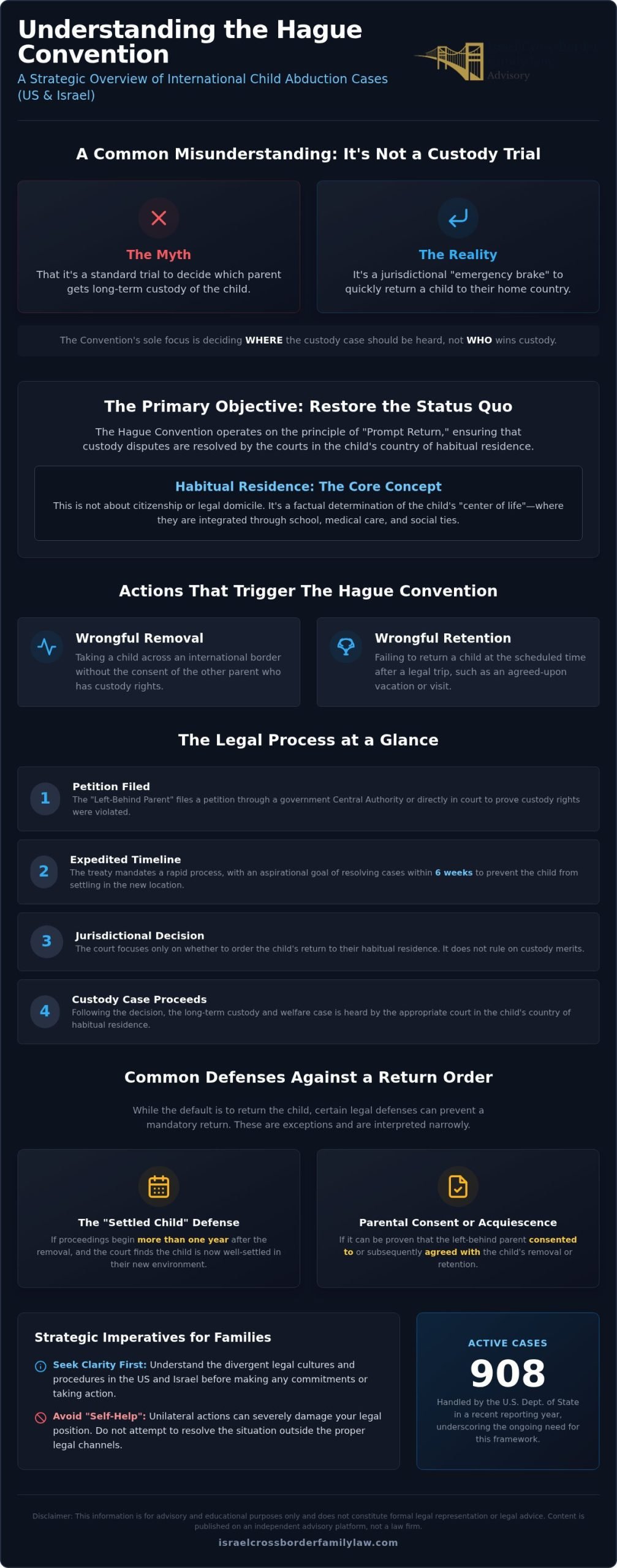
The primary objective of the treaty is to restore the status quo. It functions by returning the child to their country of habitual residence as quickly as possible. This “Prompt Return” principle is the heart of the convention’s effectiveness. It ensures that custody disputes are decided by the courts in the child’s home country, rather than by the courts in the country where the child was taken. In 2025, the U.S. Department of State handled 908 active abduction cases, which underscores the ongoing necessity of this framework. Having Hague Convention Child Abduction Cases Explained through an advisory lens helps demystify a high-pressure situation before you commit to a legal path.
Habitual Residence: The Core Concept
Habitual residence is the most critical factor in any Hague case. It refers to the place where the child actually lived and was integrated before the move occurred. This is a factual determination rather than a legal one; it’s fundamentally different from citizenship or “legal domicile.” When courts analyze this, they look for the child’s center of life. They examine factors like school enrollment, medical records, and social ties to determine where the child was truly settled. Because this is the foundation of the case, establishing habitual residence is where the most significant strategic energy is often spent.
Wrongful Removal vs. Wrongful Retention
The convention distinguishes between two types of actions, though both trigger the same protections. Wrongful removal occurs when a parent takes a child across an international border without the consent of the other parent who has custody rights. In contrast, wrongful retention happens when a child travels legally, perhaps for a vacation or an agreed-upon visit, but is not returned at the scheduled time. Both actions interfere with the rights of custody under the law of the state where the child was habitually resident. Whether it’s a sudden move or a refusal to return after a summer trip, the legal priority remains the same: returning the child to the jurisdiction best equipped to handle the long-term custody arrangement.
The Legal Mechanics: How a Hague Case Proceeds
When a child is moved across international borders without consent, the legal response is built for speed. The “Left-Behind Parent” typically begins the process by filing a petition, either through a designated government agency or directly in the relevant court, to prove that their rights of custody were violated. The treaty mandates an expedited timeline, with an aspirational goal of resolving cases within six weeks. This rapid pace is intended to prevent the child from becoming too settled in the new location before a decision is reached. Having Hague Convention Child Abduction Cases Explained through an advisory lens helps parents understand that the clock starts ticking the moment the child is removed or retained.
Think of the Hague proceeding as a jurisdictional traffic controller. It doesn’t determine the final destination of the child’s life; it simply points back to the starting line. This “U-turn” ensures that the courts of the child’s habitual residence, which are best positioned to evaluate long-term welfare, retain their legal authority. By focusing strictly on the location of the custody battle rather than the outcome, the convention discourages parents from crossing borders to find a more favorable legal system.
The Role of Central Authorities in the US and Israel
The process relies on seamless communication between the U.S. Department of State’s Office of Children’s Issues and the Israeli Ministry of Justice’s International Department. These agencies act as the Central Authorities for their respective nations. They facilitate the transmission of legal documents, assist in locating children, and monitor case progress to ensure compliance with treaty obligations. While these agencies provide a structured channel for cooperation, many parents choose to initiate court proceedings simultaneously to maintain the momentum required in international custody disputes.
Why Hague Cases are Not Custody Battles
A common mistake is treating a Hague hearing like a standard custody trial. In a typical family court case, a judge examines the “best interests of the child” by looking at school records, parenting skills, or home environments. In a Hague proceeding, these factors are generally irrelevant. The court’s focus is narrow: was the removal wrongful under the treaty? Bringing evidence of being the “better” parent can actually distract from the core jurisdictional argument. Having Hague Convention Child Abduction Cases Explained in this manner ensures that parents don’t waste precious time on evidence that the court cannot consider. If you need to evaluate the risks of your specific situation, it’s helpful to seek strategic clarity before making a formal commitment.
Common Defenses: When a Child Might Not Be Returned
While the primary objective of the treaty is the swift return of the child, the framework recognizes that certain exceptional circumstances may justify a refusal to issue a return order. These defenses are narrow and strictly interpreted by courts to prevent them from becoming loopholes that undermine the convention’s purpose. In Hague Convention Child Abduction Cases Explained by international legal experts, these exceptions are often the most intensely litigated aspects of the entire proceeding. Understanding these defenses is essential for any parent involved in a cross-border dispute, as they represent the primary legal hurdles to a mandatory return.
One of the most frequently cited defenses is the “one-year rule.” If a petition for return is filed more than 12 months after the wrongful removal or retention, the court is not required to order a return if it’s demonstrated that the child is now settled in their new environment. This settlement is measured by factors like school attendance, social integration, and the stability of the new home. Additionally, a court may refuse return if the parent who remained behind originally consented to the move or subsequently acquiesced to the child’s new residence. Evidence of consent often includes written agreements, emails, or text messages that clearly indicate a shared intent for the child to relocate permanently.
The Grave Risk of Harm Exception
Article 13b of the convention provides an exception if there’s a “grave risk” that the child’s return would expose them to physical or psychological harm or otherwise place them in an intolerable situation. It’s vital to understand that this is an exceptionally high legal threshold. Courts generally require specific, documented evidence of a direct threat to the child’s safety. While general concerns about regional instability or war zones are frequently raised, judges typically look for risks that are personal to the child rather than broad societal fears. In many US-Israel cases, allegations of domestic violence must be substantiated with significant detail to meet this “grave risk” standard.
The Age and Maturity of the Child
The court may also take the child’s own views into account if they’ve reached an age and degree of maturity where it’s appropriate to consider their perspective. There’s no fixed age for this in Israeli or US law; instead, the judge evaluates each child individually. Typically, children aged 10 to 12 and older are more likely to have their objections heard. Judges often conduct these interviews privately in their chambers to ensure the child feels safe to speak honestly. However, a child’s preference is not a “veto” over the return process. The court will assess whether the objection is truly the child’s own or if they’ve been influenced by the parent who took them. This nuanced evaluation is a core component of how cross-border custody disputes are managed under the treaty.
Navigating Hague Cases Between the United States and Israel
The legal corridor between the United States and Israel is one of the most active for international family law disputes. While both nations are committed treaty partners, the procedural experience for a parent can differ significantly depending on where the petition is heard. Successfully managing these matters requires more than just a general understanding of the law; it demands a nuanced grasp of how each country’s judiciary interprets treaty obligations. Having Hague Convention Child Abduction protocols and local court behaviors explained is a critical first step for any expat or international family.
The U.S. Department of State’s 2026 Annual Report, which analyzes data from the 2025 calendar year, emphasizes the importance of consistent enforcement among treaty partners. While the report designated countries like Argentina and The Bahamas as non-compliant, Israel remains a reliable partner with a sophisticated legal infrastructure for these cases. However, the cultural and legal differences in how testimony is presented can influence the speed and clarity of a case. For instance, the direct and often assertive nature of Israeli court testimony may feel unfamiliar to those used to the more formal, slower-paced American proceedings. Having Hague Convention Child Abduction Cases Explained through a cross-border lens helps bridge this cultural gap.
Israeli Family Courts and Hague Petitions
In Israel, Hague petitions are heard in specialized Family Courts. These courts are accustomed to the multi-jurisdictional complexity of international families and are generally efficient in handling expedited petitions. The Israeli judiciary often prioritizes these cases to meet the treaty’s six-week resolution goal, though the actual duration can vary based on the complexity of the defenses raised. Additionally, Israel offers legal aid for Hague cases under certain conditions, which can be a vital resource for parents navigating the high costs of international litigation. The specialized nature of these courts means that judges are deeply familiar with the “center of life” test used to determine a child’s habitual residence.
US Jurisdictional Complexities
In the United States, the process is complicated by a dual court system. A parent can choose to file a Hague petition in either a state court or a federal district court under the International Child Abduction Remedies Act (ICARA). Many experienced practitioners prefer federal court for these matters because federal judges typically have more experience with international treaties and cross-border issues. This choice of venue is a strategic decision that can impact everything from the speed of the hearing to the rules of evidence. Because of these procedural variations, it’s essential to work with an advisory platform that understands the strategic risks of each jurisdiction. If you’re facing a potential dispute, you should request a strategic case review to understand your options before the one-year window closes.
Strategic Decision-Making in Cross-Border Cases
In the wake of a child’s removal, the impulse to engage in “self-help” measures can be overwhelming. Some parents consider taking the child back themselves without a court order, but this is a critical strategic error. Such actions can lead to criminal charges or severely damage your standing in future Hague proceedings. Having Hague Convention Child Abduction Cases Explained through a lens of long-term strategy ensures that you don’t compromise your legal position in a moment of distress. Every choice made in the first few days carries immense weight, and a calm, methodical approach is always the most effective path toward a resolution.
The complexity of cross-border issues means that what works in one legal system may be counterproductive in another. For families moving between the United States and Israel, the differences in legal culture and judicial expectations are significant. This is why seeking clarity before making commitments is essential. Decisions regarding where to file and how to characterize the child’s relocation will define the trajectory of the case for months to come. This platform operates as an independent advisory, focusing on helping you navigate these risks before you engage formal legal representation under a separate agreement.
The Importance of Immediate Action
Time is a strategic factor that often works against the left-behind parent. If you delay in filing a petition or taking formal legal steps, a court may interpret your inaction as “acquiescence,” which essentially means implied consent to the move. As the child spends more time in the new location, the “settled child” defense mentioned earlier becomes a much larger hurdle. To protect your rights, you should immediately secure the child’s passport, birth certificate, and any existing custody orders. These documents are the evidentiary foundation of your case and must be organized before the one-year window begins to close.
How an International Advisory Can Help
Navigating a dispute that spans two continents requires a “big picture” perspective that local counsel may not always provide. An international advisory serves as a bridge, helping you understand how an action in an Israeli Family Court might impact a concurrent proceeding in a U.S. Federal Court. We provide a cross-cultural perspective that accounts for the nuances of both legal systems, ensuring your strategy is cohesive and informed. If you’re currently facing a cross-border custody crisis, you can request a confidential case review to gain the clarity needed to move forward. Understanding the mechanics of the process is the first step toward restoring stability for your child.
Get clarity before you commit. Request a confidential consultation.
Securing Stability Through Strategic Clarity
Navigating the multi-jurisdictional complexity of international family law requires a steady hand and a clear understanding of the “Prompt Return” principle. By having Hague Convention Child Abduction Cases Explained through a cross-border lens, you can differentiate between a jurisdictional “emergency brake” and a standard custody trial. This distinction is vital for protecting your parental rights and ensuring your case is heard in the correct forum. Remember that time is a critical factor in these proceedings; delays can be interpreted as acquiescence, and the one-year window for a mandatory return order closes quickly.
Our independent advisory platform provides authoritative guidance specifically for the US-Israel corridor, offering a calm, expert-led approach to even the most high-conflict cases. For more educational resources, you can explore our @IsraelFamilyLaw channel on YouTube. Clarity is always the first step toward a resolution that protects your child’s future and restores stability to your family. Get clarity before you commit. Request a confidential consultation. You don’t have to navigate these complex legal systems alone.
Frequently Asked Questions
Is international child abduction a crime in Israel and the US?
International parental child abduction is a criminal offense in both jurisdictions under specific statutes, but the Hague Convention itself is strictly a civil remedy. While the parent who moved the child could face criminal charges, the Convention’s primary goal is the child’s return to their home country rather than punishment. It’s important to understand that criminal and civil tracks often move independently. Strategic clarity is required to manage both aspects without one undermining the other.
How long does a Hague Convention case typically take to resolve?
The treaty mandates an expedited process with an aspirational goal of resolution within six weeks. In reality, having Hague Convention Child Abduction Cases Explained involves acknowledging that complex defenses can push this timeline to several months. In 2025, the U.S. Department of State managed over 900 active cases, showing that while courts prioritize speed, the procedural volume remains significant. Early preparation is essential to maintain this momentum.
Can I stop my child from being returned if I can prove the other parent is ‘unfit’?
Proving a parent is “unfit” is generally insufficient to block a return because a Hague hearing is not a custody trial. The court doesn’t decide who the better parent is; it only decides which country’s court system should make that decision. To stop a return, you must meet the much higher “grave risk of harm” standard. This requires documented evidence of a direct and severe threat to the child’s safety.
What happens if the child was taken to a country that is not part of the Hague Convention?
If a child is moved to a country that hasn’t signed the treaty, the Hague Convention protections are not available. In these instances, you must navigate the local family law system of that specific nation without the benefit of a standardized international framework. This often results in a much longer and more unpredictable legal struggle, as there’s no international requirement for a prompt return or jurisdictional deference.
Do I need a lawyer in both the US and Israel for a Hague case?
It’s highly advisable to have legal support in both the United States and Israel to ensure a coordinated strategy. Because actions in one court can drastically affect the other, an advisory bridge is essential for managing multi-jurisdictional complexity. This ensures that evidence gathered in the US is presented effectively in the Israeli Family Court. Coordinating between two different legal cultures requires established expertise in the US-Israel corridor.
Can a Hague case be settled through mediation instead of a trial?
Mediation is a viable and often preferred alternative to a contested trial in these high-conflict matters. Recent guidance from 2026 highlights the value of mediation in reaching voluntary return agreements that prioritize the child’s stability. This approach can reduce the emotional toll on the family and allow parents to negotiate “safe harbor” provisions. These provisions ensure a smoother transition and specific protections during the child’s return process.
What is the ‘one-year rule’ in Hague Convention cases?
The “one-year rule” is a critical defense where the court may refuse return if the child is “settled” in their new environment after 12 months. This is why having Hague Convention Child Abduction Cases Explained emphasizes the weight of early decisions. If you wait too long to file your petition, you risk losing the mandatory return protections provided by the treaty. Immediate action is the best way to preserve your legal standing.
Will the court listen to my child’s wishes during a Hague hearing?
The court will consider a child’s wishes if they’ve reached a sufficient age and degree of maturity. Judges typically conduct these interviews in private chambers to assess the child’s true feelings away from parental pressure. While the judge considers these views, they don’t grant the child a final veto. The court will also evaluate whether the child’s objection is authentic or if they’ve been influenced by the parent who relocated them.

Article by
Gabriel Lior
A Personal Journey That Became a Mission
The advisory was founded by an American father Gabriel Lior, LLB, MBA , global entrepreneur, and cross-border advisor who spent more than a decade navigating the Israeli family court system firsthand and now lives in Singapore with his son.
As a divorced parent in a cross-border family, Gabriel faced nearly every legal challenge a foreign parent can encounter in Israel — including child custody disputes, child support proceedings, property matters in Israel and abroad, false accusations, and complex immigration and relocation proceedings.
Over the years, he learned the hard way how difficult it is for non-Israeli parents to understand the system, identify the right legal strategy, and choose the right legal representation — especially when language, culture, and jurisdictional differences are involved. He also witnessed how foreign parents and new immigrants are often disadvantaged or taken advantage of by service providers and institutions simply because they lack local knowledge or fluency.
From Client to Advisor
To truly understand — and survive — the system, Gabriel pursued formal legal education in Israel, completing two Israeli law degrees, alongside a BA and MBA earned in the United States. This was never about becoming a practicing attorney, but about gaining a deep, structural understanding of how the system works — and where it breaks down for foreign parents.
This rare combination of:
Firsthand client experience
Israeli legal and US business education
International business and negotiation training
Decades of commercial execution
created a unique perspective – one that understands both sides of the table.
After years of litigation, persistence, and at times self-representation, he ultimately succeeded in securing custody of his son and relocating abroad through a rare legal victory in the Israeli Supreme Court — becoming one of the first fathers in Israel to do so under these circumstances.
Disclaimer
Important Disclaimer:
The information provided on this website and in its content is for general informational and educational purposes only and does not constitute legal advice, legal opinion, or legal representation.
Gabriel Lior is not licensed to practice law in Israel (nor is he interested in doing so) and does not provide legal services, despite having completed 2 Law Degrees. The services offered are advisory in nature and are intended to provide general guidance, strategic insight, and information regarding cross-border family law considerations.
No attorney-client relationship is formed by accessing this website, reading its content, or communicating with us.
Any decisions made based on this information are at your own discretion and risk. For legal advice specific to your situation, you should consult a licensed attorney in the relevant jurisdiction.
Where appropriate, we may refer clients to independent, licensed attorneys or professionals. Such referrals do not constitute legal representation and no liability is assumed for services provided by third parties.