This article is published on an independent advisory platform and does not constitute an attorney-client relationship. The content provided is for informational and advisory purposes only and does not constitute legal representation or legal advice.
Winning a case in Israel often has very little to do with who is “right” and everything to do with what you actually want to achieve before the first document is filed. Many people rush into litigation out of a sense of urgency, yet defining my goals for the legal process is the single most important step to prevent irreversible tactical errors. It’s easy to feel overwhelmed by the unique overlap between Israeli civil and religious courts or uncertain about how your US-based interests might be impacted by a local ruling.
You likely want to feel in control of a process that feels foreign and high-stakes. This guide will show you how to establish clear, realistic objectives so you can navigate the complexities of the Israeli system with strategic foresight. We’ll explore how to prioritize your outcomes, understand the specific risks of cross-border litigation, and ensure your strategy aligns with your long-term family or financial needs. By the end, you’ll have a roadmap to approach your case with clarity instead of confusion.
Key Takeaways
- Understand why reactive decision-making is costly and how starting with clarity protects your interests in Israeli family law matters.
- Learn a structured framework for defining my goals for the legal process, prioritizing long-term financial stability and parental access over short-term wins.
- Discover how US citizenship and foreign assets impact your strategy within the Israeli court system to ensure your goals are coordinated across both jurisdictions.
- Identify common emotional traps, such as “revenge” goals, that often lead to failed legal strategies and unnecessary conflict.
- Create a strategic roadmap by inventorying cross-border ties and establishing a list of non-negotiable outcomes before engaging in formal representation.
This article is published on an independent advisory platform and does not constitute an attorney-client relationship. The content provided is for informational and advisory purposes only and does not constitute legal representation or legal advice.
The Importance of Clarity Before Entering the Israeli Legal System
Entering a legal dispute in Israel without a clear plan is like trying to navigate a dense city without a map. Most people start by reacting to a crisis, yet the most successful outcomes begin with defining my goals for the legal process before the first court filing occurs. In any family law matter in Israel, early decisions carry significant weight. A reactive move today can lead to years of unintended consequences, especially when cross-border assets or international custody are involved.
Developing a sound Litigation strategy requires you to separate your emotional desires from your tangible legal objectives. While you might feel a need for vindication, the courts focus on specific outcomes like asset division or custody schedules. Clarifying these goals helps you select the right legal representation. You need a professional whose expertise aligns with your specific priorities rather than a generalist who may not understand the nuances of your international status.
To better understand the importance of setting clear objectives, watch this helpful video:
Understanding the ‘IL’ Legal Landscape
The Israeli system is unique because it features a dual court structure. Depending on the circumstances, your case could be heard in a Civil Family Court or a Rabbinical Court. These systems operate under different principles, and your goals might shift depending on which court has authority over your matter. This creates a “race for jurisdiction” where the first person to file often determines the legal framework for the entire case. You must understand how these courts differ before making any formal commitment.
Advisory vs. Representation: Knowing the Difference
There’s a vital distinction between hiring a litigator to fight a case and seeking independent advisory services to plan your approach. An international legal advisor helps you look at the big picture, particularly when you’re managing assets or family ties in both the US and Israel. Understanding how the advisory process works allows you to set your priorities in a neutral environment. Defining my goals for the legal process at this early stage ensures that your eventual representation is aligned with your actual life objectives, reducing the risk of costly tactical errors.
A Framework for Identifying Your Primary Legal Objectives
Identifying your primary legal objectives requires a shift from emotional reactions to strategic planning. While corporate environments often use structured frameworks to drive efficiency, these tools are equally effective when applied to personal family matters. Understanding the psychology in civil dispute resolution can help you distinguish between a temporary desire for retribution and a legitimate legal goal. By defining my goals for the legal process early on, you create a stable baseline for every negotiation that follows.
In cross-border cases, you may face difficult choices between immediate financial stability and long-term parental access. For instance, if you have assets in both the US and Israel, your priority might be securing the family home in Israel while maintaining a flexible visitation schedule that allows for international travel. Setting clear “walk-away” points is essential before entering mediation. These are your non-negotiables; they represent the specific outcomes you’re unwilling to compromise on, even if it means moving toward a formal trial.
Timeframe also plays a critical role in your strategy. You must balance short-term relief, such as immediate child support, with long-term security, like protecting your retirement accounts or inheritance rights. If you are unsure how to prioritize these competing interests, you may find it helpful to speak with an advisor to gain a neutral perspective.
Applying SMART Goals to Family Law
The SMART framework helps turn vague desires into actionable plans. To be effective, your goals must be:
- Specific: Instead of saying you want a “fair” settlement, define exactly what that looks like. For example, specify the exact percentage of a shared business you intend to retain.
- Measurable: Quantify your needs. This might mean calculating a specific monthly budget or defining a custody schedule by the exact number of days per year.
- Achievable: Your objectives must align with current Israeli legal precedents. Aiming for an outcome that a judge is unlikely to grant will only lead to wasted resources and frustration.
Relevant and Time-Bound Objectives
Your goals must reflect the reality of living as an expat or international family in Israel. If you plan to relocate to your home country in the future, your legal strategy needs to account for that possibility today. Setting clear, time-bound milestones ensures that the legal process moves toward a definitive resolution rather than becoming an endless cycle of motions and hearings. This approach keeps the focus on progress and prevents litigation from dragging on for years without a clear end in sight.
This article is published on an independent advisory platform and does not constitute an attorney-client relationship. The content provided is for informational and advisory purposes only and does not constitute legal representation or legal advice.
Navigating the Complexity of US-Israel Cross-Border Goals
Managing a legal case in Israel while maintaining financial or personal ties to the United States requires a specialized strategy. When you’re defining my goals for the legal process, you must account for how US citizenship or assets influence the Israeli court’s perspective. For instance, an Israeli judge might issue a ruling on asset division that creates unforeseen tax liabilities under the US-Israel tax treaty. Without coordinating your objectives across both systems, a “win” in one jurisdiction could lead to a significant loss in the other. It’s essential to view your case as a single, multi-jurisdictional puzzle.
The procedural reality is often governed by formal cooperation between nations. You can find detailed information on the U.S. Department of State guidance on judicial assistance regarding how documents are served and evidence is collected between the two countries. Understanding these mechanisms helps you set realistic timelines for your case. It also ensures that your strategy respects the international treaties that govern cross-border disputes.
Jurisdictional Strategy and Goal Alignment
A primary goal in Israel might inadvertently conflict with your legal status or rights in the US. This is particularly common in custody disputes where one parent wishes to move. If your objective involves international custody relocation, you must ensure that any Israeli court order is enforceable abroad. Practitioners often use “mirrored orders” to ensure that the terms of an Israeli agreement are recognized and upheld by a US court. This prevents a situation where a parent is granted permission to travel by one system but is viewed as being in violation of the other. Coordination is your best defense against legal limbo.
Financial Goals and Asset Protection
Defining goals for assets held outside of Israel is a complex undertaking. While Israeli courts generally have the authority to include foreign property in marital property distributions, the practical enforcement of these rulings requires careful planning. You should also consider how IL inheritance laws might impact your estate. As of January 2026, new immigrants and returning residents must report worldwide income to the Israeli Tax Authority, even though the 10-year tax exemption on foreign-sourced income remains in place. Seeking clarity on these regulations before you commit to a specific legal path is the only way to protect your global portfolio. Decisions made in an Israeli court today will resonate in your US tax filings for years.
This article is published on an independent advisory platform and does not constitute an attorney-client relationship. The content provided is for informational and advisory purposes only and does not constitute legal representation or legal advice.
Avoiding Emotional Traps and Misaligned Expectations
Many individuals approach the Israeli family court system with a deep desire for vindication. They want the court to acknowledge they were “right” and the other party was “wrong.” However, the Israeli legal system is primarily concerned with practical outcomes, such as the division of assets or the welfare of children. When you’re defining my goals for the legal process, focusing on “revenge” or emotional retribution is a strategic mistake. These goals are rarely achieved in a courtroom and often lead to protracted, expensive battles that leave both parties exhausted.
A common trap is setting expectations based on “what my friend’s lawyer did.” Every international case is unique, particularly when it involves US-Israel cross-border complexities. A strategy that worked for a neighbor might be entirely inappropriate for someone with a specific tax profile or a different set of dual-citizenship obligations. In family law, “winning” is often a poorly defined concept. A true win is usually a resolution that protects your long-term stability rather than a specific court order that “punishes” an ex-spouse.
The Cost of Emotional Litigation
Emotional goals lead to unnecessary legal spend because they drive reactive filings and aggressive posturing. A calm, advisory-first approach allows you to evaluate whether a specific legal motion actually serves your primary objectives. By defining my goals for the legal process with a focus on data rather than emotion, you can avoid the high costs of reactive litigation. The emotional trap of the Israeli court system is the belief that aggressive litigation will eventually provide the emotional closure that only time and personal healing can offer.
Managing Expectations with Realistic Data
Grounding your goals in reality requires looking at how cases actually proceed in Israel. For example, ordinary civil proceedings often take at least 12 months to reach the evidentiary stage or trial. Expecting a “quick” resolution in a complex divorce or separation for international families in Israel is often unrealistic. Transparency about risks is far more valuable than optimistic guarantees. In Israel, cases are adjudicated by professional judges, not juries, which means the process is more technical and less susceptible to emotional pleas.
If you find yourself struggling to separate your emotional needs from your legal strategy, it may be time to request a confidential consultation to gain a clearer perspective on your options.
This article is published on an independent advisory platform and does not constitute an attorney-client relationship. The content provided is for informational and advisory purposes only and does not constitute legal representation or legal advice.
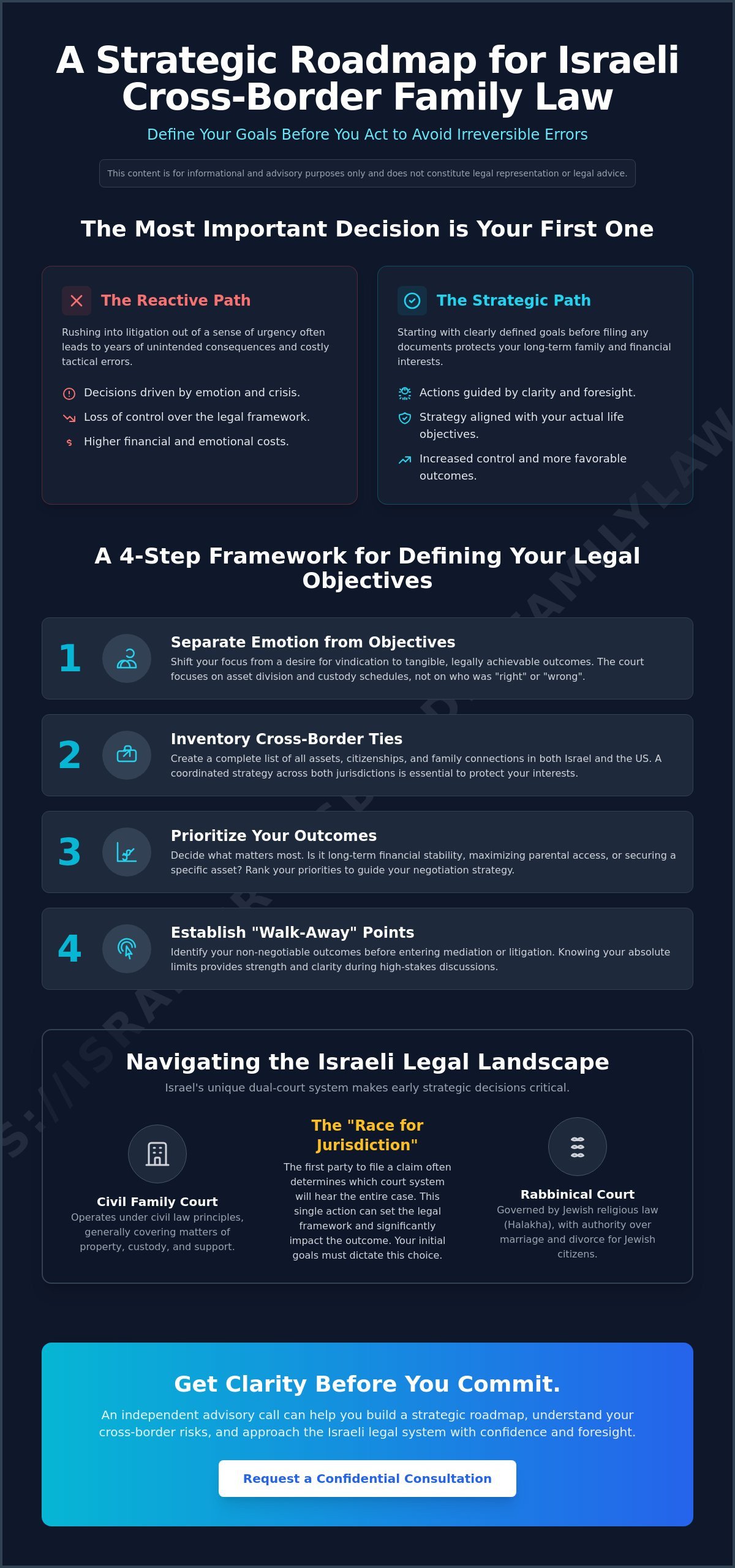
Developing a Strategic Roadmap with an International Perspective
Moving from a state of uncertainty to a position of control requires a structured approach. Once you understand the systemic differences in Israel, the next phase is defining my goals for the legal process through a clear, step-by-step roadmap. This strategy ensures that your actions in the Israeli family court or rabbinical court align with your global interests. You can develop this roadmap by following these five essential steps:
- Step 1: Inventory all cross-border ties. List every asset, bank account, and property held in both the US and Israel. As of January 2026, new immigrants must report worldwide income to the Israeli Tax Authority, so complete transparency is vital for your strategy.
- Step 2: Draft a ‘Priority List’. Identify your non-negotiable outcomes. Distinguish between what you must have for long-term security and what you are willing to concede during negotiations.
- Step 3: Consult an advisory platform. Vet your goals against current Israeli law before you hire a litigator. This prevents you from pursuing objectives that a professional judge is unlikely to grant.
- Step 4: Refine your roadmap based on jurisdictional risks. Adjust your plan to account for cross-border complexities, such as the US-Israel tax treaty or the lack of a totalization agreement for social security.
- Step 5: Communicate refined goals to your attorney. Provide your representing lawyer with a clear brief. When your attorney knows your exact priorities, they can focus their efforts on the outcomes that matter most to you.
The Role of the Advisory Platform
An independent advisor serves as a bridge between the American legal expectations you may have and the practical reality of the Israeli system. By seeking a confidential case review, you can test your strategy in a neutral environment. This step is crucial because it allows you to identify potential tactical errors before they become part of the public court record. An advisor helps you focus on defining my goals for the legal process with an international lens, ensuring that a settlement in Israel doesn’t create a legal or tax crisis in the US.
Finalizing Your Strategy
Your strategic roadmap should be a written document that provides you with peace of mind. While the court process may require some flexibility as new evidence emerges, having a core set of objectives keeps you grounded. For more visual guidance on navigating these hurdles, you can view the educational resources on the Israel Family Law YouTube channel. A well-prepared strategy is the difference between being a passive participant and an informed decision-maker. Get clarity before you commit. We invite you to reach out for a confidential advisory call or message us via WhatsApp to discuss your strategy.
This article is published on an independent advisory platform and does not constitute an attorney-client relationship. The content provided is for informational and advisory purposes only and does not constitute legal representation or legal advice.
Securing Your Future Through Strategic Foresight
Navigating the Israeli legal landscape requires more than just local representation; it demands a comprehensive strategy that accounts for your life in both Israel and the United States. By defining my goals for the legal process early, you ensure that every tactical choice serves your long-term financial and parental interests. You now have the tools to separate emotional impulses from achievable legal outcomes and the framework to coordinate your assets across two distinct jurisdictions.
Our independent advisory platform provides the specialized US-Israel cross-border expertise necessary to bridge these gaps. With licensed practitioners who possess decades of international experience, we focus on high-level strategy rather than just litigation. This objective approach helps you avoid irreversible errors while providing the peace of mind that comes from a well-vetted roadmap. Get clarity before you commit. Request a confidential consultation to align your legal objectives with your global reality.
This article is published on an independent advisory platform and does not constitute an attorney-client relationship. The content provided is for informational and advisory purposes only and does not constitute legal representation or legal advice.
Frequently Asked Questions
What is the difference between a legal goal and a life goal?
A life goal is a personal or emotional desire, such as wanting to feel heard or seeking closure after a difficult separation. In contrast, a legal goal is a specific, tangible outcome that a judge in Israel has the authority to grant, such as a defined custody schedule or a specific division of marital assets. Distinguishing between the two is a vital part of defining my goals for the legal process to ensure your resources are spent on outcomes the court can actually deliver.
Can my goals in an Israeli divorce affect my status in the US?
Yes, your objectives in an Israeli court can have significant consequences for your financial and legal standing in the United States. For example, the way assets are divided in Israel may trigger specific tax liabilities under the US-Israel tax treaty or complicate your reporting requirements to the IRS. Additionally, custody goals must be structured to ensure they are recognized by US authorities if you plan to travel or relocate with your children in the future.
How do I know if my goals are realistic under Israeli law?
Realism is determined by aligning your objectives with current Israeli legal precedents and the specific rules of the court handling your case. Israeli family law is adjudicated by professional judges rather than juries, and ordinary civil proceedings typically take at least 12 months to reach a trial stage. Understanding these systemic realities helps you avoid pursuing “revenge” goals or outcomes that are statistically unlikely to be granted by a judge.
Should I define my goals before or after meeting with a lawyer?
It’s highly beneficial to begin defining my goals for the legal process before you formally engage a litigating attorney. By establishing your priorities early, you can select a lawyer whose specific expertise and style align with your roadmap. This proactive approach prevents your case from being driven by a lawyer’s standard trial tactics, which may not account for your unique cross-border needs or long-term family objectives.
What happens if my spouse’s goals are the complete opposite of mine?
When goals conflict, the case typically moves toward mediation or contested litigation. In the Israeli system, the “race for jurisdiction” often determines whether a case is heard in a Civil Family Court or a Rabbinical Court, each of which may view conflicting goals differently. Having a clear list of non-negotiable priorities allows you to enter negotiations with a firm understanding of where you can compromise and where you must stand firm.
How do cross-border assets change the goal-setting process?
Foreign assets introduce layers of complexity regarding valuation, taxation, and enforcement. Since January 2026, new immigrants in Israel are required to report worldwide income, meaning your goals must account for total transparency with the Israeli Tax Authority. You must also consider whether an Israeli court order can be practically enforced against property located in the US, which often requires specific legal “mirroring” to be effective.
Is it possible to change my goals once the legal process has started?
You can adjust your goals as new information comes to light, but doing so mid-process is often costly and can weaken your strategic position. Frequent changes in direction can lead to inconsistent legal arguments and increased attorney fees. It’s better to invest time in the advisory phase to set stable, well-researched goals that can withstand the pressures of the litigation process without requiring constant revision.
How much weight do Israeli courts give to US-based financial agreements?
Israeli courts may recognize US prenuptial or postnuptial agreements, but their enforceability depends on whether they meet specific Israeli legal criteria. For an agreement to be upheld in Israel, it often needs to be validated by an Israeli court or meet strict standards regarding how it was signed and understood by both parties. An early review of these documents is essential to determine how much they will actually protect your assets in an Israeli proceeding.
Get clarity before you commit. Request a confidential consultation.

Article by
Gabriel Lior
A Personal Journey That Became a Mission
The advisory was founded by an American father Gabriel Lior, LLB, MBA , global entrepreneur, and cross-border advisor who spent more than a decade navigating the Israeli family court system firsthand and now lives in Singapore with his son.
As a divorced parent in a cross-border family, Gabriel faced nearly every legal challenge a foreign parent can encounter in Israel — including child custody disputes, child support proceedings, property matters in Israel and abroad, false accusations, and complex immigration and relocation proceedings.
Over the years, he learned the hard way how difficult it is for non-Israeli parents to understand the system, identify the right legal strategy, and choose the right legal representation — especially when language, culture, and jurisdictional differences are involved. He also witnessed how foreign parents and new immigrants are often disadvantaged or taken advantage of by service providers and institutions simply because they lack local knowledge or fluency.
From Client to Advisor
To truly understand — and survive — the system, Gabriel pursued formal legal education in Israel, completing two Israeli law degrees, alongside a BA and MBA earned in the United States. This was never about becoming a practicing attorney, but about gaining a deep, structural understanding of how the system works — and where it breaks down for foreign parents.
This rare combination of:
Firsthand client experience
Israeli legal and US business education
International business and negotiation training
Decades of commercial execution
created a unique perspective – one that understands both sides of the table.
After years of litigation, persistence, and at times self-representation, he ultimately succeeded in securing custody of his son and relocating abroad through a rare legal victory in the Israeli Supreme Court — becoming one of the first fathers in Israel to do so under these circumstances.
Disclaimer
Important Disclaimer:
The information provided on this website and in its content is for general informational and educational purposes only and does not constitute legal advice, legal opinion, or legal representation.
Gabriel Lior is not licensed to practice law in Israel (nor is he interested in doing so) and does not provide legal services, despite having completed 2 Law Degrees. The services offered are advisory in nature and are intended to provide general guidance, strategic insight, and information regarding cross-border family law considerations.
No attorney-client relationship is formed by accessing this website, reading its content, or communicating with us.
Any decisions made based on this information are at your own discretion and risk. For legal advice specific to your situation, you should consult a licensed attorney in the relevant jurisdiction.
Where appropriate, we may refer clients to independent, licensed attorneys or professionals. Such referrals do not constitute legal representation and no liability is assumed for services provided by third parties.