What if the “offshore” bank account you maintain in London or New York is far more visible to the Israeli legal system than you previously assumed? If you’re an expat or part of an international family, you likely feel a sense of unease regarding how International Bank Accounts and Divorce intersect. It’s natural to worry that foreign funds might be shielded from view or that the complexity of tracing assets across borders will lead to an inequitable settlement.
We understand these concerns and the stress that comes with multi-jurisdictional financial interests. This guide, published on an independent advisory platform, provides the strategic clarity you need to understand how Israeli courts identify, value, and divide overseas holdings. You’ll learn about the latest disclosure requirements effective as of January 2026, the methods used to trace potentially hidden funds, and the specific steps required to protect pre-marital assets. We’ll examine the “Balancing of Resources” principle to help you navigate the risks and decision-making required for a fair outcome without providing formal legal advice.
Key Takeaways
- Learn how Israeli courts exercise authority over global assets, ensuring your entire financial footprint is considered in a cross-border settlement.
- Understand the strict disclosure requirements for International Bank Accounts and Divorce and why modern transparency makes “offshore” accounts visible to the court.
- Identify how critical factors like the separation “Value Date” and currency exchange volatility can impact the final valuation of your foreign holdings.
- Gain insights into the forensic tools and discovery processes used to trace funds and ensure financial transparency across international borders.
- Recognize why an effective strategy must bridge the gap between the Israeli legal system and the financial regulations of your home country.
This content is published on an independent advisory platform and is intended for informational purposes only. It does not constitute legal representation or formal legal advice. Strategic guidance is provided to help international families understand risks and decision-making in cross-border cases.
The Complexity of International Bank Accounts in Israeli Divorce
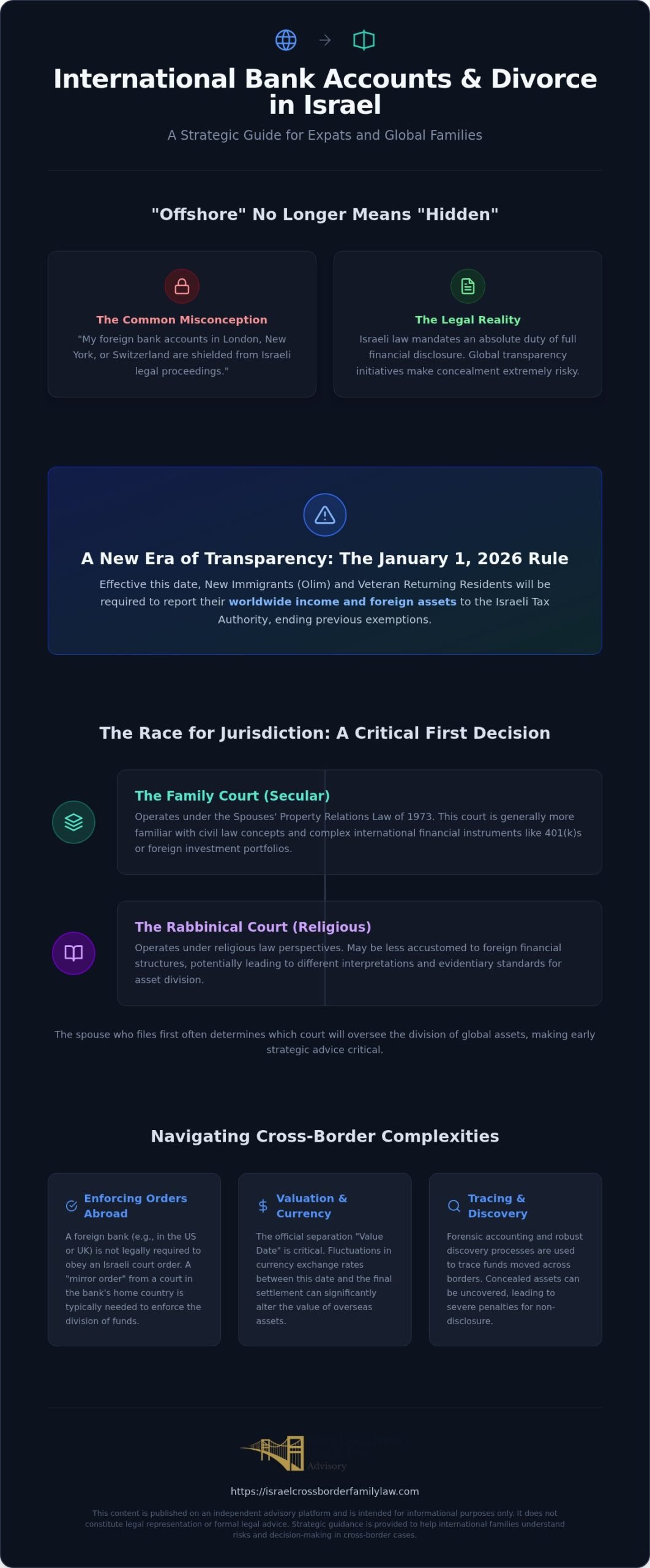
In the context of an Israeli divorce, international bank accounts encompass any liquid assets, savings, or investment portfolios held in financial institutions outside of Israel (IL). Whether these funds are in a high-interest savings account in London or a brokerage account in New York, they are subject to the principle of global asset reach. Israeli courts maintain the authority to include a couple’s worldwide wealth in the final balancing of resources. Many Anglo expats mistakenly believe their overseas holdings are shielded from local proceedings, yet the legal reality in Israel is one of comprehensive financial transparency. This visibility is often underestimated until the discovery process begins.
A defining feature of the Israeli system is the race for jurisdiction. This occurs when one spouse files for divorce in the secular Family Court while the other may prefer the Rabbinical Court. This decision is critical. Each forum may approach the division of International Bank Accounts and Divorce with different procedural nuances. While both are bound by the Spouses’ Property Relations Law of 1973, the way they interpret foreign financial evidence can vary significantly. Filing first often dictates which legal framework will oversee the valuation and division of your global wealth, making early strategic decisions paramount.
Jurisdictional Authority and Foreign Banks
Israeli courts can issue specific orders regarding assets located in the US or Europe, but these orders often encounter practical hurdles. A foreign bank, such as a major US institution, is not legally required to follow an Israeli court order directly. To enforce a division of funds, you often need a mirror order from a court in the country where the bank is located. This process relies on international comity, where courts respect the judicial decisions of other nations, provided they align with local public policy. Understanding these limitations is essential for anyone attempting to secure or divide funds held in foreign jurisdictions.
The Role of the Rabbinical Court in Asset Division
The Rabbinical Court operates under religious law perspectives that may differ from civil concepts of equitable distribution used in many US states. There is an inherent risk when litigating international funds in a forum that may be less familiar with complex US financial structures like 401(k)s or specialized investment vehicles. For expats and foreign nationals, choosing the correct legal venue requires a strategic understanding of how each court views foreign wealth. Early decisions in this jurisdictional race can dictate the complexity and cost of your entire settlement, as the Rabbinical Court may focus on different evidentiary standards than the Family Court.
This content is published on an independent advisory platform and is intended for informational purposes only. It does not constitute legal representation or formal legal advice. Strategic guidance is provided to help international families understand risks and decision-making in cross-border cases.
The Disclosure Requirement: Why Offshore Does Not Mean Hidden
Israeli law mandates an absolute duty of full financial disclosure, typically initiated through the submission of a comprehensive financial affidavit known as Form 1. This document requires both parties to list all assets, regardless of their geographic location or the type of institution holding them. While some individuals believe that funds held in jurisdictions like Switzerland or the Cayman Islands remain beyond the reach of the court, this is increasingly a myth. In the current era of global financial transparency, concealment is difficult and carries significant risk. Failure to disclose assets related to International Bank Accounts and Divorce is viewed by Israeli courts as bad faith litigation, which can lead to severe procedural and financial repercussions.
The landscape of transparency changed significantly on January 1, 2026. New immigrants (Olim) and veteran returning residents are now required to report their worldwide income and foreign assets to the Israeli Tax Authority. This policy shift eliminates the previous reporting exemption and ensures that the court has a clearer window into your global financial footprint. Gaining a clear view of your global obligations early on is the best way to avoid risks, and you might find it helpful to learn more about how our advisory process functions before making formal disclosures.
FATCA and CRS: The End of Financial Secrecy
The Foreign Account Tax Compliance Act (FATCA) creates a direct link between US and Israeli tax authorities, requiring Israeli financial institutions to report on accounts held by US citizens. Conversely, the IRS maintains strict U.S. disclosure requirements for those with foreign holdings. For those with accounts in Europe or elsewhere, the Common Reporting Standard (CRS) facilitates the automatic exchange of information between dozens of countries. If you are managing International Bank Accounts and Divorce, your tax returns are often the first place a cross-border legal advisor looks. These documents frequently reveal the existence of accounts through reported interest, dividends, or foreign tax credits.
Penalties for Concealing International Assets
If a judge suspects that a spouse is intentionally hiding money, they may apply a judicial “adverse inference.” This means the court can assume the hidden assets exist and are of a high value, potentially ruling in favor of the other spouse on domestic assets to compensate for the missing funds. The consequences of non-disclosure often include:
- The court assuming the highest possible value for the undisclosed funds.
- Significant financial sanctions and the potential for a lopsided distribution of domestic assets.
- A permanent loss of credibility with the presiding judge, which can negatively impact custody or alimony decisions.
Beyond the immediate financial impact, concealing assets destroys your standing in the eyes of the court. This loss of trust can be impossible to recover, affecting every subsequent ruling in your divorce proceedings.
This content is published on an independent advisory platform and is intended for informational purposes only. It does not constitute legal representation or formal legal advice. Strategic guidance is provided to help international families understand risks and decision-making in cross-border cases.
Valuation and Division Challenges for US-Israel Portfolios
The determination of a “Value Date” serves as the foundational pivot point for any cross-border financial settlement in Israel. This date, typically the day the couple separates or one spouse files for divorce, effectively freezes the marital pool for valuation purposes. For those managing International Bank Accounts and Divorce, this date is essential because it dictates which balances are subject to the 50/50 division mandated by the Spouses’ Property Relations Law. Assets held before the marriage or those received via inheritance are generally considered separate property. However, if these funds were commingled with marital assets; such as using an inherited US brokerage account to fund the family’s life in Israel (IL); the court may view the entire account as marital property subject to division.
Distinguishing between these asset classes requires meticulous documentation. Early decisions regarding how you present your financial history can carry immense weight. If you’ve lived as an expat for years, the line between “mine” and “ours” often blurs, making it vital to seek clarity before making any commitments during negotiations.
Currency Volatility and Settlement Timing
In early 2026, the Bank of Israel reported an actual volatility of 8.4% for shekel/dollar exchange rate changes. This level of fluctuation can significantly alter the real-world value of a settlement overnight. If a court calculates a spouse’s share based on a specific dollar amount but the shekel weakens before the transfer occurs, the receiving spouse may suffer a substantial loss in purchasing power. Strategic legal agreements often include clauses to “freeze” the exchange rate at the Value Date or use specific calculations to account for these shifts. Without these protections, the inherent complexity of expats and foreign nationals managing assets in multiple currencies can lead to unintended financial imbalances.
Tax Implications of Dividing US Accounts
The “net value” of an account is rarely the number shown on a monthly statement. When dividing US-based portfolios, you must account for potential tax liabilities that could be triggered by the liquidation or transfer of assets. Selling stocks in a US account to pay out a spouse in Israel may trigger capital gains taxes in the United States. The US-Israel Tax Treaty influences how retirement accounts like 401(k)s or IRAs are treated compared to standard savings. Because US financial institutions don’t recognize Israeli court orders for retirement accounts, a Qualified Domestic Relations Order (QDRO) is often required. Understanding the nuances of U.S.-Israel enforcement of financial orders is vital to ensure that the division of assets is both legally valid and tax-efficient in both jurisdictions. Coordinating with a US-based CPA is a strategic necessity to avoid unexpected IRS penalties during the Israeli divorce process.
This content is published on an independent advisory platform and is intended for informational purposes only. It does not constitute legal representation or formal legal advice. Strategic guidance is provided to help international families understand risks and decision-making in cross-border cases.
Tracing Overseas Funds and Ensuring Transparency
The process of identifying and securing assets related to International Bank Accounts and Divorce often requires more than just standard disclosure. When transparency is in question, the role of forensic accountants becomes pivotal. These professionals specialize in cross-border financial investigations, using sophisticated methods to reconstruct financial histories that may have been intentionally obscured or transferred through multiple entities. Through the legal process of discovery, your legal team can petition the court to obtain bank records directly from foreign institutions, bypassing a non-cooperative spouse. This ensures that the court bases its rulings on verifiable data rather than self-reported figures.
A critical area of focus involves the analysis of U.S. tax returns, specifically the Report of Foreign Bank and Financial Accounts (FBAR). Discrepancies between reported foreign income and actual lifestyle spending frequently serve as red flags for undisclosed wealth. If there is a credible risk that assets may be dissipated or moved to unreachable jurisdictions, Israeli courts can issue protective orders. These include “Mareva Injunctions” to freeze assets globally or a “Stay of Exit” order (Tzav Ikur Yezia) to prevent a spouse from leaving Israel (IL) until financial matters are resolved. These measures are designed to preserve the status quo until a final balancing of resources can be calculated.
Digital Footprints and International Wire Transfers
Tracing the flow of money often begins with the Bank of Israel, which monitors large-scale capital movements. Every significant international wire transfer leaves a digital footprint that can be reconstructed with the right expertise. By reviewing “transfer of funds” records, an advisor can track salaries earned in Israel being moved systematically into foreign savings accounts or investment vehicles. Lifestyle audits also play a role; if a spouse’s reported income does not match their high-end spending or international travel, it often points to undisclosed international wealth that requires further investigation.
A Checklist for Financial Transparency
To ensure a fair settlement, you must be proactive in gathering documentation before the litigation process reaches its peak. We recommend securing at least 5 to 7 years of FBAR filings and US Form 1040 tax returns to establish a clear financial baseline. It is essential to obtain original bank statements directly from the financial source whenever possible, as third-party copies can be incomplete. For a more detailed breakdown of how to prepare your case, see our Guide for Expats and Foreign Nationals. Identifying hidden assets requires a strategic, multi-jurisdictional approach. If you suspect funds are being withheld, it is vital to speak with a strategic advisor who understands the nexus between Israeli and US financial systems.
This content is published on an independent advisory platform and is intended for informational purposes only. It does not constitute legal representation or formal legal advice. Strategic guidance is provided to help international families understand risks and decision-making in cross-border cases.
Strategic Decision-Making for Cross-Border Settlements
The successful resolution of cases involving International Bank Accounts and Divorce requires an integrated strategy that respects both Israeli and US legal realities. A standard Israeli divorce lawyer, while proficient in local family law, may lack the specialized knowledge to navigate critical US financial nuances or IRS reporting obligations. Relying solely on local counsel without considering the global implications of your settlement can lead to costly errors, particularly when dealing with complex investment portfolios or cross-border tax liabilities. An effective approach must bridge the gap between two very different legal cultures.
Mediation is often the most effective path for families with complex international assets. It allows for creative solutions that a judge might not have the flexibility to order, such as offsetting foreign holdings against domestic property to simplify the transfer process. Ultimately, clarity and transparency are your most cost-effective tools. By resolving disputes through informed negotiation rather than protracted litigation, you protect your wealth and reduce the emotional toll on your family.
The Advisory Approach to International Divorce
Strategy and risk management should begin long before you enter a courtroom. Decisions made during the initial “Settlement of Dispute” phase in Israel carry significant weight, as early financial admissions are difficult to walk back. By taking a proactive approach, you can identify potential jurisdictional conflicts and valuation disputes early. You can learn more about How It Works to understand how strategic guidance helps you prepare for these multi-jurisdictional challenges and the weight of early decisions.
Finalizing the Settlement: The Mirror Order Requirement
Finalizing the division of assets often requires steps beyond the Israeli court system. For example, an Israeli divorce decree is generally insufficient to split a US-based 401(k) or IRA. US financial institutions typically require a Qualified Domestic Relations Order (QDRO), which is a specific legal document issued by a US court. Without this mirror order, transferring retirement funds can trigger immediate tax penalties and early withdrawal fees. It is vital to ensure your Israeli agreement is drafted with the specific language required to be enforceable and recognized by US courts and financial institutions. Ensuring your agreement is “US-ready” prevents the need for expensive secondary litigation in the future.
Securing Your Global Financial Future
This content is published on an independent advisory platform and is intended for informational purposes only. It does not constitute legal representation or formal legal advice. Strategic guidance focuses on risk management and decision-making for international families.
Managing the intersection of International Bank Accounts and Divorce requires a specialized understanding of how the Israeli legal system interacts with global financial standards. As we’ve explored, the myth of hidden offshore accounts has been dismantled by modern transparency and reporting requirements. Success in these cases depends on a strategy that accounts for currency volatility, tax implications, and the necessity of mirror orders for US-based retirement funds. By prioritizing early disclosure and strategic valuation, you can mitigate the risks of lopsided settlements or judicial sanctions.
This advisory platform provides calm, authoritative guidance to help international families bridge the gap between divergent legal cultures. For more in-depth visual explanations of these complex topics, you can explore our resources on the Israel Family Law YouTube channel. Our expertise in complex US-Israel cross-border issues ensures you have the clarity needed to make informed decisions before making any legal commitments. You don’t have to navigate these multi-jurisdictional complexities alone. Get clarity before you commit. Request a confidential consultation.
Frequently Asked Questions
Can an Israeli judge order the closure of my US bank account?
An Israeli judge does not have the direct authority to order a US financial institution to close an account, as their judicial power is limited to the State of Israel (IL). However, the court can order you to close the account or transfer the funds as part of the settlement. If you fail to comply with such an order, the judge may impose financial sanctions or adjust the distribution of your domestic assets to compensate your spouse.
What happens if my spouse refuses to disclose their foreign bank accounts?
If a spouse intentionally conceals assets related to International Bank Accounts and Divorce, the court may apply an “adverse inference.” This allows the judge to assume the undisclosed funds exist and assign them a high value based on the other spouse’s claims. The court can also issue a “Stay of Exit” order, which prevents the non-disclosing spouse from leaving Israel until they provide full financial transparency.
Do I have to pay Israeli taxes on money I receive from a US account in a divorce settlement?
Transfers of property or cash between spouses during a divorce are generally not treated as taxable events under Israeli law. However, you must be aware of the tax consequences of liquidating assets to fund the settlement. Selling stocks or mutual funds in a US account may trigger capital gains taxes in the United States, which can significantly reduce the net amount you actually receive.
Is it possible to hide money in cryptocurrency during an international divorce?
Hiding wealth in cryptocurrency is increasingly difficult as Israeli courts now utilize specialized digital forensic tools to track blockchain transactions. Digital currencies are treated as liquid assets and must be disclosed just like traditional bank accounts. Forensic experts can often trace the flow of marital funds from Israeli bank accounts to crypto exchanges, making non-disclosure a high-risk strategy.
How long does it typically take to trace international assets in Israel?
The process of tracing international assets usually takes between six months and one year, depending on the complexity of the financial structures involved. The timeline is often dictated by how quickly foreign banks respond to discovery requests and the clarity of the digital footprint. Using forensic accountants to analyze wire transfers from Israel (IL) can often help identify accounts more efficiently.
Will the court consider my pre-marital US savings as shared property?
Pre-marital savings are generally considered separate property, but they can be classified as shared assets if they were “commingled” during the marriage. If you used those funds to pay for your family’s home or transferred them into a joint account, the court may rule that you intended to share the asset. Providing clear bank statements that show the funds remained separate is vital for asset protection.
What is an FBAR, and why does my divorce lawyer need to see it?
The FBAR is a US Treasury form used to report foreign financial accounts that exceed $10,000 at any time during the calendar year. In the context of International Bank Accounts and Divorce, these forms are essential evidence because they provide a historical record of account balances and ownership. They help ensure that the financial data presented to the Israeli court is consistent with what was reported to the US government.
Can I prevent my spouse from moving money out of our joint US account during the divorce?
You can petition the Israeli court for a temporary restraining order or a “Mareva Injunction” to freeze the movement of joint funds. While a US bank may not immediately honor an order from a foreign court, the Israeli judge can hold your spouse personally and financially liable for any dissipated funds. This legal step is often paired with an emergency application to ensure assets are preserved until a final agreement is reached.

Article by
Gabriel Lior
A Personal Journey That Became a Mission
The advisory was founded by an American father Gabriel Lior, LLB, MBA , global entrepreneur, and cross-border advisor who spent more than a decade navigating the Israeli family court system firsthand and now lives in Singapore with his son.
As a divorced parent in a cross-border family, Gabriel faced nearly every legal challenge a foreign parent can encounter in Israel — including child custody disputes, child support proceedings, property matters in Israel and abroad, false accusations, and complex immigration and relocation proceedings.
Over the years, he learned the hard way how difficult it is for non-Israeli parents to understand the system, identify the right legal strategy, and choose the right legal representation — especially when language, culture, and jurisdictional differences are involved. He also witnessed how foreign parents and new immigrants are often disadvantaged or taken advantage of by service providers and institutions simply because they lack local knowledge or fluency.
From Client to Advisor
To truly understand — and survive — the system, Gabriel pursued formal legal education in Israel, completing two Israeli law degrees, alongside a BA and MBA earned in the United States. This was never about becoming a practicing attorney, but about gaining a deep, structural understanding of how the system works — and where it breaks down for foreign parents.
This rare combination of:
Firsthand client experience
Israeli legal and US business education
International business and negotiation training
Decades of commercial execution
created a unique perspective – one that understands both sides of the table.
After years of litigation, persistence, and at times self-representation, he ultimately succeeded in securing custody of his son and relocating abroad through a rare legal victory in the Israeli Supreme Court — becoming one of the first fathers in Israel to do so under these circumstances.
Disclaimer
Important Disclaimer:
The information provided on this website and in its content is for general informational and educational purposes only and does not constitute legal advice, legal opinion, or legal representation.
Gabriel Lior is not licensed to practice law in Israel (nor is he interested in doing so) and does not provide legal services, despite having completed 2 Law Degrees. The services offered are advisory in nature and are intended to provide general guidance, strategic insight, and information regarding cross-border family law considerations.
No attorney-client relationship is formed by accessing this website, reading its content, or communicating with us.
Any decisions made based on this information are at your own discretion and risk. For legal advice specific to your situation, you should consult a licensed attorney in the relevant jurisdiction.
Where appropriate, we may refer clients to independent, licensed attorneys or professionals. Such referrals do not constitute legal representation and no liability is assumed for services provided by third parties.