What if the first legal document you file in Israel unknowingly dictates your financial future for the next decade? For many international families, the “race to jurisdiction” is a confusing and high-stakes introduction to a legal system that operates very differently from those in the US or UK. You might feel overwhelmed by directory rankings or fear that a lawyer won’t grasp the nuances of your cross-border life. It’s natural to seek a steady, knowledgeable guide when the stakes involve your children and your assets.
Evaluating a high-profile firm like the Michal Mozes Law Office requires understanding how their specific expertise in mediation and multi-jurisdictional complexity aligns with your needs. This article offers an educational overview of Adv. Mozes’s practice and provides a framework for evaluating legal counsel in Israel. You will gain clarity on the risks of cross-border litigation, the functions of the dual court system, and why early strategic decisions carry so much weight. This content is published on an independent advisory platform and is intended for informational purposes only; it does not constitute legal advice or an attorney-client relationship. Legal services are only provided by licensed attorneys under a separate engagement.
Key Takeaways
- Discover how Adv. Mozes’s recognition in major Israeli legal directories like Dun’s 100 serves as a benchmark for evaluating high-profile representation.
- Learn why the Michal Mozes Law Office emphasizes mediation and notary services to provide creative, out-of-court solutions for international families.
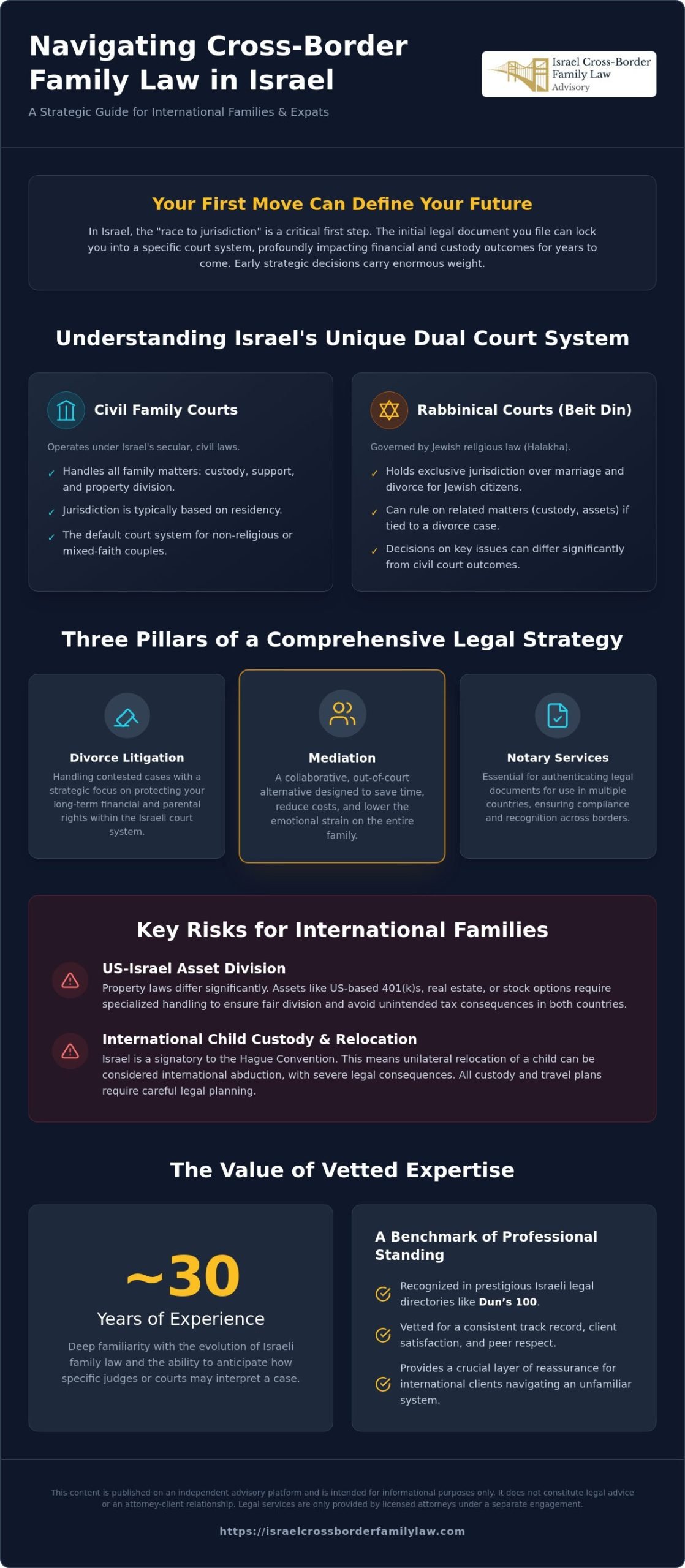
- Understand the fundamental differences between the Civil Family Courts and the Rabbinical Courts to better navigate the unique Israeli legal landscape.
- Identify the specific risks involved in US-Israel asset division and international child custody cases, including the application of the Hague Convention.
- Gain a framework for using independent strategic advice to clarify your objectives before committing to a long-term legal representative.
Who is Michal Mozes? An Overview of Her Legal Practice in Israel
Adv. Michal Mozes is a prominent Israeli attorney who has built a reputation for handling high-stakes family and inheritance law matters. As the founder of the Michal Mozes Law Office, she provides a steady hand for clients facing the inherent complexities of the Israeli court system. Adv. Michal Mozes is a veteran of the Israeli Family Court system with nearly three decades of experience. Her practice serves as a critical resource for those who need to understand the weight of early legal decisions in a jurisdiction that often feels foreign to English speakers.
To gain a broader perspective on how specialized family law practices operate, watch this helpful overview:
Professional Standing and Recognitions
In the Israeli legal market, professional excellence is often measured by inclusion in prestigious directories such as Dun’s 100 and BDI. These rankings aren’t just accolades; they signify that a firm has been vetted for its track record, client satisfaction, and professional standing among its peers. For international families, these rankings offer a layer of reassurance. They indicate that the practitioner understands the strategic nuances required to succeed within the local judiciary and has maintained a high standard of practice over many years.
Historical longevity is a significant factor when evaluating counsel. With nearly thirty years in practice, Adv. Mozes has witnessed the evolution of Israeli family law firsthand. This experience allows her to anticipate how specific judges or courts might interpret a case, which is invaluable in a system where precedents and religious laws intersect. Her role as an executive and founder ensures that the firm’s approach remains focused on achieving strategic objectives while maintaining a calm, professional environment for clients during challenging times.
The Scope of the Michal Mozes Law Office
The firm’s practice is built around the three pillars of modern family law: divorce litigation, mediation, and inheritance disputes. This comprehensive scope is vital for expats and foreign nationals who often face overlapping legal challenges. For instance, a divorce might involve complex asset division or the need for precise legal documentation that must be recognized both in Israel and abroad. The Michal Mozes Law Office integrates these needs into a cohesive strategy.
- Family Law and Divorce: Handling contested cases with a focus on protecting the client’s long-term financial and parental interests.
- Mediation: Providing a collaborative alternative to the courtroom, which can often save time and reduce the emotional strain on the family unit.
- Notary Services: Essential for international families who need to authenticate documents for use in multiple jurisdictions, ensuring cross-border compliance.
By integrating these services, the firm addresses the multi-jurisdictional complexity that international families face. Whether you are dealing with property in the United States or custody issues in Tel Aviv, having a single point of professional contact can simplify an otherwise overwhelming process. This integrated approach allows for a clearer understanding of the risks and opportunities available within the Israeli legal framework.
Core Specializations: Divorce, Mediation, and Notary Services
The Michal Mozes Law Office operates with a philosophy that blends decades of procedural knowledge with creative legal strategy. In the complex landscape of Israeli family law, “innovation” is more than a professional accolade; it is a necessary tool for resolving modern disputes that involve digital assets, international relocation, or multi-state inheritance. Adv. Mozes focuses on providing structured, strategic paths that prioritize the long-term stability of the family unit, whether through assertive representation or collaborative negotiation.
Mediation vs. Litigation in Israel
The Israeli legal system has evolved to prioritize mediation as a primary step in family disputes. Under current regulations, many couples are required to attend initial dispute resolution sessions before a case can proceed to a full court hearing. This mandate aligns with the practice at the Michal Mozes Law Office, where mediation is treated as a core pillar of service. For international families, mediation offers a level of privacy and control that litigation cannot provide. It allows parties to draft enforceable financial agreements that respect the nuances of their cross-border lives without the risks of a public court battle.
Families often feel overwhelmed when Navigating the Israeli Family Court System, particularly because religious and civil laws overlap in ways that don’t exist in the West. A skilled mediator helps bridge these gaps, ensuring that agreements regarding child support or property division are both legally sound and culturally appropriate. By choosing a path of structured negotiation, expats and foreign nationals can often avoid the significant costs and lengthy timelines associated with contested litigation, which can last two to four years in the Israeli courts.
The Role of the Notary in Cross-Border Matters
For US citizens and other internationals living in Israel, notary services are a vital administrative link between two different legal worlds. The authentication of documents for use in foreign jurisdictions, often involving an Apostille, is a frequent requirement for those managing assets or legal status in both the US and Israel. These services ensure that powers of attorney, wills, and estate documents are recognized by authorities in both nations, preventing future bureaucratic delays.
In Israel, notary fees are strictly regulated by the Ministry of Justice and are uniform across all practitioners. This transparency helps clients understand the baseline costs of document certification as of 2026. Beyond simple signatures, a notary with deep family law expertise can ensure that a will or a prenuptial agreement is drafted to withstand the scrutiny of both the Israeli Family Court and foreign legal bodies. This dual-focus approach is essential for protecting wealth and ensuring that your final wishes are respected across borders.
Gaining a clear perspective on your options is the first step toward a stable resolution. You might find it helpful to speak with a professional advisor to clarify your goals before moving forward with formal documentation.
Navigating the Israeli Family Court System as an Anglo
For English speakers moving through a divorce in Israel, the most immediate and impactful concept to understand is the “Race to Jurisdiction.” In the Israeli legal landscape, the spouse who files first often determines whether the case is heard in the secular Family Court or the religious Rabbinical Court. This choice is not merely administrative; it can fundamentally alter the outcome of property division, spousal support, and child custody. Decisions made in the first 48 hours of a dispute often carry weight for years to come. The Michal Mozes Law Office provides the strategic foresight necessary to evaluate these risks before a single document is submitted to the authorities.
Civil vs. Religious Courts
Israel maintains a unique dual-court system where Jewish couples must obtain a religious divorce, known as a “Get,” through the Rabbinical Court (Beit Din). While the religious court has exclusive jurisdiction over the marriage and divorce itself, civil matters like asset distribution and child support can be adjudicated in either the Family Court or the Rabbinical Court. As noted in the Dun’s 100 profile for Michal Mozes Law Office, Adv. Mozes is deeply involved in the professional committees that shape these regulations, allowing her to provide nuanced risk assessments for international Jewish couples.
Choosing the right venue requires an honest look at your specific circumstances. For example, a 2025 amendment clarified the Rabbinical Court’s authority to handle child support within a divorce lawsuit, including education and healthcare needs. This shift underscores why international families must seek clarity on how each court might interpret their financial standing. Navigating both systems requires an attorney who understands the procedural differences and the potential impact on your global assets.
Language and Communication Barriers
The Israeli legal system operates entirely in Hebrew, creating a significant barrier for English-speaking clients who expect the transparency and detailed communication common in US or UK legal cultures. There is often a gap between Western legal concepts like “community property” and the Israeli principle of “Balancing of Resources.” A cross-border lawyer acts as more than just a litigator; they serve as a bridge, translating complex Israeli statutes into plain English that aligns with your expectations.
Clear communication is especially vital for For Expats and Foreign Nationals who may be unfamiliar with local court etiquette or the pace of the Israeli judiciary. When you understand the “why” behind a specific legal move, the process becomes less intimidating. The goal is to ensure you are never left wondering about the status of your case or the implications of a court order. By bridging these cultural and linguistic gaps, you can make informed decisions that protect your family’s future without the added stress of a language barrier.
Key Considerations for International Families in Israel
Managing family law matters that span multiple legal jurisdictions creates a level of inherent complexity that standard domestic practices are often unequipped to handle. When assets or children are moved across borders, the legal friction between two different systems can lead to unforeseen financial or parental consequences. The Michal Mozes Law Office addresses these transnational issues by focusing on the strategic alignment of Israeli law with foreign legal requirements. This approach is vital for ensuring that a resolution reached in Tel Aviv remains enforceable and recognized in jurisdictions like New York or California.
International Asset and Inheritance Planning
For international families, a standard Israeli will often fails to address the specific complexities of assets held in the United States. US estate tax laws and state-level probate rules may conflict with Israeli inheritance law, potentially leaving heirs with significant tax liabilities or contested claims. Strategic planning requires a cross-border perspective that anticipates how both systems will interact over time. This level of foresight is similarly critical when Navigating US-Israel M&A or other high-value corporate transactions that directly impact family wealth and succession.
Asset division in a divorce also requires a nuanced understanding of how Israeli courts treat foreign property. While the Spouses (Property Relations) Law generally mandates a 50/50 division of assets accumulated during the marriage, the practical enforcement of this “Balancing of Resources” can be difficult when property or bank accounts are located abroad. The Michal Mozes Law Office helps clients identify these risks early, ensuring that financial disclosures are comprehensive and that any resulting agreements are structured to withstand scrutiny in both nations.
Custody and Relocation Risks
Relocation is perhaps the most sensitive area of international family law. Israeli courts apply the “best interests of the child” standard, but this is interpreted through the lens of the child’s established life within the Israeli social and educational framework. Moving a child out of the country without a formal agreement or a specific court order can trigger the Hague Convention on the Civil Aspects of International Child Abduction. Understanding the risks of International Custody and Relocation is essential before making any life-altering commitments.
The legal framework for moving children out of Israel after a divorce is rigorous. Courts will closely examine the proposed educational environment, the child’s relationship with the non-relocating parent, and the long-term impact on the child’s identity. If you are managing assets or custody concerns across borders, it’s prudent to request a confidential consultation to discuss your specific circumstances and gain a clear understanding of your legal standing. Gaining this clarity early can prevent the significant emotional and financial costs associated with international litigation.
Enforcing a foreign judgment, such as a US child support order, in Israeli courts is a structured process that requires precise legal documentation. As of January 1, 2026, the Israeli Judicial Authority has updated various court fees, including those for the ratification of foreign agreements. Without proper authentication and a clear understanding of these local procedural requirements, foreign orders may not be recognized by local authorities. This leaves families without the financial support they are entitled to and underscores the importance of a multi-jurisdictional legal strategy.
Making Informed Decisions: The Importance of Independent Advisory
Choosing legal representation in a foreign country is a decision that impacts your family’s trajectory for years. There is a significant difference between hiring a litigator to fight a specific battle and seeking a strategic advisor who understands the broader cross-border landscape. Before committing to a long-term engagement, it’s essential to define your goals clearly. This “clarity before commitment” approach ensures that the professional you choose aligns with your specific financial and parental objectives. High-stakes family law requires a steady hand and a clear roadmap before any formal petitions are filed.
A Strategic Approach to Legal Representation
This article is published on an independent advisory platform, not a law firm. Our role is to provide strategic guidance and risk assessment before you enter a formal attorney-client relationship. By utilizing a Confidential Case Review, you can organize your facts, identify potential multi-jurisdictional pitfalls, and prepare a specific set of questions for potential counsel. Understanding How the Advisory Works allows you to approach firms like the Michal Mozes Law Office from a position of informed strength rather than one of confusion or urgency.
When evaluating the Michal Mozes Law Office or any high-profile Israeli firm, you should look beyond directory rankings. While professional accolades indicate local standing, you must assess how that expertise translates to your international life. A strategic advisor helps you determine if a firm’s strengths in litigation or mediation match the specific complexity of your US-Israel assets or custody arrangements. This preparation helps bridge the gap between your expectations and the realities of the Israeli legal system.
Final Checklist for Choosing an Israeli Lawyer
Selecting the right advocate requires a methodical approach. It’s helpful to consider the following points during your initial consultations to ensure the firm can handle the nuances of your case:
- Verify Licensing and Experience: Confirm the attorney’s standing with the Israel Bar Association and their specific track record with international families or expats.
- Assess Treaty Knowledge: Ensure the firm has a deep comfort level with US-Israel treaty implications, such as the Hague Convention or cross-border tax issues related to asset division.
- Review Fee Structures: Request a transparent explanation of fees, including retainer expectations and the cost differences between mediation and court appearances.
- Evaluate Communication: Ensure the attorney can explain complex Israeli statutes in plain English and that their communication style matches your need for transparency.
Taking the time to evaluate these factors protects you from the risks of early, misinformed decisions. Legal services are only provided by licensed attorneys under a separate engagement; however, the strategic groundwork you lay now will define the success of that future relationship. Get clarity before you commit. Request a confidential consultation.
Strategizing Your Path Forward in Israel
As an independent advisory platform, we focus on helping you identify risks and clarify your goals before you commit to a formal attorney-client relationship. Our expertise in US-Israel cross-border frameworks provides the steady guidance Anglos need to navigate the Israeli legal system with confidence. Securing the right counsel is the first step toward a stable resolution for your children and your financial future. It’s possible to move through these challenges with professional support that respects your unique cultural background.
Get clarity before you commit. Request a confidential consultation.
Frequently Asked Questions
Is Michal Mozes an expert in international divorce?
Yes, Adv. Mozes is recognized as a leading authority in family law with a specific focus on complex litigation. Her practice frequently handles matters involving cross-border assets and international relocation, which are central to international divorce cases in Israel. This specialized expertise is reflected in her consistent rankings in prestigious directories like Dun’s 100.
What is the difference between a mediator and a divorce lawyer in Israel?
A mediator acts as a neutral third party to help couples reach an amicable agreement, whereas a divorce lawyer represents one party’s interests in a courtroom. In Israel, the legal system often requires an initial dispute resolution phase before litigation can proceed. Many practitioners, including those at the Michal Mozes Law Office, are qualified to serve in both capacities depending on the specific needs of the family.
Can Michal Mozes help with US-based assets in an Israeli divorce?
Yes, her practice specializes in the division of global assets, including property and financial accounts located in the United States. Israeli courts apply the principle of “Balancing of Resources” to divide marital property. Handling US-based assets requires a nuanced understanding of how Israeli court orders will be recognized and enforced across international borders to ensure financial stability.
How long has Michal Mozes been practicing family law in Israel?
Adv. Michal Mozes has been practicing law for nearly three decades, bringing deep historical knowledge to her client matters. This longevity is a key indicator of her professional standing and experience within the Israeli judiciary. Her extensive career allows her to navigate the evolving regulations of both the secular Family Courts and the religious Rabbinical Courts with high levels of proficiency.
Does the Michal Mozes Law Office handle Hague Convention cases?
Yes, the firm manages complex international child custody disputes, including those involving the Hague Convention on the Civil Aspects of International Child Abduction. These cases are high-stakes and require immediate strategic action to prevent or resolve the unauthorized relocation of children. The firm focuses on protecting the child’s best interests within this rigorous global legal framework.
What should I look for when hiring a family lawyer in Tel Aviv?
You should prioritize a lawyer with specific experience handling Anglo clients and cross-border legal complexities. It’s essential to look for professional recognition in directories like BDI or Dun’s 100 and verify their comfort level with international treaties. It is also important to find a practitioner who can communicate complex Hebrew legal concepts in plain English to ensure full transparency during the process.
Are Israeli notary services from Michal Mozes valid in the United States?
Yes, provided they are accompanied by an Apostille, which is an international certification that authenticates the document for use in foreign jurisdictions. The Michal Mozes Law Office provides these regulated notary services to ensure that wills, powers of attorney, and financial agreements are recognized by US authorities. This certification is essential for maintaining legal compliance and protecting assets in both nations.
How do I know if I need a cross-border advisory before hiring a lawyer?
You likely need a cross-border advisory if your case involves assets in multiple countries, children with dual citizenship, or conflicting legal systems. An independent advisory platform helps you clarify your strategic goals and assess risks before you commit to a specific litigator. This preliminary step ensures you choose a legal representative who truly matches your specific international requirements and family objectives.

Article by
Gabriel Lior
A Personal Journey That Became a Mission
The advisory was founded by an American father Gabriel Lior, LLB, MBA , global entrepreneur, and cross-border advisor who spent more than a decade navigating the Israeli family court system firsthand and now lives in Singapore with his son.
As a divorced parent in a cross-border family, Gabriel faced nearly every legal challenge a foreign parent can encounter in Israel — including child custody disputes, child support proceedings, property matters in Israel and abroad, false accusations, and complex immigration and relocation proceedings.
Over the years, he learned the hard way how difficult it is for non-Israeli parents to understand the system, identify the right legal strategy, and choose the right legal representation — especially when language, culture, and jurisdictional differences are involved. He also witnessed how foreign parents and new immigrants are often disadvantaged or taken advantage of by service providers and institutions simply because they lack local knowledge or fluency.
From Client to Advisor
To truly understand — and survive — the system, Gabriel pursued formal legal education in Israel, completing two Israeli law degrees, alongside a BA and MBA earned in the United States. This was never about becoming a practicing attorney, but about gaining a deep, structural understanding of how the system works — and where it breaks down for foreign parents.
This rare combination of:
Firsthand client experience
Israeli legal and US business education
International business and negotiation training
Decades of commercial execution
created a unique perspective – one that understands both sides of the table.
After years of litigation, persistence, and at times self-representation, he ultimately succeeded in securing custody of his son and relocating abroad through a rare legal victory in the Israeli Supreme Court — becoming one of the first fathers in Israel to do so under these circumstances.
Disclaimer
Important Disclaimer:
The information provided on this website and in its content is for general informational and educational purposes only and does not constitute legal advice, legal opinion, or legal representation.
Gabriel Lior is not licensed to practice law in Israel (nor is he interested in doing so) and does not provide legal services, despite having completed 2 Law Degrees. The services offered are advisory in nature and are intended to provide general guidance, strategic insight, and information regarding cross-border family law considerations.
No attorney-client relationship is formed by accessing this website, reading its content, or communicating with us.
Any decisions made based on this information are at your own discretion and risk. For legal advice specific to your situation, you should consult a licensed attorney in the relevant jurisdiction.
Where appropriate, we may refer clients to independent, licensed attorneys or professionals. Such referrals do not constitute legal representation and no liability is assumed for services provided by third parties.