Imagine arriving at Ben Gurion Airport only to discover that a “Stop-Exit” order prevents your child from boarding the plane. For many international families moving between the US and Israel, the threat of parental child abduction or the sudden imposition of Emergency Travel Restrictions for Children creates immense anxiety. It’s understandable to feel caught between two different legal cultures, especially when conflicting court orders leave you unsure of your next move.
This guide will help you understand the strategic steps necessary to manage these high-stakes situations. You’ll learn how to legally implement a travel restriction, the specific requirements for lifting a Ne-Exeat order, and how to balance child safety with long-term travel rights. We’ll explore the nuances of the Israeli legal system and how they interact with international protocols. Please note that this content is published on an independent advisory platform, not a law firm. It’s intended for informational and strategic guidance rather than formal legal advice, helping you gain clarity before making critical decisions in a cross-border dispute.
Key Takeaways
- Understand the specific legal triggers and scenarios that lead to Emergency Travel Restrictions for Children within the US-Israel legal corridor.
- Learn the formal procedures for implementing or responding to an Israeli “Stop-Exit” order to ensure your child’s location remains secure during a dispute.
- Explore how the Hague Convention functions as a protective shield to prevent the wrongful retention or removal of children across international borders.
- Identify the requirements for modifying or lifting a travel ban, including the strategic use of “Guarantees of Return” to satisfy court concerns.
- Discover why early planning and cross-border expertise are essential for navigating the cultural and procedural gaps between different national legal systems.
What Are Emergency Travel Restrictions for Children?
In the complex environment of cross-border family life, emergency travel restrictions are legal mechanisms used to prevent the unauthorized removal of a child from their country of habitual residence. For families with ties to both the United States and Israel, Emergency Travel Restrictions for Children serve as a vital safeguard during periods of high conflict. They are typically initiated when one parent fears that the other may relocate the child permanently without consent or a court-approved plan.
These measures usually arise during divorce proceedings, intense custody disputes, or following direct threats of abduction. Understanding the nuances of Emergency Travel Restrictions for Children is paramount for parents who wish to maintain their child’s stability during a legal transition. It’s essential to distinguish between a temporary restriction, often called a “Stop-Exit” order in Israel, and a permanent travel ban. Temporary orders are designed to freeze the situation while the court reviews the facts, whereas permanent bans are rare and usually only part of a final custody ruling. International families often face higher scrutiny at border crossings because the legal implications of moving a child between jurisdictions are significantly more complex than domestic travel.
Strategic guidance is often necessary to understand how these orders interact with the Hague Convention on the Civil Aspects of International Child Abduction, which is the primary treaty governing the return of children in these cases. For more detailed information on how these treaties apply to your situation, you can review our resources on Hague Convention child abduction.
Disclaimer: This content is published on an independent advisory platform and does not constitute legal representation or formal legal advice. Legal services are only provided by licensed attorneys under a separate engagement.
The Role of the Israeli Family Court
Israeli courts are guided by the “best interests of the child” principle. When a parent files an ex-parte motion, the court can issue a ruling based solely on that parent’s evidence if there’s an immediate risk of the child leaving the country. This one-sided approach is meant to prevent a “race to the airport.” For children with dual US-Israeli citizenship, jurisdictional overlaps can complicate matters, as both countries may feel they have the right to decide the child’s future. Seeking clarity on these jurisdictional differences is a critical early step for any expat parent before committing to a specific legal path.
Signs You May Need a Travel Restriction
Proactive observation can prevent a crisis before it starts. You should be alert to specific behaviors that suggest a parent might be planning to leave the jurisdiction without your knowledge. Key red flags include:
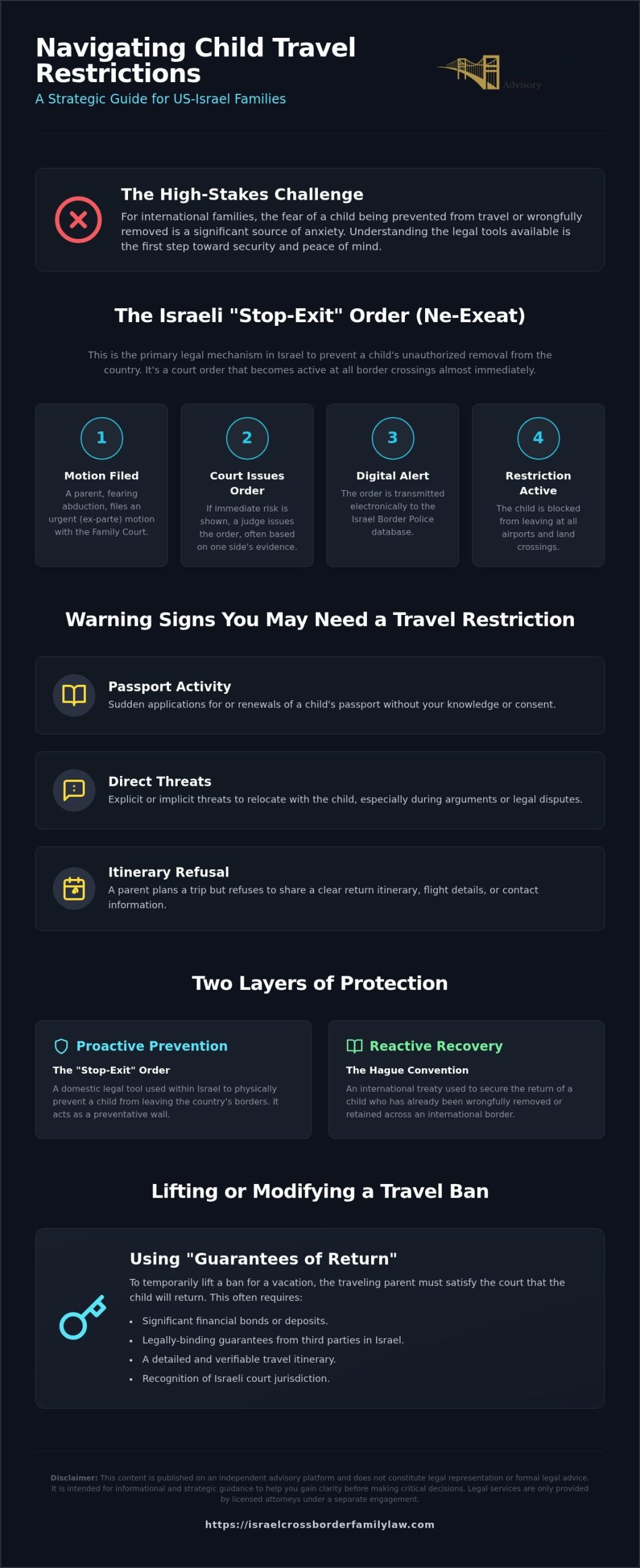
- Passport Activity: Sudden applications for or renewals of a child’s passport without your involvement or consent.
- Direct Threats: Explicit or implicit threats of relocation made during heated legal disputes or arguments.
- Itinerary Refusal: A parent plans a vacation but refuses to share a clear return itinerary, flight numbers, or local contact information.
Recognizing these patterns early allows for more measured, strategic decision-making. It’s often more effective to implement safeguards before a parent attempts to leave rather than trying to recover a child once they have already crossed an international border.
The Ne-Exeat Order: Understanding Israeli Stop-Exit Protocols
In the Israeli legal system, the primary tool for enforcing Emergency Travel Restrictions for Children is the Tzav Ikuv Yetzia Min Ha’aretz, commonly known as a Stop-Exit order. This is a formal judicial stay that prevents a minor from leaving the country’s borders. Once a judge in the Family Court or Rabbinical Court signs this order, it is transmitted electronically to the Israel Border Police. The restriction becomes active across all points of departure, including Ben Gurion Airport and various land crossings, almost immediately. This digital integration ensures that the order is not dependent on physical paperwork at the terminal; it is tied directly to the child’s identity records.
The duration of these orders varies based on the specific legal context. A judge may issue a temporary order, often lasting between seven and thirty days, to maintain the status quo until a full hearing can take place. If the court determines there is a persistent flight risk, the order may be extended until the conclusion of all legal proceedings. Convincing a judge to issue such a stay requires a significant legal threshold. The petitioner must demonstrate a credible fear that the child’s departure is imminent and that such a move would frustrate the court’s ability to decide on custody or relocation matters. If you are concerned about an impending departure, it is helpful to review the specifics of your situation before the child reaches the airport.
Disclaimer: This content is published by an independent advisory platform and does not constitute legal representation. Strategies and risks discussed are for informational purposes; formal legal services are provided only by licensed attorneys under a separate agreement.
Dual Nationality and the ‘Stop-Exit’ Risk
Many expat families mistakenly believe that a child’s US passport provides a bypass to Israeli border controls. However, the Israeli Ministry of Interior maintains an integrated database that links a child’s Israeli identity number with any foreign passports they may hold. Dual citizenship complicates exit protocols because it creates a secondary layer of identification that the Israeli border system is specifically designed to track and block once an order is issued. Even if you present a US passport at the gate, the system will flag the Israeli citizen record and prevent boarding.
The Ne-Exeat Order in the US Legal System
While Israel uses the digital Stop-Exit system, the US legal system often relies on “Ne-Exeat” clauses within custody decrees. These clauses usually mandate that neither parent can remove the child from a specific jurisdiction without written consent or a court order. US courts frequently enforce these by ordering the seizure of the child’s passport. It’s vital to understand that a US court order does not have self-executing power in Israel. Contrary to some common misconceptions, the US Embassy cannot override or “break” an Israeli Stop-Exit order. If a child is already on Israeli soil, the local court’s ruling takes precedence, and the US order serves primarily as evidence of the other parent’s intent or the “habitual residence” of the child under the Hague Convention protocols.
The Hague Convention: A Shield Against International Abduction
While the Israeli Stop-Exit order is a powerful domestic tool, the primary international framework for protecting children across borders is the 1980 Hague Convention on the Civil Aspects of International Child Abduction. Both the United States and Israel are long-standing signatories to this treaty, which creates a standardized legal pathway for the return of children who have been wrongfully removed or retained. The treaty operates on the principle that custody decisions should be made by the courts in the child’s country of “habitual residence” rather than by a parent who unilaterally moves the child to a new jurisdiction.
A critical distinction within the treaty is the difference between a “Right of Custody” and a “Right of Access.” To trigger a return order under the Hague Convention, the left-behind parent must demonstrate they held and were exercising rights of custody at the time of the removal. Rights of access, which generally refer to visitation, are protected but rarely provide sufficient grounds for a court to order a child’s return to another country. Understanding these nuances is essential for families navigating Emergency Travel Restrictions for Children, as the treaty’s protections depend heavily on how your initial custody agreement is drafted. You can learn more about the Hague Convention and child abduction to see how these definitions might apply to your specific family structure.
Disclaimer: This content is published on an independent advisory platform and does not constitute legal representation. Strategy and risk assessments are informational; formal legal advice is only provided by licensed attorneys under a separate engagement.
Preventative Measures Under the Hague Convention
Families don’t have to wait for an abduction to occur before utilizing the treaty’s framework. You can establish travel safeguards by ensuring your custody orders explicitly define “habitual residence” and require mutual consent for any international travel. If a crisis arises, the Central Authority in each country, the U.S. Department of State and the Israeli Ministry of Justice, acts as a coordinator to facilitate communication and legal cooperation. The Hague Convention is exclusively a mechanism for the prompt return of a child to their country of habitual residence and does not empower a court to determine long-term custody arrangements.
Defenses Against a Hague Return Order
In certain emergency cases, an Israeli or US court may decline to return a child if specific legal defenses are proven. The most common is the “Grave Risk” exception, where the returning parent must show that the child would face physical or psychological harm if sent back. Courts may also consider a child’s objection if the minor has reached an age and degree of maturity where their views should be taken into account. Additionally, the “Settled” defense applies if more than one year has passed since the removal and the child has become deeply integrated into their new environment. These defenses are difficult to prove and require a sophisticated understanding of how local judges interpret international law.
How to Lift or Modify an Emergency Travel Ban
Lifting a “Stop-Exit” order in the Israeli legal system is not as simple as filing a single administrative form. When Emergency Travel Restrictions for Children are in place, the court’s primary concern is ensuring the child returns to Israel after any permitted travel. To modify or suspend these restrictions, a parent must file a formal motion demonstrating that the risk of non-return is minimal. This process often involves a strategic negotiation where the traveling parent provides “Guarantees of Return” to satisfy the judge’s concerns about potential abduction or relocation.
In many cases, the court requires the involvement of third-party guarantors, known as Areivim. These individuals are typically Israeli residents with stable financial standing who sign a legal commitment to the court. If the child is not returned by the specified date, these guarantors may become personally liable for significant financial penalties. This system creates a localized social and financial pressure designed to ensure compliance with the court’s orders. For families navigating these complex requirements, it is helpful to review our guidance on international custody and relocation to understand the long-term implications of these travel permits.
Disclaimer: This content is published on an independent advisory platform and does not constitute legal representation. Strategies and risks discussed are for informational purposes; formal legal services are only provided by licensed attorneys under a separate engagement.
Financial Bonds and Security Deposits
Courts frequently mandate financial security as a condition for lifting a travel ban. This can take the form of a cash deposit held by the court or a bank guarantee. The amount is determined on a case-by-case basis, reflecting the perceived flight risk and the child’s specific needs. If the child does not return on time, the court may forfeit the bond immediately. This financial deterrent is a cornerstone of the Israeli approach to managing cross-border travel during active disputes. If you need assistance determining the best strategy for your specific case, contact us for a confidential review.
Temporary Permits for Specific Travel
It is possible to request a “Window of Travel” for specific family events, such as a bar mitzvah or a holiday in the US. This requires drafting a detailed itinerary, including flight numbers and local addresses, alongside a “Consent to Jurisdiction” agreement. This agreement stipulates that the traveling parent accepts the Israeli court’s authority even while abroad. To strengthen the request, parents often obtain a “mirror-order” from a US court. This US order confirms that the American legal system recognizes the Israeli travel permit and will enforce the child’s return, providing the Israeli judge with an extra layer of international security.
Strategic Guidance for Cross-Border Families
Decisions made during the initial stages of a cross-border dispute carry immense weight. Proactive planning is often the most effective way to prevent the sudden imposition of Emergency Travel Restrictions for Children. When families wait until a crisis occurs at the departure gate, their legal options become limited and reactive. Establishing a clear, mutually agreed-upon framework for international travel before tensions reach a breaking point provides a sense of security for both parents and children. It’s much easier to negotiate travel protocols when both parties still feel a degree of mutual trust rather than attempting to lift a court-ordered ban in the heat of litigation.
Navigating the cultural and legal gap between US and Israeli expectations requires a bridge between two very different systems. While US courts may focus on passport control and specific “Ne-Exeat” clauses, the Israeli system relies heavily on the digital “Stop-Exit” infrastructure. Seeking clarity before making significant international commitments, such as moving a child for a trial period, is vital. Misunderstandings about how these commitments are viewed by a judge can lead to unintended legal consequences that restrict future travel for years. Understanding how our advisory works can help you align these moving parts before they become points of contention.
Disclaimer: This content is published on an independent advisory platform and is not a law firm. Our focus is on strategy, risk management, and decision-making guidance rather than formal legal representation. Legal services are only provided by licensed attorneys under a separate engagement.
Building a Multi-Jurisdictional Strategy
A successful approach requires a strategy that functions seamlessly in both Tel Aviv and the United States. Cross-border families often struggle because their legal representation in one country doesn’t communicate effectively with counsel in the other. This lack of coordination can lead to conflicting orders that are impossible to follow. It’s essential to protect your rights without unnecessarily escalating the conflict. A balanced strategy focuses on achieving long-term stability rather than short-term legal victories that may trigger a defensive travel stay.
Clarity Before You Commit
Before making any international commitments or relocating, a thorough risk assessment is necessary. You must evaluate the likelihood of a travel ban based on your specific family history and current legal standing. Preparing for a confidential case review involves gathering all existing custody decrees and identifying potential jurisdictional overlaps. This step allows you to move forward with confidence, knowing you have addressed the complexities of both legal systems.
Get clarity before you commit. Request a confidential consultation.
Securing Your Family’s Future Across Borders
Managing the complexities of Emergency Travel Restrictions for Children requires more than just local legal knowledge; it demands a comprehensive strategy that bridges the gap between US and Israeli jurisdictions. We’ve explored how Israeli “Stop-Exit” orders function through digital integration and the ways the Hague Convention serves as a global safeguard against unauthorized relocation. Whether you’re seeking to implement a travel ban or need to modify an existing order through financial guarantees, the weight of your early decisions cannot be overstated.
Success in these matters often depends on seeking authoritative guidance before a crisis occurs at the airport. With specialized expertise in US-Israel cross-border family law and a dedicated focus on Hague Convention disputes, our advisory provides the clarity international families need to navigate conflicting court orders. It’s possible to protect your child’s safety while maintaining their right to travel, provided you have a clear roadmap. Get clarity before you commit. Request a confidential consultation today to begin building a stable future for your family.
Disclaimer: This content is published on an independent advisory platform, not a law firm. We focus on strategy, risks, and decision-making guidance rather than an attorney-client relationship. Legal services are only provided by licensed attorneys under a separate engagement.
Frequently Asked Questions
Can I stop my child from leaving Israel if I suspect they won’t return?
Yes, you can file an emergency motion for a “Stop-Exit” order in the Family or Rabbinical Court. This is a common part of implementing Emergency Travel Restrictions for Children when a flight risk is demonstrated. The court can issue an order ex-parte, meaning without the other parent’s presence, to prevent immediate departure. It’s vital to act quickly as these orders are processed with high priority in the Israeli system.
What is a ‘Stop-Exit’ order and how do I know if my child has one?
A “Stop-Exit” order (Tzav Ikuv Yetzia) is a judicial stay that blocks a minor’s departure at all Israeli border crossings. To check if an order exists, you can contact the Israel Border Police or check the official government portal. Because these orders are digital, they’re flagged instantly at Ben Gurion Airport when a passport is scanned. This ensures that the child cannot board a flight even if they hold multiple passports.
How long does it take to get an emergency travel restriction in Israel?
An emergency order can often be obtained within hours if the court is convinced of an imminent flight risk. In urgent cases, judges may review motions outside of standard hours to prevent a “race to the airport.” Once signed, the order is electronically transmitted to the Border Police almost immediately. This digital speed is the primary defense for families who fear a child might be removed from the country on short notice.
Can a US court order prevent my child from being taken to Israel?
A US court can issue a “Ne-Exeat” order or seize passports to prevent travel, but these orders aren’t self-executing in Israel. While a US judge can penalize a parent for violating an order, the Israeli border authorities won’t stop a child based on a US decree alone. You must seek a local Israeli stay to ensure enforcement on the ground. Relying solely on a foreign order often leads to a false sense of security.
What happens if a parent violates a travel restriction?
Violating a travel restriction can lead to severe legal consequences, including contempt of court charges and the forfeiture of financial bonds. If a parent successfully removes a child despite an order, the other parent can initiate a return petition under the Hague Convention. Such violations also heavily influence future custody and visitation rulings in both US and Israeli courts. It’s a high-risk decision that can permanently damage a parent’s legal standing and travel rights.
Do I need a lawyer to lift a travel ban for my child?
While not strictly mandatory, navigating the requirements to lift a ban is complex and usually requires professional assistance. You’ll need to provide “Guarantees of Return” and potentially secure third-party guarantors (Areivim) who live in Israel. A strategic advisor can help you prepare the necessary financial and legal safeguards to satisfy the court’s concerns. This guidance ensures you maintain your travel rights while providing the court with the security it requires.
Can I travel with my child if the other parent refuses to sign the passport application?
You cannot apply for a US or Israeli passport for a minor without both parents’ consent unless you have a specific court order. If one parent refuses, you must petition the court to appoint a “guardian ad litem” or issue an order allowing you to sign on behalf of both. This is a standard procedure in cases involving Emergency Travel Restrictions for Children. It’s essential to resolve these passport issues through the court rather than attempting workarounds.
What financial guarantees are required to allow a child to travel during a dispute?
Courts often require cash deposits or bank guarantees, which can range significantly depending on the perceived flight risk. These funds are held by the court and forfeited if the child does not return by the agreed date. Additionally, you may need two Israeli residents to sign as guarantors, assuming personal financial liability for the child’s return. These financial layers are designed to create a strong deterrent against unauthorized relocation during a legal dispute.

Article by
Gabriel Lior
A Personal Journey That Became a Mission
The advisory was founded by an American father Gabriel Lior, LLB, MBA , global entrepreneur, and cross-border advisor who spent more than a decade navigating the Israeli family court system firsthand and now lives in Singapore with his son.
As a divorced parent in a cross-border family, Gabriel faced nearly every legal challenge a foreign parent can encounter in Israel — including child custody disputes, child support proceedings, property matters in Israel and abroad, false accusations, and complex immigration and relocation proceedings.
Over the years, he learned the hard way how difficult it is for non-Israeli parents to understand the system, identify the right legal strategy, and choose the right legal representation — especially when language, culture, and jurisdictional differences are involved. He also witnessed how foreign parents and new immigrants are often disadvantaged or taken advantage of by service providers and institutions simply because they lack local knowledge or fluency.
From Client to Advisor
To truly understand — and survive — the system, Gabriel pursued formal legal education in Israel, completing two Israeli law degrees, alongside a BA and MBA earned in the United States. This was never about becoming a practicing attorney, but about gaining a deep, structural understanding of how the system works — and where it breaks down for foreign parents.
This rare combination of:
Firsthand client experience
Israeli legal and US business education
International business and negotiation training
Decades of commercial execution
created a unique perspective – one that understands both sides of the table.
After years of litigation, persistence, and at times self-representation, he ultimately succeeded in securing custody of his son and relocating abroad through a rare legal victory in the Israeli Supreme Court — becoming one of the first fathers in Israel to do so under these circumstances.
Disclaimer
Important Disclaimer:
The information provided on this website and in its content is for general informational and educational purposes only and does not constitute legal advice, legal opinion, or legal representation.
Gabriel Lior is not licensed to practice law in Israel (nor is he interested in doing so) and does not provide legal services, despite having completed 2 Law Degrees. The services offered are advisory in nature and are intended to provide general guidance, strategic insight, and information regarding cross-border family law considerations.
No attorney-client relationship is formed by accessing this website, reading its content, or communicating with us.
Any decisions made based on this information are at your own discretion and risk. For legal advice specific to your situation, you should consult a licensed attorney in the relevant jurisdiction.
Where appropriate, we may refer clients to independent, licensed attorneys or professionals. Such referrals do not constitute legal representation and no liability is assumed for services provided by third parties.