A standard US-drafted contract often carries surprisingly little weight in an Israeli courtroom, making a specialized us-israel prenuptial agreement essential for cross-border couples. You likely recognize that protecting your pre-marital assets and family inheritances is vital when your life spans two different legal cultures. It’s natural to feel anxious that a document signed in a US state might be ignored by an Israeli Rabbinical court or a Family Court judge during a period of transition.
This advisory guide, published on an independent platform, provides the strategic clarity you need to ensure your contract is enforceable in both jurisdictions. We’ll examine the inherent complexities of dual-jurisdiction asset protection and explain the precise steps required to validate a foreign contract so it stands up to Israeli scrutiny. For visual guidance on these matters, you can explore the resources on the @IsraelFamilyLaw YouTube channel. By understanding the significant differences between these legal systems, you can ensure your business interests and family legacy remain secure before you make a formal commitment.
Key Takeaways
- Understand why a signature alone is often insufficient and how the “Ishur” (judicial confirmation) process provides the necessary legal weight for enforceability in Israel.
- Learn how to bridge the jurisdictional gap so that your US-based real estate and bank accounts are clearly defined as separate property within the Israeli legal system.
- Discover the specific risks of using a standard domestic contract and why a us-israel prenuptial agreement must satisfy the unique requirements of both jurisdictions.
- Gain clarity on protecting family inheritances and business interests from the default property division rules used by Israeli Family and Rabbinical courts.
- Explore the benefits of a strategic approach that utilizes practitioners familiar with both cultures to navigate the complexities of international assets and family law.
Disclaimer: This content is published on an independent advisory platform and is intended for informational purposes only. It does not constitute legal representation or formal legal advice.
Understanding the Complexity of US-Israel Prenuptial Agreements
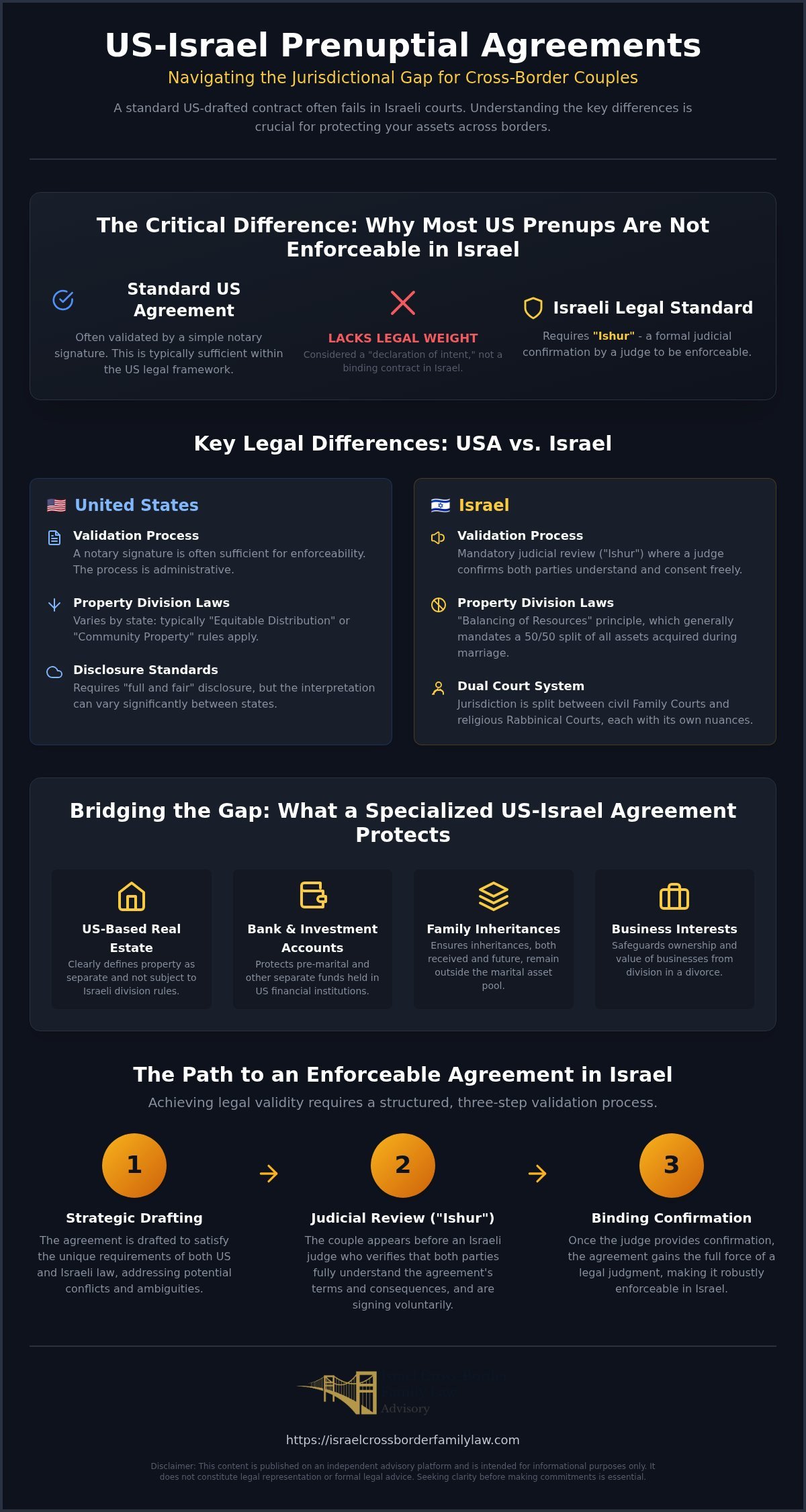
A Prenuptial agreement serves as a foundational financial plan, but for those moving between the United States and Israel, it becomes a complex dual-jurisdiction contract. A us-israel prenuptial agreement is more than a simple set of instructions for asset division. It acts as a jurisdictional bridge designed to withstand the scrutiny of two distinct legal systems. Many couples mistakenly assume that a contract valid in New York or California will be automatically recognized in Tel Aviv. However, the Israeli legal system operates under specific statutes, primarily the Spouses Financial Relations Law, 1973, which sets strict standards for how agreements must be validated to be enforceable.
To better understand the financial importance of these agreements in a cross-border context, watch this helpful video:
Relying on a single-country agreement creates significant exposure. If your contract doesn’t meet the procedural requirements of the Israeli courts, a judge might set it aside entirely. This often happens because Israeli law requires a specific type of judicial approval that doesn’t exist in the US. Without this, your US-based assets, including real estate and business interests, could be subjected to the Israeli “balancing of resources” principle, which generally mandates an equal split of assets acquired during the marriage.
Why Expats and Dual Citizens Need a Specialized Approach
In the US, assets are often divided based on “equitable distribution” or “community property” rules. Israel follows a “balancing of resources” model. While similar to community property, the application changes the moment a couple establishes their “center of life” in Israel. Relocating can shift which country’s laws apply to your divorce, even if you married elsewhere. Early decisions, such as where you sign your agreement and how you disclose your US bank accounts, carry immense weight. If you don’t address these nuances, you risk losing the protections you thought you secured before your move.
The Distinction Between US and Israeli Legal Cultures
Israel’s dual court system adds another layer of complexity. Both civil Family Courts and religious Rabbinical Courts have jurisdiction over certain family matters. A us-israel prenuptial agreement must be drafted to be effective in both. Disclosure requirements in Israel can also differ from the “full and fair” disclosure standards required by many US states. This cultural gap often leads to confusion. Focusing on the strategy behind your agreement, rather than just the forms, is a central part of a cross-border approach. You can learn more about this perspective by reviewing about the advisory platform.
The Jurisdictional Gap: How Israeli Courts View US Agreements
Israeli courts generally respect foreign contracts under the principle of comity, which is the legal recognition of one nation’s laws by another. However, this respect isn’t absolute. When a couple brings a US-drafted document into an Israeli courtroom, the judge must determine if the agreement aligns with Israeli public policy. A common reason a us-israel prenuptial agreement might be challenged is the absence of “Ishur” or formal judicial confirmation. In the US, a notary signature is often enough. In Israel, the Spouses Financial Relations Law requires a judge to verify that both parties understood the terms and signed voluntarily. Without this step, even a perfectly drafted New York contract may be viewed as merely a “declaration of intent” rather than a binding legal document.
The bilateral framework of U.S. Relations With Israel highlights the deep connection between the two nations, yet their legal systems remain distinct. To mitigate risks, drafters often include a “Proper Law of the Contract” clause. This specifies which country’s laws should govern the interpretation of the agreement. For those navigating life as expats or foreign nationals, this clause is a critical strategic tool for maintaining consistency across borders.
Enforceability Challenges for US Expats
Israeli courts apply a “Fairness and Reasonableness” test that can differ significantly from US standards. An agreement that is considered standard in a community property state might be viewed as unconscionable in Israel if it leaves one spouse with no resources. This discrepancy creates a risk of “forum shopping,” where one spouse attempts to file for divorce in the jurisdiction they believe will be more favorable to their financial interests. If an agreement isn’t explicitly validated in Israel, a spouse might successfully argue that the Israeli “balancing of resources” should override the foreign contract.
Reconciling the Two Systems
To bridge this gap, many couples choose to create “mirror agreements” or a single, integrated cross-border contract that references specific Israeli statutes. This demonstrates a clear intent to be bound by both legal systems. Understanding the dynamics of the Rabbinical courts is also essential, especially regarding clauses that address the “Get” or religious divorce. These courts have their own interpretation of financial pressure and may reject clauses they perceive as coercive. You can gain deeper insight into these court dynamics by viewing the YouTube channel videos. Before finalizing any cross-border strategy, it’s helpful to request a confidential case review to assess your specific risks.
Disclaimer: This content is published on an independent advisory platform and is intended for informational purposes only. It does not constitute legal representation or formal legal advice.
Essential Clauses for Protecting Cross-Border Assets
A well-structured us-israel prenuptial agreement must go beyond generalities to address the specific nature of international wealth. In a cross-border context, “separate property” should be defined with granular detail. This includes identifying specific US-based real estate, bank accounts, and investment portfolios held before the marriage. Without clear schedules, these assets risk being categorized under the Israeli “balancing of resources” regime if they are managed or improved during the marriage. Transparency is now mandatory for all new residents. As of January 1, 2026, the 10-year reporting exemption for foreign assets has been canceled for new immigrants, meaning your global financial footprint is visible from day one.
Future assets acquired in either country also require proactive planning. If you intend for business income generated in Israel to remain separate from US-based family holdings, the contract must state this explicitly. Relying on default laws in either jurisdiction often leads to an unintended 50/50 split of marital growth. By defining these boundaries early, you create a predictable framework that protects your financial independence regardless of where you decide to live.
Inheritance and Gift Protection
Israeli law generally excludes inheritances from marital property, but “commingling” remains a significant risk. If you use inherited funds from US-based parents to renovate a home in Israel, a court might rule that the asset has been “mingled” and is now subject to division. Drafting protections for future inheritances requires a strategy that coordinates with your broader US-Israel estate planning. This ensures that assets passing through US trusts are protected by the us-israel prenuptial agreement even after they enter the Israeli jurisdiction. Clear clauses can prevent a spouse from claiming a share of family gifts that were intended for you alone.
Business Interests and Professional Practices
For couples involved in the tech sector, protecting equity in startups is a primary concern. Whether you hold stock options in a Delaware C-Corp or a Tel Aviv-based private company, the agreement should include specific valuation clauses. These provisions define how a business is valued at the time of marriage versus its value during a potential dissolution. Addressing corporate governance and potential mergers or acquisitions ensures that your professional practice remains separate from marital assets. This level of detail prevents a spouse from claiming a share of the “active appreciation” of a business that grew significantly during the marriage. It’s about protecting the sweat equity you’ve invested in your career.
Disclaimer: This content is published on an independent advisory platform and is intended for informational purposes only. It does not constitute legal representation or formal legal advice.
The Validation Process: Making Your Agreement Binding in Israel
In the United States, a prenuptial agreement is often considered finalized once both parties sign the document before a notary. This isn’t the case in Israel. To create a binding us-israel prenuptial agreement, you must obtain “Ishur,” which is formal judicial confirmation. The Israeli legal system requires a judge or authorized official to verify that you entered the agreement of your own free will and fully grasp its financial consequences. Without this judicial seal, a US-drafted contract remains vulnerable to being overturned if a dispute arises within the Israeli jurisdiction. It’s often viewed merely as a statement of intent rather than a binding judgment.
The timing of your validation also matters. If you’re already married, the process is stricter. Post-nuptial agreements must be validated by a judge in the Family Court or the Rabbinical Court. For those about to marry, a notary can sometimes provide this confirmation, but for cross-border couples with complex assets, the court’s involvement provides a higher level of certainty. This step ensures that your US-based holdings are recognized as separate property under Israeli law.
Step-by-Step Validation in the Israeli Family Court
The process of validating your agreement follows a specific procedural path. First, you must file a formal petition for the confirmation of a financial agreement. As of January 2026, the standard fee for opening a file in the Family Court is 568 NIS. Once filed, the court schedules a brief hearing. During this session, the judge speaks directly to both spouses to ensure there was no coercion. They want to confirm that both parties understand how the agreement deviates from the default property division rules. Finally, if the judge is satisfied, they sign the agreement and apply the court’s official seal, giving the contract the legal weight of a judgment.
Special Considerations for Expats
For those navigating this process as expats and foreign nationals, language is a primary hurdle. Israeli courts operate in Hebrew. If your agreement is drafted in English, you’ll need a certified Hebrew translation. Verified data from 2026 suggests these translations typically range from 500 NIS to 2,000 NIS depending on the document’s complexity. While a notary can validate an agreement before a marriage takes place, the court remains the gold standard for dual-jurisdiction protection. Ensuring your us-israel prenuptial agreement meets these procedural standards is a strategic necessity. If you’re unsure whether your current US contract satisfies these Israeli requirements, you can reach out for a confidential strategy session to clarify your next steps.
Disclaimer: This content is published on an independent advisory platform and is intended for informational purposes only. It does not constitute legal representation or formal legal advice. Legal services are only provided by licensed attorneys under a separate engagement.
Strategic Planning: The Cross-Border Advisory Approach
Successful asset protection for international couples requires moving away from a “template” mentality. A us-israel prenuptial agreement is not a static form but a strategic document that must satisfy two distinct legal philosophies simultaneously. Adopting a “dual-track” approach ensures that while the agreement meets the specific requirements of the Israeli Spouses Financial Relations Law, it also remains robust under US state laws. This strategy prevents the “legal friction” that often occurs when a document drafted in one country is presented as evidence in another. It’s about creating a cohesive plan that functions as a single, unified shield for your global interests.
The complexity of these cases necessitates the involvement of multi-qualified practitioners who understand both legal cultures. Having advisors who are familiar with the nuances of both the Israeli Family Court and US jurisdictional standards acts as a bridge between systems. This expertise is vital for coordinating between your US and Israeli legal counsel effectively. When your professional teams collaborate seamlessly, they can ensure that your US-based trusts and Israeli business equity are handled with consistent logic. Maintaining this agreement is equally important. Life changes, such as the birth of children or the acquisition of significant US real estate, may warrant a postnuptial update to reflect your current financial reality.
Clarity Before Commitment
Seeking clarity before you sign any document is the most effective way to identify jurisdictional risks. A confidential case review allows you to map out your assets and understand how they might be viewed by different courts before a dispute ever arises. You can learn more about how the advisory works for international families by exploring our strategic framework. Early decisions define the outcome of international legal disputes, and taking the time to build a custom strategy now can prevent years of uncertainty later. It’s a proactive step toward securing your family’s future across borders.
Next Steps for US-Israel Couples
Your first step should be gathering comprehensive documentation for all assets located in both the United States and Israel. This includes bank statements, real estate deeds, and corporate governance documents for any business interests. Once you have a clear picture of your holdings, you can review pricing and engagement models to find an advisory approach that fits your needs. Get clarity before you commit. Request a confidential consultation to begin your strategic planning process.
Disclaimer: This content is published on an independent advisory platform and is intended for informational purposes only. It does not constitute legal representation or formal legal advice. Legal services are only provided by licensed attorneys under a separate engagement.
Securing Your Financial Future Across Borders
Protecting a global family legacy requires more than a standard contract. It demands a strategic framework that bridges the gap between the US and Israeli legal systems. A comprehensive us-israel prenuptial agreement is only truly effective when it satisfies the specific validation requirements of the Israeli Family Court while remaining robust under US state laws. Defining your US-based real estate and Israeli business interests as separate property prevents the risk of unintended asset division during a move between jurisdictions.
Prioritizing the “Ishur” or judicial confirmation process gives your agreement the legal weight of a judgment, ensuring it is enforceable in both countries. This advisory platform offers authoritative, jargon-free guidance for Anglos and expats who need to navigate these multi-jurisdictional complexities with confidence. Early decisions regarding your financial strategy will define the long-term security of your international family life.
Get clarity before you commit. Request a confidential consultation. Taking these steps today provides the strategic foundation your family needs to move forward with peace of mind.
Disclaimer: This content is published on an independent advisory platform and is intended for informational purposes only. It does not constitute legal representation or formal legal advice. Legal services are only provided by licensed attorneys under a separate engagement.
Frequently Asked Questions
Is a prenuptial agreement signed in the US valid in Israel?
A prenuptial agreement signed in the US is not automatically enforceable in Israel. To become binding, it must undergo a validation process known as “Ishur” before an Israeli Family Court or a notary. Without this formal judicial confirmation, the document may be viewed by an Israeli judge as a mere declaration of intent rather than a finalized legal contract. This creates significant risks for assets located within the Israeli jurisdiction.
Do I need a Hebrew translation of my US prenuptial agreement?
You will need a certified Hebrew translation if you intend to validate or enforce your agreement in an Israeli court. Israeli judicial proceedings are conducted in Hebrew, and judges require translated versions of foreign documents to verify their contents. Based on 2026 estimates, these translations typically cost between 500 NIS and 2,000 NIS. Ensuring the translation is accurate is a critical step in the cross-border validation process.
Can the Israeli Rabbinical Court overturn my US prenup?
The Rabbinical Court has the authority to review and potentially set aside clauses in a us-israel prenuptial agreement if they conflict with religious law. This most often happens with provisions concerning the religious divorce or “Get.” Religious judges may view certain financial penalties as coercive, which can impact the validity of the entire agreement. It is essential to draft documents that respect both civil and religious legal standards.
What is the difference between a prenuptial and a financial agreement in Israel?
In the Israeli legal system, a prenuptial agreement is a specific type of “financial agreement” (Heskem Mamon) governed by the 1973 Spouses Financial Relations Law. The term “financial agreement” covers contracts signed both before and after the wedding. While a pre-marital agreement can sometimes be validated by a notary, any agreement signed after the marriage ceremony must be confirmed by a judge in either the Family or Rabbinical Court.
How much does it cost to validate a foreign prenup in the Israeli Family Court?
Validating a foreign agreement involves specific court filing fees. As of January 2026, the fee to open a file for the confirmation of a financial agreement in the Family Court is 568 NIS. If the process involves a “Settlement of Dispute” application, an additional fee of 119 NIS applies. These costs are separate from the legal fees charged by practitioners for preparing the petition or attending the judicial hearing.
What happens to my US assets if I die in Israel without a prenuptial agreement?
If you die as an Israeli resident without an agreement, your US-based liquid assets and investments may be subject to Israeli succession and property laws. While US real estate is often governed by the laws of the state where it is located, Israeli courts may apply the “balancing of resources” rule to other global assets. This underscores the importance of coordinating your prenuptial agreement with a comprehensive cross-border will and estate plan.
Can we sign a prenuptial agreement after we are already married in Israel?
You can sign a financial agreement at any point after you are already married in Israel. This is commonly referred to as a post-nuptial agreement. These documents serve the same purpose as a us-israel prenuptial agreement by defining separate and marital property. However, post-nuptial contracts must be validated by a judge in a formal court hearing to ensure both spouses understand the terms and are signing voluntarily.
Does a US prenup protect my inheritance from Israeli “balancing of resources” laws?
A US prenup can protect your inheritance, but it must be properly validated in Israel to prevent “commingling” risks. Under the default Israeli law, inheritances are usually separate, but if you use those funds to buy a family home or pay off a joint mortgage, they can become marital property. A clear, validated agreement ensures that these US-based gifts and inheritances remain your separate property regardless of how they are used.
Disclaimer: This content is published on an independent advisory platform and is intended for informational purposes only. It does not constitute legal representation or formal legal advice. Legal services are only provided by licensed attorneys under a separate engagement.

Article by
Gabriel Lior
A Personal Journey That Became a Mission
The advisory was founded by an American father Gabriel Lior, LLB, MBA , global entrepreneur, and cross-border advisor who spent more than a decade navigating the Israeli family court system firsthand and now lives in Singapore with his son.
As a divorced parent in a cross-border family, Gabriel faced nearly every legal challenge a foreign parent can encounter in Israel — including child custody disputes, child support proceedings, property matters in Israel and abroad, false accusations, and complex immigration and relocation proceedings.
Over the years, he learned the hard way how difficult it is for non-Israeli parents to understand the system, identify the right legal strategy, and choose the right legal representation — especially when language, culture, and jurisdictional differences are involved. He also witnessed how foreign parents and new immigrants are often disadvantaged or taken advantage of by service providers and institutions simply because they lack local knowledge or fluency.
From Client to Advisor
To truly understand — and survive — the system, Gabriel pursued formal legal education in Israel, completing two Israeli law degrees, alongside a BA and MBA earned in the United States. This was never about becoming a practicing attorney, but about gaining a deep, structural understanding of how the system works — and where it breaks down for foreign parents.
This rare combination of:
Firsthand client experience
Israeli legal and US business education
International business and negotiation training
Decades of commercial execution
created a unique perspective – one that understands both sides of the table.
After years of litigation, persistence, and at times self-representation, he ultimately succeeded in securing custody of his son and relocating abroad through a rare legal victory in the Israeli Supreme Court — becoming one of the first fathers in Israel to do so under these circumstances.
Disclaimer
Important Disclaimer:
The information provided on this website and in its content is for general informational and educational purposes only and does not constitute legal advice, legal opinion, or legal representation.
Gabriel Lior is not licensed to practice law in Israel (nor is he interested in doing so) and does not provide legal services, despite having completed 2 Law Degrees. The services offered are advisory in nature and are intended to provide general guidance, strategic insight, and information regarding cross-border family law considerations.
No attorney-client relationship is formed by accessing this website, reading its content, or communicating with us.
Any decisions made based on this information are at your own discretion and risk. For legal advice specific to your situation, you should consult a licensed attorney in the relevant jurisdiction.
Where appropriate, we may refer clients to independent, licensed attorneys or professionals. Such referrals do not constitute legal representation and no liability is assumed for services provided by third parties.