What if the court where you first file for support matters more than the actual income you report? For international families, the choice between Family and Rabbinical courts in Israel is a high-stakes decision that often dictates the financial future of both parents and children. Many residents find that hiring a child support lawyer for expats in Ashdod is the first step in managing these overlapping jurisdictions and the friction of a cross-border life.
You likely feel the weight of these decisions and the anxiety surrounding unfair calculations or the complex enforcement of foreign orders. This guide provides a strategic framework to navigate the complexities of Israeli child support law and the specific hurdles of international enforcement. We’ll explore the dual court system, the validation of US judgments, and how to select an advisor who bridges the cultural legal gap between two different systems. For further visual guidance on these topics, explore the resources at https://www.youtube.com/@IsraelFamilyLaw.
Key Takeaways
- Understand the critical distinctions between Israeli Family Courts and Rabbinical jurisdictions to navigate the “jurisdictional race” effectively.
- Identify why a child support lawyer for expats in Ashdod must possess specific expertise in cross-border enforcement and international legal treaties.
- Learn the process for recognizing and enforcing US or foreign support orders in Israel through the principle of comity and local validation.
- Gain a strategic framework for your initial consultation to move beyond basic information and focus on high-level case planning.
- Evaluate the risks of proceeding without a dedicated cross-border strategy to ensure your financial arrangements remain fair and enforceable globally.
Navigating Child Support in Ashdod as an Expat
In the Israeli legal landscape, child support is referred to as mezonot. This system is unique because it blends civil statutes with religious laws, creating a complex environment for international families. Residents of Ashdod often find themselves in a challenging position where local norms and Child support laws in Israel intersect with their existing foreign obligations. For an expat, the financial stakes are high, and the emotional stress is often compounded by a lack of familiarity with the local court’s expectations.
Relying on a standard local approach often fails in cross-border scenarios. A typical domestic strategy might not account for how a support order affects your tax status in your home country or how it will be enforced if you relocate. This is why many international families seek a child support lawyer for expats in Ashdod who can provide a strategic bridge between systems. Identifying these risks early is essential for maintaining long-term financial stability.
To better understand the complexities of family law and international relocation, watch this helpful video:
The Ashdod Family Court Environment
Ashdod is a diverse city with a significant population of English speakers, yet the local court environment remains deeply rooted in Israeli legal tradition. Since the legislative changes in November 2025, there is an intensified "jurisdictional race" between Family and Rabbinical courts. An advisor who understands "Anglo" legal culture can ensure your background is properly translated for the court. This local presence, combined with a global perspective, helps in navigating the specific tendencies of Ashdod judges.
Common Challenges for Foreign Nationals
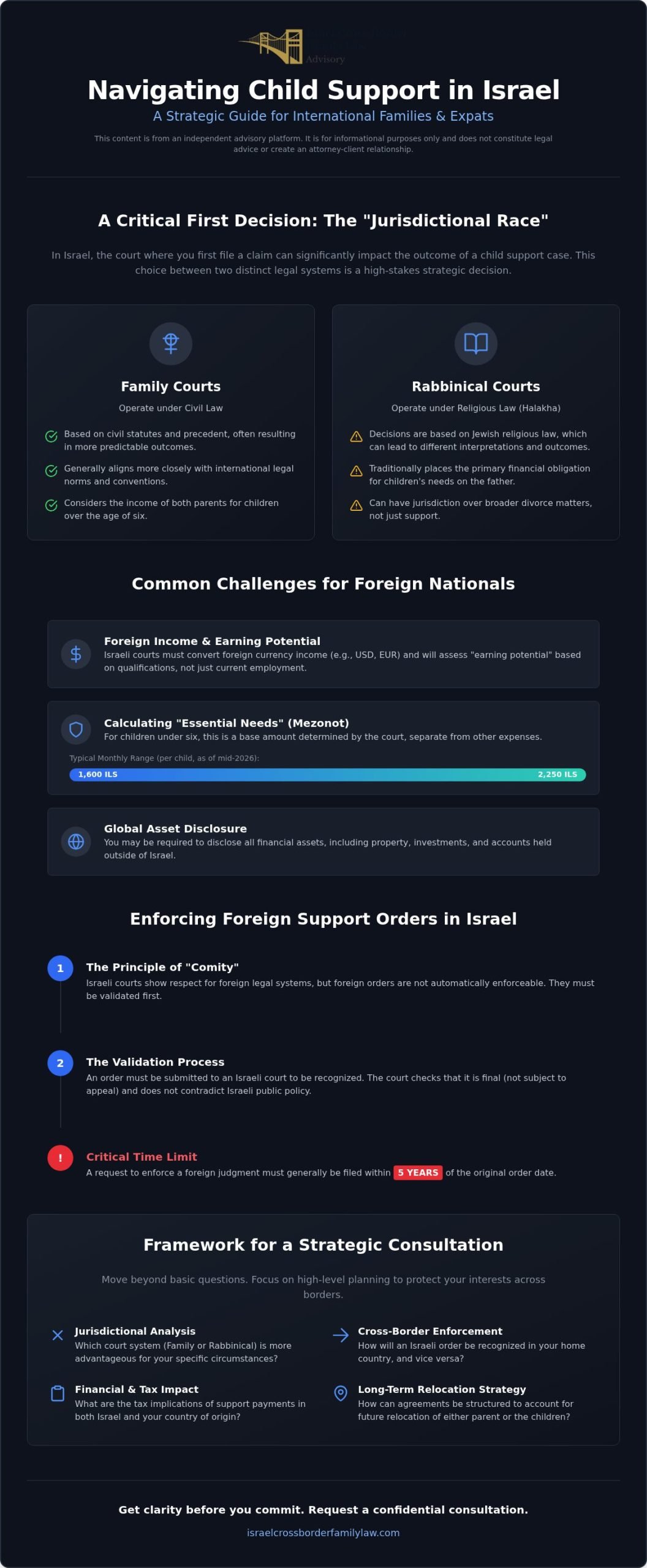
Foreign nationals face specific hurdles that don’t affect local citizens. One primary issue is calculating support based on income earned in foreign currencies like USD. Courts also look at your "earning potential" rather than just current income, which can be difficult if your professional qualifications were obtained abroad. Other challenges include:
- Calculating "Essential Needs" for children under six, which as of mid-2026 typically range from 1,600 to 2,250 ILS per month.
- Managing disclosure requirements for assets held outside of Israel.
- Coordinating with the Ministry of Justice in cases involving international enforcement.
The Intersection of Israeli Law and International Orders
Many families arriving in Israel carry existing child support orders from the United States or Europe. A common misconception is that these foreign judgments are automatically recognized by local authorities. In reality, Israeli courts apply the principle of "comity," which is a legal standard of mutual respect between different judicial systems. While the court generally aims to respect foreign orders, they must first be validated through a specific legal process to ensure they don’t contradict Israeli public policy or local statutes.
The risk for international families lies in the potential for conflicting orders. If one parent attempts to modify a support arrangement in an Israeli court while a foreign order is still active, it can lead to a jurisdictional deadlock. This creates significant financial and legal exposure for both parties. A child support lawyer for expats in Ashdod helps navigate these overlaps by analyzing which court holds primary authority and how to harmonize obligations across different legal systems. This strategic oversight is vital for preventing the accumulation of arrears in one country while paying support in another.
Enforcing US Orders in Ashdod
For a US order to be enforceable in Israel, it must be final and not subject to further appeal in its home state. One critical detail often overlooked is the timeframe; a request to enforce a foreign judgment in Israel must generally be filed within five years of the original date. The process requires a certified Hebrew translation by an Israeli notary and proof that the defendant was given a fair opportunity to be heard. You can find more details on these procedural requirements in this Processing Guide for International Child Support Cases. Understanding these mechanics is essential for successful child support cross-border enforcement.
The Role of the Hague Convention
While child support is a financial matter, it’s often inextricably linked to custody and relocation issues governed by international treaties. The Hague Convention plays a major role in how courts handle families that move between jurisdictions. A professional advisor must understand these global frameworks to ensure that a support claim doesn’t inadvertently trigger a custody dispute or a claim of Hague Convention child abduction. Decisions made in a local court can have profound echoes across the Atlantic. It’s often helpful to explore your strategic options before filing any motion that could impact your international standing.
Key Criteria for Selecting a Cross-Border Family Lawyer in Ashdod
Choosing a child support lawyer for expats in Ashdod is a decision that impacts your financial stability across multiple continents. While many practitioners handle domestic divorces, few possess the specialized skill set required to manage multi-jurisdictional complexity. You need a strategist who understands that your life and assets aren’t contained within a single postal code. A professional who lacks experience with international families may overlook the long-term implications of an Israeli ruling on your foreign financial obligations.
A "Local Only" lawyer might understand the nuances of the Ashdod Family Court, but they may struggle when presented with US tax returns, 401(k) statements, or the technicalities of the 2017 Supreme Court ruling on proportional income for children over six. Conversely, a cross-border specialist acts as a bridge. They combine a deep understanding of Israeli statutes with the ability to interpret foreign financial documents. This dual proficiency ensures that your support calculations are based on an accurate representation of your global assets and earning potential.
Experience with International Families
An advisor’s track record with the Anglo community is a primary indicator of their capability. You should seek a professional who is comfortable reading W2s and understanding the differences between US and Israeli income structures. Multi-jurisdictional licensing is another critical marker. A lawyer licensed in both Israel and a foreign jurisdiction offers a nuanced perspective that a locally-trained peer cannot match. This background allows them to anticipate how a decision in Ashdod might affect your future filings or enforcement actions back home. It’s about more than just translation; it’s about understanding the different legal cultures at play.
Local Knowledge vs. Global Strategy
While global expertise is vital, a physical presence in the target market remains essential. Your representative should be familiar with the specific tendencies of judges and court staff at the Ashdod Family Court. This local familiarity helps in managing the "jurisdictional race" and ensuring that your filings are handled with technical precision. The most effective approach balances this local presence with a high-level international strategy. You can learn more about how this integrated expertise is structured by reviewing our about the advisory page. This combination of local boots on the ground and a global mindset ensures your case is prepared for both the immediate court hearing and long-term international enforcement.
Get clarity before you commit. Request a confidential consultation.
Strategic Preparation: What to Discuss During Your Initial Consultation
Expats often mistake the initial consultation for a casual introduction. In reality, this session is the most critical step in securing a fair arrangement. When searching for a child support lawyer for expats in Ashdod, you need to distinguish between a "free chat" and a high-level strategic case review. A standard inquiry might only cover the basics of Israeli law. A strategic review, however, analyzes how those laws interact with your specific international footprint. It’s the difference between hearing what the law is and learning how the law applies to your life.
Before your meeting, organize your financial life into a cohesive narrative. Gather your last three years of tax returns, current pay stubs, and any existing foreign support orders. This preparation allows the advisor to focus on high-level strategy rather than administrative data entry. Full disclosure is non-negotiable. You must be transparent about all international assets, including foreign pension funds, rental properties abroad, and stock options. Beyond the data, evaluate the professional fit. You need someone who explains risks honestly and communicates clearly in English. This ensures you aren’t lost in translation during high-stakes hearings.
Critical Questions to Ask
Prepare a list of targeted questions to test the advisor’s cross-border fluency. Don’t be afraid to ask for specific examples of past successes in similar scenarios. Consider these points:
- How many cross-border cases have you handled specifically within the Ashdod Family Court?
- What mechanisms do you suggest for handling currency fluctuations between the Shekel and the Dollar or Euro?
- What is the long-term strategy if the other parent decides to move back to their home country?
- How do you coordinate with local professionals if assets are held in multiple jurisdictions?
Understanding Fees and Pricing
International family law involves unique costs that domestic cases do not. These often include certified translations, foreign document validation, and coordination with legal teams abroad. Demystifying the cost structure early prevents financial surprises later. You should look for an advisor who provides a clear breakdown of their pricing models. Avoid "hidden" costs by asking about administrative surcharges and how communication via email or phone is billed. In cross-border matters, the volume of documentation is often double that of a local case. Knowing how these complexities impact your final bill is part of making an informed choice.
Schedule your strategic case review
Get clarity before you commit. Request a confidential consultation.
Moving Forward with Strategy Before Commitment
Expats living in Ashdod face a unique set of challenges that require a proactive and calculated approach. Proceeding without a cross-border strategy exposes you to significant risks, such as unfair support calculations or orders that cannot be enforced once you leave the country. A child support lawyer for expats in Ashdod should be selected based on their ability to integrate local court requirements with international legal standards. Without this dual focus, you may find yourself entangled in a system that doesn’t fully account for your global financial reality.
The complexity of the Israeli legal system, particularly with the parallel authority of Family and Rabbinical courts, makes early decision-making vital. You can find detailed information on how to navigate this process on our how it works page. Understanding the sequence of events helps you maintain control over your case and prevents you from being caught off guard by jurisdictional shifts or local cultural nuances. Informed choice is the only way to protect your children’s future and your own financial stability.
The Advisory Advantage
High-stakes matters demand more than just a standard court filing; they require a comprehensive roadmap. Our advisory model focuses on decision-making guidance, helping you weigh the risks of different jurisdictions before committing to a specific legal path. A confidential case review allows you to explore these options in a secure environment. This strategic phase ensures that your financial and parental rights are protected both in Israel and abroad. It’s about building a foundation of certainty before entering the courtroom.
Educational Resources for Ashdod Expats
Knowledge is your strongest asset when dealing with cross-border family law. We encourage you to explore the educational videos on our YouTube channel, which break down complex topics into manageable insights. Additionally, reading sibling articles like Divorce in Israel for US Citizens can provide a broader context for your situation. The ultimate goal is to achieve total clarity before you commit to any long-term legal representation. By educating yourself on the "jurisdictional race" and calculation formulas, you’re better prepared to select the right child support lawyer for expats in Ashdod.
Get clarity before you commit. Request a confidential consultation.
Securing Strategic Clarity for Your Cross-Border Case
Managing child support in Israel involves navigating a dual court system and the technicalities of the 2017 Supreme Court ruling on proportional income. Expats must account for the 2025 legislative shifts that have intensified the jurisdictional race between Family and Rabbinical courts. A standard approach often overlooks the friction between local statutes and international enforcement. Selecting a child support lawyer for expats in Ashdod requires finding a professional who acts as a bridge between these divergent legal cultures.
Our strategic advisory model provides the cross-border expertise necessary to handle these high-stakes matters with precision. Through a confidential case review, you can identify potential risks and develop a roadmap that protects your family’s financial stability. This process ensures you have the information needed to make informed choices before committing to a specific legal path. Taking the time to understand these complexities now prevents long-term complications in the future.
You can move forward with confidence by prioritizing strategy over immediate litigation.
Get clarity before you commit. Request a confidential consultation.
Frequently Asked Questions
Do I need a lawyer in Ashdod if my child support order was issued in the US?
Yes, because foreign orders aren’t automatically enforceable in Israel. You must validate the judgment through the Israeli court system to ensure it doesn’t conflict with local public policy. A child support lawyer for expats in Ashdod can guide the strategic validation process. Without this formal recognition, the local Enforcement and Collection Authority cannot act on your foreign order to collect arrears or secure payments.
How is child support calculated in Israel for expats with foreign income?
Calculations follow the 2017 Supreme Court ruling for children over six, which considers both parents’ proportional income and shared parenting time. For children under six, the father typically covers "Essential Needs," which as of 2026 range from 1,600 to 2,250 ILS per month. Courts will evaluate your global earning potential using international financial disclosures, rather than just looking at a current pay stub or local salary averages.
Can I change an existing child support order if I move to Ashdod?
You can request a modification if you demonstrate a substantial change in circumstances. Moving to a new country with a significantly different cost of living often qualifies as a valid reason for review. However, you must first determine if the Israeli court has jurisdiction to modify your specific foreign order. This involves a complex analysis of the children’s residence and the terms of the original judgment issued abroad.
What happens if the paying parent leaves Israel?
Enforcement becomes a cross-border matter involving international treaties and reciprocal agreements. Israel and the US share a Memorandum of Understanding to facilitate support collection across borders. If the parent leaves with arrears exceeding ₪18,600, the Israeli Enforcement Authority may trigger administrative sanctions before their departure. A child support lawyer for expats in Ashdod helps coordinate with foreign agencies to ensure the support order remains enforceable in the new jurisdiction.
Does the Rabbinical court have jurisdiction over my child support case?
It might, following the November 2025 law change that expanded religious court authority. Rabbinical courts can now hear child support matters if they’re tied to a divorce lawsuit, even without both parents’ consent. This has created a "jurisdictional race" where the venue is often determined by whichever parent files first. Choosing between the Family Court and the Rabbinical Court is a critical strategic decision that impacts the final financial arrangement.
Are legal fees for child support cases tax-deductible for US expats?
Generally, personal legal fees for divorce or child support aren’t deductible under current US tax law. However, specific costs related to tax advice or the production of taxable income might have different treatments. You should consult a qualified tax professional to review your specific situation. Our advisory platform focuses on the legal strategy within Israel while highlighting the necessity of a multi-disciplinary approach to managing your cross-border financial obligations.
How long does the child support process take in the Ashdod Family Court?
Timelines vary based on case complexity, but a standard claim might take several months to a year for a final ruling. You can request "temporary child support" shortly after filing to ensure the children’s needs are met during the litigation. Efficiently organizing your international financial documentation and foreign tax returns can help prevent administrative delays. For more visual insights on court timelines, visit https://www.youtube.com/@IsraelFamilyLaw.
Can I enforce an Israeli child support order back in the United States?
Yes, through the principle of comity and existing reciprocal agreements between the two nations. Most US states recognize foreign support orders if they meet specific criteria for fairness and finality. You would typically work with a state child support agency or a private attorney in the US to register the Israeli order. This process requires certified translations and proof of service, making it vital to handle the initial case correctly.
Get clarity before you commit. Request a confidential consultation.

Article by
Gabriel Lior
A Personal Journey That Became a Mission
The advisory was founded by an American father Gabriel Lior, LLB, MBA , global entrepreneur, and cross-border advisor who spent more than a decade navigating the Israeli family court system firsthand and now lives in Singapore with his son.
As a divorced parent in a cross-border family, Gabriel faced nearly every legal challenge a foreign parent can encounter in Israel — including child custody disputes, child support proceedings, property matters in Israel and abroad, false accusations, and complex immigration and relocation proceedings.
Over the years, he learned the hard way how difficult it is for non-Israeli parents to understand the system, identify the right legal strategy, and choose the right legal representation — especially when language, culture, and jurisdictional differences are involved. He also witnessed how foreign parents and new immigrants are often disadvantaged or taken advantage of by service providers and institutions simply because they lack local knowledge or fluency.
From Client to Advisor
To truly understand — and survive — the system, Gabriel pursued formal legal education in Israel, completing two Israeli law degrees, alongside a BA and MBA earned in the United States. This was never about becoming a practicing attorney, but about gaining a deep, structural understanding of how the system works — and where it breaks down for foreign parents.
This rare combination of:
Firsthand client experience
Israeli legal and US business education
International business and negotiation training
Decades of commercial execution
created a unique perspective – one that understands both sides of the table.
After years of litigation, persistence, and at times self-representation, he ultimately succeeded in securing custody of his son and relocating abroad through a rare legal victory in the Israeli Supreme Court — becoming one of the first fathers in Israel to do so under these circumstances.
Disclaimer
Important Disclaimer:
The information provided on this website and in its content is for general informational and educational purposes only and does not constitute legal advice, legal opinion, or legal representation.
Gabriel Lior is not licensed to practice law in Israel (nor is he interested in doing so) and does not provide legal services, despite having completed 2 Law Degrees. The services offered are advisory in nature and are intended to provide general guidance, strategic insight, and information regarding cross-border family law considerations.
No attorney-client relationship is formed by accessing this website, reading its content, or communicating with us.
Any decisions made based on this information are at your own discretion and risk. For legal advice specific to your situation, you should consult a licensed attorney in the relevant jurisdiction.
Where appropriate, we may refer clients to independent, licensed attorneys or professionals. Such referrals do not constitute legal representation and no liability is assumed for services provided by third parties.