Disclaimer: This article is published on an independent advisory platform, not a law firm. The information provided focuses on strategy, risks, and decision-making guidance; it does not constitute formal legal representation or an attorney-client relationship.
What if a routine summer trip to visit grandparents results in your child being kept abroad indefinitely without your consent? This scenario is at the heart of the complex legal distinction between Wrongful Retention vs Wrongful Removal. While the emotional impact on parents is identical, the legal path to recovery depends on whether the child was taken without permission or kept after a permitted visit ended. You likely feel an overwhelming sense of confusion regarding which country’s laws apply and how to navigate the technicalities of the Hague Convention between the US and Israel.
We understand that the fear of losing contact with a child across borders is paralyzing. This guide is designed to provide you with a clear understanding of legal triggers and the immediate steps required to protect your parental rights. We’ll preview the role of habitual residence, the procedural steps of a Hague case, and strategic ways to bridge the gap between legal systems. For further clarity on navigating these cross-border challenges, you may find the insights on the Israel Family Law YouTube channel particularly helpful as you begin your research. Get clarity before you commit.
Key Takeaways
- Distinguish between the act of taking a child without permission and failing to return them after an agreed trip to understand the nuances of Wrongful Retention vs Wrongful Removal.
- Learn how the Hague Convention serves as a critical legal bridge between the US and Israel to protect parental rights in international custody disputes.
- Identify the “Retention Date” to pinpoint exactly when a permitted visit becomes an illegal stay, which is vital for filing a successful claim.
- Gain clarity on the procedural steps involved in working with Central Authorities in both jurisdictions to secure a child’s return.
- Discover the importance of maintaining detailed paper trails and seeking expert guidance before international travel to mitigate legal risks.
Understanding the Legal Framework of International Child Abduction
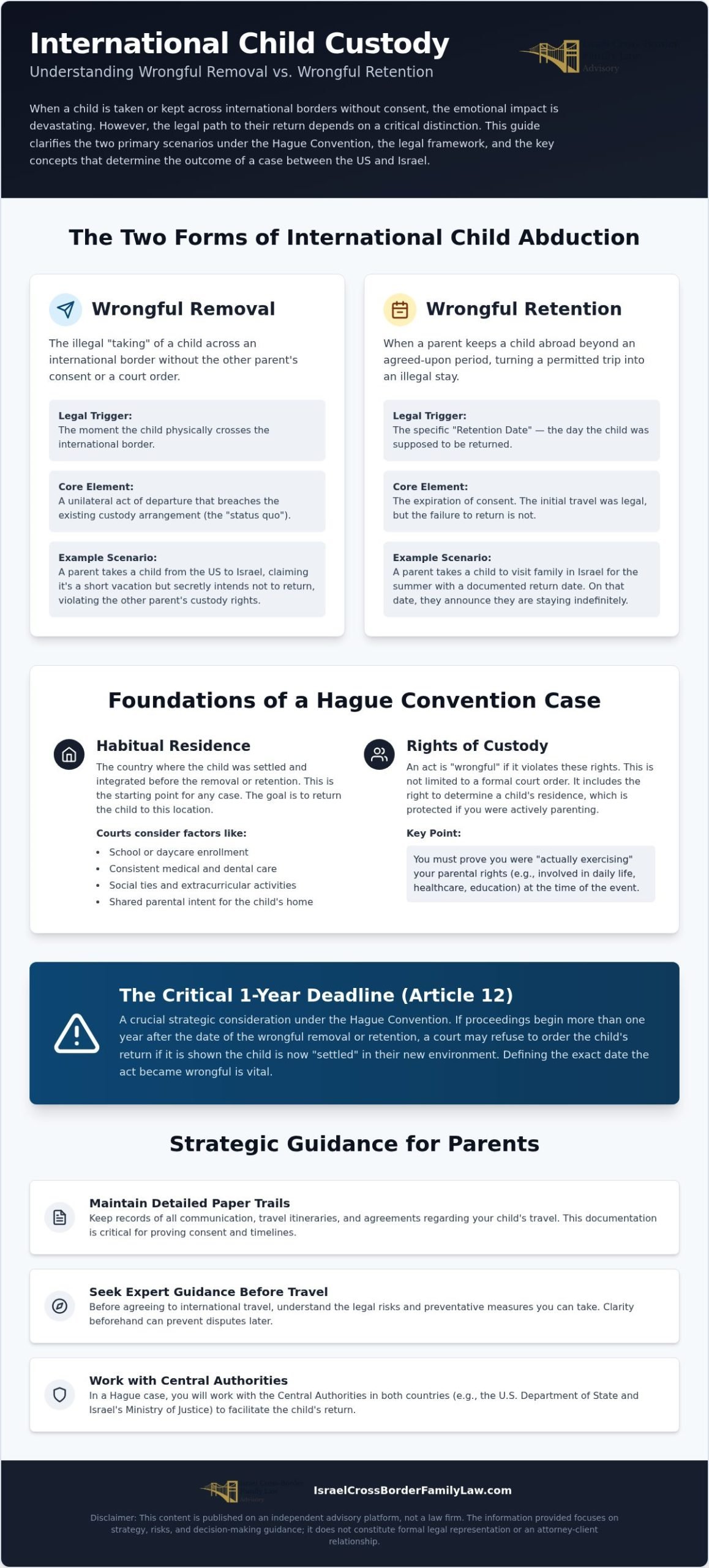
The Hague Convention functions as a vital legal bridge between the United States and Israel. It provides a standardized process for resolving disputes when a child is moved across borders without permission. Understanding the technical distinction between Wrongful Retention vs Wrongful Removal is essential because it dictates the specific legal triggers and evidence required for your application. This distinction matters deeply for your legal filing because it determines the “commencement date” of the abduction. Under Article 12 of the Convention, if a case is filed more than one year after the removal or retention, the court may refuse to return the child if they’re already “settled” in their new environment. Defining the exact moment the action became wrongful is a critical strategic priority for any parent seeking a return order.
The Legal Threshold of “Wrongful”
Under international law, an act is considered “wrongful” if it violates the “rights of custody” attributed to a parent under the laws of the country where the child lived immediately before the move. You don’t need a formal, signed custody order from a judge to trigger these protections. If you were actually exercising parental responsibilities and possessed the right to determine the child’s place of residence, the court recognizes those rights as valid. The legal framework focuses on the breach of these rights rather than proving criminal intent. This distinction ensures that the law protects the child’s stability regardless of the parent’s stated motivations. It’s about the objective violation of the status quo, not the subjective “reason” the other parent stayed.
Habitual Residence: The Critical Starting Point
Determining a child’s habitual residence is the most significant hurdle in many cross-border cases. This term refers to the location where the child was physically settled and integrated into the community prior to the dispute. Courts analyze specific indicators to establish this “home base,” including:
- Enrollment in local schools or daycare centers.
- Consistency of medical and dental care within the jurisdiction.
- Social ties, extracurricular activities, and family proximity.
- The shared intent of the parents regarding the child’s living situation.
Israeli courts and US courts sometimes differ in their interpretation of “settled” status. For instance, a temporary move for a “trial period” might be viewed differently in Jerusalem than in a US court. Establishing a clear, documented timeline of the child’s life is the first step in any Hague Convention child abduction matter. Strategic clarity at this stage is vital because once a child is deemed “settled” in a new country, the legal path to return becomes significantly more difficult. The overarching goal remains returning the child to this habitual residence so the appropriate local court can determine custody.
Wrongful Removal: Identifying the Illegal “Taking”
Wrongful removal occurs when a parent unilaterally decides to relocate a child to a new country without the express consent of the other parent or a court order. In the context of Wrongful Retention vs Wrongful Removal, removal is defined by the physical act of departure. It’s an immediate breach of the status quo that triggers the Hague Convention the moment the child crosses the international border. For families moving between the US and Israel, this often manifests when one parent takes the child to Israel under the guise of a vacation but with the hidden intent of permanent relocation. To succeed in a return claim, you must prove that you were “actually exercising” your rights of custody at the time of the move. This means you were involved in the child’s daily life, healthcare, or education, rather than simply holding a theoretical right on paper.
Scenario Analysis: The Unilateral Move
Consider a situation where a parent flies with a child to Tel Aviv while a US custody proceeding is active. This bypasses the judicial process and constitutes a unilateral removal. The legal outcome often hinges on the distinction between “Rights of Custody” and “Rights of Access.” Access refers only to visitation, whereas custody includes the right to determine residence. If you only possess visitation rights, the Hague Convention may not mandate a return. You should request a review of your current status to clarify your standing before filing. This distinction is a common point of confusion for expats who don’t realize that not all parental rights are treated equally under international treaties.
Violation of Rights of Custody
Israeli law recognizes both parents as natural guardians under the Legal Capacity and Guardianship Law. This “joint guardianship” is a powerful right of custody that allows a parent to claim wrongful removal even without primary physical placement. The Israeli Central Authority, located in the Ministry of Justice, coordinates with the US Department of State to process these applications. Speed is essential because the Convention requires the return of the child unless they have become “settled” in their new environment. If a child spends significant time in Israel, attending school and building social ties, a court may find that uprooting them again causes more harm than staying. Therefore, the first 12 months after removal are the most critical window for legal intervention.
Wrongful Retention: When a Permitted Trip Becomes Illegal
Wrongful retention differs from removal because the child initially leaves their home country with the full consent of both parents. The legal issue arises when that consent expires, and the parent abroad refuses to return the child to their habitual residence. In the debate of Wrongful Retention vs Wrongful Removal, retention is often more complex to litigate because it requires establishing the exact “Retention Date.” This is the precise moment when the legitimate stay turned into an illegal one. While a removal is a single event, retention is a continuing state that begins the day the child was supposed to be back on a flight home.
The Shift from Consent to Retention
Proving retention requires a clear paper trail that documents the original agreement. Courts look for evidence of the agreed-upon return date, such as round-trip airline tickets, email exchanges discussing school start dates, or text messages confirming a specific return flight. If the consent for the trip was conditional, staying in Tel Aviv only for a specific family event, for example, and those conditions are breached, the retention begins the moment the condition is no longer met. You must be able to show that the other parent was aware of the expiration of their permission to keep the child abroad.
A significant risk in these cases is “acquiescence.” This occurs if the left-behind parent waits too long to object or sends messages that suggest they’ve accepted the child’s new living arrangement. Under the Hague Convention, if you appear to agree to the new status quo, even through inaction, you may lose the right to demand a summary return. Taking immediate, documented action is the only way to preserve your rights. If you don’t protest the missed return date promptly, the court may interpret your silence as consent to the child’s new residency.
Common Scenarios in US-Israel Families
We frequently see cases where a child travels from the US to visit grandparents in Jerusalem for a summer holiday. The intention is clear; the child should return before the US school year begins in late August. However, the parent in Israel may suddenly claim a medical emergency or cite the child’s “desire” to stay as a reason to ignore the return date. These excuses are often used to buy time, hoping the child will become “settled” in the Israeli school system before a legal challenge can be mounted.
Navigating these situations requires a deep understanding of how both legal systems interact. It’s not just about the law; it’s about the strategy used to counter these claims before they become permanent. Learn more about international custody and relocation to understand how to structure travel agreements that protect against these risks. Identifying the transition from a guest to a wrongful resident is the key to a successful Hague application.
The Hague Convention Process and Potential Defenses
Navigating the legal machinery of the Hague Convention requires a precise understanding of procedural timelines and jurisdictional boundaries. When a parent initiates a case, the process typically begins with an application through the Central Authority of their home country. In the United States, this is the Office of Children’s Issues; in Israel, it’s the Ministry of Justice. These entities act as a conduit for information and legal coordination between the two nations. It’s vital to remember that a Hague case isn’t a custody battle in the traditional sense. The court doesn’t initially weigh the “best interests of the child” to decide who’s the better parent. Instead, it determines which country has the proper jurisdiction to make that decision. For a comprehensive overview, refer to our Guide to the Hague Convention on Child Abduction.
The technical distinction between Wrongful Retention vs Wrongful Removal dictates the specific evidence you must present to the court. While the treaty’s goal is the prompt return of the child, the taking parent may raise specific legal defenses to block that return. These defenses are interpreted narrowly by both US and Israeli courts to prevent the treaty from being undermined by tactical litigation. Success depends on showing that the child’s habitual residence was violated and that no valid defense applies.
The “Grave Risk” Defense
Under Article 13(b), a court isn’t required to return a child if there’s a “grave risk” that the return would expose them to physical or psychological harm. This is an exceptionally high evidentiary bar. Simple claims of a “better life” in Israel or general anxiety about moving don’t meet this threshold. Israeli courts take allegations of domestic violence seriously, but they often look for “undertakings.” These are legal promises or safety measures that can be put in place in the US to mitigate risk while the custody case proceeds. Additionally, if a child is of sufficient age and maturity, the court may consider their own objection to returning, often referred to as the “Zone of Choice.”
The One-Year Rule and Settlement
Filing your application within 12 months of the removal or retention is a critical legal milestone. If you file within this one-year window, the court is mandated to order the child’s return once the wrongful act is proven. However, if more than a year has passed, the taking parent can argue the “now settled” defense. This allows the court to refuse a return if it’s shown that the child has integrated into their new community through school, friendships, and cultural ties. The court distinguishes between “fleeing” a dangerous situation and “moving” for personal preference, but the clock remains the most objective factor in these rulings. If you’re facing these timelines, you should speak with a cross-border specialist to protect your parental rights.
Strategic Guidance for Parents in Cross-Border Disputes
Managing an international dispute requires a shift from emotional reaction to disciplined strategy. Whether your situation involves Wrongful Retention vs Wrongful Removal, the strength of your case often rests on the preparation done before the first legal filing is even drafted. The complexity of cross-border issues means that early decisions carry immense weight, often dictating the outcome of a Hague trial months before it begins. Engaging a cross-border specialist before a child leaves their home country provides a layer of protection that local counsel may not be equipped to offer. This proactive approach helps mitigate the significant emotional and financial toll of international litigation, which can quickly escalate into a “scorched earth” conflict if not managed with care.
Immediate Actions and Documentation
Maintaining a meticulous paper trail is your most effective tool in establishing the facts of a removal or retention. You should keep digital and physical copies of the child’s US and Israeli passports in a secure, accessible location. Document every communication regarding travel dates, return expectations, and parental consent. If an agreement was reached via WhatsApp, email, or a handwritten note, ensure these are preserved and backed up. These records become the primary evidence used to establish the “Retention Date” or the lack of consent for a move. For those currently facing these challenges, a Confidential Case Review for international families can help organize your documentation into a coherent legal strategy.
Navigating the Israeli and US Legal Systems
Israeli Family Courts are known for their efficiency in handling Hague Convention proceedings, often scheduling hearings within weeks rather than months to comply with the treaty’s mandate for a prompt return. However, this speed can be daunting for an expat or foreign national unfamiliar with the local system. Understanding how US courts handle the enforcement of return orders from abroad is equally critical. A return order is only the first step; the physical return of the child and the subsequent custody determination in the home country require a coordinated effort between legal teams in both jurisdictions.
Early mediation is a valuable alternative that should be considered whenever possible. It allows parents to reach a structured agreement on residency and visitation without the rigid, winner-takes-all nature of a court ruling. This can save families thousands of shekels (₪) in legal fees and prevent the long-term psychological damage to the child that often accompanies high-conflict litigation. Final Advice: Get clarity before you commit. Request a confidential consultation.
Securing Your Parental Rights Across the US-Israel Bridge
Navigating the technicalities of international law requires more than just emotional resilience; it demands a precise understanding of the legal frameworks governing your family’s future. Recognizing the nuances of Wrongful Retention vs Wrongful Removal is the first step toward restoring the status quo and protecting your child’s stability. Focusing on habitual residence and maintaining a meticulous paper trail allows you to navigate these multi-jurisdictional challenges with greater confidence. The speed of the Israeli Family Courts and the complexity of the Hague Convention mean that early, strategic decision-making is your most valuable asset.
We’ve examined how the “Retention Date” serves as a critical trigger and why immediate action is necessary to prevent a child from being legally deemed “settled” in a new country. These technical distinctions often determine the success of your application. You can mitigate risks and avoid the financial toll of prolonged litigation by seeking clarity early in the process. Get clarity before you commit. Request a confidential consultation.
You don’t have to face these complex cross-border issues alone. With steady, authoritative advisory support, you can build a secure path forward for your family and protect your parental rights with confidence.
Frequently Asked Questions
What is the primary difference between wrongful removal and wrongful retention?
The primary difference lies in the initial legality of the child’s presence abroad. Wrongful removal involves the physical act of taking a child across an international border without the other parent’s consent or a court order. Wrongful retention occurs when a child travels with permission, but the parent keeping them abroad refuses to return them once that permission expires. Both actions trigger international legal protections under the Hague Convention.
How long does a Hague Convention case typically take in Israel?
Israeli Family Courts prioritize these matters to meet the treaty’s goal of a prompt return. While the Convention suggests a six-week target for a decision, the reality of the legal system usually sees cases resolved within three to six months. This timeline depends on the complexity of the defenses raised and the court’s schedule. Speed is vital to prevent the child from becoming settled in a new environment.
Can I stop my ex from taking our child to Israel if I suspect they won’t return?
You can seek a “Stay of Exit” order, known as a Tsav Ikuv Yetzia Min Haaretz, from the Israeli Family Court if you have a well-founded fear of abduction. This order prevents the child from leaving Israel until the court resolves the dispute. In the US, similar orders can be obtained through local courts. Securing these orders before travel occurs is much more effective than attempting recovery after a border crossing.
Does the Hague Convention apply if we don’t have a formal custody agreement?
Yes, the Convention protects “rights of custody” even if a formal court order doesn’t exist. Under Israeli law, both parents are natural guardians with joint rights of custody by default. If you were actually exercising parental responsibilities at the time of the dispute, you are protected. The legal focus is on the violation of these inherent rights rather than the existence of a specific document signed by a judge.
What happens if my child is old enough to refuse to return to the US?
If a child has reached an appropriate age and degree of maturity, the court may consider their objection to returning. This is known as the “mature child” defense. There is no fixed age for this; instead, judges evaluate the child’s cognitive abilities and reasons for their objection. The court must ensure the child isn’t merely repeating the taking parent’s influence before allowing the objection to block a return.
Is wrongful retention a criminal offense in Israel or the US?
International child abduction can be prosecuted as a felony in the US and a criminal offense in Israel. However, Hague Convention proceedings are strictly civil matters focused on returning the child, not punishing the parent. While a criminal warrant may be issued, the civil return process moves independently. It’s essential to understand that winning a civil case doesn’t automatically resolve potential criminal charges pending in either jurisdiction.
Do I need a lawyer in both the US and Israel for a Hague case?
It’s highly recommended to have legal coordination in both jurisdictions to manage the multi-jurisdictional complexity. A US-based attorney handles the initial application and US-side evidence, while an Israeli practitioner manages the litigation within the Israeli Family Court system. Having a specialist who understands the US-Israel legal bridge ensures that strategy is consistent across both borders, which is vital for a successful outcome in cases of Wrongful Retention vs Wrongful Removal.
What is “habitual residence” and why does it decide my case?
Habitual residence is the country where the child was physically settled and integrated before the removal or retention. It isn’t necessarily the child’s legal domicile but rather their actual home base. The court uses this to decide which country has the jurisdiction to hear the underlying custody case. Determining this location is often the most litigated aspect of these cases because it dictates which legal system will ultimately decide the child’s future.

Article by
Gabriel Lior
A Personal Journey That Became a Mission
The advisory was founded by an American father Gabriel Lior, LLB, MBA , global entrepreneur, and cross-border advisor who spent more than a decade navigating the Israeli family court system firsthand and now lives in Singapore with his son.
As a divorced parent in a cross-border family, Gabriel faced nearly every legal challenge a foreign parent can encounter in Israel — including child custody disputes, child support proceedings, property matters in Israel and abroad, false accusations, and complex immigration and relocation proceedings.
Over the years, he learned the hard way how difficult it is for non-Israeli parents to understand the system, identify the right legal strategy, and choose the right legal representation — especially when language, culture, and jurisdictional differences are involved. He also witnessed how foreign parents and new immigrants are often disadvantaged or taken advantage of by service providers and institutions simply because they lack local knowledge or fluency.
From Client to Advisor
To truly understand — and survive — the system, Gabriel pursued formal legal education in Israel, completing two Israeli law degrees, alongside a BA and MBA earned in the United States. This was never about becoming a practicing attorney, but about gaining a deep, structural understanding of how the system works — and where it breaks down for foreign parents.
This rare combination of:
Firsthand client experience
Israeli legal and US business education
International business and negotiation training
Decades of commercial execution
created a unique perspective – one that understands both sides of the table.
After years of litigation, persistence, and at times self-representation, he ultimately succeeded in securing custody of his son and relocating abroad through a rare legal victory in the Israeli Supreme Court — becoming one of the first fathers in Israel to do so under these circumstances.
Disclaimer
Important Disclaimer:
The information provided on this website and in its content is for general informational and educational purposes only and does not constitute legal advice, legal opinion, or legal representation.
Gabriel Lior is not licensed to practice law in Israel (nor is he interested in doing so) and does not provide legal services, despite having completed 2 Law Degrees. The services offered are advisory in nature and are intended to provide general guidance, strategic insight, and information regarding cross-border family law considerations.
No attorney-client relationship is formed by accessing this website, reading its content, or communicating with us.
Any decisions made based on this information are at your own discretion and risk. For legal advice specific to your situation, you should consult a licensed attorney in the relevant jurisdiction.
Where appropriate, we may refer clients to independent, licensed attorneys or professionals. Such referrals do not constitute legal representation and no liability is assumed for services provided by third parties.