What if Jerusalem is only one part of the picture in a divorce that crosses borders? A search for “international divorce attorney Jerusalem” often reflects a wider legal picture involving where each spouse lives, where children and assets are connected, and whether another country is already involved.
It’s understandable to worry that an early decision could affect later options, especially when Israeli procedures are unfamiliar or difficult to understand in English. An Israel-connected divorce may require attention to local context alongside the legal and practical considerations of another country. The relevant facts matter, and assumptions based only on citizenship or where the marriage took place may not tell the whole story.
This article explains cross-border questions to consider, Jerusalem-specific context to clarify, and useful background to prepare before a confidential discussion. It is informational and does not replace advice about your circumstances. Legal services are provided by licensed attorneys under a separate engagement.
Key Takeaways
- A divorce with meaningful ties to more than one country may raise questions about residence, family connections, and proceedings already underway.
- A discussion with an international divorce attorney in Jerusalem can help identify which Israel- and US-related facts need closer review, without assuming that one location settles every issue.
- Prepare a concise timeline, note the countries connected to your family, and organize relevant documents before discussing possible next steps.
- An initial discussion can help sort known facts from open questions before you commit to a course of action.
- This article is informational and is not a substitute for legal advice. Legal services are provided by licensed attorneys under a separate engagement.
International divorce in Jerusalem: why the cross-border connection matters
An international divorce is a divorce matter with meaningful ties to more than one country. Jerusalem may be the local connection, while a spouse, children, family life, earlier court activity, or important records are connected elsewhere. These links can raise questions about which legal systems and processes need consideration. They do not, by themselves, determine where a matter should proceed or what the outcome will be.
For someone searching for an international divorce attorney Jerusalem, a useful starting point is a clear account of the family’s connections to each place, not a quick conclusion about jurisdiction. Local context matters, but no single process should be assumed to apply to every family.
What can make a divorce involving Jerusalem cross-border?
Common situations include spouses who live in different countries, a family that has moved between Israel and another country, or children whose daily lives and family connections span borders. The marriage may have taken place abroad, or a related matter may already have been raised in another country. These details can make a divorce cross-border even when one spouse currently lives in Jerusalem.
Citizenship, residence, the marriage history, children’s circumstances, and prior proceedings may all be relevant. Their legal significance depends on the issue and applicable rules, so none should be treated as an automatic answer. A general overview such as Divorce in Israel can provide background on the local system, but it cannot determine how that system applies to an individual family.
For example, spouses may be living in Israel and the United States while their children have lived in more than one place. That outline identifies questions for review; it does not establish which country’s process applies. A careful assessment considers the facts together rather than relying on one detail, such as citizenship or the location of the wedding.
Why early decisions deserve careful attention
Early choices can shape later planning. You may need to understand how an existing proceeding, a proposed agreement, or a decision to begin a process could relate to your family’s connections in more than one country. The possible implications vary. Identify the questions before making commitments rather than assuming an initial step will have the same effect everywhere.
Start by gathering facts, not by deciding where or how to proceed. Note where each spouse lives, where children have been living, when key events occurred, and whether any process has already begun. Keep dates and documents organized, and separate what you know from what still needs clarification. This preparation helps make a discussion more focused without requiring an immediate decision.
This article is informational and does not replace legal advice about your circumstances. Legal services are provided only by licensed attorneys under a separate engagement. Clear information can help you approach the next conversation with better questions and a more grounded understanding of the issues to assess.
How Israel-US differences can shape a Jerusalem divorce plan
A family connected to Jerusalem and the United States may need to consider two legal contexts, but familiar words and assumptions do not always carry the same meaning in both places. The practical task is to identify which questions depend on each country’s rules and have them reviewed by qualified professionals. Residence, family circumstances, and any existing proceedings provide useful context, but they are not, by themselves, a reliable test of which process applies.
A cross-border connection describes the facts of a family’s situation. It does not determine which country’s legal process will apply or what result it will produce.
Which facts help clarify the international connection?
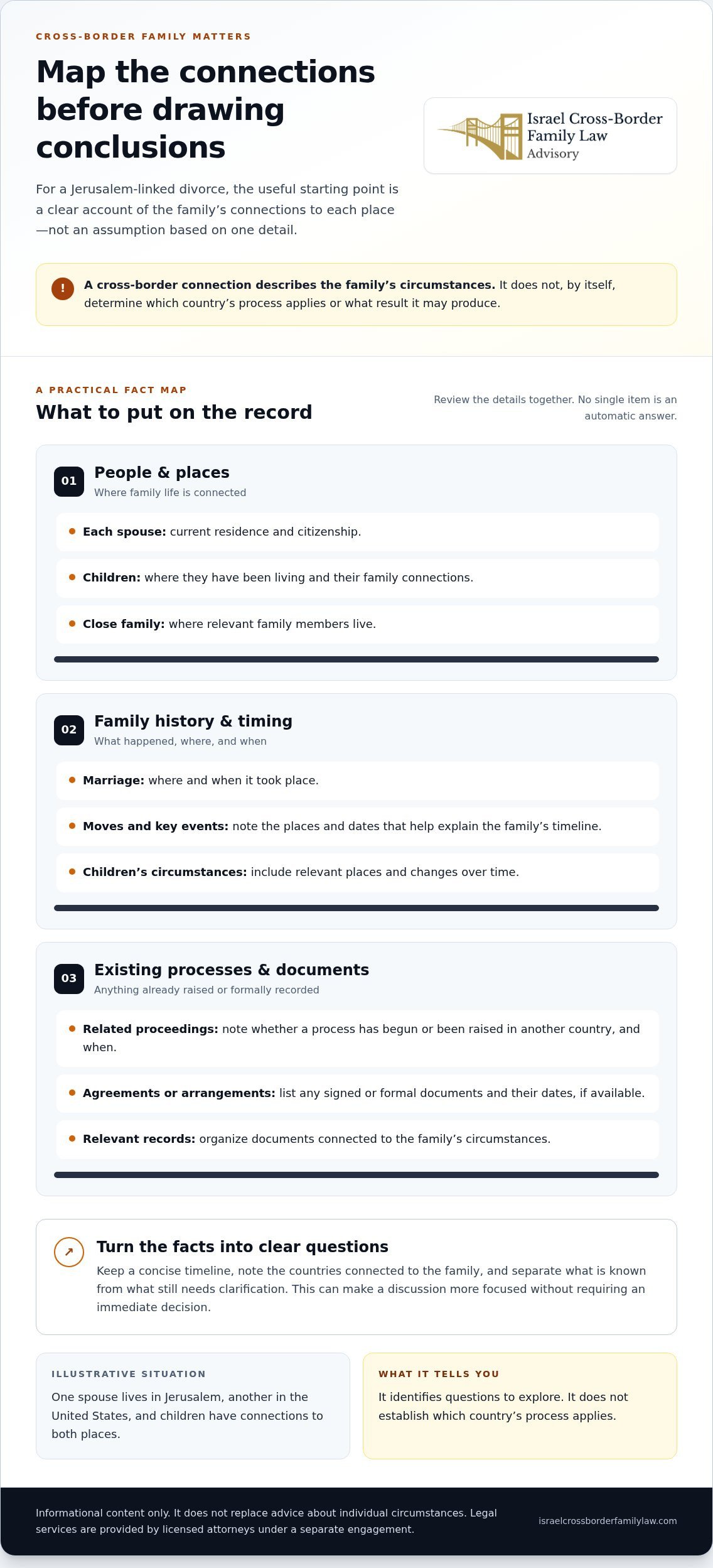
Build a neutral record of the circumstances before drawing conclusions. Note each spouse’s current residence and citizenship, where and when the marriage took place, and where children and close family members live. Also list any related proceedings, signed agreements, or other formal arrangements, with relevant dates if available. These details help frame questions for review, but they do not determine jurisdiction or predict how a decision may be treated elsewhere.
For example, a family might have one spouse living in Jerusalem, another in the United States, and children with connections to both places. That description helps identify cross-border issues to explore. It does not establish which country’s process should be used or whether a document created in one place will have an effect in another.
Why legal-system differences need individual review
Terms used in family matters can sound familiar while carrying different meanings, procedures, or consequences in different legal systems. Even when people use the same word for an agreement, court, or parenting arrangement, the relevant rules may not match. Avoid assuming that a document or step from one country translates directly to the other. Instead, clarify what each term means in its original context and which questions need separate review.
For U.S. citizens seeking general country information, the U.S. Department of State on Israel is an official starting point for background about Israel. It is not a guide to applying family law to a particular case. Questions about Israeli processes, U.S. implications, or how actions in one country may relate to the other require case-specific review by appropriately qualified professionals.
Before a discussion, separate confirmed facts from assumptions. Write down what has already happened, what each person understands the current arrangements to be, and which questions remain unanswered. This helps keep the conversation focused without committing to a particular route before the relevant contexts have been considered.
A discussion with an international divorce attorney Jerusalem can help clarify the local context and identify questions that extend beyond it. If you would like to organize the issues before making decisions, request a confidential consultation.
Do you need Jerusalem-connected guidance for an international divorce?
When a divorce touches Jerusalem and another country, it is easy to assume that choosing one location or one professional will resolve every question. A more measured first step is to separate the Israel-related questions from issues that may depend on another country’s laws, then identify what needs qualified legal review. Local context and cross-border issue-spotting can work together, but they serve different purposes.
Jerusalem-connected guidance can help organize the Israel-related facts and frame questions about local context. It should be considered alongside the family’s full cross-border circumstances. Identifying issues that involve another country does not establish which process applies or how a decision may be treated there. Outcomes depend on the facts and the applicable legal review.
For people whose Israel connection includes living in the country as foreign nationals or expatriates, the guidance for expats and foreign nationals can help frame relevant background questions. Distinguish general orientation from advice about a particular matter. Procedural details require review by appropriately licensed attorneys.
Whether your Israel connection is in Jerusalem, Tel Aviv, Herzliya, Ra’anana, Netanya, Haifa, Modi’in, Beit Shemesh, Kfar Saba, Hod Hasharon, Ramat Gan, Givatayim, Petah Tikva, Ashdod, Be’er Sheva, Eilat, Caesarea, or Zichron Ya’akov, these questions can help clarify what local context and cross-border coordination are intended to address:
| Question to clarify | Why it matters |
|---|---|
| Which facts connect the family to Jerusalem or elsewhere in Israel? | They help identify the local context that may need review, without settling a legal question on their own. |
| What important events or arrangements have already taken place, and when? | A shared timeline can help keep discussions across locations consistent and reveal where details need clarification. |
| Are professionals in different countries already involved? | Knowing who is handling which questions can help identify where information or coordination may be needed. |
| Which questions require formal legal review? | This separates general issue-spotting from advice or representation that must come through a separate engagement with licensed attorneys. |
Cross-border coordination can make the overall picture easier to understand: which facts are relevant, how the timeline fits together, what remains unanswered, and which professionals may need to address questions within their own legal systems. It does not mean that one attorney is licensed to practise in every jurisdiction or that all issues can be resolved through one discussion.
This material is informational and does not replace legal advice. Get clarity before you commit. Request a confidential consultation.
What to prepare before discussing a Jerusalem-linked divorce
A little preparation can make an initial discussion more focused, especially when family events and documents connect to more than one country. You do not need to resolve legal questions in advance. The aim is to present known facts clearly, identify gaps, and decide what needs closer review.
Build a clear cross-border timeline
A concise timeline helps explain how the family’s circumstances and any related steps developed across locations. Record key dates and places in chronological order, and distinguish confirmed details from assumptions or unanswered questions. Note whether a related matter is already active in another country, without trying to draw conclusions about its effect.
Use this short preparation sequence:
- Start with key events. List major dates, locations, and any known legal steps in order.
- Map the family’s connections. Note where each spouse and any children currently live, along with relevant past locations.
- Gather relevant records. Identify existing agreements, court documents, or other materials that relate directly to the questions you want to discuss.
- Separate facts from questions. Mark what you know, what you are unsure about, and what you need help clarifying.
Organize questions and relevant materials
Group your questions so the discussion can move from background to next steps. Useful headings include location, family circumstances, existing documents, and decisions you may need to consider. This structure helps keep a complex history manageable and makes it easier to identify which points involve Israel and which may need review in another country.
Bring only materials relevant to the initial discussion. Avoid sending sensitive records or personal details unnecessarily; a short summary may be enough to explain the issue at first. If you are preparing for a confidential case review, organize the questions you want to cover and note which documents may help explain them. Keep original records secure, and do not assume an informal summary replaces review of the underlying documents.
Preparation can support a focused conversation, but it does not determine eligibility, jurisdiction, or the outcome of a divorce matter. Those questions depend on the individual facts and applicable legal review. The purpose of an initial discussion is to clarify what is known, identify what remains open, and consider possible next steps before making commitments.
How an advisory discussion can clarify your next steps
A focused discussion can help turn a complex history into a clearer set of questions. Rather than trying to decide every issue at once, outline the Israel connection, identify relevant facts from other countries, and explain what you hope to understand before taking action. The purpose is to support informed decisions, not to predict a result or prescribe a legal route.
What a focused discussion can cover
The conversation can review the circumstances you have identified, your priorities, and any concerns that need attention. For example, you might want to understand which details about your family’s connection to Israel need further review, whether existing documents raise questions, or which issues may involve another country. The discussion can distinguish information you already have from points that still need clarification.
It may also help you organize what to ask next. You could leave with a clearer list of open questions, a sense of which topics require formal legal review, and a more orderly summary to use in later conversations. That can be useful whether you are still gathering information or considering an international divorce attorney in Jerusalem as part of your next steps. It does not establish which process applies, guarantee a particular outcome, or promise a timeline.
Where advisory guidance ends and legal services begin
Advisory guidance helps organize facts and identify questions. Legal advice and representation are different and require a separate engagement with licensed attorneys. Reading informational content or requesting an initial discussion does not, by itself, create an attorney-client relationship. Keep that distinction in mind when deciding what kind of support you need and what commitments you are ready to make.
An initial discussion can help explain the issues and possible next steps, but it is not a substitute for legal services. Where an issue requires formal legal advice or representation, those services are provided by licensed attorneys under a separate engagement.
This content is informational and does not replace legal advice or representation. Each family’s circumstances are different, and any legal implications require appropriate review. An initial discussion can help organize your understanding, identify what remains uncertain, and consider what information or professional input may be relevant before committing to a course of action.
Choose your next step with greater clarity
Before taking action, distinguish what you know from what still needs review. A considered next step may be to clarify your priorities, identify unanswered questions, and decide what information would help you move forward. That preparation can make a conversation about an international divorce attorney Jerusalem more focused, without requiring you to settle every issue in advance.
For expatriates, foreign nationals, and international families, it can help to approach the process as a series of decisions rather than one irreversible choice. Take the time you need to understand which questions matter to your circumstances and what kind of professional input may be appropriate.
A thoughtful beginning can help you move ahead with greater confidence and a clearer sense of what to consider next.
Frequently Asked Questions
Can I consult about an international divorce in Jerusalem if I live abroad?
Yes. Living abroad does not by itself prevent you from seeking an initial discussion. Distance alone also does not establish which legal process may apply. Before speaking, note where you and your family members live and whether a related matter is already underway elsewhere. A discussion with an international divorce attorney in Jerusalem may help identify questions for review, but it does not promise remote representation or a particular legal route. Legal advice or representation requires a separate engagement with appropriately licensed attorneys.
Does a US divorce automatically resolve every Israel-related issue?
Not necessarily. The effect of a decision across borders depends on the circumstances and applicable legal rules, so do not assume that one decision settles every Israel-related matter. List what the decision addressed and whether there are separate agreements or proceedings to consider. Those records can help assess what needs further review. This general information is not legal advice, and any conclusion about recognition or effect requires review by appropriately licensed attorneys.
How do I know whether my divorce has an international connection?
Look for practical links to more than one country, such as spouses living in different places, family members located across borders, or a related proceeding in another country. These are indicators to explore, not a legal test or conclusion. Write down where key events occurred and when, then have qualified professionals review how those details relate to the legal systems involved. The location of a wedding or a person’s citizenship alone may not answer every question.
How long does an international divorce involving Jerusalem take?
There is no reliable general timeline for every international divorce involving Jerusalem. Timing may depend on the facts, the jurisdictions involved, the issues that need attention, and how the matter proceeds. Prepare a sequence of important events and identify which specific factors could affect your situation. An initial discussion may help clarify those questions, but it cannot promise a schedule. Formal legal advice requires a separate engagement with appropriately licensed attorneys.
Can one attorney handle divorce matters in both Israel and the United States?
Do not assume one attorney can provide legal services in both countries. The work involved and the professional authority required depend on the jurisdiction and the issue. A cross-border matter may call for coordination among qualified professionals, with each addressing questions within the scope of their authority. General issue-spotting is not legal representation. Legal services are provided only by licensed attorneys under a separate engagement, and coordination does not guarantee a particular outcome.
What should I bring to an initial international divorce discussion?
Bring a concise event timeline, a list of countries and relevant locations, your main questions, and documents that directly relate to them, such as an existing agreement or notice about a proceeding. Keep sensitive records secure and share only what is appropriate through the process. If you are unsure whether a document matters, note its name and date rather than sending it in advance. Preparation organizes the discussion, but it does not establish legal rights or predict an outcome.
How much does an international divorce consultation cost?
Consultation costs vary by service. Review the pricing information for current details relevant to the discussion. An initial discussion and separately engaged legal services are distinct. Requesting a discussion does not guarantee representation or a legal result. If you are comparing what to budget for, first identify which service or stage the published pricing describes, then consider any separate legal engagement on its own terms.

Article by
Gabriel Lior
A Personal Journey That Became a Mission
The advisory was founded by an American father Gabriel Lior, LLB, MBA , global entrepreneur, and cross-border advisor who spent more than a decade navigating the Israeli family court system firsthand and now lives in Singapore with his son.
As a divorced parent in a cross-border family, Gabriel faced nearly every legal challenge a foreign parent can encounter in Israel — including child custody disputes, child support proceedings, property matters in Israel and abroad, false accusations, and complex immigration and relocation proceedings.
Over the years, he learned the hard way how difficult it is for non-Israeli parents to understand the system, identify the right legal strategy, and choose the right legal representation — especially when language, culture, and jurisdictional differences are involved. He also witnessed how foreign parents and new immigrants are often disadvantaged or taken advantage of by service providers and institutions simply because they lack local knowledge or fluency.
From Client to Advisor
To truly understand — and survive — the system, Gabriel pursued formal legal education in Israel, completing two Israeli law degrees, alongside a BA and MBA earned in the United States. This was never about becoming a practicing attorney, but about gaining a deep, structural understanding of how the system works — and where it breaks down for foreign parents.
This rare combination of:
Firsthand client experience
Israeli legal and US business education
International business and negotiation training
Decades of commercial execution
created a unique perspective – one that understands both sides of the table.
After years of litigation, persistence, and at times self-representation, he ultimately succeeded in securing custody of his son and relocating abroad through a rare legal victory in the Israeli Supreme Court — becoming one of the first fathers in Israel to do so under these circumstances.
Disclaimer
Important Disclaimer:
The information provided on this website and in its content is for general informational and educational purposes only and does not constitute legal advice, legal opinion, or legal representation.
Gabriel Lior is not licensed to practice law in Israel (nor is he interested in doing so) and does not provide legal services, despite having completed 2 Law Degrees. The services offered are advisory in nature and are intended to provide general guidance, strategic insight, and information regarding cross-border family law considerations.
No attorney-client relationship is formed by accessing this website, reading its content, or communicating with us.
Any decisions made based on this information are at your own discretion and risk. For legal advice specific to your situation, you should consult a licensed attorney in the relevant jurisdiction.
Where appropriate, we may refer clients to independent, licensed attorneys or professionals. Such referrals do not constitute legal representation and no liability is assumed for services provided by third parties.