This article is published on an independent advisory platform and does not constitute an attorney-client relationship or legal representation. Legal services are only provided by licensed attorneys under a separate engagement.
What if the future of your international assets and your children’s residence depends on a legal system you don’t fully understand? For many expats in Israel, the intersection of civil law and the Rabbinical court system feels like a maze designed to create uncertainty. You likely feel that managing a divorce across two continents is inherently risky, especially when high-value business interests or complex property holdings are involved. Adv. Ilan Yacobovitch specializes in bridging these gaps, ensuring that international families have a clear, strategic path forward.
In this overview, you’ll learn how a structured legal approach can protect your interests in cross-border disputes. We’ll examine how Ilan Yacobovitch applies the 1980 Hague Convention and the 1973 Spouses Property Relations Law to provide stability for his clients. We’ll also preview the critical steps for managing business valuations and relocation requests before they reach a crisis point. Get clarity before you commit. Request a confidential consultation. For more insights, visit the Israel Family Law YouTube channel at https://www.youtube.com/@IsraelFamilyLaw.
This article is published on an independent advisory platform (not a law firm) and does not imply an attorney-client relationship.
Key Takeaways
- Learn how the boutique practice of Adv. Ilan Yacobovitch provides specialized guidance for international families navigating complex litigation and mediation in Israel.
- Understand the unique legal requirements for managing cross-border divorce and international child relocation cases involving assets in multiple countries.
- Discover how to protect business interests and real estate when corporate assets become a central part of a family law dispute.
- Gain clarity on the “Race to Jurisdiction” and how the dual system of civil Family Courts and religious Rabbinical Courts affects your legal strategy.
- Identify the key criteria for selecting a bicultural representative who can bridge the gap between different legal systems and cultures.
This article is published on an independent advisory platform (not a law firm) and is for informational purposes only. It does not imply an attorney-client relationship. Legal services are only provided by licensed attorneys under a separate engagement.
Who is Adv. Ilan Yacobovitch and What is His Role in Israeli Law?
Adv. Ilan Yacobovitch is a prominent Tel Aviv-based attorney who has spent decades specializing in the complex fields of family and inheritance law. His practice focuses on high-stakes litigation and mediation, particularly for clients who need to bridge the gap between the Israeli legal system and international standards. Recognized in the Dun’s 100 rankings for professional quality across civil and commercial sectors, he provides a steady hand for those facing life-altering legal transitions in Israel.
To better understand how these legal principles apply to daily family decisions, watch this helpful video:
Educational Background and Professional Standing
Professional standing in Israel is built on a foundation of rigorous legal training and active participation in the Israeli Bar Association. Ilan Yacobovitch brings decades of experience to the table, acting as a vital “team on the ground” for global clients who cannot always be physically present in Tel Aviv. His expertise is especially relevant when dealing with international treaties, such as the Hague Convention on International Child Abduction, which requires immediate and localized action. By maintaining a high-tier expertise ladder, the firm ensures that international families receive guidance that respects both local statutes and global expectations.
The Boutique Firm Philosophy
This specialized practice differs significantly from large-scale corporate firms by prioritizing a boutique approach. Personalized strategy is essential in sensitive family matters because every cross-border situation involves unique cultural and financial nuances. Ilan Yacobovitch focuses on complex, multi-jurisdictional disputes where the impact of early decisions can dictate the outcome for years to come. Instead of a high-volume model, the firm emphasizes clarity and risk-based decision-making for expats and international families who may be unfamiliar with how the Israeli courts operate. You can learn more about how this guidance helps families by visiting the about the advisory section of this platform.
Get clarity before you commit. Request a confidential consultation.
This article is published on an independent advisory platform and is not a law firm. The information provided is for educational purposes only and does not constitute legal advice or an attorney-client relationship. Legal services are provided only by licensed attorneys under a separate engagement.
Specialized Services for International and Cross-Border Families
Managing family law across borders requires a firm grasp of both Israeli statutes and international treaties. Ilan Yacobovitch focuses on the strategic alignment of these two worlds to protect family interests. Whether a case involves assets in Tel Aviv or London, the goal is to create a unified legal strategy. When families operate in multiple countries, small differences in local laws can lead to significant financial or personal risks. It’s essential to address these complexities before they escalate into high-conflict litigation.
Hague Convention and Child Relocation
In the Israeli context, child abduction under the Hague Convention occurs when a child is moved to or kept in a country without the other parent’s consent, violating existing rights of custody. This often happens during high-conflict separations where one parent feels the urge to return to their home country. Legal strategies for international relocation and custody focus on proving the child’s habitual residence and ensuring any move serves the child’s best interests. Understanding the Israeli Implementation of the Hague Convention is essential, as the Israeli court system follows specific 1991 procedural regulations to ensure the swift return of children. Expert representation helps prevent these situations by drafting clear travel and relocation agreements that the courts will recognize.
International Divorce and Separation
Expats and foreign nationals living in Israel face unique hurdles when ending a marriage. Jurisdictional conflicts often arise if one party files in Israel while the other files in a foreign court. Ilan Yacobovitch helps clients in managing divorce and separation by identifying the most favorable forum early in the process. This proactive approach prevents forum shopping and ensures that financial settlements account for properties, pensions, and business interests located in multiple countries. A divorce decree in one country doesn’t always automatically apply to assets in another without specific enforcement actions.
Cross-border inheritance and estate management also require specialized attention. Under the 1965 Inheritance Law, Israeli courts may have jurisdiction over the estate of any person who was a resident of Israel at the time of their death, or who left property in the country. For dual-citizens, drafting prenuptial or financial agreements is not just about the present; it’s about ensuring these documents are enforceable in both jurisdictions. Without this foresight, a document signed in New York or London might not be recognized by an Israeli Rabbinical or Family Court during a dispute.
Get clarity before you commit. Request a confidential consultation.
The Intersection of Family Law and Business Interests
Divorce involving corporate assets adds a heavy layer of complexity to Israeli legal proceedings. If a family business represents the primary source of wealth, the lines between personal life and professional equity blur quickly. Israeli courts often view business growth during a marriage as a joint effort. This means a spouse might be entitled to a portion of the company’s valuation even if they never held a formal role. This reality makes a deep understanding of corporate structures vital for any legal strategy.
Ilan Yacobovitch brings a strategic perspective to these high-stakes scenarios. His experience is recognized in the Ilan Yacobovitch Dun’s 100 Ranking, which highlights his specialization in complex international cases and child relocation. Because cross-border families often hold shares in tech startups or multinational firms, a lawyer must grasp the nuances of M&A and international tax law. Without this knowledge, asset division can lead to unintended tax liabilities or the forced sale of a thriving enterprise. Protection of these interests requires a lawyer who can navigate both the family court and the boardroom.
Resolving Disputes in Family-Owned Businesses
Conflict often starts during the valuation stage. In Israel, the 1973 Spouses (Property Relations) Law governs how assets are balanced. A common trigger for litigation is a “valuation gap,” where one spouse claims the business is worth 40% less than the other’s estimate. Mediation is frequently the preferred path for high-value cases to keep sensitive commercial data private. For those involved in corporate ventures, understanding divorce and separation for international families is essential to protecting business continuity and preventing operational paralysis.
Property and Real Estate in Family Law
Real estate often anchors a family’s portfolio. For US-based beneficiaries, managing Israeli property requires navigating two different legal systems simultaneously. Israeli real estate law involves specific registration processes through the Land Registry, known as the Tabu. If a property was purchased before the marriage but renovated with joint funds, the division isn’t always a simple 50/50 split. Asset protection should ideally begin before a conflict starts. Strategic financial agreements can define exactly how Israeli land or commercial buildings are handled, preventing years of litigation in family court. Choosing a professional like Ilan Yacobovitch ensures that these agreements respect both Israeli law and the practicalities of international asset management.
Get clarity before you commit. Request a confidential consultation.
This article is published on an independent advisory platform and is not a law firm. The content provided is for informational and advisory purposes only and does not constitute legal representation or an attorney-client relationship. Legal services are only provided by licensed attorneys under a separate engagement.
Navigating the Unique Israeli Court System
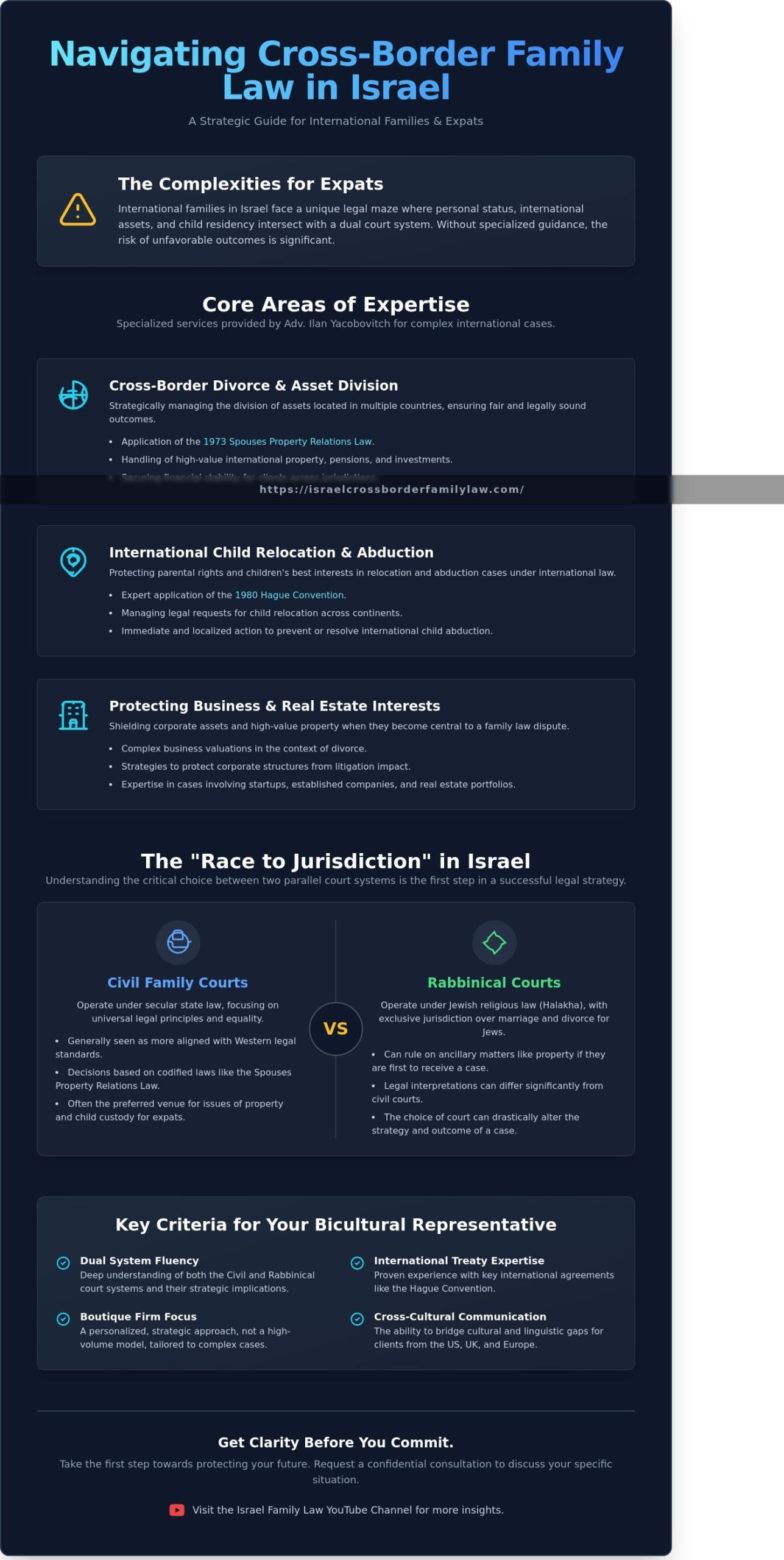
The Israeli legal landscape presents a structure that often surprises international families. Unlike the unified systems found in many Western countries, IL operates a dual-court model for family matters. This system consists of civil Family Courts and religious Rabbinical Courts. Both systems have the authority to hear cases, but they operate under different philosophies and procedural rules. Understanding how these two paths intersect is the first step in protecting your interests.
Civil vs. Religious Jurisdiction
The interaction between civil and religious courts is complex. While the Family Court applies civil law, the Rabbinical Court operates according to Jewish law (Halacha). For an expat or international family, choosing the wrong venue can lead to outcomes that don’t align with their expectations. For instance, a Rabbinical Court might view property division or spousal support differently than a civil judge would. Ilan Yacobovitch provides the necessary how-it-works clarity to help clients understand which system better suits their specific circumstances. This advisory role is vital because once a court claims jurisdiction, moving the case elsewhere is extremely difficult.
The “Race to Jurisdiction” is a defining feature of Israeli law. In many cases, the spouse who files first in their preferred court determines where the entire case is heard. This creates a high-stakes environment where the first 48 hours of a dispute can define years of future litigation. If one party files for divorce in the Rabbinical Court and “attaches” issues like child custody or assets, that court may take control of those matters before the other party even realizes a case has begun.
The Importance of Early Strategy
Strategic planning must happen before any legal action is taken. International families should seek counsel the moment they suspect a dispute is escalating. Decisions made in haste often lead to long-term jurisdictional traps. Since 2016, the Law for the Settlement of Family Disputes has required most parties to attend four mandatory mediation sessions before they can litigate. This cooling-off period is designed to reduce conflict, but it requires a careful approach to ensure your rights aren’t compromised while you wait.
Strategy involves risk-based decision making. It’s not just about winning a case; it’s about understanding the cultural and legal nuances of the IL system. For those who prefer visual learning, the YouTube channel “Israel Family Law” offers explainers on these court processes. Ilan Yacobovitch emphasizes that mediation and arbitration are often more effective for cross-border families than traditional court battles, as they allow for more flexible, private agreements that a rigid court ruling might not provide.
Get clarity before you commit. Request a confidential consultation.
This article is published on an independent advisory platform and does not constitute a law firm or an attorney-client relationship.
Choosing Representation for Cross-Border Family Matters
Selecting the right representative isn’t just about finding a lawyer; it’s about finding a bridge between two distinct legal realities. International families often face a jurisdictional race where the first to file in a specific country can dictate the outcome of the entire case. Moving from a state of confusion to a structured legal strategy requires a professional who understands the financial and emotional stakes involved. Ilan Yacobovitch provides the necessary expertise to help clients evaluate these risks before they make irreversible decisions.
Effective representation involves more than just knowledge of the law; it requires an honest assessment of the differences between the Israeli and US legal systems. For example, the 2022 Israeli Central Bureau of Statistics report noted that roughly 15,000 divorces occur annually in IL, with a growing percentage involving international assets. Without a clear strategy, families risk losing control over their financial future or their children’s residence. A representative must be able to translate these risks into a plan that protects your interests in both jurisdictions.
Qualities of an Effective Cross-Border Advocate
A cross-border advocate must be bilingual and bicultural. It isn’t enough to speak Hebrew; the representative must understand the nuances of the Israeli Rabbinical courts versus the Family Courts. Since Israel is a start-up nation, many divorce cases involve complex assets like RSU grants, options, and intellectual property. A qualified representative works with expats and foreign nationals to ensure these high-tech assets are valued correctly across borders. They also collaborate with your existing legal teams in other jurisdictions to prevent conflicting court orders.
Key traits to look for include:
- Proven experience managing multi-jurisdictional litigation.
- The ability to explain Israeli legal procedures in plain English.
- A network of financial experts familiar with international tax and valuation.
- A focus on strategy-led decision making rather than reactive litigation.
Next Steps for International Families
Families should prepare for an initial consultation by gathering financial records and marriage documents from both countries. It’s vital to seek pricing transparency and clear engagement terms early in the process. Ilan Yacobovitch emphasizes that an early, honest risk assessment is more valuable than a guarantee of success. Understanding the potential pitfalls of the Israeli legal system allows you to make decisions based on logic rather than emotion. This structured approach helps you move from uncertainty to a position of informed strength.
Get clarity before you commit. Request a confidential consultation.
Securing Your Family’s Future Across Borders
Navigating the intersection of international family law and the Israeli court system requires a strategic approach rather than a reactive one. Decisions made in the early stages of a relocation or a Hague Convention case often dictate the legal trajectory for years. Adv. Ilan Yacobovitch brings decades of specialized experience as a member of the Israeli Bar to these sensitive matters. His professional excellence is recognized in the Dun’s 100 rankings, which highlights a deep understanding of how to protect both personal interests and complex business assets within the Israeli jurisdiction.
It’s vital to recognize that the Israeli legal landscape operates differently than those in the U.S. or Europe. Understanding these cultural and procedural nuances is the first step toward a stable resolution. By prioritizing clarity and risk assessment early on, you can manage the complexities of cross-border life with greater confidence. This information is for educational purposes and doesn’t constitute legal advice; formal representation requires a separate engagement. Taking the right steps now helps ensure your family’s interests remain protected during challenging transitions.
Get clarity before you commit. Request a confidential consultation.
This article is published on an independent advisory platform and is not a law firm. It does not imply an attorney-client relationship. Legal services are provided only by licensed attorneys under a separate engagement.
Frequently Asked Questions
Is Ilan Yacobovitch experienced in Hague Convention child abduction cases?
Yes, Ilan Yacobovitch has extensive experience managing international child abduction cases under the 1980 Hague Convention. These sensitive matters require immediate action, as Israeli procedural regulations aim to conclude the “return order” process within 6 weeks of filing. His practice focuses on the complex interplay between international treaties and Israeli domestic law to protect parental rights and the best interests of the child.
Can a US prenuptial agreement be enforced in Israel by a family lawyer?
A US prenuptial agreement is generally enforceable in Israel, provided it meets the specific criteria established by the Israeli Financial Relations Law of 1973. If the agreement wasn’t validated by a court or a notary at the time of signing, an Israeli family court may need to review its fairness before it’s upheld. Ilan Yacobovitch assists clients in navigating these cross-border validation requirements to ensure that foreign contracts remain robust during Israeli legal proceedings.
What is the difference between a family court and a rabbinical court in Israel?
Israel operates a dual-track system where Family Courts and Rabbinical Courts share jurisdiction over many domestic issues. Family Courts handle civil matters like property division and custody based on secular law. Rabbinical Courts apply Jewish religious law and have exclusive authority over the marriage and divorce decree itself. This often leads to a “race for jurisdiction,” where the court where a case is filed first dictates the legal framework used for the entire dispute.
How does Ilan Yacobovitch handle high-value business disputes in divorce?
Strategic management of high-value assets requires a deep understanding of both corporate structures and Israeli family law. Ilan Yacobovitch coordinates with forensic accountants to track assets and value private companies or tech startups. Since the 2016 “Spousal Property” reforms, Israeli courts have become more sophisticated in dividing future earning capacity and intellectual property, making expert guidance essential for protecting business interests.
Does the firm represent US citizens who don’t live in Israel?
Yes, the firm frequently represents US citizens and international clients who reside abroad but have legal interests or family disputes within Israel. Modern technology allows for remote consultations and video court appearances in many circumstances. This is particularly helpful for expats who need to manage Israeli real estate or inheritance issues from a different time zone without the need for constant travel.
What should I do if I am served with divorce papers in Israel while visiting?
You must act immediately, as being served while physically present in Israel can grant Israeli courts jurisdiction over your global assets. You typically have 30 days to file a response or a jurisdictional challenge. Failing to respond can lead to a default judgment or even an “exit order,” which prevents you from leaving the country until the legal matter is resolved. Get clarity before you commit. Request a confidential consultation.
How are inheritance disputes for properties in Israel resolved for foreign heirs?
Inheritance for foreign residents is governed by the Israeli Succession Law of 1965, which often refers to the law of the deceased’s last domicile. If a US citizen dies owning property in Israel, the heirs must obtain an Israeli Succession Order to transfer the title. Disputes frequently arise regarding the validity of foreign wills, requiring a specialized legal strategy to bridge the gap between US probate processes and Israeli land registry requirements.
For more information on navigating the Israeli legal system, you can view educational resources on our YouTube channel: https://www.youtube.com/@IsraelFamilyLaw

Article by
Gabriel Lior
A Personal Journey That Became a Mission
The advisory was founded by an American father Gabriel Lior, LLB, MBA , global entrepreneur, and cross-border advisor who spent more than a decade navigating the Israeli family court system firsthand and now lives in Singapore with his son.
As a divorced parent in a cross-border family, Gabriel faced nearly every legal challenge a foreign parent can encounter in Israel — including child custody disputes, child support proceedings, property matters in Israel and abroad, false accusations, and complex immigration and relocation proceedings.
Over the years, he learned the hard way how difficult it is for non-Israeli parents to understand the system, identify the right legal strategy, and choose the right legal representation — especially when language, culture, and jurisdictional differences are involved. He also witnessed how foreign parents and new immigrants are often disadvantaged or taken advantage of by service providers and institutions simply because they lack local knowledge or fluency.
From Client to Advisor
To truly understand — and survive — the system, Gabriel pursued formal legal education in Israel, completing two Israeli law degrees, alongside a BA and MBA earned in the United States. This was never about becoming a practicing attorney, but about gaining a deep, structural understanding of how the system works — and where it breaks down for foreign parents.
This rare combination of:
Firsthand client experience
Israeli legal and US business education
International business and negotiation training
Decades of commercial execution
created a unique perspective – one that understands both sides of the table.
After years of litigation, persistence, and at times self-representation, he ultimately succeeded in securing custody of his son and relocating abroad through a rare legal victory in the Israeli Supreme Court — becoming one of the first fathers in Israel to do so under these circumstances.
Disclaimer
Important Disclaimer:
The information provided on this website and in its content is for general informational and educational purposes only and does not constitute legal advice, legal opinion, or legal representation.
Gabriel Lior is not licensed to practice law in Israel (nor is he interested in doing so) and does not provide legal services, despite having completed 2 Law Degrees. The services offered are advisory in nature and are intended to provide general guidance, strategic insight, and information regarding cross-border family law considerations.
No attorney-client relationship is formed by accessing this website, reading its content, or communicating with us.
Any decisions made based on this information are at your own discretion and risk. For legal advice specific to your situation, you should consult a licensed attorney in the relevant jurisdiction.
Where appropriate, we may refer clients to independent, licensed attorneys or professionals. Such referrals do not constitute legal representation and no liability is assumed for services provided by third parties.