The first 48 hours after a child is removed from their home country are not just a period of high emotional distress; they are the most critical window for legal intervention. Taking an Emergency Action After a Child Is Taken Abroad requires a shift from panic to a disciplined, strategic response. You likely feel every second counts, and in the world of international custody, that is a reality you must address with precision. At Israel Cross Border Law Firm, we understand this urgency and provide this content as strategic guidance. While this information focuses on strategy, risks, and decision-making, it does not constitute formal legal representation or an attorney-client relationship.
We understand the fear of permanent separation and the confusion over complex international jurisdictional boundaries. You don’t have to navigate this without a map. This guide provides a clear roadmap for immediate action and an understanding of the international frameworks required to secure a child’s return. We will preview the documentation needed, the role of central authorities in Israel and the U.S., and how to navigate the potential legal risks of cross-border disputes. By moving from a state of shock to a position of informed strategy, you can better protect your parental rights.
Key Takeaways
- Learn why immediate documentation and filing a report in the child’s place of habitual residence are the first essential steps in protecting your parental rights.
- Understand how to coordinate an Emergency Action After a Child Is Taken Abroad by utilizing the Hague Convention as a specialized mechanism for return rather than a standard custody dispute.
- Discover the procedural requirements for filing a return application through the Central Authority in Israel or the United States to ensure international cooperation.
- Gain clarity on common legal defenses, such as the “Grave Risk” exception, that can complicate or delay the recovery process in cross-border litigation.
- Prepare for the financial and emotional complexities of international disputes by identifying the cultural and legal nuances between the Israeli and American systems.
The First 48 Hours: Immediate Steps to Protect Your Parental Rights
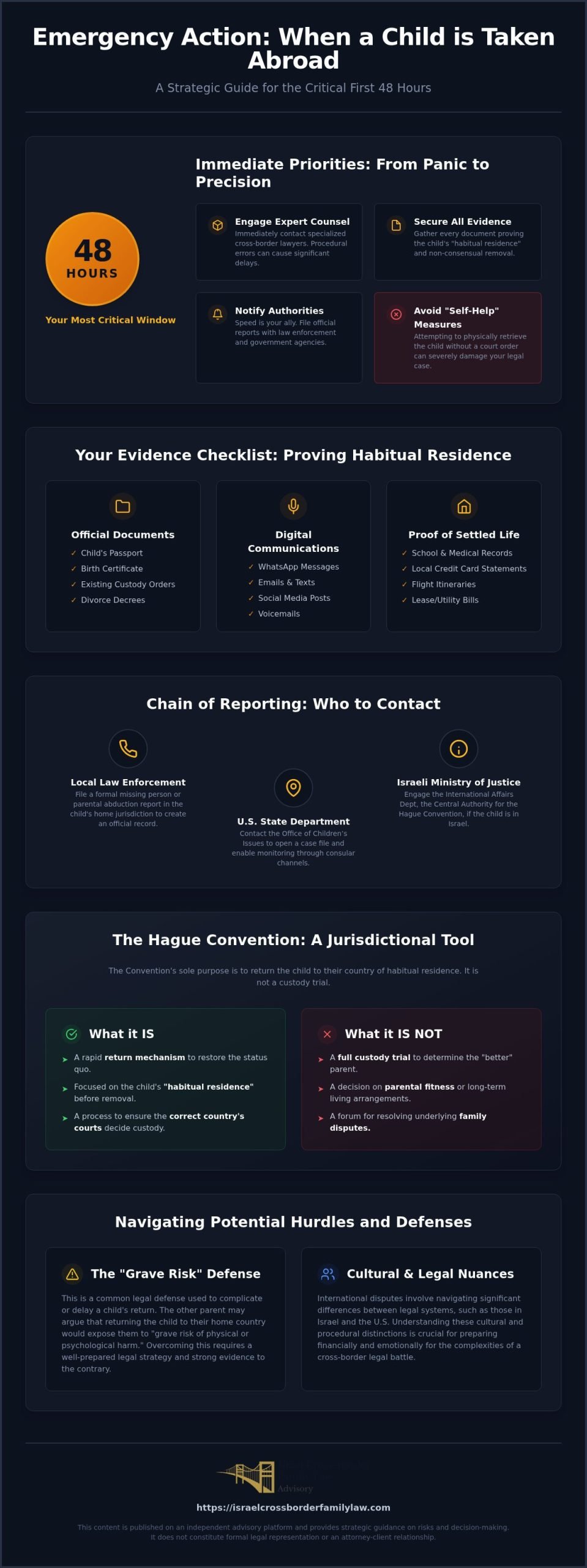
The initial hours following the discovery that a child has been removed from their home country are the most critical. This is the window where evidence is most accessible and the legal foundation for a return is established. Taking an Emergency Action After a Child Is Taken Abroad requires a shift from emotional distress to disciplined, strategic documentation. You must resist the urge to engage in “self-help” measures, such as attempting to physically retrieve the child without a court order. These actions often backfire, as they can be used to argue that you are unstable or that the child was not “wrongfully” removed. Instead, your focus should remain on preserving your legal standing under the Hague Convention on the Civil Aspects of International Child Abduction.
Engaging specialized cross-border counsel immediately is essential. International family law is a highly technical field where a single procedural error can delay a case for months. In Israel, the family courts operate under specific regulations designed to expedite these matters, but they require precise filings that align with international standards. Professional guidance helps you avoid common pitfalls and ensures that your initial reports to law enforcement are framed correctly to support a future Hague Convention petition.
Securing Essential Evidence and Records
You need to act quickly to gather every piece of data that proves the child’s “habitual residence” was in their home country and that the removal was non-consensual. Start by securing copies of the child’s passport, birth certificate, and any existing custody orders or divorce decrees from either jurisdiction. Digital evidence is often the most persuasive in modern cross-border disputes. You should preserve all recent communication with the other parent, including WhatsApp messages, emails, and social media posts that might indicate their intent or show they did not have permission to relocate. Flight itineraries, credit card statements showing local purchases, and school or medical records help establish the child’s settled life before the removal occurred.
Contacting the Relevant Authorities
Speed is your greatest ally when notifying official bodies. If the removal is currently in progress, you should immediately alert airport authorities and border control. For cases involving the United States and Israel, the following steps are vital:
- US State Department: Contact the Office of Children’s Issues to report the abduction and open a case file. They can provide resources and monitor the child’s welfare through consular channels.
- Israeli Ministry of Justice: If the child has been taken to Israel, you must engage with the International Affairs Department, which serves as the Central Authority for the Hague Convention.
- Local Law Enforcement: File a formal missing person or parental abduction report in the child’s home jurisdiction. This creates an official record of the date and time the removal was discovered.
By following these structured steps, you lay the groundwork for a successful legal strategy while maintaining the calm, authoritative approach required in international litigation.
The Hague Convention: The Legal Framework for International Return
When a child is moved across borders without permission, the primary legal instrument used to secure their return is the Hague Convention on the Civil Aspects of International Child Abduction. This treaty is not a forum for a custody trial. It doesn’t determine which parent is “better” or where the child should live permanently. Instead, it functions as a jurisdictional return mechanism. Its sole purpose is to restore the status quo by returning the child to their country of habitual residence so that local courts there can make long-term custody decisions. Understanding this distinction is vital when coordinating an Emergency Action After a Child Is Taken Abroad, as the legal arguments focus on geography and rights of custody rather than parental fitness.
The treaty operates on the principle that custody disputes should be resolved in the place where the child is most settled. By removing the incentive for a parent to “forum shop” by taking a child to a more favorable legal system, the Convention protects the integrity of the original jurisdiction. For families moving between Israel and the United States, this framework provides a structured pathway to address international child abduction cases with a level of predictability that would otherwise be impossible in a foreign court system. It serves as the legal foundation for any Emergency Action After a Child Is Taken Abroad between signatory nations.
Habitual Residence: The Core of the Dispute
Courts determine a child’s habitual residence by looking at the reality of their daily life rather than their nationality or the parents’ future intentions. This assessment is fact-heavy and looks at where the child has established social, educational, and familial ties. Factors such as the length of stay, enrollment in Israeli or American schools, and the degree of integration into the local community are weighed heavily. A temporary vacation or a short-term relocation for work usually doesn’t shift a child’s habitual residence, but the line can become blurred if the stay was intended to be permanent. If you are unsure how a court might view your child’s primary residence, it’s wise to seek a professional assessment of your specific circumstances before filing.
Wrongful Removal vs. Wrongful Retention
A case typically falls into one of two categories. Wrongful removal occurs when a parent takes a child out of their home country without the other parent’s consent. Wrongful retention happens when a parent has initial permission to take the child abroad, perhaps for a summer holiday in Israel, but then refuses to return them at the agreed-upon time. Both scenarios trigger the same legal protections, but the “date of removal” or “date of retention” is a critical deadline. Under the Convention, if a petition is filed more than one year after the wrongful act, the court may consider whether the child has become “well-settled” in their new environment; this can potentially block a return order.
Initiating a Return Petition in Israel or the United States
Once you’ve secured the evidence discussed in the previous section, the next phase of taking Emergency Action After a Child Is Taken Abroad involves the formal engagement of the Central Authority. In the United States, this is the Department of State’s Office of Children’s Issues; in Israel, it is the International Affairs Department within the Ministry of Justice. These entities act as the primary facilitators of international cooperation, ensuring that your application meets the treaty’s technical requirements before it enters the courtroom. While there are no fees for filing a Hague Convention application with these authorities, you’ll need to account for the costs of specialized legal representation to manage the subsequent litigation.
The Central Authority doesn’t act as your personal legal counsel; rather, they serve as a bridge between the two nations’ legal systems. They review your application for completeness, verify the jurisdictional claims, and transmit the request to the corresponding authority in the country where the child is located. This administrative step is a prerequisite for the judicial phase, where the actual “return order” is litigated in family court. Understanding how the process unfolds is essential for maintaining a strategic advantage during these high-stakes negotiations.
Filing Through the Central Authority
Accurate documentation is the bedrock of a successful filing. You’ll need to submit detailed forms that outline the child’s identity, the legal basis for your custody rights, and the specific circumstances of the wrongful removal or retention. Because these cases involve two different languages and legal cultures, the importance of precise translations between Hebrew and English cannot be overstated. A minor mistranslation in a prior custody agreement or a text message can lead to significant delays or misinterpretations by the receiving court. The Central Authority coordinates this flow of information, but the burden of providing clear, authenticated evidence rests entirely on you.
The Judicial Phase in Israeli or US Family Courts
While the Central Authority handles the administrative start, the final decision rests with the family court in the country where the child is currently located. The Hague Convention mandates that these proceedings be handled with extreme urgency. In Israel, specific regulations aim for a conclusion within six weeks, though recent data suggests that complex cases may take a year or more to reach a final judgment. During a preliminary hearing, the judge focuses exclusively on jurisdictional facts. It’s vital to remember that this is not a trial to determine long-term custody or parental fitness. The court’s scope is strictly limited to determining if a wrongful removal occurred and whether the child should be returned to their place of habitual residence for further proceedings.
Navigating Legal Defenses and Potential Risks
While the Hague Convention is designed to return children quickly, it’s not an automatic process. The parent who removed the child will likely raise specific legal defenses to block the return order. These defenses are strictly interpreted by courts in Israel and the United States to prevent the treaty’s purpose from being undermined. Understanding these risks is a vital part of any Emergency Action After a Child Is Taken Abroad. Beyond the “well-settled” defense mentioned earlier, which applies if you delay filing for more than one year, the taking parent may argue that you originally consented to the move or later accepted it through your actions.
It’s crucial to recognize that these defenses aren’t just hurdles; they are the primary battlegrounds of international litigation. A successful strategy involves anticipating these claims and preparing a robust rebuttal before the first hearing occurs. Failing to address these risks early can lead to a court refusing the return, effectively shifting the custody battle to the foreign jurisdiction where the child is currently located.
The Grave Risk Exception (Article 13b)
This is the most frequently litigated defense in cross-border cases. Article 13b allows a court to refuse a return if there’s a grave risk that the child would be exposed to physical or psychological harm or otherwise placed in an intolerable situation. Courts in both Israel and the U.S. maintain an exceptionally high evidentiary burden for this. It isn’t enough to show that the home country is less stable or that one parent has a better home. The risk must be specific, severe, and immediate. Allegations of domestic violence or instability are taken seriously, but they must be supported by documented evidence rather than general claims. If you are concerned about how these allegations might impact your case, you should speak with a specialist to evaluate the strength of your evidence.
Child’s Objection and Maturity
A court may also refuse to order a return if the child objects and has reached an age and degree of maturity where it’s appropriate to take their views into account. There is no fixed age in Israeli or American law, but judges often begin to give weight to these objections around ages 11 to 13. However, the objection must be the child’s own. Judges and court-appointed experts are highly trained to distinguish between a genuine objection and “parental alienation,” where the taking parent has coached the child to speak against the other parent. This is why a strategic Emergency Action After a Child Is Taken Abroad often involves working with psychological experts who can provide a neutral assessment of the child’s true state of mind.
Strategic Guidance: Preparing for a Cross-Border Legal Battle
Strategic planning in international disputes requires looking far beyond the immediate crisis of the removal. While the initial focus of an Emergency Action After a Child Is Taken Abroad is securing a return order, you must also prepare for the significant financial and emotional costs of prolonged litigation. Early decisions regarding which court to approach first can haunt a case for years. In Israel, the choice between the Civil Family Court and the Rabbinical Court can significantly alter the legal landscape for custody and support. This “race to the court” is a critical factor that requires immediate, informed decision-making to protect your long-term parental rights and ensure that your case is heard in the most appropriate forum.
The Value of Specialized Cross-Border Counsel
A standard local divorce lawyer, while skilled in domestic matters, is often ill-equipped for the multi-jurisdictional complexity of a Hague case. These disputes involve a sophisticated interplay between the laws of two different nations and require an integrated strategy that moves in both the U.S. and Israel simultaneously. Specialized counsel understands the cultural nuances of both legal systems and can anticipate how a judge in Jerusalem might interpret a custody order from New York or California. This level of expertise in cross-border matters ensures that your rights are protected across all relevant jurisdictions and that you avoid the procedural traps that often ensnare less experienced practitioners. Navigating the differences between the Israeli Rabbinical courts and Civil courts is a specialized task that requires more than just general legal knowledge.
Next Steps and Moving Forward
Securing a return order is a major milestone, but it is not the end of the journey. You must plan for the logistics of the child’s transition back to their home country, which often involves coordinating with central authorities, airline personnel, and airport security to ensure a safe passage. During this transition, establishing temporary protective orders is vital to ensure the child’s safety and financial support until a permanent custody trial can occur in the home jurisdiction. These orders, often called undertakings, serve as a bridge to maintain stability while the long-term custody arrangement is litigated in the proper forum. They are essential for managing the child’s return in a way that minimizes further trauma and prevents future legal uncertainty.
Get clarity before you commit. Request a confidential consultation.
Securing Your Child’s Future Through Strategic Legal Action
Taking an Emergency Action After a Child Is Taken Abroad requires more than just speed; it demands a disciplined adherence to international legal frameworks. You’ve learned that the first 48 hours are foundational for gathering evidence and that the Hague Convention serves as a precise mechanism for restoration rather than a standard custody dispute. By engaging with the Central Authorities in both Israel and the United States, you can navigate the technical hurdles of cross-border litigation with confidence.
We bring decades of cross-border experience and a deep understanding of US-Israel Central Authority protocols to every case. Our specialized focus on Hague Convention litigation ensures that your strategy is built on a foundation of established expertise and multi-jurisdictional proficiency. You don’t have to face this complexity alone. With the right roadmap and professional guidance, you can move toward a resolution that prioritizes your child’s safety and your parental rights.
Get clarity before you commit. Request a confidential consultation.
Frequently Asked Questions
What is the very first thing I should do if my child is taken abroad?
Contact local law enforcement and the US State Department’s Office of Children’s Issues immediately to file a formal report. This creates an official record of the discovery. Then, consult with a cross-border legal specialist to initiate an Emergency Action After a Child Is Taken Abroad. Speed is vital to prevent the child from being moved again or becoming well-settled in the new country.
How long does a Hague Convention return process typically take?
While Israeli regulations aim for a conclusion within six weeks, the actual timeframe often varies significantly. Recent data indicates that complex US-Israel cases can take between six months and over a year to reach a final judgment. The total duration depends on the court’s schedule, the complexity of the legal defenses raised, and whether the initial decision is appealed to a higher court.
Can I still get my child back if the other country is not a Hague signatory?
Yes, but the process is significantly more complex and relies on local laws rather than a standardized treaty. Without the Hague framework, you must often litigate custody directly in the foreign court system, which can be unpredictable and culturally challenging. In these instances, coordinating with the US State Department and specialized local counsel in the foreign jurisdiction remains the primary path to recovery.
Will the court decide who gets permanent custody during a Hague hearing?
No, the court’s only role in a Hague hearing is to determine if the child was wrongfully removed and should be returned. The hearing functions as a jurisdictional mechanism, not a custody trial. Once the child is returned to their place of habitual residence, the local courts in that jurisdiction will handle the subsequent long-term custody and child support proceedings.
What happens if my child says they do not want to return?
The court may consider a child’s objection if they’ve reached an appropriate age and degree of maturity, which is often around age 11 to 13. However, judges are trained to distinguish between a genuine preference and parental alienation. Experts are typically appointed to interview the child and determine if their objection is independent or the result of coaching by the taking parent.
Do I need a lawyer in both the US and Israel for my case?
Having an integrated legal strategy that covers both the US and Israel is often essential for a successful Emergency Action After a Child Is Taken Abroad. While the primary litigation occurs where the child is located, you may need to file protective orders or gather evidence in the home country simultaneously. A multi-qualified team ensures that your actions in one country don’t accidentally jeopardize your legal standing in the other.
Can I stop my child from being taken if I suspect they are at risk of abduction?
You can take preventive steps such as enrolling in the Children’s Passport Issuance Alert Program or obtaining a court order that explicitly prohibits international travel without consent. In Israel, you can request a Stay of Exit order, known as a Tzav Ikur Yetzia Min HaAretz. This order prevents the child from leaving the country’s borders and is a critical tool for parents who suspect an imminent abduction risk.
Are US custody orders automatically enforced in Israel?
No, foreign custody orders are not automatically enforceable in Israel without a formal recognition process. However, a valid US order serves as vital evidence in a Hague Convention case to prove that your custody rights were breached. To have an order fully enforced for long-term visitation or support, you must generally apply for its recognition through the Israeli family court system.

Article by
Gabriel Lior
A Personal Journey That Became a Mission
The advisory was founded by an American father Gabriel Lior, LLB, MBA , global entrepreneur, and cross-border advisor who spent more than a decade navigating the Israeli family court system firsthand and now lives in Singapore with his son.
As a divorced parent in a cross-border family, Gabriel faced nearly every legal challenge a foreign parent can encounter in Israel — including child custody disputes, child support proceedings, property matters in Israel and abroad, false accusations, and complex immigration and relocation proceedings.
Over the years, he learned the hard way how difficult it is for non-Israeli parents to understand the system, identify the right legal strategy, and choose the right legal representation — especially when language, culture, and jurisdictional differences are involved. He also witnessed how foreign parents and new immigrants are often disadvantaged or taken advantage of by service providers and institutions simply because they lack local knowledge or fluency.
From Client to Advisor
To truly understand — and survive — the system, Gabriel pursued formal legal education in Israel, completing two Israeli law degrees, alongside a BA and MBA earned in the United States. This was never about becoming a practicing attorney, but about gaining a deep, structural understanding of how the system works — and where it breaks down for foreign parents.
This rare combination of:
Firsthand client experience
Israeli legal and US business education
International business and negotiation training
Decades of commercial execution
created a unique perspective – one that understands both sides of the table.
After years of litigation, persistence, and at times self-representation, he ultimately succeeded in securing custody of his son and relocating abroad through a rare legal victory in the Israeli Supreme Court — becoming one of the first fathers in Israel to do so under these circumstances.
Disclaimer
Important Disclaimer:
The information provided on this website and in its content is for general informational and educational purposes only and does not constitute legal advice, legal opinion, or legal representation.
Gabriel Lior is not licensed to practice law in Israel (nor is he interested in doing so) and does not provide legal services, despite having completed 2 Law Degrees. The services offered are advisory in nature and are intended to provide general guidance, strategic insight, and information regarding cross-border family law considerations.
No attorney-client relationship is formed by accessing this website, reading its content, or communicating with us.
Any decisions made based on this information are at your own discretion and risk. For legal advice specific to your situation, you should consult a licensed attorney in the relevant jurisdiction.
Where appropriate, we may refer clients to independent, licensed attorneys or professionals. Such referrals do not constitute legal representation and no liability is assumed for services provided by third parties.