This article is published on an independent advisory platform (not a law firm) and does not constitute an attorney-client relationship. Legal services are provided only by licensed attorneys under a separate engagement.
A fixed monthly support payment is not actually fixed. Without the right protections, it is a shrinking asset that loses value every time the exchange rate shifts or prices at the grocery store rise. You likely already feel the pressure of maintaining a household in Israel, where the cost of living is currently 29% higher than the OECD average. It’s frustrating to watch your purchasing power disappear because your agreement lacks specific cost of living adjustments for international alimony.
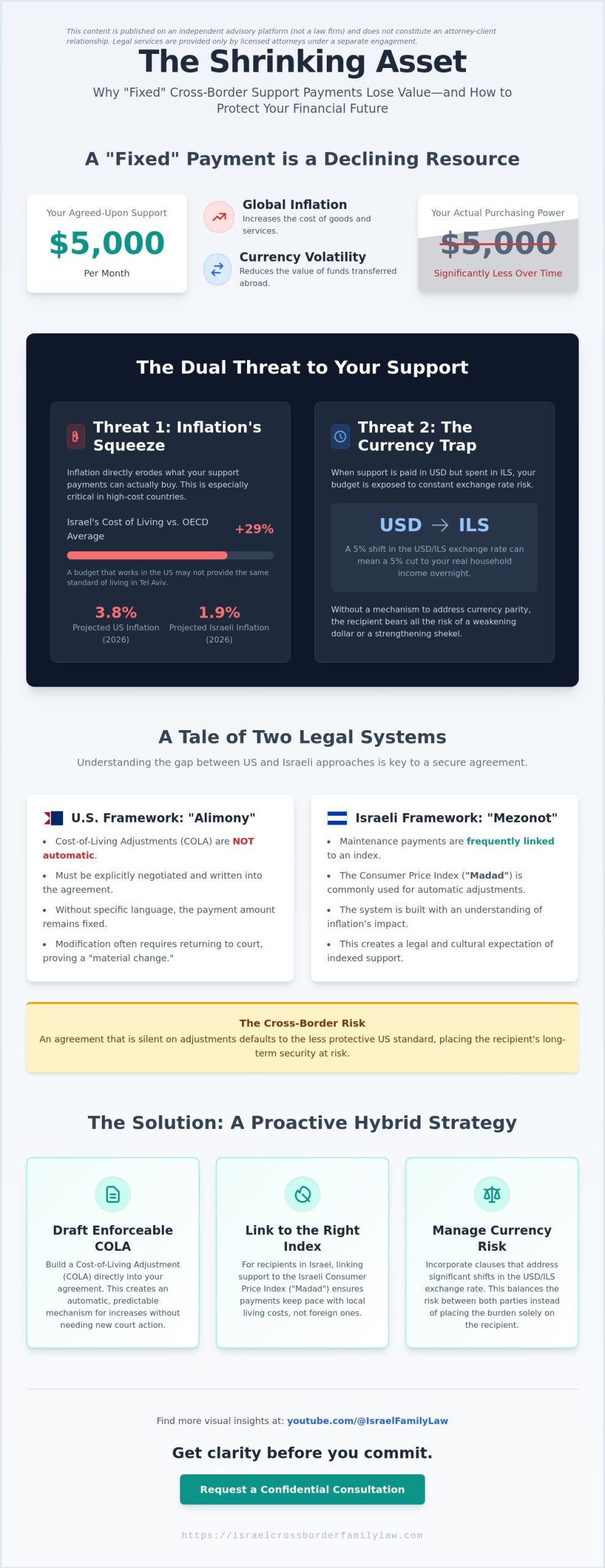
You can secure your future by understanding how to buffer your support against 2026’s 3.8% US inflation and 1.9% Israeli inflation rates. This guide explains how to protect cross-border payments using a hybrid strategy that accounts for local price hikes and currency parity. We will explore how US and Israeli courts handle inflation, the impact of the USD to ILS exchange rate, and how to create enforceable adjustment mechanisms. Find more visual insights at https://www.youtube.com/@IsraelFamilyLaw. Get clarity before you commit. Request a confidential consultation.
Key Takeaways
- Understand how a properly structured adjustment mechanism protects your monthly support from being eroded by long-term economic shifts.
- Learn to identify the “Currency Trap” where exchange rate volatility between the Dollar and the Shekel impacts your actual household budget.
- Compare how Israeli and US courts approach cost of living adjustments for international alimony to ensure your agreement is legally sound in both jurisdictions.
- Evaluate the benefits of different inflationary indices, such as the Israeli Consumer Price Index (Madad), when drafting new cross-border agreements.
- Gain clarity on the process for seeking a modification of existing support orders when there is a material change in financial circumstances.
This article is published on an independent advisory platform (not a law firm) and must not imply an attorney-client relationship. Legal services are only provided by licensed attorneys under a separate engagement.
Understanding Cost of Living Adjustments (COLA) in Cross-Border Alimony
In transnational family law, a Cost-of-Living Adjustment (COLA) serves as a vital mathematical safeguard. It’s a mechanism designed to ensure that the actual value of a support payment remains consistent over time, regardless of how much prices rise. For international families, this is not just a technicality; it’s a way to protect the future. With US inflation at 3.8% and Israel’s rate at 1.9% as of April 2026, a payment that seems fair today can quickly lose its utility if it remains static.
To better understand how support amounts can change over time, watch this helpful video:
Fixed payments are uniquely vulnerable in cross-border scenarios. While a court might set a monthly amount based on today’s costs, those dollars or shekels won’t buy the same amount of groceries or electricity in five years. This is especially true in Israel, where the cost of living remains approximately 29% higher than the OECD average. The valuation of your agreement starts the moment it’s signed. If you wait several years to enforce or adjust it, you may find the “real” value has already dropped significantly.
It’s also essential to recognize the terminology differences. In Israel, legal professionals often use the term “maintenance” (mezonot), which frequently includes an automatic link to the consumer price index. In the US, “alimony” or “spousal support” laws vary by state, and many don’t include automatic increases. This gap between legal systems can create significant friction if your agreement doesn’t explicitly address cost of living adjustments for international alimony.
The Purpose of COLA in International Support
The primary goal is to maintain the agreed-upon standard of living for the recipient living abroad without requiring them to return to court every few years. Litigation is expensive and stressful. By building an automatic adjustment into the initial agreement, both parties gain predictability. This balances the financial burden fairly. The payer knows exactly how the increase is calculated, and the recipient is protected from the eroding effects of inflation.
Common Terminology for International Families
Understanding the tools used for indexation is the first step toward clarity. The Consumer Price Index (CPI) measures the average change over time in the prices paid by urban consumers for a market basket of goods. In Israel, this is known as the “Madad.”
Families must also consider Purchasing Power Parity. This concept explains why $1,000 might cover basic needs in a mid-sized US city but fail to provide the same lifestyle in Tel Aviv’s high-cost environment. Linking payments to the correct index ensures that the support remains functional in the country where the recipient actually lives. For those managing a divorce or separation as an international family, choosing the right economic indicator is a strategic decision that dictates long-term stability.
This article is published on an independent advisory platform (not a law firm) and must not imply an attorney-client relationship. Legal services are only provided by licensed attorneys under a separate engagement.
The Dual Threat: Global Inflation and Currency Volatility
International support agreements face a unique “double squeeze” that purely domestic orders never encounter. While inflation increases the cost of basic goods, currency volatility can simultaneously reduce the value of the funds transferred. For individuals managing cost of living adjustments for international alimony, these shifting variables represent a constant risk to long-term financial security. Since 2020, the USD to ILS exchange rate has experienced significant movement, often catching families off guard when the Shekel strengthens against the Dollar.
This phenomenon is frequently described as the “Currency Trap.” If a US-based payer sends a fixed amount of $3,000 per month, the recipient’s actual budget in Israel fluctuates based on the daily mid-market rate. When the Shekel is strong, those Dollars buy fewer groceries, pay less rent, and cover fewer utility bills. The U.S. government foreign cost-of-living adjustments provide a professional model for how institutional entities account for these variations, yet private agreements often fail to include similar protections. This lack of foresight creates immense psychological stress for expats who watch their purchasing power evaporate through no fault of their own.
Inflation Risks for the Recipient
In early 2026, residents in Israel faced immediate price increases in essential services. This included a 1.5% rise in electricity, a 5% jump in cooking gas, and water price hikes of up to 2.5%. In high-demand hubs like Tel Aviv, housing and education costs frequently outpace general inflation figures. There is often a significant lag time between these price spikes and the legal recognition of a “material change in circumstances.” Recipients must meticulously document these rising expenses to justify a modification, which adds a layer of administrative burden to an already complex situation.
Exchange Rate Risks for the Payer
Payers also face considerable uncertainty when obligations are tied to a foreign currency. With USD to ILS forecasts for late 2026 ranging between 2.42 and 2.92, budgeting for a multi-year obligation becomes difficult. Fixing an exchange rate in a contract might seem like a solution, but it can become a double-edged sword if the market moves drastically in one direction. Strategic legal drafting can include “collars” or “caps and floors” to limit how much the payment can fluctuate in a single year. To explore how these mechanisms might apply to your specific situation, you may want to request a confidential consultation to discuss risk-based decision-making.
This article is published on an independent advisory platform (not a law firm) and must not imply an attorney-client relationship. Legal services are only provided by licensed attorneys under a separate engagement.
Comparing Israeli and US Frameworks for Support Adjustments
Navigating the legal frameworks of two different nations requires an understanding of fundamentally different philosophies regarding inflation. In Israel, the concept of linking financial obligations to the Consumer Price Index, or “Madad,” is deeply ingrained in the legal culture. Conversely, the United States lacks a unified national standard for spousal support. This leaves individual states to determine how and when payments should be updated. This divergence creates significant hurdles when managing cost of living adjustments for international alimony across borders.
Israeli courts typically view maintenance as a dynamic obligation. In domestic cases, the “Madad” is almost always automatically linked to support payments. This ensures the amount updates regularly, often on a quarterly basis, to reflect current economic reality. However, when enforcing a foreign order, the process is not automatic. The Israeli Family Court must first declare the foreign judgment enforceable. If the original US order is silent on inflation, the recipient must often request a modification based on a material change in circumstances to align the payment with local costs.
Automatic Indexation in Israel
The Israeli system provides an inherent protection against local inflation through its standard use of the Consumer Price Index. These adjustments are usually calculated every three months, though some orders specify monthly or annual updates. Israeli court precedents generally favor maintaining the real value of support. For international families, this means that while the “Madad” is standard for domestic cases, a foreign order without these clauses requires active legal strategy to achieve similar protection in an Israeli context.
The US “Modification” Threshold
In many US jurisdictions, alimony is treated as a static figure. To change the amount, a party must usually prove a “substantial change in circumstances.” This is a high legal bar. Unlike the predictable federal cost-of-living adjustments seen in government retirement plans, private alimony in the US rarely increases automatically. Inflation alone is sometimes not enough to trigger a US court modification. This leaves the recipient to absorb rising costs unless the original agreement was drafted with foresight.
Enforcement challenges arise when a US order is brought to Israel under the current Memorandum of Understanding. A critical detail is that US spousal support is generally only enforceable in Israel if it is part of a child support order. If the US order lacks a COLA clause, the Israeli court may only enforce the face value of the original judgment. Bridging this gap requires a nuanced understanding of both legal systems and their divergent cultures. Get clarity before you commit. Request a confidential consultation.
This article is published on an independent advisory platform (not a law firm) and must not imply an attorney-client relationship. Legal services are only provided by licensed attorneys under a separate engagement.
Strategic Drafting: Protecting Purchasing Power in New Agreements
The most effective way to manage financial volatility is through proactive drafting before an agreement is finalized. Early decisions in the divorce process often dictate your financial security for decades. When you negotiate cost of living adjustments for international alimony, you’re not just agreeing on a monthly number; you’re agreeing on a standard of living. Without specific clauses that account for the unique pressures of a cross-border life, the real value of support can degrade quickly.
Choosing the right economic index is a critical strategic choice. As of April 2026, the US annual inflation rate sits at 3.8%, while Israel’s rate is 1.9%. If the recipient lives in Israel but the payment is linked to the US Consumer Price Index, the support amount may rise faster than local costs. Conversely, linking to the Israeli “Madad” ensures the payment keeps pace with the specific price hikes seen in Israeli utilities and housing. Some families opt for a weighted average of both indices to balance the risks between the payer and the recipient fairly.
Designing a Cross-Border COLA Clause
A well-drafted clause specifies the frequency of adjustments to prevent constant friction between parties. Annual updates are common, but some families prefer semi-annual reviews during periods of high economic volatility. It’s essential to name the specific data source, such as the US Bureau of Labor Statistics or the Bank of Israel. You should also consider including “extraordinary inflation” triggers. These allow for an immediate review if inflation exceeds a certain percentage within a single quarter, providing a safety net for unpredictable global events.
Mitigating Currency Exchange Friction
Currency fluctuations can be as damaging as inflation. You can choose a “Fixed-Rate” approach, where the exchange rate is set for the year, or a “Spot-Rate” approach, which uses the market rate at the time of transfer. Many international families use “collars” to create a floor and a ceiling for the exchange rate. This ensures the payer never pays more than a certain amount in their home currency, while the recipient is guaranteed a minimum amount in Shekels. Understanding how international families navigate divorce can help you identify which of these mechanisms fits your risk tolerance. To ensure your agreement includes these specific protections, you may wish to request a confidential consultation to discuss your drafting strategy.
Clear review dates are also vital. Instead of leaving the agreement open-ended, schedule a formal review every three to five years. This allows both parties to assess whether the chosen index and currency protections are still functioning as intended. It’s a structured way to maintain fairness without returning to a high-conflict legal environment.
This article is published on an independent advisory platform (not a law firm) and must not imply an attorney-client relationship. Legal services are only provided by licensed attorneys under a separate engagement.
Navigating the Modification Process for Existing Orders
Many international families eventually discover that an agreement signed years ago no longer meets the financial demands of the present. If your current judgment is silent on inflation or currency shifts, you may need to pursue a formal modification to implement cost of living adjustments for international alimony. This process requires a clear-eyed assessment of your original order and a strategic approach to the court system. Reopening a case is a significant decision that involves weighing the potential increase in support against the costs and risks of litigation.
The first step is to determine if your situation meets the legal threshold for a modification. In both US and Israeli jurisdictions, you must typically demonstrate a “material change in circumstances.” This means the change must be substantial, permanent, and not something that was anticipated when the original order was created. While the 2026 US inflation rate of 3.8% is a factor, courts often look for how these economic shifts specifically impact your household budget in Israel, where costs remain 29% higher than the OECD average.
Steps to Request an Adjustment
You must begin by reviewing the “choice of law” and “jurisdiction” clauses in your original agreement. These clauses dictate which country’s courts have the authority to change the order. If an Israeli court is asked to modify a foreign judgment, the process is complex. The court must first recognize the foreign order before it can consider a modification. Understanding the nuances of enforcing child and spousal support across borders is essential here. You will need to gather specific evidence, including bank statements and documentation of local price hikes. For example, referencing the 2026 increases in Israeli electricity (1.5%) and cooking gas (5%) provides the concrete data courts require.
Seeking Professional Clarity
Strategic negotiation is often more productive than aggressive litigation in cross-border cases. Reaching a mutual agreement on a new adjustment mechanism can save both parties from the high costs of international legal battles. However, you should never make new commitments or sign waivers without fully understanding the long-term impact on your purchasing power. The differences between the US and Israeli legal cultures are significant, and an error in the modification process can be difficult to reverse. Get clarity before you commit. Request a confidential consultation to explore your options for a stable financial future.
This article is published on an independent advisory platform (not a law firm) and must not imply an attorney-client relationship. Legal services are only provided by licensed attorneys under a separate engagement.
Securing Financial Stability Across Jurisdictions
Achieving long-term financial equilibrium in a transnational context requires a sophisticated understanding of how inflation and currency fluctuations intersect. The 29% cost-of-living premium in Israel, combined with 2026’s unique inflationary pressures, necessitates the inclusion of robust cost of living adjustments for international alimony. By moving beyond static support figures, you ensure that your financial agreements remain functional and resilient against the multi-jurisdictional complexities of the US and Israeli legal landscapes.
Our advisory platform offers specialized expertise in US-Israel cross-border family law, focusing on comprehensive risk assessments for international families. Our practitioners are licensed to practice in multiple jurisdictions, providing the nuanced cultural and legal understanding required to bridge divergent systems. Get clarity before you commit. Request a confidential consultation.
Taking proactive steps today provides the structural certainty needed for a secure and predictable future in Israel.
This article is published on an independent advisory platform (not a law firm) and must not imply an attorney-client relationship. Legal services are only provided by licensed attorneys under a separate engagement.
Frequently Asked Questions
Is a cost-of-living adjustment automatic in international alimony?
No, cost of living adjustments for international alimony are not automatic under Israeli law. While domestic Israeli support orders often include a link to the price index, foreign orders enforced in Israel generally remain at their face value. You must either draft an automatic mechanism into your original agreement or request a court-ordered modification based on a material change in circumstances.
Which inflation index should I use if I live in Israel but my ex is in the US?
The choice of index should reflect where the recipient’s primary expenses are managed. If you live in Israel, the Israeli Consumer Price Index (Madad) is the most accurate measure of local price hikes for utilities and housing. Some families opt for a hybrid approach or the US Consumer Price Index to balance the financial risks between a US-based payer and an Israeli recipient.
Can I change my alimony amount if the exchange rate makes it worth less?
You can request a modification if currency volatility creates a substantial gap in your purchasing power. This requires demonstrating that the exchange rate shift represents a material change in your financial reality. Since the USD to ILS rate has experienced significant movement since 2020, showing how these fluctuations impact your daily budget in Israel is a key part of the strategy.
Do Israeli courts recognize US alimony orders that don’t have COLA?
Israeli courts recognize US alimony orders under the 2009 Memorandum of Understanding, but they typically enforce the specific dollar amount stated in the judgment. If the US order is silent on inflation, the Israeli court will not automatically add a cost of living adjustments for international alimony clause. You would likely need to file for a modification in the Israeli Family Court to address rising costs.
How much does it cost to modify an international support agreement?
The total cost depends on whether the modification is achieved through negotiation or contested litigation. You should factor in court filing fees and the professional time required to navigate the multi-jurisdictional complexities of the case. Reaching a settlement through strategic negotiation is generally more cost-effective than pursuing a high-conflict court battle in two different legal systems.
What happens if the cost of living goes down?
If your agreement is strictly linked to an index and that index decreases, the payment amount could technically drop. Most practitioners suggest including a “floor” clause in the contract to ensure the support never falls below the original base amount. This protects the recipient during periods of deflation while allowing for upward adjustments when prices rise.
How do I prove that the cost of living has increased in Israel?
Proof involves presenting official data from the Israeli Central Bureau of Statistics alongside your personal financial records. You can cite specific 2026 price increases in essential services, such as the hikes in electricity and cooking gas, to demonstrate rising costs. Comparative bank statements and rent receipts are also vital to show the court how these macroeconomic shifts have impacted your actual standard of living.

Article by
Gabriel Lior
A Personal Journey That Became a Mission
The advisory was founded by an American father Gabriel Lior, LLB, MBA , global entrepreneur, and cross-border advisor who spent more than a decade navigating the Israeli family court system firsthand and now lives in Singapore with his son.
As a divorced parent in a cross-border family, Gabriel faced nearly every legal challenge a foreign parent can encounter in Israel — including child custody disputes, child support proceedings, property matters in Israel and abroad, false accusations, and complex immigration and relocation proceedings.
Over the years, he learned the hard way how difficult it is for non-Israeli parents to understand the system, identify the right legal strategy, and choose the right legal representation — especially when language, culture, and jurisdictional differences are involved. He also witnessed how foreign parents and new immigrants are often disadvantaged or taken advantage of by service providers and institutions simply because they lack local knowledge or fluency.
From Client to Advisor
To truly understand — and survive — the system, Gabriel pursued formal legal education in Israel, completing two Israeli law degrees, alongside a BA and MBA earned in the United States. This was never about becoming a practicing attorney, but about gaining a deep, structural understanding of how the system works — and where it breaks down for foreign parents.
This rare combination of:
Firsthand client experience
Israeli legal and US business education
International business and negotiation training
Decades of commercial execution
created a unique perspective – one that understands both sides of the table.
After years of litigation, persistence, and at times self-representation, he ultimately succeeded in securing custody of his son and relocating abroad through a rare legal victory in the Israeli Supreme Court — becoming one of the first fathers in Israel to do so under these circumstances.
Disclaimer
Important Disclaimer:
The information provided on this website and in its content is for general informational and educational purposes only and does not constitute legal advice, legal opinion, or legal representation.
Gabriel Lior is not licensed to practice law in Israel (nor is he interested in doing so) and does not provide legal services, despite having completed 2 Law Degrees. The services offered are advisory in nature and are intended to provide general guidance, strategic insight, and information regarding cross-border family law considerations.
No attorney-client relationship is formed by accessing this website, reading its content, or communicating with us.
Any decisions made based on this information are at your own discretion and risk. For legal advice specific to your situation, you should consult a licensed attorney in the relevant jurisdiction.
Where appropriate, we may refer clients to independent, licensed attorneys or professionals. Such referrals do not constitute legal representation and no liability is assumed for services provided by third parties.