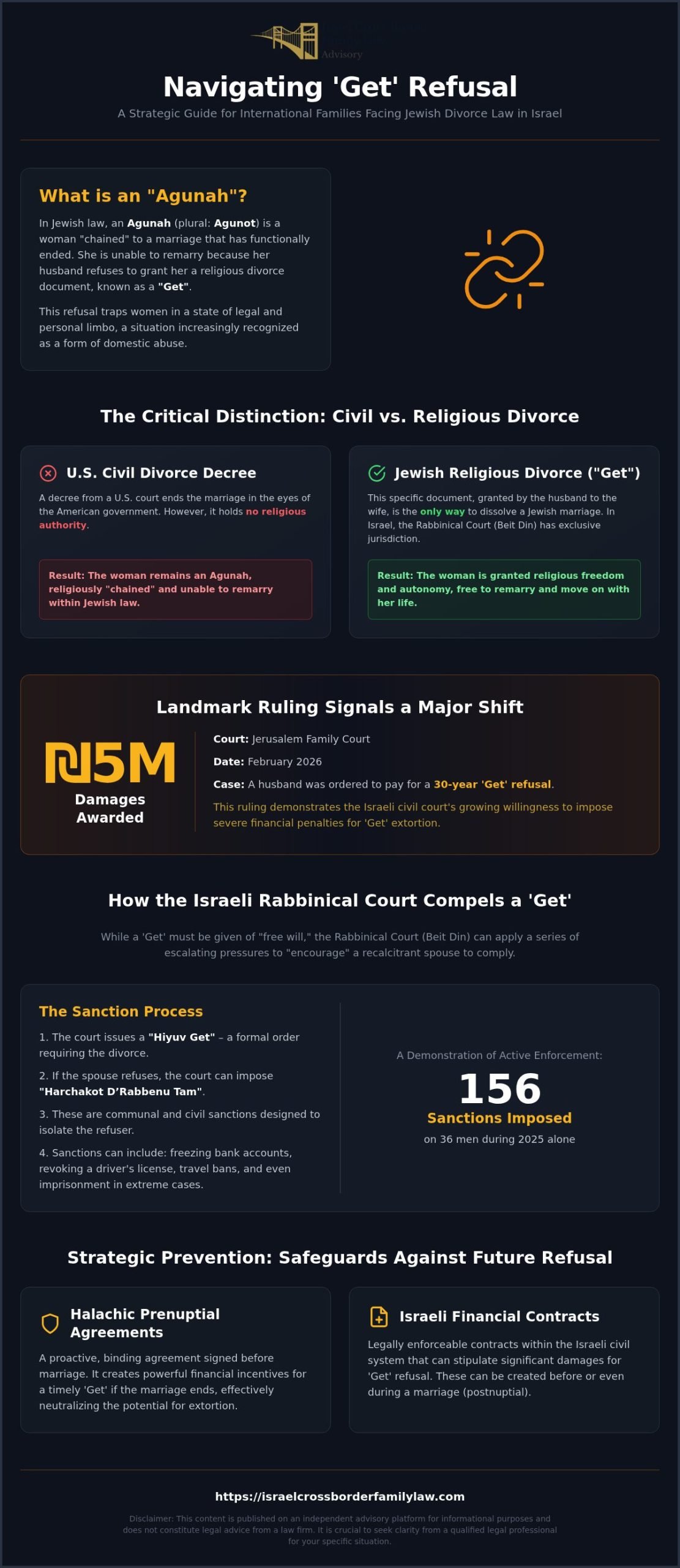
Did you know that in February 2026, a Jerusalem Family Court ordered a husband to pay nearly ₪ 5,000,000 in damages for a 30-year get refusal? This landmark ruling signals a significant shift in how the Israeli legal system addresses the plight of agunot. If you’re caught between the secular laws of the United States and the religious requirements of Israel, you likely feel trapped in a jurisdictional maze. It’s exhausting to realize that a civil divorce decree doesn’t equate to religious freedom, especially when a spouse uses the Get as a tool for extortion or control.
This guide provides the authoritative clarity you need to break the chains of get refusal and reclaim your future. We’ll examine the strategic use of financial sanctions, the evolving role of Rabbinical Courts, and how to utilize cross-border legal leverage to secure your religious divorce. You’ll gain a clear roadmap to navigating these complex systems, ensuring you understand the tools available to compel a Get and prevent future refusal before it begins. By integrating international legal expertise with local Israeli practice, we’ll outline a path toward your complete personal and religious autonomy.
Key Takeaways
- Identify the legal parameters defining the status of agunot, ensuring you understand why a Get must be granted of “free will” according to halachic standards.
- Learn how the Israeli Rabbinical Courts apply communal and civil sanctions; it’s a powerful mechanism for addressing the complexities of get refusal.
- Manage the multi-jurisdictional hurdles that occur when a spouse attempts to evade religious obligations by residing in the United States.
- Discover how halachic prenuptial agreements and Israeli financial contracts serve as strategic safeguards to prevent the possibility of being “chained” to a dead marriage.
- Bridge the cultural divide within the Israeli religious legal system by partnering with specialized advocates who cater to the Anglo-Israeli experience.
What is an Agunah? Understanding the “Chained Woman” in Jewish Law
In the complex architecture of Jewish family law, the term What is an Agunah? refers to a woman who is legally anchored or chained to a marriage that has functionally ended. While the plural term agunot historically described women whose husbands were lost at sea or missing in battle, modern usage primarily focuses on those whose husbands intentionally withhold a religious divorce. Strategic intervention for agunot often requires a multi-jurisdictional approach to address the intersection of secular and religious codes.
The dissolution of a Jewish marriage requires a “Get,” a specific divorce document that the husband must deliver to the wife. Halakhic law mandates that this act be performed of his own free will. If a husband refuses to grant this document, he becomes a “Mesorevet Get,” or get-refuser. While a male equivalent, the “Agun,” exists, the legal and social consequences are significantly more severe for women due to the structure of halakhic marriage. The psychological toll on international Jewish families is profound. Get refusal often serves as a form of domestic abuse, trapping women in a state of legal limbo that prevents them from moving forward with their lives.
Disclaimer: This content is published on an independent advisory platform for informational purposes and does not constitute legal advice from a law firm.
The Distinction Between Civil and Religious Divorce
For families moving between the United States and Israel, the gap between secular and religious law creates significant risk. A civil divorce decree from a US court effectively ends the legal marriage in the eyes of the American government, but it doesn’t terminate the Jewish marriage. Without a Get, a woman remains an agunah. If she chooses to remarry without this religious release, her subsequent relationship is considered adulterous under Jewish law. Crucially, any children born from that union may be classified as “Mamzerim,” a status that severely restricts their ability to marry within the Jewish community. In Israel, the Rabbinical Court (Beit Din) maintains exclusive jurisdiction over the marriage and divorce of Jewish citizens and residents, making their involvement unavoidable.
The Role of the Israeli Rabbinical Court (Beit Din)
The Beit Din is the primary authority responsible for determining if a spouse is truly recalcitrant. When a spouse refuses to cooperate, the court may issue a “Hiyuv Get,” which is a formal legal order requiring the husband to grant the divorce. This isn’t just a suggestion; it’s a judicial determination that the marriage must end. Understanding how the Israeli legal system works for expats is essential for those navigating these proceedings from abroad. Once a Hiyuv Get is issued, it opens the door for the court to apply various legal pressures to ensure compliance.
The Legal Mechanism of Get Refusal and Rabbinical Sanctions
The Israeli Rabbinical Court possesses a unique set of tools designed to incentivize compliance when a spouse refuses to grant a Get. These mechanisms, often categorized as “Harchakot D’Rabbenu Tam,” involve a series of social and communal sanctions intended to isolate the recalcitrant spouse until they fulfill their religious obligation. According to the Jewish Women’s Archive, get refusal is increasingly recognized as a form of domestic abuse, and the Israeli legal system has evolved to treat it with corresponding gravity. In 2025 alone, Israeli rabbinical courts imposed 156 sanctions on 36 men who refused to grant a get, demonstrating an active and increasing reliance on these judicial tools to support agunot. When the court determines that a spouse is wrongfully withholding a divorce, it can transition from communal pressure to rigorous civil sanctions.
Compelling a Get: The Limits of Rabbinical Authority
A fundamental paradox exists within Jewish law: a Get must be given of the husband’s free will, yet the court must find ways to “encourage” that will. If a Get is physically forced, it’s considered a “Get Me’useh,” a coerced divorce, and is halakhically invalid. To navigate this, the Beit Din applies sanctions that make the refuser’s life difficult enough that they “choose” to grant the divorce to end the pressure. This strategic use of leverage often requires the assistance of private investigators to locate spouses who’ve gone into hiding or to identify assets that can be targeted for seizure. If you’re facing such a deadlock, it’s vital to discuss your case with a professional who understands these specific cross-border pressures.
Sanctions in Practice: From Bank Accounts to Driver’s Licenses
The Rabbinical Court’s authority extends into the secular life of the refuser through various administrative penalties. These include freezing bank accounts, cancelling driver’s licenses, and even revoking professional certifications, effectively stripping the individual of their ability to function in modern society. In extreme cases, the court may even order imprisonment to compel compliance. Beyond these administrative hurdles, the court can authorize social shaming, which may include publicizing the refuser’s name in synagogues or communal forums to ensure they face the social consequences of their actions. The “Stay of Exit” order, or Tsav Ikur Yetzia Mehaaretz, stands as the most potent tool in the Israeli Rabbinical Court’s arsenal, ensuring the refuser cannot flee the jurisdiction to avoid their responsibilities. These measures are often paired with significant financial penalties, which can reach hundreds of thousands or even millions of shekels, such as the ₪ 5,000,000 judgment awarded in early 2026, providing the necessary leverage for a resolution.
Cross-Border Complications: When the Spouse Lives in the US
The phenomenon of “get-refusal by proxy” presents a unique challenge for agunot when the recalcitrant spouse resides in the United States while the wife is in Israel. This geographical distance often creates a false sense of immunity for the refuser, who may believe they’re beyond the reach of the Israeli Rabbinical Court’s authority. While the Beit Din cannot physically arrest an individual on American soil, the legal landscape is shifting to favor the “chained” spouse. A May 2026 case in the Haifa Rabbinical Court demonstrated this evolving leverage; an American agunah finally received her get after the court successfully placed liens on her husband’s Israeli assets. This strategy highlights the importance of identifying any local “hooks,” such as property, inheritance rights, or financial accounts within Israel, to compel compliance from abroad.
The “International Get” and Jurisdictional Clashes
Navigating the service of legal papers to a refuser in the US requires precise coordination to ensure that the Israeli court’s orders are recognized or at least impactful. It’s essential to align the efforts of Israeli rabbinical counsel with US civil attorneys who understand the local “Get Laws,” particularly in states like New York, where statutes allow judges to consider barriers to remarriage during divorce proceedings. These legal systems don’t operate in isolation. Often, issues of get-refusal are entangled with cross-border child support enforcement and custody disputes. In some instances, the Hague Convention on the Civil Aspects of International Child Abduction is invoked when a parent uses the withholding of a Get as a tool of coercive control during an international relocation battle.
Leveraging Civil Litigation in the US to Secure a Get
Strategic litigation in American civil courts offers additional avenues for relief that go beyond religious sanctions. Many practitioners now utilize US tort law, specifically claims for the intentional infliction of emotional distress, to seek financial damages against a get-refuser. US courts are increasingly willing to view the withholding of a religious divorce as a factor in alimony awards and asset distribution, treating it as a form of economic or psychological misconduct. However, you must be wary of “forum shopping,” where a spouse attempts to move the case to the jurisdiction they believe will be most lenient. Success in these complex matters depends on a unified strategy that treats the civil and religious components as two sides of the same coin, ensuring that pressure applied in a US courtroom translates into a signed document in an Israeli Beit Din.
Strategic Prevention and Resolution: Prenups and Postnups
Prevention is the most effective defense against the risk of becoming one of the many agunot trapped in a legal stalemate. The Halachic Prenuptial Agreement stands as a sophisticated legal instrument designed to ensure that a husband faces immediate, pre-negotiated financial consequences if he refuses to grant a Get. This agreement typically stipulates a significant daily support payment that begins the moment the couple ceases to live together. In Israel, practitioners often integrate these provisions into a “Heskem Mamon,” or Financial Agreement. This document must be approved by an Israeli court or the Beit Din to ensure its legal validity. These contracts don’t technically force a divorce; instead, they create a financial reality where get refusal becomes economically unsustainable. For couples whose marriages are already deteriorating, a Postnuptial Agreement provides a similar framework, allowing parties to formalize their obligations before the relationship reaches a point of total breakdown.
Mediation serves as a vital tool for resolving these disputes without the need for aggressive litigation. It provides a confidential space where cross-border families can negotiate the terms of their separation, including the religious divorce, away from the adversarial environment of the courtroom. This collaborative approach often yields faster results and preserves communal relationships that might otherwise be destroyed by public sanctions or social shaming. If you’re unsure which path to take, schedule a consultation to explore your options.
Steps to Take if You Are Facing Get Refusal
If you’re already facing a recalcitrant spouse, your strategy must be proactive and highly organized. Follow these critical steps to build your case:
- Document everything: Keep detailed records of all communication and every attempt made to secure a Get.
- Assess leverage: Seek specialized cross-border legal advice to identify jurisdictional advantages in both Israel and the US.
- Beit Din proceedings: Formally initiate a case in the Rabbinical Court to secure a “Hiyuv Get” order.
- Civil litigation: Evaluate the potential for tort claims or asset-related litigation in both countries to increase pressure.
The Importance of Early Strategic Decisions
The initial filing of a divorce petition is a high-stakes decision that dictates the trajectory of the entire case. In Israel, the “race to the court” determines whether the civil Family Court or the Rabbinical Court will handle matters like alimony and property division. Filing in the wrong jurisdiction can inadvertently strip you of the leverage needed to secure a Get. Understanding how our advisory works for complex cases is essential for anyone managing a multi-jurisdictional divorce. Strategic planning ensures that your civil legal moves are perfectly aligned with your religious objectives, preventing the spouse from using the Get as a bargaining chip in financial negotiations.
Navigating the Rabbinical System as an Anglo Expat
Navigating the Israeli Rabbinical Court (Beit Din) often presents a formidable cultural and linguistic hurdle for Anglo expats. While the legal principles are rooted in ancient tradition, the court operates as a modern judicial arm of the State of Israel. For agunot from English-speaking backgrounds, the gap between their expectations of a Western-style courtroom and the reality of the Beit Din can lead to strategic errors. It’s not just about the language spoken; it’s about the nuances of halakhic procedure and the specific social codes that the Dayanim (judges) respect. Successfully bridging this gap requires a sophisticated understanding of how religious authority intersects with civil rights in the Israeli landscape.
Managing the emotional and psychological toll of get-refusal is a critical component of any long-term strategy. Organizations like Yad La’isha provide essential advocacy and support for women caught in these complex situations, offering a lifeline when the legal process feels overwhelming. However, communal support must be paired with rigorous legal maneuvering. Before making any formal commitments or signing documents, you must seek clarity on how your actions in the Beit Din will ripple across your international interests. Expert strategy is the only way to ensure that your pursuit of religious freedom doesn’t compromise your civil standing or financial security.
What to Expect in the Israeli Rabbinical Court
The atmosphere in the Beit Din is often more direct and less structured in appearance than a US civil court, yet the legal consequences are absolute. Dayanim often engage in active questioning, and their focus may shift rapidly between strict legal technicalities and communal mediation. A common pitfall for Anglos is treating the session as an informal discussion or failing to provide the specific types of evidence that the rabbinical system prioritizes. Despite its religious nature, the Beit Din is a formal legal body with the power to issue binding orders that affect your freedom, assets, and parental rights. Failing to respect the formality of the proceedings can result in unfavorable rulings that are difficult to appeal.
Strategic Guidance for International Families
A “one-size-fits-all” approach consistently fails in cross-border divorce because it ignores the friction between divergent legal cultures. Engaging an English-speaking “Toenet Rabbani” (Rabbinical Advocate) or a specialized lawyer who understands the Anglo-Israeli experience is a critical differentiator. These practitioners act as a bridge, translating complex halakhic concepts into a cohesive global strategy. You should utilize a confidential case review to map out every move before the “race to the court” begins. For visual guides and detailed breakdowns of these processes, you can reference our resources on Israel Family Law. Ultimately, achieving a resolution for agunot requires a unified front that leverages every available tool in both the religious and civil systems.
Reclaiming Your Freedom Through Strategic Resolution
Securing a Get in a cross-border context is a complex legal objective that demands a bridge between divergent legal cultures. You’ve learned that religious freedom isn’t just a matter of rabbinical authority; it’s a strategic result of leveraging civil sanctions, financial penalties, and precise jurisdictional timing. Whether you’re utilizing the potent “Stay of Exit” order in Israel or pursuing civil torts in American courts, every move must be calculated to maximize pressure while maintaining halakhic validity. Our specialized expertise in US-Israel family law provides the authoritative guidance Anglos and expats need to resolve even the most entrenched get-refusal cases. We understand the specific hurdles facing agunot and are dedicated to drafting roadmaps that lead to autonomy. Don’t let jurisdictional confusion delay your future any longer. Get clarity before you commit and request a confidential consultation to discuss your global strategy. You deserve a clear path forward; with the right legal leverage, religious freedom is within your reach.
Frequently Asked Questions
What is the difference between an Agunah and a Mesorevet Get?
An Agunah is a woman trapped in a marriage because her husband refuses to grant a religious divorce, whereas a Mesorevet Get is the specific legal designation for the individual withholding the Get. While the term agunot historically included women whose husbands were missing, modern cases often involve active refusal. This distinction is critical in the Beit Din, as the court must formally identify the recalcitrant spouse before it can apply civil or communal sanctions to resolve the deadlock.
Can a US citizen be forced by an Israeli court to give a Get?
Yes, the Israeli Rabbinical Court can exert authority over a US citizen if they are physically present in Israel or have significant local ties, such as property or bank accounts. While the court cannot reach into a US jurisdiction to arrest a refuser, it can issue a “Stay of Exit” order to prevent them from leaving Israel once they enter. Strategic liens on local assets have also proven effective in compelling compliance from abroad.
Does a civil divorce in the US automatically mean I am divorced in Israel?
No, a civil divorce decree from a US court does not terminate a Jewish marriage under halakhic law. To be considered divorced in Israel, you must obtain a Get through the Rabbinical Court system. Failure to do so leaves you in a state of religious limbo, which prevents you from remarrying in Israel and can have severe consequences for the status of future children within the Jewish community. This dual requirement is often a surprise for expats.
What is a Halachic Prenuptial Agreement and why is it important?
A Halachic Prenuptial Agreement is a binding contract signed before marriage that stipulates financial penalties if one spouse refuses to participate in a religious divorce. It’s a proactive tool designed to make get refusal economically unfeasible. By agreeing to these terms early, couples create a clear mechanism for resolution that bypasses the need for long, adversarial court battles and protects both parties from the risk of becoming agunot. This agreement is a vital strategic safeguard.
Can the Israeli Rabbinical Court take away a refuser’s passport?
Yes, the Rabbinical Court has the legal power to order the impounding of a refuser’s passport to ensure they remain within the country until the Get is delivered. This administrative sanction is often paired with a “Stay of Exit” order. These measures are designed to prevent a spouse from fleeing to the United States or another jurisdiction to evade their religious and legal obligations under Israeli law. It is a highly effective enforcement tool.
What happens if a husband disappears and cannot be found to give a Get?
If a husband disappears, the case shifts from a matter of refusal to a search for a missing person. You’ll need to work with private investigators and international agencies to locate him and deliver the Get. In extreme cases where a husband cannot be found, the Beit Din may investigate specific halakhic grounds to annul the marriage, though this is a complex and rare legal remedy that requires expert rabbinical advocacy to navigate correctly.
How long does the process of compelling a Get usually take in Israel?
The timeline for compelling a Get varies significantly based on the level of recalcitrance and the specific sanctions applied. While some cases resolve in a matter of months through mediation, more difficult disputes involving international jurisdictional hurdles can last several years. Early strategic decisions, such as filing in the correct court and having a robust financial agreement in place, are the most effective ways to accelerate the process and secure a timely resolution.
Is it possible for a man to be an “Agun” (chained husband)?
Yes, a man can technically be an “Agun” if his wife refuses to accept the Get, though the halakhic consequences differ significantly. While a man in this situation faces fewer restrictions regarding his ability to move on, he still requires a religious dissolution to be fully free under Israeli law. In such cases, the Rabbinical Court can apply similar sanctions against the wife, including financial penalties, to incentivize her to accept the divorce document properly.

Article by
Gabriel Lior
A Personal Journey That Became a Mission
The advisory was founded by an American father Gabriel Lior, LLB, MBA , global entrepreneur, and cross-border advisor who spent more than a decade navigating the Israeli family court system firsthand and now lives in Singapore with his son.
As a divorced parent in a cross-border family, Gabriel faced nearly every legal challenge a foreign parent can encounter in Israel — including child custody disputes, child support proceedings, property matters in Israel and abroad, false accusations, and complex immigration and relocation proceedings.
Over the years, he learned the hard way how difficult it is for non-Israeli parents to understand the system, identify the right legal strategy, and choose the right legal representation — especially when language, culture, and jurisdictional differences are involved. He also witnessed how foreign parents and new immigrants are often disadvantaged or taken advantage of by service providers and institutions simply because they lack local knowledge or fluency.
From Client to Advisor
To truly understand — and survive — the system, Gabriel pursued formal legal education in Israel, completing two Israeli law degrees, alongside a BA and MBA earned in the United States. This was never about becoming a practicing attorney, but about gaining a deep, structural understanding of how the system works — and where it breaks down for foreign parents.
This rare combination of:
Firsthand client experience
Israeli legal and US business education
International business and negotiation training
Decades of commercial execution
created a unique perspective – one that understands both sides of the table.
After years of litigation, persistence, and at times self-representation, he ultimately succeeded in securing custody of his son and relocating abroad through a rare legal victory in the Israeli Supreme Court — becoming one of the first fathers in Israel to do so under these circumstances.
Disclaimer
Important Disclaimer:
The information provided on this website and in its content is for general informational and educational purposes only and does not constitute legal advice, legal opinion, or legal representation.
Gabriel Lior is not licensed to practice law in Israel (nor is he interested in doing so) and does not provide legal services, despite having completed 2 Law Degrees. The services offered are advisory in nature and are intended to provide general guidance, strategic insight, and information regarding cross-border family law considerations.
No attorney-client relationship is formed by accessing this website, reading its content, or communicating with us.
Any decisions made based on this information are at your own discretion and risk. For legal advice specific to your situation, you should consult a licensed attorney in the relevant jurisdiction.
Where appropriate, we may refer clients to independent, licensed attorneys or professionals. Such referrals do not constitute legal representation and no liability is assumed for services provided by third parties.