You might believe that a six month stay in Israel is just a temporary transition, but the law often sees it differently. A move you intended to be short term can legally shift your child’s center of gravity in less time than you think. Having Habitual Residence Explained is the first step in protecting your family when living between the United States and Israel. It’s a concept that determines which country has the power to make life altering decisions about your children.
It is completely normal to feel anxious about conflicting laws or the strict rules of the Hague Convention. You likely worry that one wrong move could trap you in an unfavorable court system or lead to accusations of child abduction. This article clarifies where your legal home actually is and how recent 2026 judicial shifts in both the US and Israel affect your standing. We’ll explore why courts now prioritize a child’s actual experience over a parent’s original intent; this includes looking at the June 2026 Cohen case and new Israeli regulations. Our goal is to help you prepare for potential jurisdictional challenges with confidence and strategic insight.
Key Takeaways
- Discover how habitual residence serves as the legal anchor that determines whether a US or Israeli court has the authority to decide your family law matters.
- Learn why the center of interests test prioritizes a child’s actual daily life and integration over a parent’s original intent, with Habitual Residence Explained through the lens of recent 2026 judicial shifts.
- Understand the risks of temporary moves and how a stay in Israel or the US can legally shift your residency status in as little as six to twelve months.
- Identify the critical differences between nationality, domicile, and residence to ensure you are navigating the cross-border legal landscape with the correct strategy.
- Gain clarity on how to document your intentions and protect your jurisdictional interests before making a significant international commitment.
What Is Habitual Residence? Defining Your Legal Center of Gravity
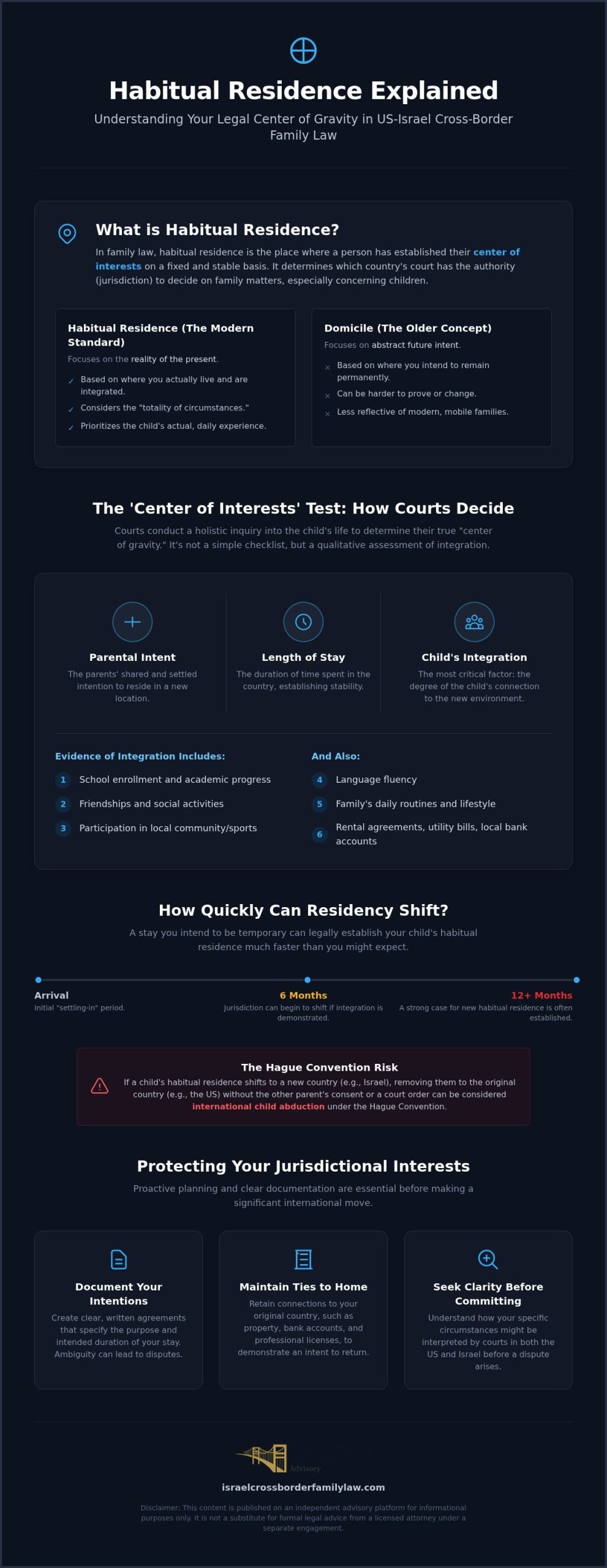
Understanding where your legal life is rooted is essential for international families. In family law, Habitual residence is defined as the place where a person has established their center of interests on a fixed and stable basis. It isn’t just about where you own property or hold a passport; it’s about where the core of your daily life exists. This concept is the primary factor that determines which court has the power, or jurisdiction, to hear your case. Having Habitual Residence Explained clearly helps you avoid the risk of fighting a legal battle in an unfavorable court system.
While you might have multiple homes or residences across the globe, the law generally recognizes only one habitual residence for the purpose of jurisdictional authority. Modern legal frameworks have moved away from the older concept of domicile. While domicile often focuses on where a person intends to remain permanently or where they intend to die, habitual residence looks at where they actually live right now. This shift reflects our modern, mobile society. It prioritizes the stability of a person’s current environment over abstract future intentions.
To better understand how this concept functions in real world scenarios, watch this helpful video:
The Role of the Hague Convention
The 1980 Hague Convention relies on this concept as its north star to resolve cases of international child abduction. When a parent moves a child across borders without consent, the court must first determine the child’s habitual residence. If a child is taken from that location, it’s defined as a wrongful removal. This treaty ensures that custody disputes are decided in the country where the child was most integrated before the dispute began. You can learn more about how this applies to Hague Convention child abduction cases on our advisory platform.
Intention vs. Physical Presence
Simply arriving in a new country doesn’t make it your habitual residence overnight. There’s typically a settling in period where a family integrates into the local community through school, work, and social ties. Legal standards, including the 2020 US Supreme Court ruling in Monasky v. Taglieri, suggest that courts look at the totality of circumstances. To change your legal residence, you must demonstrate animus, which is the clear and settled intent to remain in the new location for the foreseeable future. Establishing this intent requires more than just a plane ticket; it requires proof of a new life being built.
The ‘Center of Interests’ Test: How Courts Decide
When a court applies the determination of habitual residence, it conducts a holistic inquiry into the family’s life. This is often referred to as the “Center of Interests” test. It’s not a simple counting game of days spent in a country. Instead, judges look for the quality of the stay. They want to know where the family has truly put down roots. Even if you have been in a country for a relatively short time, you may establish residence if the evidence shows you have fully integrated into the local community.
To prove this center of gravity, families often submit rental agreements, utility bills, and evidence of local community involvement. These documents serve as a paper trail of integration. Having Habitual Residence Explained through these practical examples makes it clear that your daily habits define your legal status. If you are unsure how your current living situation might be interpreted in court, it’s wise to seek clarity on your specific circumstances before a dispute arises.
Primary Factors for Adults
For adults, the inquiry centers on professional and financial stability. Courts examine where your primary source of income is located and where you perform your daily work. Financial ties, such as the location of your primary bank accounts, tax filings, and real estate holdings, carry significant weight. Social ties also matter; being registered to vote or holding active memberships in local religious or civic organizations demonstrates a commitment to the new environment. Judges look for a settled purpose in your physical presence.
Primary Factors for Children
When children are involved, the court’s focus shifts to their daily integration and stability. Education is a primary factor; judges look at where the child is enrolled in school or daycare. Healthcare is another critical indicator, focusing on where the child receives regular checkups from doctors or therapists. Finally, the court assesses the child’s linguistic and cultural adaptation. Do they speak the local language? Do they participate in local traditions and have a stable circle of friends?
The June 2026 Eighth Circuit decision in Cohen v. Cohen confirms that a child’s actual experience often outweighs a parent’s original plan. In that case, a move intended to be temporary became a new habitual residence after two years because the child was stable in school and had local friends. This trend shows that the longer a stay lasts, the more the quality of that stay shifts from a visit to a legal home. Understanding these nuances is vital for any family moving between the US and Israel.
Habitual Residence vs. Domicile and Nationality
Many international families confuse their legal status with the passport they carry. You can be a US citizen, domiciled in New York, yet habitually resident in Tel Aviv. Nationality identifies who you are, but habitual residence determines where you legally live for family law purposes. This distinction is vital because a court’s jurisdiction relies on your actual center of gravity, not your citizenship. When two countries claim you as a resident, you enter a state of legal limbo that can complicate custody or divorce proceedings significantly. Having Habitual Residence Explained in the context of these other legal terms helps you build a more secure cross-border strategy.
Domicile represents a deeper legal tie than residence. It involves the intent to remain in a place permanently or to return there eventually. While you can change your residence relatively quickly by moving and integrating, changing your domicile often requires a more profound shift in your long term plans. In the US-Israel nexus, courts are increasingly adept at peeling back these layers to find where a family’s life is truly centered. They won’t simply accept a passport as proof of a legal home.
The Limits of Citizenship
Carrying an Israeli or US passport doesn’t automatically grant jurisdiction to that country’s courts. In cross-border disputes, judges apply the “closest connection” principle to see which legal system is best suited to handle the case. This is especially true for families with dual citizenship. The cooperation between the U.S. and Israel in family law cases often focuses on these factual ties rather than just the color of a travel document. Understanding these boundaries ensures you don’t rely on a passport as a shield when it may not provide the protection you expect.
Why Domicile Still Matters for Wills and Estates
While family law focuses on where you live, inheritance law often looks at your domicile. This creates a functional split in your legal identity. It’s possible for habitual residence to govern your divorce or custody arrangements while your domicile still dictates how your assets are distributed after death. This separation of legal concepts creates a complex environment for those with assets in both countries. If you’re managing property across borders, reviewing resources on dual country wills us israel can help you align your estate planning with your current residency. Clarity in one area of law doesn’t always guarantee clarity in another.
Cross-Border Challenges: The US-Israel Nexus
Navigating the legal bridge between the United States and Israel requires an understanding of how two distinct systems view your home. While US courts often look at the totality of circumstances under state laws like the UCCJEA, Israeli authorities apply the “Center of Life” (Merkaz HaChayim) test. This creates a complex jurisdictional landscape where your legal status can shift without you realizing it. Having Habitual Residence Explained specifically for this nexus is critical because a move you consider temporary can quickly become a permanent legal reality in the eyes of a judge.
Many families fall into what we call the “Trial Period Trap.” They move to Israel for a sabbatical or a year abroad, keeping their US home and bank accounts “just in case.” However, if the children are enrolled in Israeli schools and the family integrates into a local community, Israeli courts may claim jurisdiction. Research indicates that a stay in Israel can legally shift a child’s habitual residence in as little as six to twelve months. If you’re planning a move or find yourself in a dispute, it’s vital to consult with an advisor to map out your jurisdictional risks before the clock runs out.
The choice of court in Israel, whether it is the Family Court or the Rabbinical Court, also depends heavily on residency. Your center of life affects not just custody, but which legal framework will govern your divorce. This “race to the court” is a unique feature of the Israeli system that US expats must understand to protect their interests.
Moving Between the US and Israel
Families in cities with high Anglo populations, such as Jerusalem, Tel Aviv, or Ra’anana, often maintain deep ties to the US. You might believe that keeping a property in New York or New Jersey protects your US residency. In reality, if your daily life is centered in Israel, the “Merkaz HaChayim” test will likely favor Israeli jurisdiction. Early decisions about school enrollment and local health fund registrations carry immense weight in these determinations. You should seek clarity on how these choices define your legal home before making a commitment.
The Hague Convention in Israel
Israeli courts are strictly bound by the Hague Convention and have recently updated their procedures. As of August 2026, Israeli law mandates that an initial hearing in a Hague case must occur within 15 days of a petition being filed. This accelerated timeline makes it essential to have clear, written agreements, such as travel consents, before crossing borders. Without these documents, a move could be viewed as a wrongful removal under the Hague Convention and child abduction rules. Protecting your family requires documenting your intent clearly and early.
Strategic Planning: Protecting Your Jurisdictional Interests
Proactive planning is the most effective way to manage the risks inherent in a multi-jurisdictional lifestyle. As we have examined, your center of life can shift based on daily habits and integration, often faster than parents anticipate. Having Habitual Residence Explained through the lens of strategy means recognizing that your first actions in a new country define your legal status. Courts look for a settled purpose; therefore, the way you structure your move determines which legal system will eventually govern your family’s future.
Documenting your intent is a critical component of this strategy. If a move is intended to be temporary, such as a one year sabbatical, your records should reflect that clearly. This includes maintaining your primary US residence, keeping active voter registrations, and ensuring that employment contracts specify a return date. Conversely, if you are moving permanently, your actions should demonstrate a full integration into Israeli society. Without clear evidence, a judge must rely on the child’s actual experience, which often creates a result neither parent originally intended.
Prenuptial and postnuptial agreements also serve as powerful tools for defining jurisdiction. These documents can specify which court system should handle disputes, providing a layer of predictability in an otherwise complex environment. While these agreements must meet specific legal standards in both the US and Israel to be enforceable, they offer a starting point for families seeking to avoid a jurisdictional battle. Seeking clarity before a conflict arises is always the best way to manage risk.
Actionable Steps for Expats
- Maintain clear records: Keep copies of all emails, contracts, and letters that discuss the intended duration of your stay.
- Monitor ‘Center of Life’ markers: Be mindful of how school registrations, health insurance choices, and local memberships might be viewed by a court.
- Consult early: Speak with a cross-border professional before making a significant international move to understand the specific risks to your status.
Getting Clarity Before You Commit
Every family’s situation is unique, and the interaction between US state laws and Israeli regulations requires a nuanced approach. Taking the time to request a Confidential Case Review can help you identify potential pitfalls before they become legal crises. This proactive step ensures that you make decisions based on strategy rather than anxiety.
Disclaimer: This content is published on an independent advisory platform and is intended for informational and educational purposes only. It does not constitute legal representation or a formal attorney-client relationship. Legal services are only provided by licensed attorneys under a separate, formal engagement.
Get clarity before you commit. Request a confidential consultation.
Securing Your Family’s Legal Future Across Borders
Managing a life between the United States and Israel requires a strategic understanding of where your legal center of gravity truly lies. As we have examined, habitual residence isn’t defined by your citizenship but by the factual integration of your daily life. Early decisions regarding school enrollment or healthcare registrations carry significant legal weight; they can shift your jurisdiction in as little as six months. Having Habitual Residence Explained in this context empowers you to make informed decisions that protect your rights in both legal systems.
The inherent complexity of cross-border family law demands a proactive approach focused on risk mitigation. By documenting your intent and seeking professional guidance before making a move, you can avoid the anxiety of jurisdictional battles or Hague Convention disputes. Our advisory platform provides the specialized expertise necessary to navigate these multifaceted challenges with a calm, strategy-first perspective. You don’t have to face these transitions without a clear map of the legal landscape.
Get clarity before you commit. Request a confidential consultation to discuss your family’s unique situation. You can move forward with the confidence that your interests are protected across every border.
Frequently Asked Questions
Can a child have two habitual residences at the same time?
No, a child cannot legally have two habitual residences simultaneously for jurisdictional purposes. While a child may spend significant time in both the US and Israel, the court seeks a single center of gravity to determine which legal system has authority. This prevents conflicting orders from different countries. Judges examine where the child is most integrated through school, friends, and daily routines to identify this one legal home.
How long do I have to live in Israel before it becomes my habitual residence?
There is no rigid timeline, but a stay in Israel can shift residency in as little as six to twelve months. Legal integration depends on factors like school enrollment and local health fund registration rather than a specific day count. Having Habitual Residence Explained in this context highlights that the quality of the stay matters more than the duration. A move intended to be temporary can become legally permanent if the child settles in.
Does my US green card or citizenship determine my habitual residence?
No, your US green card or citizenship does not determine your habitual residence. Immigration status and travel documents identify your nationality, but family law courts focus on where you actually live and work. It’s common for a US citizen to be habitually resident in Israel for custody purposes. Courts prioritize your physical presence and social ties over the color of your passport or your permanent residency status in another country.
What happens if my spouse and I disagree on where our habitual residence is?
When spouses disagree, the court conducts a holistic inquiry into the family’s daily life to make a determination. Judges look at the totality of the circumstances to see where the children are most stable and integrated. This often involves reviewing rental agreements, utility bills, and school records. If you find yourself in this situation, it’s vital to have your Habitual Residence Explained by a professional to understand how a judge might weigh your specific facts.
Can I change my habitual residence just by moving to a new country for a few weeks?
No, a move of only a few weeks is generally insufficient to establish a new habitual residence. You must demonstrate a settled purpose and a degree of permanence in the new location. A short vacation or a brief work assignment doesn’t create the social and personal integration required by law. Courts look for evidence that you have truly moved your life’s center, not just changed your scenery for a short period.
How does habitual residence affect child support enforcement between the US and Israel?
Jurisdiction over child support typically follows the child’s habitual residence. If a child is integrated into life in Israel, the Israeli Family Court or Rabbinical Court will usually have the authority to establish or modify support orders. While the US and Israel cooperate on enforcement through international agreements, the primary residence of the child determines which country’s laws and cost of living standards will be used to calculate the support amounts.
Is habitual residence the same thing as tax residency?
No, habitual residence is a distinct concept from tax residency. Tax laws often rely on rigid day-counting rules or fiscal ties to determine where you owe money. Family law residency is more fluid and focuses on social, cultural, and personal integration. You might be a tax resident of the US due to your citizenship or income, while being habitually resident in Israel for the purposes of a custody or divorce case.
What should I do if I am worried my spouse will claim a change in our habitual residence?
You should immediately document your intent and maintain your ties to your original home. Keep records of return flight bookings, temporary school enrollment letters, and emails discussing the move’s short term nature. It’s also helpful to keep your primary US bank accounts and voter registrations active. If you feel a jurisdictional shift is happening without your consent, you should seek an advisory review of your strategy to protect your legal standing.

Article by
Gabriel Lior
A Personal Journey That Became a Mission
The advisory was founded by an American father Gabriel Lior, LLB, MBA , global entrepreneur, and cross-border advisor who spent more than a decade navigating the Israeli family court system firsthand and now lives in Singapore with his son.
As a divorced parent in a cross-border family, Gabriel faced nearly every legal challenge a foreign parent can encounter in Israel — including child custody disputes, child support proceedings, property matters in Israel and abroad, false accusations, and complex immigration and relocation proceedings.
Over the years, he learned the hard way how difficult it is for non-Israeli parents to understand the system, identify the right legal strategy, and choose the right legal representation — especially when language, culture, and jurisdictional differences are involved. He also witnessed how foreign parents and new immigrants are often disadvantaged or taken advantage of by service providers and institutions simply because they lack local knowledge or fluency.
From Client to Advisor
To truly understand — and survive — the system, Gabriel pursued formal legal education in Israel, completing two Israeli law degrees, alongside a BA and MBA earned in the United States. This was never about becoming a practicing attorney, but about gaining a deep, structural understanding of how the system works — and where it breaks down for foreign parents.
This rare combination of:
Firsthand client experience
Israeli legal and US business education
International business and negotiation training
Decades of commercial execution
created a unique perspective – one that understands both sides of the table.
After years of litigation, persistence, and at times self-representation, he ultimately succeeded in securing custody of his son and relocating abroad through a rare legal victory in the Israeli Supreme Court — becoming one of the first fathers in Israel to do so under these circumstances.
Disclaimer
Important Disclaimer:
The information provided on this website and in its content is for general informational and educational purposes only and does not constitute legal advice, legal opinion, or legal representation.
Gabriel Lior is not licensed to practice law in Israel (nor is he interested in doing so) and does not provide legal services, despite having completed 2 Law Degrees. The services offered are advisory in nature and are intended to provide general guidance, strategic insight, and information regarding cross-border family law considerations.
No attorney-client relationship is formed by accessing this website, reading its content, or communicating with us.
Any decisions made based on this information are at your own discretion and risk. For legal advice specific to your situation, you should consult a licensed attorney in the relevant jurisdiction.
Where appropriate, we may refer clients to independent, licensed attorneys or professionals. Such referrals do not constitute legal representation and no liability is assumed for services provided by third parties.