
This article is published on an independent advisory platform (not a law firm) and must not imply an attorney-client relationship.
A prenuptial agreement drafted for a New York wedding might be little more than a piece of paper once you land at Ben Gurion Airport. If you’re planning a life between two countries, you likely realize that standard contracts don’t always cross borders effectively. Securing a prenuptial agreement for international marriage isn’t just about preparing for a worst-case scenario. It’s about creating a strategic roadmap that protects your pre-marital assets and inherited wealth across different legal cultures. You probably feel that your financial future shouldn’t be left to the whims of a foreign court system you don’t yet understand.
It’s a common concern for international families who fear that unknown foreign laws might split assets unfairly. In this guide, you’ll learn how to navigate the complexities of US and Israeli jurisdictions to ensure your agreement is enforceable in both NYC and Israel. We’ll preview the essential requirements for judicial validation, the role of the 1973 Spouses’ Property Relations Law, and how to maintain predictability if you relocate. For more insights, you can view our resources at https://www.youtube.com/@IsraelFamilyLaw. Get clarity before you commit. Request a confidential consultation.
This article is published on an independent advisory platform (not a law firm) and does not imply an attorney-client relationship.
Key Takeaways
- Understand the “race to jurisdiction” and how the timing of filing in the US or Israel can determine your financial outcome.
- Learn the validation steps required to ensure a prenuptial agreement for international marriage is recognized as a binding Heskem Mamon in Israeli courts.
- Identify how to safeguard complex assets like tech exits, stock options, and inheritances using cross-border legal definitions.
- Explore the role of the Rabbinical Court and how to draft agreements that maintain clarity across both civil and religious systems.
- Discover why relocation clauses and independent counsel in both jurisdictions are vital for a document that remains enforceable after a move.
Why International Marriages Require a Cross-Border Prenuptial Strategy
This article is published on an independent advisory platform (not a law firm) and does not imply an attorney-client relationship.
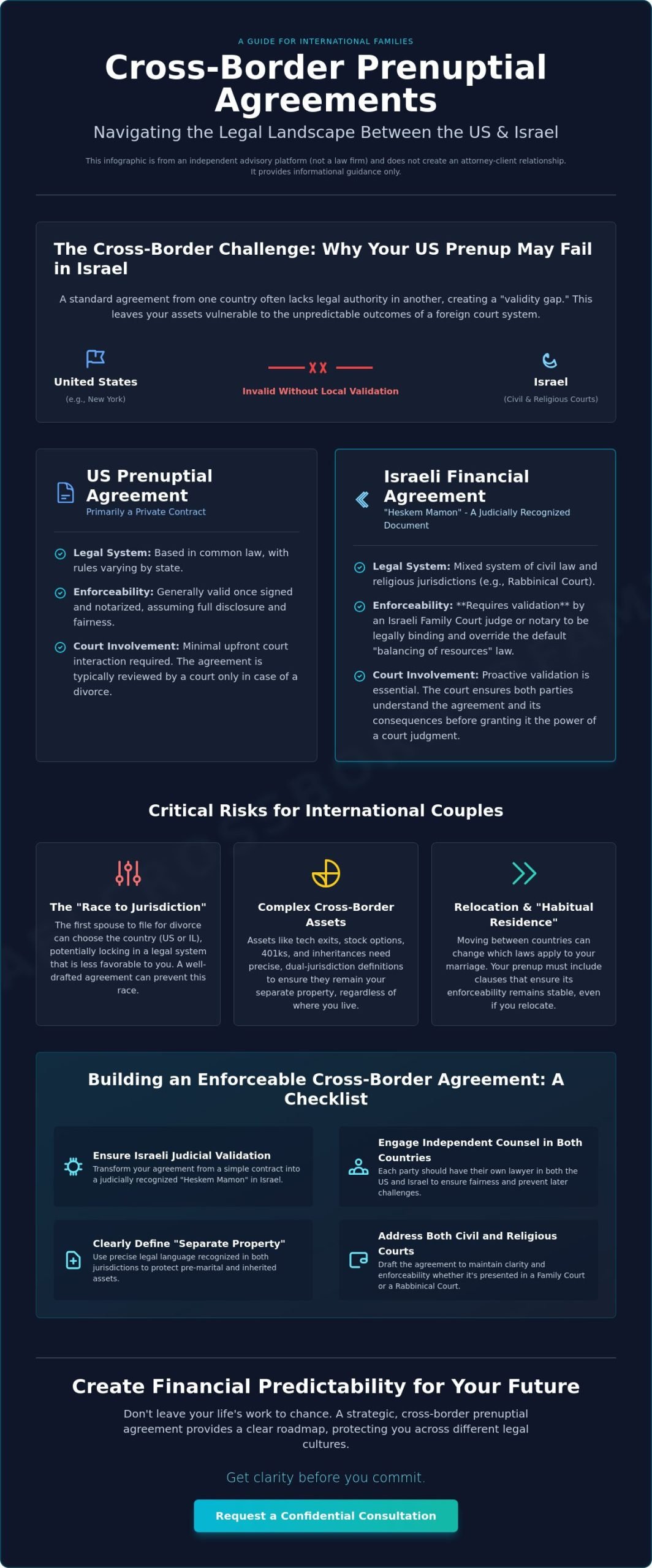
Entering a marriage that spans continents introduces legal variables that most couples don’t consider until it’s too late. A standard prenuptial agreement often fails to account for the “race to jurisdiction.” This is a legal reality where the first person to file for divorce in either the US or IL can effectively choose which legal system governs the split. In a US-Israel context, this choice can lead to drastically different outcomes regarding asset division and support. If you don’t define your terms early, you’re essentially letting two different court systems compete over your future.
To better understand the psychology and long-term benefits of these contracts, watch this helpful video:
The international dimension of your life means your wealth is likely split between regions. You might manage a tech startup in Tel Aviv while maintaining a 401k or real estate in New York. A prenuptial agreement for international marriage must address these specific assets to prevent them from being trapped in legal limbo. Over time, your “habitual residence” might shift from one country to another. This shift changes which laws apply to your marriage, making it essential to have a document that travels with you and remains enforceable regardless of where you call home.
The Complexity of Dual Legal Systems
US legal systems are rooted in common law, but Israel uses a mixed system that includes civil law and religious jurisdictions. A generic template from the internet won’t account for the specific validation requirements of the Israeli Family Court. Relying on a one-size-fits-all document is a significant risk for expats. You must understand how international treaties and local laws interact to ensure your property division remains predictable.
Identifying Your Cross-Border Risk Profile
Your risk profile depends on your assets and your domicile status. Whether you hold startup equity in IL or pre-marital savings in the US, each asset requires specific wording to remain “separate property.” Your citizenship also influences how courts perceive your permanent home. Seeking clarity through strategic planning is the only way to avoid the confusion of conflicting legal cultures. For more on these early strategic decisions, explore the resources at Israel Family Law. Get clarity before you commit. Request a confidential consultation.
This article is published on an independent advisory platform (not a law firm) and does not imply an attorney-client relationship.
Understanding the Financial Agreement (Heskem Mamon) in Israel vs. US Prenups
In the United States, a prenuptial agreement is generally treated as a contract between two private parties. While states have different rules about disclosure and fairness, the document is typically enforceable once signed and notarized. Israel operates under a different legal philosophy. The Spouses’ Property Relations Law of 1973 governs how assets are handled. It establishes a default regime known as “balancing of resources.” This means that without a specific agreement, all assets acquired during the marriage are split equally upon divorce or death. To override this default, you need a prenuptial agreement for international marriage that is locally recognized as a Heskem Mamon.
The “validity gap” is a common trap for international couples. You might have a perfectly drafted agreement from a top-tier firm in New York, but an Israeli court may view it as non-binding if it hasn’t been validated according to IL law. For a Heskem Mamon to be enforceable, it must be approved by a judge or a specific government official. This step is not a mere formality. It’s a legal requirement to ensure that both parties are entering the contract with full awareness of their rights. You should request a confidential consultation to determine if your existing documents meet these specific criteria.
The Court Approval Process in Israel
The validation process involves a hearing before the Family Court or the Rabbinical Court. During this session, the judge will speak with both spouses to verify “informed consent.” They’ll ask if you’ve read the agreement, if you understand its consequences, and if you’re signing it of your own free will. While a notary can sometimes approve an agreement before the wedding, any financial contract signed after the marriage must be approved by the court to be valid. This judicial oversight protects the integrity of the prenuptial agreement for international marriage and makes it much harder to challenge later.
US Enforceability of Israeli Agreements
If you eventually move back to the US, your Israeli agreement will likely be evaluated under the principle of “comity.” This is a legal doctrine where courts in one jurisdiction respect the laws and judicial decisions of another. However, US courts, particularly in states like New York, may refuse to enforce a foreign agreement if it violates local public policy. To avoid this risk, many experts recommend a “mirroring” approach for Cross-Border Prenuptial Agreements. By drafting the document to satisfy both the rigorous IL validation process and US disclosure standards, you ensure the agreement remains a powerful tool for asset protection in both countries.
This article is published on an independent advisory platform (not a law firm) and does not imply an attorney-client relationship.
Navigating Jurisdiction: How US and Israeli Courts View Foreign Agreements
When a marriage spans two countries, the question isn’t just what your agreement says, but which court will listen to it. The “Race to the Court” is a strategic reality in international law. If one spouse files for divorce in a US state like New York and the other files in Israel, the courts must determine which jurisdiction has the authority to divide assets. This decision can change the financial outcome of a split significantly. A prenuptial agreement for international marriage acts as a jurisdictional anchor, helping to prevent a scenario where two different legal systems struggle for control. You can explore more about these hurdles in our guide on divorce for international families.
Sometimes, a court may decide it isn’t the right place to hear a case. This is known as “Forum Non Conveniens.” A US judge might refuse to hear a property dispute if the couple has lived in Tel Aviv for a decade, arguing that Israeli courts are better suited to handle the matter. Conversely, Israeli courts may defer to a US jurisdiction if the majority of assets are located there. Without a clear governing law clause in your agreement, you risk spending years in expensive litigation just to decide where your case should be heard. Get clarity before you commit. Request a confidential consultation.
The Role of the Rabbinical Courts (Bet Din)
In Israel, matters of marriage and divorce for Jewish citizens fall under the exclusive jurisdiction of the Rabbinical Court. Even if you have a civil ceremony abroad, the religious court is the only body that can grant a “Get,” the Jewish writ of divorce. This creates a unique challenge for a prenuptial agreement for international marriage. While a civil Family Court handles property, the Rabbinical Court may have a different view on what constitutes “separate property.” It’s vital that your agreement includes provisions to ensure the religious divorce process doesn’t become a tool for financial leverage.
The US Perspective on International Nuptial Agreements
US courts generally respect foreign agreements, but they apply a “fairness” test. Many states follow the Uniform Premarital Agreement Act (UPAA), which looks at whether there was full financial disclosure and if both parties had independent legal advice. If an Israeli agreement appears too one-sided or was signed under pressure, a US judge might set it aside. To avoid this, your document should explicitly state which country’s laws govern the contract. A single, well-drafted sentence choosing the “Governing Law” can prevent future disputes and ensure your assets remain protected regardless of where you eventually live.
This article is published on an independent advisory platform (not a law firm) and does not imply an attorney-client relationship.
Key Provisions for Protecting Assets in a Cross-Border Context
A robust prenuptial agreement for international marriage must do more than list current bank accounts. It needs to define “Separate Property” with precision to ensure that inheritances, family gifts, and pre-marital savings remain outside the communal pot. In Israel, the default legal position is to balance all resources acquired during the marriage. If you receive a significant inheritance while living in Tel Aviv, without clear wording, that asset could eventually be subject to claims by a spouse. Clarity on these points today prevents legal ambiguity years down the line.
Future assets often present the greatest risk for international families. You might be working on intellectual property or hold stock options that won’t vest for several years. A strategic agreement addresses these contingencies, including potential tech exits or shifting business valuations. You should also consider the inclusion of a “Sunset Clause.” This provision allows the agreement to expire after a set period, such as 15 or 20 years. It’s a way to acknowledge that a long-term marriage might require a different financial arrangement than a newly formed one.
Spousal support is another area where US and Israeli systems diverge significantly. In many US states, “maintenance” is calculated based on the length of the marriage and the disparity in income. In Israel, “Mezonot” for a spouse can be influenced by religious law or specific civil statutes. Your prenuptial agreement for international marriage should clarify which standards apply. This prevents a situation where a court imposes a support obligation that neither party intended or understood when they married.
Protecting Business Interests and Startups
For founders in the Israeli tech ecosystem, protecting a startup is often a primary concern. You need to ring-fence your “sweat equity” to ensure that the growth in value of your company isn’t automatically shared. This is especially important for expats and foreign nationals who may have business interests spanning multiple countries. Defining how business valuations are handled today can prevent a costly battle over future exits or funding rounds.
Real Estate and the “Family Home” Trap
The “matrimonial home” often carries a unique status in both IL and US law. Courts frequently view the family residence differently than a standard investment property. Even if you owned the home before the wedding, using communal funds to pay the mortgage or for renovations can create “equity” for the other spouse. It’s essential to document who is responsible for these costs and how those contributions affect ownership. If you have questions about specific property holdings, you should contact us for a confidential review of your situation. Get clarity before you commit. Request a confidential consultation.
This article is published on an independent advisory platform (not a law firm) and does not imply an attorney-client relationship.
Strategic Planning: Drafting an Agreement That Travels With You
A primary risk for international couples is the assumption that their lives will remain static in one country. In reality, careers and family needs often lead to relocation between Tel Aviv and New York or other global hubs. A prenuptial agreement for international marriage must include a robust “Relocation Clause.” This provision anticipates future moves and specifies which country’s laws will govern your assets if you change your habitual residence. Without this foresight, a move can inadvertently expose your assets to a legal system you never intended to use. It’s about building mobility into your financial security.
Choosing Your Legal Strategy
Successful international planning often utilizes a “Bridge” approach. This strategy involves drafting a document that satisfies the strictest requirements of both the US and IL systems simultaneously. For example, the agreement should meet the high financial disclosure standards of the US while also undergoing the formal judicial validation required in Israel. Using plain English explanations within the document is also vital. It provides clear evidence to a judge that you understood the specific risks and waived certain rights voluntarily. When starting this conversation with your partner, focus on strategy and risk management. It’s a constructive way to build a foundation of transparency before the wedding.
Next Steps for International Couples
The first practical step is gathering a comprehensive list of your global assets. This include real estate, retirement accounts, and business interests in both countries. Complete transparency is the best defense against future claims of non-disclosure. Timing is equally critical. You should never sign a prenuptial agreement for international marriage the week before your wedding. Courts often view last-minute signings as a sign of duress, which can jeopardize the entire document. Give yourselves months, not days, to finalize the details. Get clarity before you commit. Request a confidential consultation.
This article is published on an independent advisory platform (not a law firm) and does not imply an attorney-client relationship.
Securing Your Future Across Borders
Building a life between the United States and Israel requires more than just shared goals; it demands a legal foundation that respects both systems. A prenuptial agreement for international marriage is your most effective tool for preventing the “validity gap” that often leaves foreign contracts unenforceable in Israeli courts. By prioritizing formal validation as a Heskem Mamon and including strategic relocation clauses, you ensure that your assets remain protected regardless of where your career or family life leads you next. Predictability is the greatest asset you can bring to a cross-border union.
Our advisory brings a dual-qualified perspective to these complex matters, drawing on decades of cross-border US-Israel family law experience. We maintain a specialized focus on the unique needs of the Anglo and expat communities, helping you navigate the significant differences between religious and civil jurisdictions with confidence. Strategy and risk-based decision-making are the keys to long-term legal clarity. Get clarity before you commit. Request a confidential consultation.
Taking these steps today allows you to focus on your new beginning with the peace of mind that your financial interests are soundly documented.
This article is published on an independent advisory platform (not a law firm) and does not imply an attorney-client relationship.
Frequently Asked Questions
Is a US prenuptial agreement enforceable in Israel?
A US agreement isn’t automatically valid in Israel. To be enforceable, it must be validated by an Israeli court or a notary to meet the standards of a Heskem Mamon. Without this formal approval process, an Israeli judge may choose to ignore the US document and apply default Israeli property laws instead. It’s vital to ensure your document is recognized by the local legal system if you plan to reside in IL.
What is the difference between a prenup and a Heskem Mamon?
A “prenup” is a general English term, while a Heskem Mamon is a specific legal document governed by Israel’s 1973 Spouses’ Property Relations Law. The primary difference is the requirement for judicial or official validation. In Israel, a judge or notary must verify that both spouses understand the consequences of the agreement before it becomes a binding legal contract. This adds a layer of protection that standard US contracts often lack.
Do we need two separate lawyers for an international prenup?
Yes, seeking independent counsel in both jurisdictions is a standard best practice for a prenuptial agreement for international marriage. This ensures that the document satisfies the specific legal requirements of both the US state and Israel. Having dual representation also prevents a spouse from later claiming they didn’t understand the risks or lacked proper guidance, which is a common reason courts set agreements aside.
Can a prenuptial agreement prevent the Rabbinical Court from taking jurisdiction?
An agreement can’t stop the Rabbinical Court from handling the actual divorce decree, or “Get,” but it can limit their authority over property division. By clearly defining asset distribution and choosing a civil jurisdiction for financial matters, you create a stronger legal shield. It’s essential to draft these clauses carefully to ensure the religious court respects the financial terms you’ve already established in your civil agreement.
What happens to our international assets if we don’t have a prenup?
Without an agreement, Israel’s default “balancing of resources” rule typically applies to all assets acquired during the marriage. This means your global savings, property, and even business interests could be split 50/50 upon divorce. This rule applies even if the assets are located in the US or held in only one spouse’s name. A prenuptial agreement for international marriage is the only way to override this default regime.
Can we sign a postnuptial agreement if we are already married and moving to Israel?
You can sign a postnuptial agreement at any time after the wedding. However, in Israel, a post-marital financial agreement must be approved by the Family Court or the Rabbinical Court to be legally binding. Unlike a pre-wedding agreement, a notary’s signature isn’t sufficient for couples who are already married. This judicial review ensures the agreement is fair and that both parties are signing it voluntarily.
How much does an international prenuptial agreement cost?
The total investment varies significantly based on the complexity of your global assets and the number of jurisdictions involved. Factors like tech startup equity, intellectual property, and multi-state real estate holdings will influence the time required for drafting and validation. You should consult with practitioners in both countries to understand the typical rates for their specific professional environments. Get clarity before you commit. Request a confidential consultation.
Does a prenup affect child support or custody in a cross-border divorce?
Prenuptial agreements generally don’t bind a court’s decision regarding child support or custody. In both the US and Israel, judges prioritize the “best interests of the child” above any private contract. While you can include your intentions in the document, a court will always perform its own review based on the family’s circumstances at the time of the separation. These agreements are primarily designed for property and asset protection.

Article by
Gabriel Lior
A Personal Journey That Became a Mission
The advisory was founded by an American father Gabriel Lior, LLB, MBA , global entrepreneur, and cross-border advisor who spent more than a decade navigating the Israeli family court system firsthand and now lives in Singapore with his son.
As a divorced parent in a cross-border family, Gabriel faced nearly every legal challenge a foreign parent can encounter in Israel — including child custody disputes, child support proceedings, property matters in Israel and abroad, false accusations, and complex immigration and relocation proceedings.
Over the years, he learned the hard way how difficult it is for non-Israeli parents to understand the system, identify the right legal strategy, and choose the right legal representation — especially when language, culture, and jurisdictional differences are involved. He also witnessed how foreign parents and new immigrants are often disadvantaged or taken advantage of by service providers and institutions simply because they lack local knowledge or fluency.
From Client to Advisor
To truly understand — and survive — the system, Gabriel pursued formal legal education in Israel, completing two Israeli law degrees, alongside a BA and MBA earned in the United States. This was never about becoming a practicing attorney, but about gaining a deep, structural understanding of how the system works — and where it breaks down for foreign parents.
This rare combination of:
Firsthand client experience
Israeli legal and US business education
International business and negotiation training
Decades of commercial execution
created a unique perspective – one that understands both sides of the table.
After years of litigation, persistence, and at times self-representation, he ultimately succeeded in securing custody of his son and relocating abroad through a rare legal victory in the Israeli Supreme Court — becoming one of the first fathers in Israel to do so under these circumstances.
Disclaimer
Important Disclaimer:
The information provided on this website and in its content is for general informational and educational purposes only and does not constitute legal advice, legal opinion, or legal representation.
Gabriel Lior is not licensed to practice law in Israel (nor is he interested in doing so) and does not provide legal services, despite having completed 2 Law Degrees. The services offered are advisory in nature and are intended to provide general guidance, strategic insight, and information regarding cross-border family law considerations.
No attorney-client relationship is formed by accessing this website, reading its content, or communicating with us.
Any decisions made based on this information are at your own discretion and risk. For legal advice specific to your situation, you should consult a licensed attorney in the relevant jurisdiction.
Where appropriate, we may refer clients to independent, licensed attorneys or professionals. Such referrals do not constitute legal representation and no liability is assumed for services provided by third parties.
Related Insights & Resources

Enforcing Foreign Divorce Decrees in Israel: A Guide
This content is published on an independent advisory platform, not a law firm, and focuses...Read More →
Que Cherche un Évaluateur de Garde d’Enfants ? Un Guide pour les Familles Américano-Israéliennes
Une simple incompréhension culturelle ou une réaction mal interprétée lors d'une visite à domicile pourrait-elle...Read More →
Reut Sade Law Office: Trusted IL Family & Divorce Counsel
Nearly 40% of Jewish marriages in Israel end in divorce, yet many international families don't...Read More →