Imagine the moment you realize your child has been taken across international borders to Israel without your permission. The fear is immediate, and the pressure to file Emergency Hague Convention Applications can feel crushing as you try to grasp how two different legal systems interact. At Israel Cross Border Law Firm, we understand you’re likely feeling that the clock is working against you; the window for effective action is often measured in days, not months.
This guide, presented by Israel Cross Border Law Firm, provides the clarity you need to manage these high-stakes filings with confidence. You’ll gain a strategic understanding of the legal steps required to navigate a parental abduction emergency between the US and Israel. We’ll examine the strict timelines of the Israeli Family Court, the specific evidence needed to prove habitual residence, and the methods for minimizing trauma during the return process. While this content offers crucial insights, it is intended for informational purposes and does not constitute formal legal advice or representation. For personalized legal assistance, please contact us directly.
Key Takeaways
- Learn why establishing “habitual residence” is the essential cornerstone of any successful return petition.
- Understand how to manage the critical first 48 hours when filing Emergency Hague Convention Applications so you don’t make common procedural errors.
- Differentiate between summary return proceedings and long-term custody disputes to identify the fastest path for your child’s safety.
- Prepare for the specific environment of Israeli Family Courts, where cases move quickly and require local strategic oversight.
- Discover how a coordinated legal strategy between US and Israeli teams can protect your rights and help secure a stable outcome.
What is an Emergency Hague Convention Application?
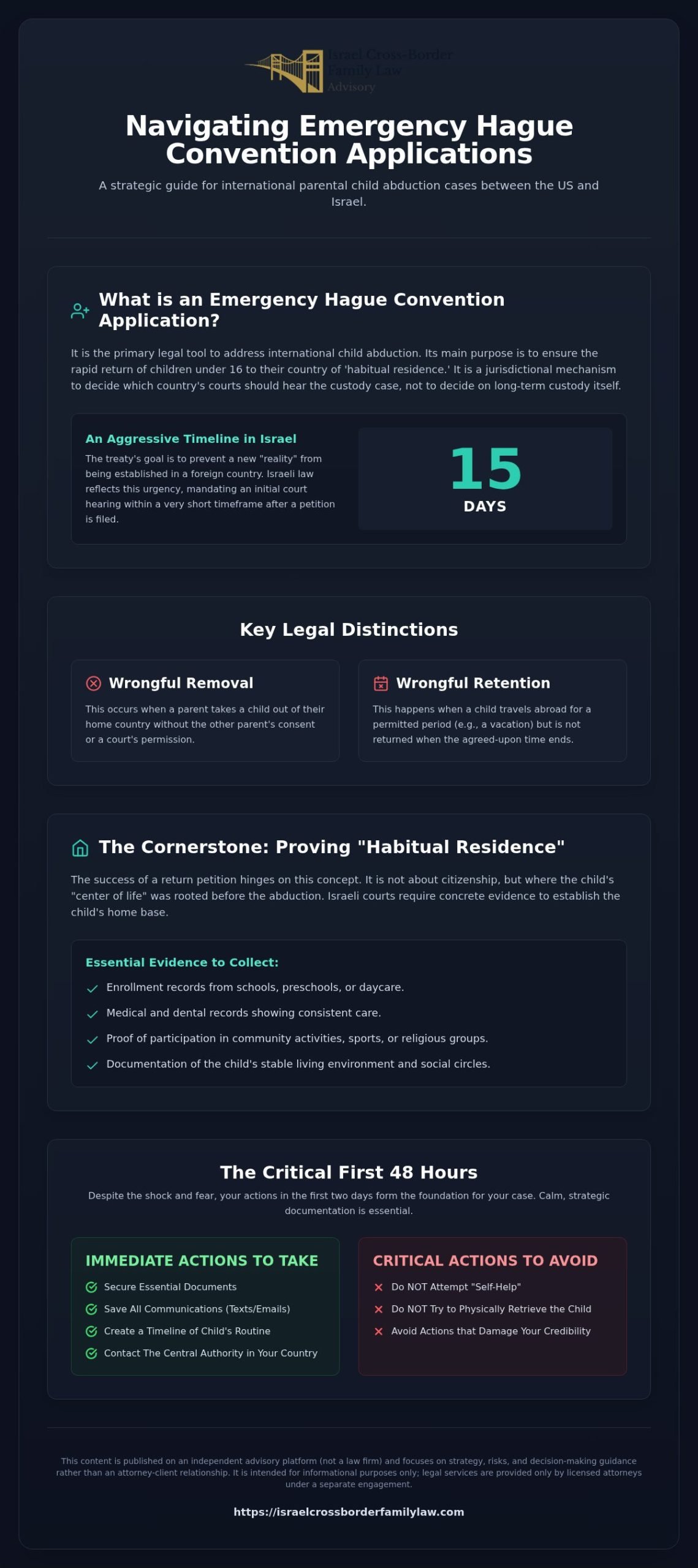
When a child is moved across international borders without the consent of both parents, the primary legal framework used to address the situation is the Hague Convention on the Civil Aspects of International Child Abduction. This international treaty is designed to return children under the age of 16 to their country of habitual residence as quickly as possible. For families caught in a cross-border crisis, filing Emergency Hague Convention Applications is the standard procedure to restore the status quo. It functions as a jurisdictional tool to decide which country’s courts should hear a custody case, rather than making a final determination on who the child should live with long-term.
In the specific context of the US and Israel, the treaty provides a fast-track legal mechanism to resolve where a child should live. Israeli law requires an initial court hearing to take place within 15 days of a petition being filed. This aggressive timeline reflects the treaty’s goal of preventing a parent from establishing a new “reality” in a foreign country through the passage of time. You can find a deeper breakdown of these procedural requirements in our guide on Hague Convention child abduction.
Wrongful Removal vs. Wrongful Retention
There’s a significant legal distinction between removal and retention that you must understand before filing in Israel. Wrongful removal occurs when a parent takes a child out of their home country without the other parent’s permission. Wrongful retention happens when a child travels to Israel for a permitted reason, like a family visit, but isn’t returned once the agreed period ends. Both actions trigger the Convention; however, the evidence required to prove the “wrongful” nature of the act differs. Your initial emergency filing must clearly document the lack of consent or the breach of the return agreement to meet the court’s standards.
The Role of Habitual Residence
The outcome of most return petitions depends on the child’s “habitual residence.” This isn’t just about where the child is a citizen; it’s about where their life was actually rooted before the dispute. For dual-citizenship families, this definition can become complex. Israeli Family Courts look at the “center of life” for the child, examining specific social and physical ties. To establish a US state as the habitual residence, you’ll need to provide concrete evidence such as:
- Enrollment records from schools, preschools, or local daycare centers.
- Medical and dental records showing consistent care in the home country.
- Proof of the child’s participation in community activities or religious groups.
- Documentation of the child’s stable living environment and primary social circles.
For more educational resources and strategic guidance on these topics, we recommend exploring the Israel Family Law YouTube channel. This content is published on an independent advisory platform (not a law firm) and focuses on strategy, risks, and decision-making guidance rather than an attorney-client relationship. It’s intended for informational purposes; legal services are only provided by licensed attorneys under a separate engagement.
Immediate Steps: The First 48 Hours of a Parental Abduction
The discovery that a child has been taken across international borders is a period of profound shock and fear. Despite the emotional toll, the actions you take in the first 48 hours will form the evidentiary foundation for your case. Immediate documentation is essential for successful Emergency Hague Convention Applications. It’s vital to avoid “self-help” measures, such as attempting to physically retrieve the child from Israel without a court order. These actions can damage your credibility and jeopardize your legal standing in both US and Israeli courts.
Securing Essential Documentation
Start organizing your records as soon as you suspect a wrongful removal or retention. You’ll need proof of the child’s life before the dispute began to establish their settled status. Collect birth certificates, passports, and any existing custody orders. Save all texts and emails regarding the child’s location or the other parent’s intentions. A timeline of their daily routine in their home country provides the court with needed context. This evidence allows your team to meet the fast-paced requirements of the Israeli legal system.
Engaging the Central Authority
Once you’ve secured your documentation, contact the Central Authority in your home jurisdiction. In the US, this is the Department of State; in Israel, it’s the Ministry of Justice. These agencies facilitate the Convention’s requirements and assist in locating the child. However, this administrative filing is only the first step toward a resolution. The final decision on the child’s return rests with the Israeli Family Court, making a coordinated legal strategy essential. If you’re feeling overwhelmed by these requirements, you can reach out for a confidential review to gain clarity on your next steps.
This content is published on an independent advisory platform and does not constitute a law firm or legal representation. Our focus is on strategy, risk management, and decision-making guidance. Legal services are only provided by licensed attorneys under a separate engagement.
Hague Convention vs. Local Custody: Choosing the Right Legal Path
One of the most frequent points of confusion for parents is the distinction between a custody battle and a Hague proceeding. A Hague application is a summary proceeding. Its primary objective is to determine if a child was wrongfully removed and should be returned to their country of habitual residence. It doesn’t decide long-term parenting schedules or legal custody rights. If you’re filing Emergency Hague Convention Applications, your focus is strictly on jurisdiction, ensuring that the proper court hears the case rather than arguing who is the better parent.
Strategic clarity at this stage is paramount. Filing a standard custody petition in Israel can inadvertently signal your acceptance of Israeli jurisdiction, effectively waiving your ability to seek a return under the Hague Convention. This move can trap your family in a multi-year dispute in a foreign court system that you didn’t choose. You must prioritize the Hague filing if your goal is to have the case heard in your home country. This choice represents a critical fork in the road for your legal strategy.
The Speed of Hague Proceedings
The treaty establishes a target of six weeks for a final decision, yet the reality in 2026 reflects a more complex landscape. While Israeli law mandates an initial hearing within 15 days of filing, cases in major jurisdictions like Tel Aviv and Jerusalem frequently extend beyond the six-week mark. It’s not uncommon for a final judgment to take over a year when the respondent presents a “grave risk” defense. These claims often necessitate extensive evidentiary reviews and expert testimony, which naturally slows the pace of the summary proceeding. Understanding these practical timelines helps you manage expectations and prepare for a potentially extended legal process.
Enforcement of Return Orders
Enforcement requires a proactive approach once a judge rules in your favor. When an Israeli court issues a return order, it usually includes a “Stay of Exit” order to secure the child’s presence within the country until travel is finalized. If the respondent fails to cooperate with the court’s timeline, the judge can authorize the Israeli police and social services to facilitate the child’s departure. This ensures the legal victory translates into a physical return to the US. You can learn more about international custody and relocation to understand how these enforcement mechanisms interact with your home country’s laws.
This content is published on an independent advisory platform and does not constitute a law firm or legal representation. Our focus is on strategy, risk management, and decision-making guidance. Legal services are only provided by licensed attorneys under a separate engagement.
How Israeli Courts Handle Emergency Abduction Cases
Israeli Family Courts maintain exclusive jurisdiction over these matters, often processing cases involving US expats with a high degree of specialization. Despite this expertise, all legal proceedings are conducted in Hebrew. For a parent based in the US, this creates an immediate need for English-speaking advisory to ensure their voice is accurately represented. Most central cases are heard in the Family Courts of Tel Aviv or Jerusalem, where judges are deeply familiar with the multi-jurisdictional complexities of the US-Israel legal bridge.
When presiding over Emergency Hague Convention Applications, the court doesn’t look for the “best” parent. Instead, the judge asks a narrow question: is there a legally valid reason to refuse the child’s return? The Israeli Supreme Court has consistently held that exceptions to the treaty should be interpreted narrowly. This means the burden of proof rests heavily on the parent who took the child, requiring them to meet a high evidentiary standard to justify the removal or retention.
The ‘Grave Risk’ Defense (Article 13b)
The most frequently cited exception is Article 13b, which addresses a “grave risk” that the child’s return would expose them to physical or psychological harm. Israeli judges require clear and convincing evidence to uphold this defense. While the court takes allegations of domestic violence seriously, it also examines whether the courts in the child’s home state are capable of providing protection. General unhappiness or a parent’s preference for the Israeli lifestyle won’t meet this threshold. You must be prepared to counter these defenses with documented facts that reflect the child’s actual environment in the US.
The Child’s Objection
In some instances, the court will consider the child’s own objection to being returned. There is no rigid age at which this becomes mandatory, but judges often begin to weigh these views more heavily as a child approaches 10 or 12 years of age. A court-appointed social worker, known as a Pakid Saad, is typically tasked with interviewing the child. Their role is to determine if the child is mature enough to form an independent opinion and whether they have been coached by the abducting parent. It’s a common misconception that a child’s preference is a veto; the court maintains the final authority to decide if that preference constitutes a valid legal objection under the treaty.
If you’re navigating this complex process, it’s essential to have a clear roadmap. You can request a confidential consultation to discuss the specific strategic considerations of your case. For more information on how these cases are structured, review our guide on Hague Convention child abduction.
This content is published on an independent advisory platform and does not constitute a law firm or legal representation. Our focus is on strategy, risk management, and decision-making guidance. Legal services are only provided by licensed attorneys under a separate engagement.
Strategic Decision-Making: Navigating Cross-Border Complexities
The decisions you make during the first week of a parental abduction crisis carry significant weight for your family’s future. While the primary objective of Emergency Hague Convention Applications is the immediate return of the child, the methods used to reach that goal shouldn’t undermine your long-term legal standing. A fragmented approach, where your US and Israeli legal teams operate in isolation, often leads to conflicting statements that a respondent can exploit. A unified strategy ensures that every filing in the Israeli Family Court aligns with your objectives back home.
Mediation remains a viable, though often overlooked, path even in high-conflict scenarios. Negotiating a voluntary return under the “shadow” of a Hague petition can provide a structured, less adversarial resolution. This approach allows parents to agree on travel arrangements and temporary visitation without the trauma of a police-enforced exit order. However, such negotiations should only occur alongside formal legal preparations to ensure your rights aren’t delayed or waived through inaction.
Managing the US-Israel Legal Bridge
Your existing US custody orders must be drafted with international enforcement in mind. If an order is vague about travel restrictions or habitual residence, it provides an opening for defenses in the Israeli court. Handling conflicting orders from different jurisdictions requires a nuanced understanding of both systems. A multi-qualified advisor who understands the cultural and legal nuances of both the US and Israel can act as a bridge, ensuring your documentation is robust and your strategy is cohesive across borders.
Next Steps for Parents
Taking the right first step is more important than simply taking a fast one. We encourage you to review our comprehensive Hague Convention Child Abduction resources to understand the procedural requirements in detail. You can also watch educational videos on the Israel Family Law YouTube channel for further guidance on navigating the Israeli legal landscape. Clarity before commitment is the key to protecting your child’s future.
Get clarity before you commit. Request a confidential consultation to gain the strategic oversight your family needs.
This content is published on an independent advisory platform and does not constitute a law firm or legal representation. Our focus is on strategy, risk management, and decision-making guidance. Legal services are only provided by licensed attorneys under a separate engagement.
Securing Your Child’s Future Through Strategic Clarity
Navigating the complex landscape of Emergency Hague Convention Applications requires more than just speed; it demands a deep understanding of the US-Israel legal bridge. By prioritizing immediate documentation and choosing a summary return proceeding over standard custody battles, you protect your jurisdictional rights and the stability of your child. Early decisions carry significant weight, and a unified strategy between international legal teams often determines the success of a return petition in the Israeli Family Court.
This independent advisory platform provides specialized US-Israel cross-border expertise designed to guide international families through these high-stakes disputes. We offer calm, strategic oversight focused on risk management and informed decision-making rather than formal legal representation. Clarity before you commit is the most effective tool you have in a parental abduction crisis. It’s important to remember that legal services are only provided by licensed attorneys under a separate engagement.
Get clarity before you commit. Request a confidential consultation to discuss your specific situation. You don’t have to navigate these multi-jurisdictional complexities alone; we’re here to help you find a steady path forward.
Frequently Asked Questions
How long does an emergency Hague Convention application take in Israel?
Israeli law requires an initial court hearing within 15 days of filing a petition. While the treaty targets a final decision within six weeks, the practical reality in 2026 is often much longer. Complex cases involving expert testimony can extend for over a year. The speed of Emergency Hague Convention Applications depends heavily on the specific defenses raised and the court’s current caseload in districts like Tel Aviv.
Can I file a Hague application if there is no existing custody order?
You don’t need a formal custody order to initiate a return request. The Convention protects “rights of custody” that exist by operation of law in the child’s country of habitual residence. If you were exercising care for the child before they were taken to Israel, those rights are typically sufficient. It’s often helpful to document your daily involvement in the child’s life to establish these rights for the court.
Do I need a lawyer in both the US and Israel for a Hague case?
Coordinating between legal teams in both jurisdictions is essential for a unified strategy. While the main litigation occurs in the Israeli Family Court, your US counsel ensures that home-state orders support the return process. A multi-qualified advisor can act as a bridge between these two systems. This prevents conflicting arguments that might jeopardize your standing in either country during the summary proceedings.
What is the ‘grave risk’ exception in Hague Convention cases?
The “grave risk” exception, found in Article 13b, allows a court to refuse a return if it would expose the child to intolerable harm. Israeli judges interpret this very narrowly, requiring clear and convincing evidence of danger. It’s not enough to show that one parent is better; the respondent must prove that the child’s safety is at immediate risk in the home country if returned.
Can my child choose to stay in Israel if they are over 12 years old?
A child’s preference isn’t an automatic veto, but Israeli courts weigh the views of older children more heavily. A court-appointed social worker interviews the child to assess their maturity and whether they’ve been influenced by the abducting parent. While a 12-year-old’s objection is significant, the judge still makes the final decision based on the treaty’s specific legal criteria rather than the child’s simple wish.
Is the Hague Convention applicable if the parents were never married?
Marital status doesn’t determine the applicability of the treaty. The focus remains on whether the left-behind parent held and was exercising “rights of custody” at the time of removal. In many US states and under Israeli law, unmarried parents often have these rights automatically or through a voluntary acknowledgment of paternity. Documentation of your active role as a parent is the key evidentiary requirement here.
What happens if the other parent hides the child in Israel?
If a parent hides a child, the Israeli Central Authority works with the police to locate them. Courts can issue immediate “Stay of Exit” orders to prevent the child from leaving Israel or being moved again. When filing Emergency Hague Convention Applications, these protective measures are often requested simultaneously to secure the child’s presence until the court can hear the merits of the return petition.
How much does a Hague Convention return application cost?
There are no court filing fees for these petitions in the Israeli Family Court system. However, parents should account for the costs of specialized legal counsel, translation of documents into Hebrew, and potential expert witness fees. These expenses vary based on the case’s complexity and the defenses raised. It’s best to discuss these logistical costs during a strategic consultation to understand the necessary financial commitment.

Article by
Gabriel Lior
A Personal Journey That Became a Mission
The advisory was founded by an American father Gabriel Lior, LLB, MBA , global entrepreneur, and cross-border advisor who spent more than a decade navigating the Israeli family court system firsthand and now lives in Singapore with his son.
As a divorced parent in a cross-border family, Gabriel faced nearly every legal challenge a foreign parent can encounter in Israel — including child custody disputes, child support proceedings, property matters in Israel and abroad, false accusations, and complex immigration and relocation proceedings.
Over the years, he learned the hard way how difficult it is for non-Israeli parents to understand the system, identify the right legal strategy, and choose the right legal representation — especially when language, culture, and jurisdictional differences are involved. He also witnessed how foreign parents and new immigrants are often disadvantaged or taken advantage of by service providers and institutions simply because they lack local knowledge or fluency.
From Client to Advisor
To truly understand — and survive — the system, Gabriel pursued formal legal education in Israel, completing two Israeli law degrees, alongside a BA and MBA earned in the United States. This was never about becoming a practicing attorney, but about gaining a deep, structural understanding of how the system works — and where it breaks down for foreign parents.
This rare combination of:
Firsthand client experience
Israeli legal and US business education
International business and negotiation training
Decades of commercial execution
created a unique perspective – one that understands both sides of the table.
After years of litigation, persistence, and at times self-representation, he ultimately succeeded in securing custody of his son and relocating abroad through a rare legal victory in the Israeli Supreme Court — becoming one of the first fathers in Israel to do so under these circumstances.
Disclaimer
Important Disclaimer:
The information provided on this website and in its content is for general informational and educational purposes only and does not constitute legal advice, legal opinion, or legal representation.
Gabriel Lior is not licensed to practice law in Israel (nor is he interested in doing so) and does not provide legal services, despite having completed 2 Law Degrees. The services offered are advisory in nature and are intended to provide general guidance, strategic insight, and information regarding cross-border family law considerations.
No attorney-client relationship is formed by accessing this website, reading its content, or communicating with us.
Any decisions made based on this information are at your own discretion and risk. For legal advice specific to your situation, you should consult a licensed attorney in the relevant jurisdiction.
Where appropriate, we may refer clients to independent, licensed attorneys or professionals. Such referrals do not constitute legal representation and no liability is assumed for services provided by third parties.