Imagine a family living in New York or London, where a civil divorce was finalized years ago. They moved on, started new chapters, and eventually moved to Israel, only to discover that a missing religious document has placed their children on a state-mandated marriage blacklist. This is the reality of the mamzer status, which is a designation that carries significant legal weight within the Israeli Rabbinate and affects thousands of individuals currently on restricted lists. It’s a heavy, often frightening realization for secular or international families who assume a civil decree is the final word on their personal status. You aren’t alone in feeling overwhelmed by how ancient religious categories intersect with modern Israeli life.
This guide, published on an independent advisory platform, explains the legal implications of mamzer status in Israel and how international families can navigate these complex cross-border family law risks. We’ll examine the role of the Rabbinical Court, the specific risks for those with foreign divorces, and the strategic steps you can take to protect your family’s future. Understanding the intersection of civil and religious law provides the clarity needed to address these sensitive matters before they become permanent legal barriers for the next generation.
Key Takeaways
- Learn why a civil divorce in the United States does not satisfy the requirements of the Israeli Rabbinical Court, potentially leaving children at risk of being designated as a mamzer.
- Understand the specific legal restrictions that apply to individuals with this status, including limitations on marriage and how the designation is passed to future generations.
- Discover the unique procedural approach of the Rabbinical Courts, including their general policy of rejecting DNA evidence in paternity cases to avoid detrimental rulings on personal status.
- Identify the strategic importance of finalizing a religious “Get” before entering a new relationship to prevent complex jurisdictional traps that arise in cross-border families.
- Gain insights into coordinating legal timelines between international jurisdictions and Israel to ensure your family’s personal status is protected across borders.
What is a Mamzer? Defining the Status in 2026
In the framework of Israeli family law, the term mamzer identifies an individual born from a relationship that is strictly forbidden by Jewish religious law, or Halakha. This isn’t merely a religious label used within community circles; it’s a formal legal status with profound consequences for a person’s ability to marry in Israel. The status is hereditary. It passes from parent to child through generations regardless of the individual’s personal choices or level of religious observance. For international families moving to Israel, this ancient category often clashes with modern expectations of civil law, creating significant jurisdictional risks that require careful management.
Common Misconceptions vs. Legal Reality
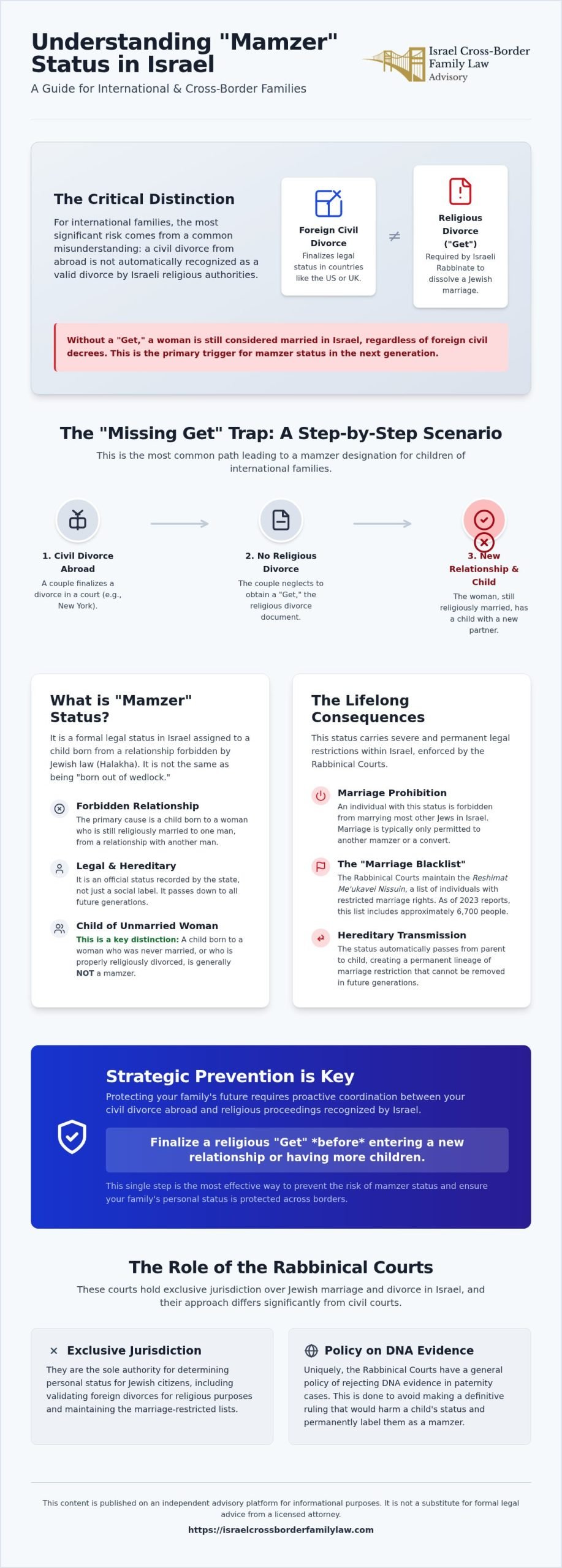
The most frequent error made by those unfamiliar with the system is equating this status with the Western concept of a child “born out of wedlock.” In most English-speaking jurisdictions, parents being unmarried at the time of birth carries no legal weight regarding the child’s future rights. However, the Definition of Mamzer in Jewish Law is much narrower and more specific. A child born to an unmarried woman is generally not a mamzer under Israeli law. The primary risk arises when a woman who is still religiously married to one man has a child with another. This often happens when a couple secures a civil divorce in a foreign country but neglects to obtain a “Get,” the religious divorce decree. Without a Get, the Israeli Rabbinate views the woman as still married, making any subsequent children from a new partner legally restricted.
The Role of the Rabbinical Courts in Israel
The Rabbinical Courts hold exclusive jurisdiction over Jewish marriage and divorce within Israel. Their authority allows them to maintain the Reshimat Me’ukavei Nissuin, commonly referred to as the marriage blacklist. According to 2023 reports, approximately 6,700 individuals are recorded on various marriage-restricted lists in Israel. The court identifies potential cases through various touchpoints, such as when individuals apply for marriage licenses or during divorce proceedings involving expats and foreign nationals. When the court designates someone with this status, they’re prohibited from marrying most other Jews in Israel. Their legal options are typically limited to marrying another person with the same status or a convert. Understanding these boundaries is essential for families navigating the differences between international civil decrees and the binding religious rulings of the Israeli state.
Halakhic Grounds: How Mamzer Status Occurs
To understand how an individual becomes a mamzer, one must look at the specific prohibitions within Jewish law. While many assume this status stems from any extramarital affair, the legal reality is much narrower. It centers on the concept of Eishet Ish, or a married woman. Under Halakha, if a woman is religiously married, any child she conceives with a man who isn’t her husband is designated with this status. This creates a significant legal presumption of paternity that the Rabbinical Courts must address when resolving matters for expats and foreign nationals. It’s a binary system where the validity of the previous marriage dictates the status of the child.
The Problem of the Missing Get
This is where the most common jurisdictional trap occurs for international families. A couple might obtain a civil divorce in a US court, believing their legal ties are severed. However, if they don’t finalize a “Get”, the religious divorce document, the woman remains married in the eyes of the Israeli Rabbinate. This results in the “chained woman” or Agunah scenario. If she enters a new relationship and has children before the Get is delivered, those children are at high risk. These modern problems and rabbinical court process complexities often arise years after the parents have moved on with their lives. Securing a religious decree is a prerequisite for protecting future generations from hereditary marriage restrictions in Israel.
Incestuous Foundations and Halakhic Nuance
A secondary category involves children born from relationships between close relatives as defined by the Torah. While these cases are statistically rarer in modern practice, the Rabbinical Courts handle them with extreme legal sensitivity. There’s a critical distinction between a forbidden marriage and an invalid one. In these instances, the focus remains on the specific biblical prohibitions that create the mamzer status. Because the consequences are so severe, the court often looks for any halakhic loophole to avoid a formal ruling. It’s often beneficial to request a confidential consultation to understand how these specific categories might impact your family’s unique cross-border situation.
The Consequences of Mamzerut: Marriage and Social Status
The legal designation of a mamzer carries heavy practical implications within the state of Israel. It isn’t a mere social label or a private religious matter; it creates a binding legal barrier to marriage that the state enforces through the Chief Rabbinate. Under current regulations, an individual with the mamzer status is strictly prohibited from marrying most members of the Jewish community. Their legal options for union are restricted to marrying another person with the same status or a convert to Judaism. This limitation effectively creates a closed legal loop for those identified by the Rabbinical Courts, impacting their ability to build a family within the traditional frameworks of the state.
The Marriage Bar in Israel
Because Israel does not offer civil marriage for its Jewish citizens, the Rabbinate’s rulings are the final word on matrimonial eligibility. The “List of Prevented Marriages” serves as a digital gatekeeper. According to 2023 reports, approximately 6,700 individuals are currently recorded on this blacklist, which prevents them from obtaining a marriage license within the country. While some couples attempt to bypass these restrictions by marrying abroad or through online Utah ceremonies, these solutions are often incomplete. A landmark High Court ruling in March 2023 required the Interior Ministry to recognize online marriages for registration purposes, yet this does not alter the religious status of the individuals involved. For expats and international families, this means that while a marriage might be registered on a Teudat Zehut, the underlying religious impediment remains, potentially affecting the status of future children.
Hereditary Implications and Family Planning
The most challenging aspect of this status is its perpetual nature. Unlike other legal penalties that might be resolved through administrative action, this designation is hereditary and passes to all future descendants without exception. It affects grandchildren and great-grandchildren, regardless of their own religious practice or personal conduct. The emotional weight of this reality often leads to significant anxiety for parents who discover a jurisdictional gap in their own divorce history. The “Stain of Mamzerut” represents a multi-generational legal hurdle that complicates family planning and long-term residency goals in Israel. Addressing these risks requires a strategic understanding of how cross-border divorce decrees interact with the Rabbinate’s strict genealogical tracking to ensure that early decisions don’t create permanent barriers for the next generation.
Strategic Prevention: Protecting Your Family’s Future
Strategic prevention remains the most effective method for navigating the complex intersection of international civil law and Israeli religious requirements. Families often find themselves in precarious positions not because of intentional wrongdoing, but due to a lack of coordination between different legal systems. For international families, the goal is to ensure that a mamzer status never becomes a possibility by addressing personal status issues proactively. This requires a shift in perspective, where religious divorce is treated as a critical legal prerequisite rather than a secondary ritual. Taking these steps early provides a layer of security for children and protects their future ability to marry within the state of Israel.
Timing the Get in Cross-Border Divorce
One of the most significant jurisdictional traps occurs when a civil decree is finalized long before the religious divorce is even considered. To mitigate risk, the religious divorce should ideally coincide with or even precede the civil filing. This prevents a scenario where one party gains leverage in civil court and then refuses to deliver a Get, effectively leaving the other spouse in a state of halakhic marriage. In international cases, managing the risk of Get-refusal is vital because the Israeli Rabbinical Court has limited enforcement powers over individuals residing permanently abroad. Coordinating these timelines ensures that both legal systems recognize the dissolution of the marriage simultaneously. Learn more about how cross-border divorce works to understand the strategic alignment required for these cases.
Legal Safeguards and Financial Agreements
Drafting robust prenuptial or postnuptial agreements is a powerful tool for preventing the chain of events that lead to a mamzer designation. These documents can include specific clauses that compel the delivery of a Get through financial incentives or penalties, which are often enforceable in both Israeli and foreign jurisdictions. In Israel, “Agreements for Mutual Respect” are frequently used to provide a framework for a dignified separation while ensuring that neither party is “chained” to a dead marriage. These safeguards are particularly important for expats who may not fully grasp the weight of Israeli religious law until they are already facing a crisis. Consulting with a cross-border family lawyer during the initial stages of a separation can identify these risks before they escalate into permanent legal barriers for the next generation.
Before registering a child born during a period of marital doubt, seek expert advisory to ensure the parents’ status is clear in the eyes of the Rabbinate. Early decisions regarding how and where a child is registered can have lasting impacts on their legal standing in Israel. To ensure your family’s future remains secure, it’s prudent to request a confidential consultation to review your specific cross-border circumstances.
Navigating the Rabbinical Court Process
The Rabbinical Court, or Beit Din, operates under a different set of procedural priorities than the civil family court system. While civil courts often seek biological certainty through modern technology, the Rabbinical Court frequently prioritizes the preservation of a child’s personal status. They have a recognized halakhic duty to “save” children from being designated as a mamzer. This results in a surprising legal environment where the court may actively avoid evidence that could lead to a detrimental ruling. For families navigating this system, it’s essential to understand that the court often uses established legal fictions and presumptions to protect the child’s future eligibility for marriage.
Evidence handling in these cases is a primary example of this protective stance. Under current Israeli policy, the Rabbinical Court generally rejects or even prohibits DNA testing in paternity cases if the results could potentially label a child as a mamzer. This is a significant departure from Western legal standards where DNA is considered the ultimate proof. In the Beit Din, religious law provides a framework where biological truth is sometimes secondary to the legal goal of maintaining a child’s standing within the community. Understanding when to provide information and when to rely on these court protections is a critical part of the process.
The Principle of “Majority of Acts”
The most powerful tool the court uses is the halakhic presumption known as rov be’ilot achar ha-ba’al, which translates to the “majority of acts are after the husband.” This principle presumes that a child born to a married woman belongs to her husband, even if the couple has been living apart for a significant period. As long as there’s even a remote mathematical possibility of contact, the court prefers this presumption over investigating alternative paternity. In many proceedings, silence is the most effective legal strategy. Volunteering unnecessary details about a new relationship or the timing of a separation can inadvertently undermine these presumptions and force the court’s hand toward a restrictive ruling.
Seeking Professional Advisory
Navigating the Beit Din requires a different skill set than appearing in a civil court. There’s a vital distinction between a civil lawyer and a Rabbinical Court advocate who understands the nuances of halakhic litigation. For international families, the challenge is finding a bridge between the US civil system they’ve left and the Israeli religious system they’re entering. This is why professional advisory is essential before making any formal statements to the court or registering a child’s birth. This content is published on an independent advisory platform to help families manage these risks through strategy and informed decision-making. You can find specific guidance for expats and foreign nationals to help align your international divorce history with Israeli requirements. Get clarity before you commit. Request a confidential consultation.
Securing Your Family’s Legal Future in Israel
Navigating the intersection of US civil decrees and Israeli religious law requires more than just administrative filing; it demands a proactive strategy to protect the next generation. We’ve explored how a missing religious divorce can lead to a mamzer designation, which creates permanent marriage restrictions within the state of Israel. However, the Rabbinical Court often utilizes legal presumptions to safeguard children when cases are managed with the right expertise. By prioritizing the religious Get and aligning your cross-border legal timelines, you can mitigate these risks effectively.
This content is published on an independent advisory platform focusing on US-Israel family law strategy and Rabbinical Court procedures. Understanding these fundamental differences between legal cultures is the first step toward long-term security. Strategic planning ensures that early decisions in a separation don’t become insurmountable barriers years later. With the right guidance, you can navigate these complexities and ensure your family’s personal status remains protected across every jurisdiction.
Get clarity before you commit. Request a confidential consultation.
Frequently Asked Questions
Can a DNA test prove my child is not a mamzer?
DNA testing is generally not a solution in these cases. In fact, the Rabbinical Court often blocks DNA tests in paternity disputes specifically to avoid a restrictive ruling. If a test proved the mother’s husband was not the father, the child’s status would be compromised. The court prefers to rely on the legal presumption that the child belongs to the husband to protect the child’s future eligibility for marriage.
Does mamzer status apply if I was never married in a religious ceremony?
This depends on whether your previous union is recognized by the Rabbinate. Generally, if a Jewish woman was never married in any ceremony recognized by Halakha, her children are not at risk. However, the Rabbinical Court may scrutinize the validity of a previous civil or Reform marriage to determine if it created a binding status. It is a complex determination that requires reviewing the specific circumstances of the previous relationship.
What happens if I have a child with someone else before my Get is final?
Having a child before a Get is finalized creates a significant legal risk. Even if you have a civil divorce from a foreign court, the Rabinate considers you religiously married to your first husband. Under these conditions, the child is legally defined as a mamzer. This status is hereditary and will prevent the child from marrying most other Jews in Israel. Strategic timing of the religious divorce is essential to prevent this outcome.
Is a child of a non-Jewish father considered a mamzer?
No, a child born to a Jewish mother and a non-Jewish father is not a mamzer. This specific status only arises from certain forbidden unions between two Jewish individuals. The child is fully recognized as Jewish through their mother and does not face the marriage restrictions associated with prohibited relationships. This is one of the many nuances where religious law differs significantly from secular expectations of personal status and family lineage.
Can mamzer status be “fixed” or reversed later in life?
There is no formal administrative process to reverse this status once a final ruling is issued. The Israeli legal system focuses almost entirely on prevention rather than correction. This is why the Rabbinical Courts use legal fictions and presumptions to avoid making the designation in the first place. Once the status is recorded in the state’s database, it is passed down to all future generations, making early strategic advisory the only effective path.
How does the Israeli Rabbinical Court find out about potential mamzerut?
The court typically identifies potential issues during the marriage registration process or during divorce proceedings. When you apply for a marriage license, the Rabbinate reviews your parents’ marriage and divorce history. If they find a child was born before a mother received her Get, they may open an investigation. They also cross-reference population registry data with their own records of religious divorces to maintain the marriage database and identify discrepancies.
Does mamzer status affect my child’s Israeli citizenship?
Citizenship and civil rights are not affected by this religious status. Your child will still receive an Israeli passport, have access to national healthcare, and be able to vote in all elections. The restrictions are limited to personal status laws, specifically the right to marry within Israel. Because the Rabbinate holds a monopoly over Jewish marriage, the impact is felt only when the child reaches marriageable age and applies for a license to wed.
What is the “Blacklist” and how do I check if I am on it?
The “Blacklist” is the Reshimat Me’ukavei Nissuin, an internal database of people restricted from marriage. It contains the names of approximately 6,700 individuals as of 2023. You cannot access this list through a public website or search engine. Most people only discover their inclusion when they attempt to register for marriage. A specialized advocate can perform a formal inquiry to clarify your status or that of your children if there is a concern.

Article by
Gabriel Lior
A Personal Journey That Became a Mission
The advisory was founded by an American father Gabriel Lior, LLB, MBA , global entrepreneur, and cross-border advisor who spent more than a decade navigating the Israeli family court system firsthand and now lives in Singapore with his son.
As a divorced parent in a cross-border family, Gabriel faced nearly every legal challenge a foreign parent can encounter in Israel — including child custody disputes, child support proceedings, property matters in Israel and abroad, false accusations, and complex immigration and relocation proceedings.
Over the years, he learned the hard way how difficult it is for non-Israeli parents to understand the system, identify the right legal strategy, and choose the right legal representation — especially when language, culture, and jurisdictional differences are involved. He also witnessed how foreign parents and new immigrants are often disadvantaged or taken advantage of by service providers and institutions simply because they lack local knowledge or fluency.
From Client to Advisor
To truly understand — and survive — the system, Gabriel pursued formal legal education in Israel, completing two Israeli law degrees, alongside a BA and MBA earned in the United States. This was never about becoming a practicing attorney, but about gaining a deep, structural understanding of how the system works — and where it breaks down for foreign parents.
This rare combination of:
Firsthand client experience
Israeli legal and US business education
International business and negotiation training
Decades of commercial execution
created a unique perspective – one that understands both sides of the table.
After years of litigation, persistence, and at times self-representation, he ultimately succeeded in securing custody of his son and relocating abroad through a rare legal victory in the Israeli Supreme Court — becoming one of the first fathers in Israel to do so under these circumstances.
Disclaimer
Important Disclaimer:
The information provided on this website and in its content is for general informational and educational purposes only and does not constitute legal advice, legal opinion, or legal representation.
Gabriel Lior is not licensed to practice law in Israel (nor is he interested in doing so) and does not provide legal services, despite having completed 2 Law Degrees. The services offered are advisory in nature and are intended to provide general guidance, strategic insight, and information regarding cross-border family law considerations.
No attorney-client relationship is formed by accessing this website, reading its content, or communicating with us.
Any decisions made based on this information are at your own discretion and risk. For legal advice specific to your situation, you should consult a licensed attorney in the relevant jurisdiction.
Where appropriate, we may refer clients to independent, licensed attorneys or professionals. Such referrals do not constitute legal representation and no liability is assumed for services provided by third parties.