This article is published on an independent advisory platform and is for informational purposes only. It does not constitute legal representation or legal advice. Legal services are only provided by licensed attorneys under a separate engagement.
If you are searching for how to get my child’s name on a no-fly list, you might be surprised to learn that the official No-Fly List is reserved for national security; it isn’t available for parental disputes. It’s completely natural to feel anxious when you’re managing a family across two different legal systems. You want to ensure that a dual-citizenship loophole doesn’t lead to an unauthorized international removal. We understand the weight of this responsibility and the confusion that often arises when trying to reconcile U.S. and Israeli regulations.
This guide provides the clarity you need to move from fear to a proactive safety strategy. You’ll learn the precise legal steps required in both Israel and the United States to protect your children and secure their safety. We’ll explain how the U.S. Children’s Passport Issuance Alert Program (CPIAP) functions and how to secure an Israeli Departure Prohibition Order, also called a Tzav Ikur Yetzia. By understanding how these cross-border mechanisms work together, you can better manage the complexities of international family law. Get clarity before you commit. Request a confidential consultation.
Key Takeaways
- Distinguish between national security No-Fly lists and the specific legal tools used to prevent international child removal in cross-border family law cases.
- Learn the procedural requirements for securing an Israeli Departure Prohibition Order and the financial implications of court-mandated guarantees.
- Understand why the U.S. Children’s Passport Issuance Alert Program is the primary method for those asking how to get my child’s name on a no-fly list to prevent unauthorized travel.
- Recognize the strategic risks involved in travel restrictions, including the potential for reciprocal bans that may impact your own international mobility.
- Build a proactive safety strategy that coordinates legal protections across both jurisdictions to effectively address dual-citizenship loopholes.
This article is published on an independent advisory platform and is for informational purposes only. It does not constitute legal representation or legal advice. Legal services are only provided by licensed attorneys under a separate engagement.
Understanding the ‘No-Fly List’ in Cross-Border Family Law
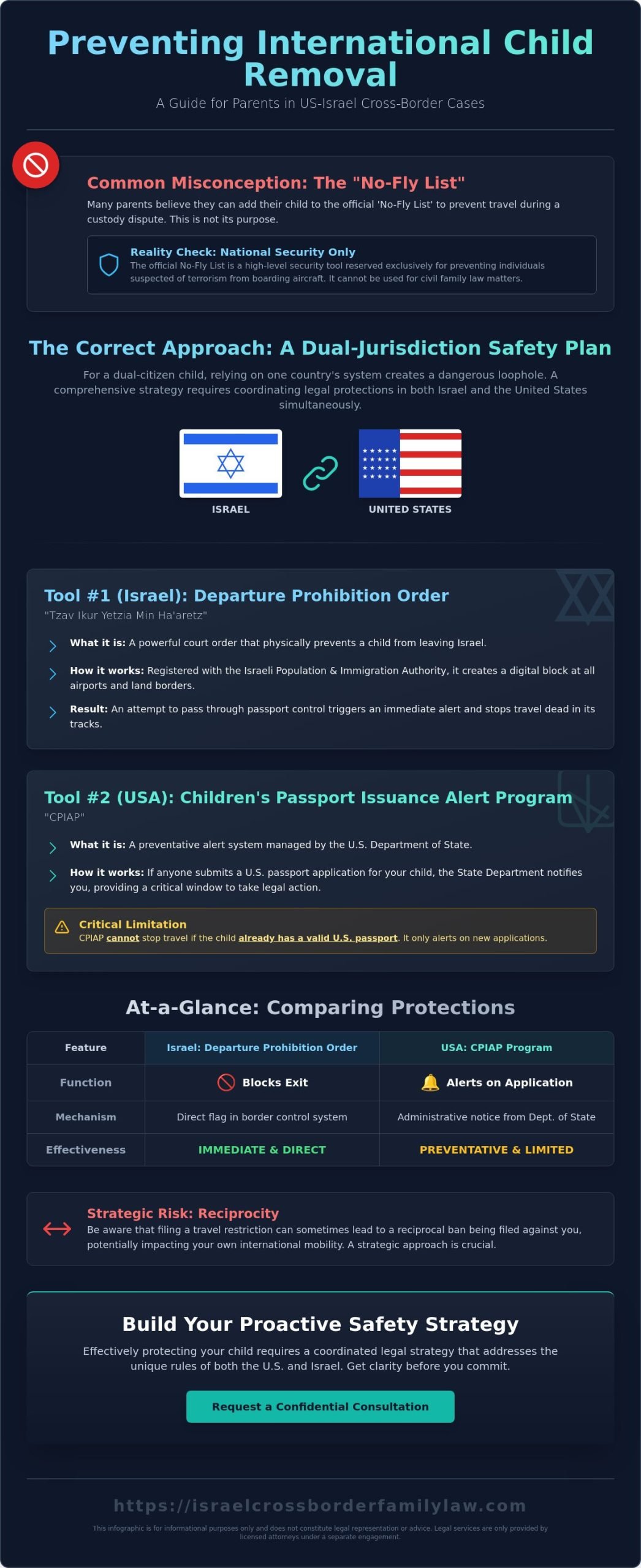
Many parents who fear international child abduction start their research by asking how to get my child’s name on a no-fly list. It’s a logical starting point, but the terminology used in popular media can be misleading for families. The actual No-Fly List is a security database managed by the U.S. government to prevent individuals suspected of terrorism from boarding commercial aircraft. Understanding the No-Fly List helps clarify that this specific tool isn’t designed for civil custody disputes or family law matters. Airlines and border authorities don’t use this list to resolve parental disagreements or enforce visitation schedules.
To see how these security lists can sometimes affect families in unexpected ways, watch this report:
Instead of a national security list, families managing potential abduction risks must use specific legal mechanisms. In a cross-border context involving Israel and the U.S., this requires a dual-track strategy. Relying on a single jurisdiction is often insufficient. A child with dual nationality can travel on two different passports, making it essential to address the rules of both countries simultaneously. For expats and foreign nationals, this complexity is a standard part of their legal reality.
The Israeli Context: Departure Prohibition Orders
In Israel, the primary tool for preventing unauthorized travel is the Tzav Ikur Yetzia Min Ha’aretz, or a Departure Prohibition Order. This is a preventative legal tool issued by an Israeli Family Court or Rabbinical Court. Once the court grants the order, it’s registered directly with the Israeli Population and Immigration Authority. It acts as a digital block at all ports of entry and exit. If a parent attempts to take a child through passport control at Ben Gurion Airport, the system alerts the officer immediately. Courts can issue these orders on a temporary basis, often called an ex parte order, if there’s an immediate risk of removal.
The US Context: Passport Issuance Alert Program (CPIAP)
The U.S. does not have an exit control system identical to Israel’s. There is no “stay-of-exit” order that a border agent checks when you leave the country. Instead, the U.S. Department of State manages the Children’s Passport Issuance Alert Program (CPIAP). This is the closest equivalent for those asking how to get my child’s name on a no-fly list within the American system. Once a child is enrolled, the Department of State notifies the parent if anyone applies for a new U.S. passport for that child. This provides a critical window to take legal action before a travel document is even created. However, CPIAP has limitations; it cannot stop a child from traveling if they already possess a valid passport.
This article is published on an independent advisory platform (not a law firm) and must not imply an attorney-client relationship. It is informational and advisory only, not legal representation or legal advice. Legal services are only provided by licensed attorneys under a separate engagement.
Step 1: Obtaining a Departure Prohibition Order in Israel
When a parent suspects that their child might be taken out of the country without consent, the most effective tool in the Israeli legal system is the Departure Prohibition Order, known as Tzav Ikur Yetzia. Many international parents start by asking how to get my child’s name on a no-fly list, but in Israel, the focus is on this specific judicial order. An ex parte application is a legal request made to an Israeli court by one parent without notifying the other parent in advance, typically used in urgent situations to prevent immediate travel. This allows the court to act before the other parent has a chance to leave with the child.
The choice of venue is the first strategic decision you’ll face. You can file for this order in either the Israeli Family Court or the Rabbinical Court. Each system has its own procedural rhythm, and the decision often depends on which court already has jurisdiction over your family matters. If you are dealing with international custody relocation issues, selecting the right court is essential for long-term stability.
Filing the Emergency Application
Speed is the most critical factor when drafting an emergency application. If the other parent has already purchased tickets or expressed a clear intent to move, you must act within hours. The court requires a tatzhir, which is a formal affidavit signed before an attorney. This document must outline the specific facts that create a “fear of flight.” Judges look for concrete evidence, such as the cancellation of local school enrollments or the selling of household goods. This evidence ensures that the spirit of the Hague Abduction Convention is upheld by preventing a wrongful removal before it occurs.
Enforcement at the Border
Once a judge signs the Departure Prohibition Order, the court’s system transmits the data electronically to the Israeli Border Police (Mishteret HaGvul). This registration happens almost instantly. The order is then active at every port of entry and exit, including Ben Gurion Airport and land crossings. If a parent attempts to clear passport control with the child, the officer’s screen will flag the restriction, and the child will be prevented from boarding. You can verify that the order is active in the national database through your legal representative to ensure the safety net is in place.
Duration and Setting Aside an Order
A temporary order issued without the other parent’s presence will eventually expire unless a follow-up hearing occurs. This “return hearing” usually takes place within seven to 14 days. During this time, the other parent has the right to object and present their own evidence. The court may choose to cancel the order, make it permanent, or lift it only after certain conditions are met. These conditions often include a financial guarantee, which can range from $10,000 to as high as $200,000 per child. To understand how these guarantees might apply to your situation, you may wish to request a confidential case review. Get clarity before you commit.
This article is published on an independent advisory platform and is for informational purposes only. It does not constitute legal representation or legal advice. Legal services are only provided by licensed attorneys under a separate engagement.
Step 2: Preventing US Passport Issuance via CPIAP
While an Israeli Departure Prohibition Order is a vital first step, it does not automatically stop the U.S. government from issuing a travel document to a dual-national child. The U.S. State Department is a sovereign entity and its passport services operate under federal law, not Israeli court mandates. Parents often research how to get my child’s name on a no-fly list when they’re worried about a spouse taking a child to the U.S. or elsewhere, but for American citizens, the primary preventive measure is the Children’s Passport Issuance Alert Program (CPIAP). This program ensures that you’re notified before a new passport is even printed, allowing you to intervene in a potential international custody relocation situation.
Once a CPIAP alert is triggered by a passport application, the U.S. Department of State implements a 28-day hold period to give the parent time to obtain or submit a court order that specifically prohibits the child’s travel. This window is critical. It provides the necessary time to present a valid U.S. court order to the Office of Children’s Issues, which can then lead to a formal denial of the passport application. Without this alert, a parent might successfully obtain a passport at a domestic agency or an overseas embassy without your knowledge.
The CPIAP Enrollment Process
To enroll your child, you must submit a “Request for Entry” form to the Department of State. This service is free of charge and serves as a global flag within the U.S. passport system. You’ll need to provide specific evidence of your parental relationship and the child’s identity. The following documentation is typically required:
- A completed and signed CPIAP request form.
- A copy of the child’s birth certificate or a consular report of birth abroad.
- Copies of any existing court orders regarding custody or travel restrictions.
- Proof of your own identity, such as a valid passport or driver’s license.
These documents should be sent directly to the Office of Children’s Issues in Washington, D.C. Once processed, the child’s name is entered into the consular database, which is accessed by every U.S. embassy and consulate worldwide.
Coordinating with the US Embassy in Israel
If your child is currently in Israel, it’s essential to ensure the U.S. Embassy in Jerusalem or the Branch Office in Tel Aviv is aware of the situation. While the CPIAP system is centralized, providing the Embassy with a copy of your Israeli Tzav Ikur Yetzia (Departure Prohibition Order) adds an extra layer of security. This information helps consular officers identify emergency travel document requests that might be used to bypass standard passport requirements. It’s important to understand that the Embassy cannot physically seize a child’s existing passport without specific legal authority or a U.S. court order. If you’re concerned about how these systems interact, you can learn more about how the advisory process works to help you build a strategy. Get clarity before you commit. Request a confidential consultation.
This article is published on an independent advisory platform and is for informational purposes only. It does not constitute legal representation or legal advice. Legal services are only provided by licensed attorneys under a separate engagement.
Strategic Risks and Misconceptions in Travel Restrictions
While you may be investigating how to get my child’s name on a no-fly list to ensure immediate safety, it’s vital to consider the long-term strategic implications of these restrictions. A travel ban is a powerful tool, but it can also be a double-edged sword. One of the most common risks is the “mirror order” effect. When one parent secures a Departure Prohibition Order, the other parent often responds by filing a reciprocal ban. This can result in both parents being legally grounded in Israel, unable to take the child to visit family abroad or go on vacation without a complex court process. This is particularly relevant in divorce and separation for international families where travel is a regular necessity.
A frequent concern for parents is whether taking such a step will make them appear aggressive or hostile in the eyes of a judge. Israeli Family Courts generally view these orders through the lens of risk management rather than punishment. If there’s a documented risk of removal to a non-signatory state of the Hague Convention, the court will likely see your actions as a responsible protective measure. However, the way you frame the request is essential. It should be presented as a strategy for stability, not a way to sever the child’s relationship with the other parent.
Legal Retaliation and Reciprocity
The sudden imposition of a travel ban can trigger immediate legal retaliation. The other parent may feel cornered and escalate the litigation, leading to a counter-suit that complicates the entire custody case. To mitigate this, many families eventually aim for a consent-based travel protocol. This involves a court-approved agreement that allows for travel under specific conditions, such as the posting of a financial bond or the requirement of a detailed itinerary. This approach balances safety with the child’s right to maintain global connections.
The Limitations of Border Control
No electronic system is 100% foolproof. In Israel, names are often transliterated from Hebrew to English, and small spelling differences on a second passport can occasionally lead to errors at border control. Additionally, while Ben Gurion Airport has robust checks, private vessels or land crossings can present different challenges. For these reasons, a court order should only be one part of your plan. Keeping the child’s physical passport in a secure, neutral location remains a fundamental safety step. To build a comprehensive plan tailored to your family’s specific needs, speak with a cross-border strategy expert. Get clarity before you commit.
This article is published on an independent advisory platform and is for informational purposes only. It does not constitute legal representation or legal advice. Legal services are only provided by licensed attorneys under a separate engagement.
Creating a Comprehensive Safety Plan for International Families
A truly effective safety plan requires more than just a stack of legal documents. It involves a coordinated effort across your child’s daily life to ensure that legal protections are actually enforceable on the ground. While your initial research likely focused on how to get my child’s name on a no-fly list, you must now integrate those legal tools into a practical routine. This includes notifying your child’s school, daycare, or summer camp about existing travel restrictions. Provide these institutions with copies of the relevant court orders and ensure they have a clear list of who is authorized to pick up the child. This proactive approach helps prevent an unauthorized removal before it ever reaches an airport or border crossing.
Early strategy is essential for families navigating international custody and relocation scenarios. A “wait and see” attitude is a high-risk approach that often leads to situations where your legal options become severely limited. By establishing a clear plan before a conflict escalates, you can manage the complexity of dual legal systems with greater confidence. This involves understanding how an Israeli order interacts with U.S. regulations to create a seamless safety net for your family.
Mediation vs. Litigation for Travel Safety
Negotiating a travel protocol through mediation is often more sustainable than relying on a court-imposed ban. A court order can sometimes feel like a permanent wall, whereas a protocol acts as a gate that allows for healthy family interaction. You can use financial guarantees, such as bank bonds, to ensure the child’s return to Israel. These guarantees typically range from $10,000 to as high as $200,000 per child, depending on the perceived risk and the destination. By drafting “safe” travel clauses that include specific return dates, flight numbers, and mandatory check-ins, you can balance security with the child’s right to maintain global family connections.
Seeking Expert Advisory
Managing cross-border family law requires a strategist who understands the specific nuances of both the Israeli and U.S. legal environments. The differences in how each country handles custody, travel, and the how to get my child’s name on a no-fly list inquiry can be significant. You need to seek clarity before making any long-term commitments or signing settlement agreements with the other parent. Early decisions often have lasting impacts on your future mobility and your child’s long-term safety. To begin building a proactive strategy for your family, you can request a confidential case review for your specific situation. Get clarity before you commit.
This article is published on an independent advisory platform and is for informational purposes only. It does not constitute legal representation or legal advice. Legal services are only provided by licensed attorneys under a separate engagement.
Securing Your Family’s Cross-Border Future
Safeguarding your children in a multi-jurisdictional environment requires a shift from reactive fear to a structured, dual-track strategy. You’ve learned that the Israeli Tzav Ikur Yetzia and the U.S. Children’s Passport Issuance Alert Program (CPIAP) are the foundational tools for preventing unauthorized international travel. While you may have initially searched for how to get my child’s name on a no-fly list, you now understand that these specific family law mechanisms offer the protection you truly need. Relying on a single country’s legal system is rarely enough for dual-national families.
Effective prevention depends on early decision-making and a deep understanding of how Israeli and U.S. laws interact. Specialized expertise in the Hague Abduction Convention and international family law is essential for managing these complexities without triggering unnecessary legal retaliation. By coordinating court orders with practical home and school safety measures, you can create a robust safety net. Get clarity before you commit. Request a confidential consultation. You have the power to protect your child’s stability through informed strategy and steady guidance.
This article is published on an independent advisory platform and is for informational purposes only. It does not constitute legal representation or legal advice. Legal services are only provided by licensed attorneys under a separate engagement.
Frequently Asked Questions
Can I put my child on a no-fly list without a lawyer in Israel?
While you can technically file paperwork yourself, navigating the Israeli Family Court or Rabbinical Court is complex and carries high stakes. These proceedings require a deep understanding of Hebrew and specific procedural rules. Most international parents find that professional guidance is necessary to avoid errors that could delay the registration of an order at Ben Gurion Airport. Professional strategy helps ensure your request is framed correctly to the judge.
How long does a Departure Prohibition Order (Tzav Ikur Yetzia) last?
A temporary emergency order typically remains in effect for 7 to 14 days until a formal hearing occurs. During this hearing, the court will decide whether to cancel the order or make it permanent until the child reaches age 18. Any party can later petition the court to modify the order if circumstances change, such as if a parent provides a sufficient financial guarantee to ensure the child’s return.
Does a US passport alert stop my child from leaving Israel?
No, a U.S. passport alert does not physically prevent a child from passing through Israeli border control. It only notifies you if someone applies for a new U.S. passport for your child. To stop a child at the Israeli border, you must obtain an Israeli Departure Prohibition Order. This is a vital distinction for parents asking how to get my child’s name on a no-fly list while living abroad.
What happens if my child has both a US and an Israeli passport?
You must secure travel restrictions in both countries to address the dual-citizenship loophole effectively. An Israeli order prevents travel on the Israeli passport, but the child could still attempt to leave using a U.S. document. Combining an Israeli court order with enrollment in the U.S. Children’s Passport Issuance Alert Program is the only way to ensure both sets of travel documents are monitored for those asking how to get my child’s name on a no-fly list.
Can the other parent travel with the child if I have a court order?
The other parent is legally barred from taking the child out of Israel while a Departure Prohibition Order is active. If they wish to travel for a specific trip, they must petition the court to lift the ban temporarily. Judges often require a financial bond or bank guarantee to ensure the child’s return. These guarantees can range from $10,000 to $200,000 per child depending on the perceived risk level.
How much does it cost to get a travel ban for a child in Israel?
The U.S. alert program is free, but obtaining an Israeli court order involves legal costs and potential financial guarantees. Courts often require the parent requesting the ban to provide a bank guarantee or third-party signatures to cover potential damages if the order is later found to be unjustified. These financial thresholds are determined by a judge based on the specific flight risk and the family’s financial situation.
What if the other parent takes the child to a country that is not in the Hague Convention?
Legal recovery becomes significantly more difficult if a child is taken to a country that does not participate in the Hague Abduction Convention. In these instances, preventative orders are your most critical defense because international treaties may not provide a clear path for the child’s return. You should prioritize a comprehensive strategy that includes both Israeli and U.S. protections before any travel to non-Hague jurisdictions is even considered.
Can I get an emergency travel ban on a weekend or holiday in Israel?
Yes, you can obtain an emergency travel ban through a specialized duty judge system that operates during weekends and holidays. Since Ben Gurion Airport remains active 24/7, the Israeli legal system provides a mechanism for urgent ex parte applications outside of standard business hours. This ensures that you can take immediate action if you discover a parent is attempting to leave with a child during a holiday or non-business day.

Article by
Gabriel Lior
A Personal Journey That Became a Mission
The advisory was founded by an American father Gabriel Lior, LLB, MBA , global entrepreneur, and cross-border advisor who spent more than a decade navigating the Israeli family court system firsthand and now lives in Singapore with his son.
As a divorced parent in a cross-border family, Gabriel faced nearly every legal challenge a foreign parent can encounter in Israel — including child custody disputes, child support proceedings, property matters in Israel and abroad, false accusations, and complex immigration and relocation proceedings.
Over the years, he learned the hard way how difficult it is for non-Israeli parents to understand the system, identify the right legal strategy, and choose the right legal representation — especially when language, culture, and jurisdictional differences are involved. He also witnessed how foreign parents and new immigrants are often disadvantaged or taken advantage of by service providers and institutions simply because they lack local knowledge or fluency.
From Client to Advisor
To truly understand — and survive — the system, Gabriel pursued formal legal education in Israel, completing two Israeli law degrees, alongside a BA and MBA earned in the United States. This was never about becoming a practicing attorney, but about gaining a deep, structural understanding of how the system works — and where it breaks down for foreign parents.
This rare combination of:
Firsthand client experience
Israeli legal and US business education
International business and negotiation training
Decades of commercial execution
created a unique perspective – one that understands both sides of the table.
After years of litigation, persistence, and at times self-representation, he ultimately succeeded in securing custody of his son and relocating abroad through a rare legal victory in the Israeli Supreme Court — becoming one of the first fathers in Israel to do so under these circumstances.
Disclaimer
Important Disclaimer:
The information provided on this website and in its content is for general informational and educational purposes only and does not constitute legal advice, legal opinion, or legal representation.
Gabriel Lior is not licensed to practice law in Israel (nor is he interested in doing so) and does not provide legal services, despite having completed 2 Law Degrees. The services offered are advisory in nature and are intended to provide general guidance, strategic insight, and information regarding cross-border family law considerations.
No attorney-client relationship is formed by accessing this website, reading its content, or communicating with us.
Any decisions made based on this information are at your own discretion and risk. For legal advice specific to your situation, you should consult a licensed attorney in the relevant jurisdiction.
Where appropriate, we may refer clients to independent, licensed attorneys or professionals. Such referrals do not constitute legal representation and no liability is assumed for services provided by third parties.