In the Israeli legal landscape, the outcome of your divorce is often decided before you even step into a courtroom, making it vital to understand expat divorce services Haifa early in the process. For international families in Northern Israel, the “race of jurisdiction” means that being the first to file can dictate whether your future is decided by a civil judge or a religious authority. This reality often creates a sense of urgency and anxiety for those unfamiliar with how the system works.
You’re likely feeling overwhelmed by the prospect of navigating a Hebrew-speaking legal system while trying to protect assets located thousands of miles away. It’s a heavy burden to carry, especially when the rules of the game feel fundamentally different from what you know in the US or Europe. This article provides the strategic clarity you need to safeguard your international financial interests and secure fair custody arrangements through informed decision-making. We’ll examine the critical differences between the Family and Rabbinical courts, the mandatory mediation process, and how to manage cross-border complexities without losing your peace of mind. Please note that this content is published on an independent advisory platform, not a law firm, and does not constitute legal representation or formal legal advice.
Key Takeaways
- Understand how the “race of jurisdiction” determines whether the Haifa Family Court or the Rabbinical Court decides your financial future.
- Learn the specific challenges of valuing and protecting US-based assets, including real estate and business interests, under Israeli law.
- Gain clarity on how “habitual residence” impacts child custody and the realistic prospects of relocation requests for expat parents.
- Navigate the mandatory mediation steps and typical timelines for expat divorce services Haifa to ensure your interests are protected from the start.
- Build a strategic roadmap through this independent advisory platform, which provides informational guidance on risks rather than formal legal representation.
Understanding the Dual Court System in Haifa
For many international families living in Northern Israel, the most striking feature of the legal landscape is the dual court system in Israel. Unlike many Western jurisdictions where a single civil court handles all family matters, Haifa residents must navigate both the civil Family Court and the religious Rabbinical Court, also known as the Beit Din. Understanding how these two entities interact is the first step when seeking expat divorce services Haifa, as the court that hears your case can significantly influence the final division of your global assets.
This advisory platform provides strategic guidance to help you recognize these risks before they become legal hurdles. It’s important to remember that we operate as an independent advisory service, not a law firm; formal legal representation is provided only by licensed attorneys under a separate engagement. Before you commit to a specific legal path, you need to understand how the Haifa courts view international families.
To better understand how this system impacts international cases, watch this helpful video:
The Family Court vs. The Rabbinical Court
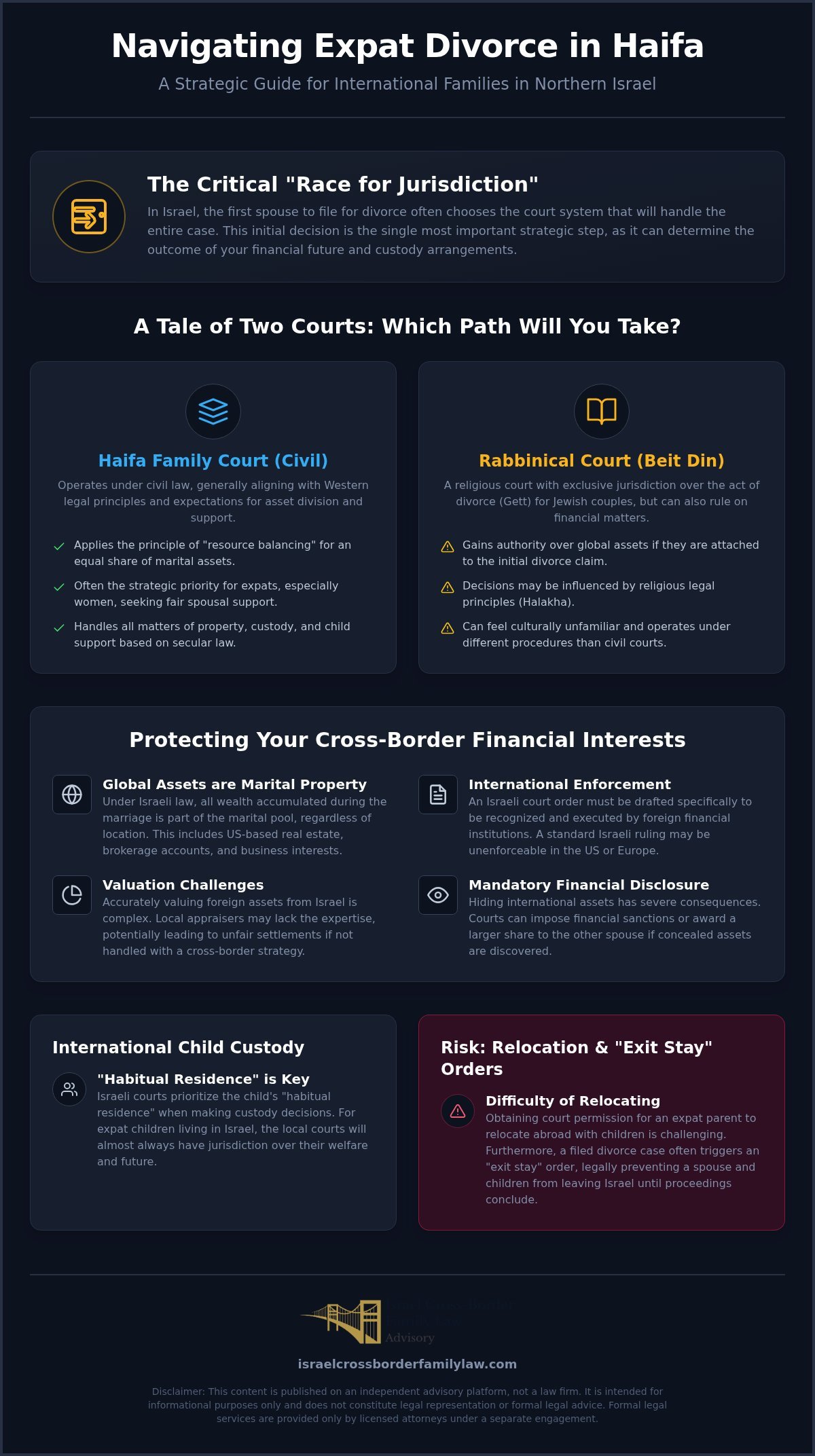
The Haifa Family Court generally applies civil law to matters like property division and child custody. However, the Rabbinical Court has exclusive jurisdiction over the actual act of divorce for Jewish couples. Jurisdictional overlaps often occur in areas of spousal support and alimony. For non-religious expats, the Beit Din can feel culturally unfamiliar, yet it possesses the power to adjudicate financial matters if they are correctly attached to the divorce claim. The choice of court often dictates whether international property is divided strictly according to Israeli civil standards or influenced by religious legal principles.
The “Race for Jurisdiction” Explained
The “race for jurisdiction” is a strategic reality where the spouse who files first effectively chooses the court system that will govern the divorce. If one spouse files a comprehensive claim in the Rabbinical Court before the other reaches the Family Court, the religious court may gain the authority to adjudicate matters involving your US-based bank accounts or European real estate. This initial filing often triggers an “exit stay” order, which can prevent a spouse or children from leaving IL until the legal proceedings conclude. For many expat women, filing in the Family Court first is often a strategic priority, as civil judges typically align more closely with Western expectations regarding spousal support and the division of complex international assets. You can learn more about how we help bridge these legal gaps on our about the advisory page.
Protecting Cross-Border Assets and Financial Interests
Israeli law typically views marital assets through the lens of “resource balancing,” a principle that assumes an equal share of wealth accumulated during the marriage. For those seeking expat divorce services Haifa, this means that a US-based brokerage account or a vacation home in Florida is technically part of the marital pool. However, the Israeli court’s ability to actually seize or divide those assets is limited by international law and the cooperation of foreign institutions. Strategic clarity is required to ensure that an Israeli court order is drafted in a way that US financial institutions will actually recognize and execute.
Valuing US real estate or private business interests from abroad presents a significant hurdle. Local Haifa appraisers often lack the specific market knowledge to accurately value a property in the Midwest or a tech startup in Silicon Valley. This discrepancy can lead to unfair settlements if you don’t use a strategy that accounts for both legal systems. Failure to provide full financial disclosure can also have severe consequences. If a spouse is found to be hiding international assets, the court may impose financial sanctions or adjust the property division to compensate the other party. In extreme cases, financial disputes can spiral into broader legal conflicts, making it helpful to understand the government’s position on International Parental Child Abduction and other high-conflict risks. Please note that this platform provides informational guidance and is not a law firm; legal services are only provided by licensed attorneys under a separate engagement.
US Pensions, 401(k)s, and IRAs
US retirement accounts are often the largest marital asset for expat families, yet they are frequently misunderstood in Israeli proceedings. While Israeli courts consider these divisible, the practical execution is complex. A Qualified Domestic Relations Order (QDRO) is a US legal instrument, not an Israeli one. To divide a 401(k), you typically need an Israeli judgment that is then mirrored by a US court order. It’s also vital to protect pre-marital assets. If you entered the marriage with a significant brokerage account, you must prove its separate nature to prevent it from being merged into the marital pool during the divorce process.
Business Interests and Tech Equity
Haifa is a central hub for the high-tech sector, meaning many expats hold Restricted Stock Units (RSUs) or startup options. Israeli courts view these as marital property to the extent they were earned during the marriage. Valuing these requires a nuanced understanding of vesting schedules and potential tax liabilities, such as the US Foreign Earned Income Exclusion, which for the 2026 tax year is set at $132,900. For those with US-based family businesses, protecting the entity from Israeli claims often involves the strategic use of financial agreements to ring-fence assets. This advisory platform focuses on identifying these risks early so you can make informed decisions. If you need assistance navigating these complexities, you may request a case review to gain clarity before you commit.
International Child Custody and Relocation from Haifa
Determining where a child will live after a divorce is often the most emotionally charged aspect of any cross-border separation. In the Haifa district, courts rely heavily on the concept of “habitual residence” to decide which country has jurisdiction over custody. If your children have been attending school and living in Haifa, the court will likely view IL as their primary home. This platform serves as an independent advisory service to help you understand these jurisdictional risks. We aren’t a law firm and legal services are only provided by licensed attorneys under a separate engagement.
When seeking expat divorce services Haifa, you’ll find the “best interests of the child” standard is the guiding principle for Israeli judges. However, what a Haifa judge considers “best” may differ from your expectations in the US or UK. For example, Israeli courts often place a high value on the child’s connection to their extended family and community within Israel. Preventative measures, such as requesting a “stay of exit” order, are common tools used to ensure children remain in the country until a final custody agreement is reached. These early decisions carry immense weight and are difficult to reverse once a pattern of residence is established.
The Hague Convention in Israel
Israel is a signatory to the Hague Convention, which governs cases of “wrongful removal” or retention of a child across international borders. In the Haifa district, Hague Convention cases are treated with extreme urgency. The court’s primary goal isn’t to decide long-term custody, but to determine if the child was taken from their habitual residence without legal consent. If a parent takes a child to the US without a court order or written permission, the other parent can petition for the child’s immediate return. These proceedings move very quickly, often reaching a resolution within weeks to prevent a “new reality” from taking root in a foreign country.
Relocation Strategy for Expats
If you intend to move back to your home country with your children, you must file a formal relocation (Hagira) request. A Haifa judge will examine several factors, including the quality of the relationship with both parents and the educational or social opportunities awaiting the child abroad. Crafting a “Mirror Order” is a critical strategic step. This involves obtaining a matching court order in your destination country to ensure the Israeli custody arrangement is legally recognized and enforceable there. International custody and relocation decisions can fundamentally alter child support obligations. Gaining strategic clarity on these overlaps before you file is essential for a stable transition for your family.
The Divorce Process in Haifa: Timelines and Practical Steps
The path to finalizing a divorce in Northern Israel follows a highly structured sequence that often differs from US or UK expectations. The mandatory first step is filing a “Settlement of Dispute” application. As of January 2026, the filing fee for this initial application is 119 NIS. This filing is not a lawsuit; instead, it triggers a mandatory period where no legal actions can be taken, allowing both parties to explore mediation. It’s during this sensitive window that seeking expat divorce services Haifa becomes critical to ensure your long-term interests are protected before the litigation phase begins. Please note that this information is provided by an independent advisory platform and does not constitute formal legal representation or advice.
The Mahut (Mediation) Process
The Mahut process consists of four mandatory meetings held at the Haifa Family Court with social workers from the Assistance Unit. These sessions are designed to lower conflict and determine if an agreement is possible without a trial. You should not sign any binding documents during these meetings without a strategic review. This “cooling off” period is your primary opportunity to build a cross-border strategy that accounts for US-Israel tax treaties and asset protection. If mediation fails, a 60-day period begins during which the person who filed first retains the right to choose the court jurisdiction.
Typical timelines for a divorce in Haifa vary based on the level of cooperation. An uncontested divorce, where both parties agree on all terms, can often be finalized within a few months. However, a contested case involving international assets or complex custody disputes can easily take over a year to resolve. The fee to open a standard divorce file in the Family Court is 568 NIS, but the true cost of a contested case lies in the time and strategic preparation required to manage multi-jurisdictional claims.
Practical Logistics for Expats
Documentation is the backbone of any successful cross-border case. You’ll need to gather marriage certificates, US tax returns, and comprehensive bank statements from all jurisdictions. For US citizens, the 2026 tax year allows a Foreign Earned Income Exclusion of up to $132,900, which is a vital figure when calculating spousal support or financial settlements. Hebrew is the official language of the Haifa courts, so all foreign documents must be translated by certified professionals. You’ll also need a translator for court protocols to ensure you fully understand every word spoken during hearings. Engaging in confidential case reviews early in the process helps you identify these logistical hurdles before they cause delays. To gain clarity on your specific situation, you can request a consultation to discuss your strategy.
Selecting the Right Expat Divorce Strategy in Northern Israel
Selecting the right expat divorce services Haifa is a decision that extends far beyond simply hiring a litigator. A general local lawyer, while proficient in Israeli civil law, may not possess the specialized knowledge required to navigate the intricacies of US-Israel tax treaties or the division of foreign retirement accounts. A strategy-first approach allows you to identify these risks before the first legal filing occurs, providing a roadmap that protects both your local and international interests. This proactive planning is essential for bridging the cultural gap between Anglo expectations of a “fair” settlement and the procedural realities of the Haifa court system. It’s about ensuring your representative understands not just the law in IL, but how that law interacts with your life abroad.
Evaluating the pricing and value of international legal advisory requires looking at the long-term cost of a poorly structured agreement. A strategic advisor doesn’t just manage a court case; they align your US and Israeli legal paths to prevent unintended tax liabilities or unenforceable custody orders. This approach ensures that every decision made in Haifa is compatible with your future financial security in the United States or elsewhere. By prioritizing strategy over immediate litigation, you’re investing in a more stable transition for your family and your finances.
Choosing Your Legal Team
When interviewing potential representatives, it’s vital to ask specific questions about their history with US citizens. You should inquire how they handle the valuation of US-based business interests and whether they’ve successfully coordinated with foreign counsel in the past. An independent advisor plays a unique role by managing these cross-border risks and ensuring your local litigation counsel doesn’t inadvertently compromise your foreign assets. This collaborative model ensures that your global strategy remains cohesive across all jurisdictions. When you seek expat divorce services Haifa, you aren’t just looking for a lawyer; you’re looking for a partner who understands the high stakes of a multi-jurisdictional life.
Moving Forward with Clarity
Early decisions, especially those regarding the race for jurisdiction, carry permanent weight. By seeking clarity before you commit to a specific path, you can significantly reduce the emotional stress that stems from legal uncertainty. Informed decision-making is your most powerful tool in securing a stable future. As a final reminder, please note that the content on this platform is provided by an independent advisory service, not a law firm. Legal services are only provided by licensed attorneys under a separate engagement. Gain clarity on your specific risks before you engage in the Haifa court race.
Securing Your Future Through Strategic Planning
Navigating a separation while living abroad requires more than just local legal knowledge. It demands a comprehensive strategy that bridges the gap between Israeli court procedures and your international financial interests. By understanding the “race of jurisdiction” and the nuances of cross-border asset division early, you can avoid the common pitfalls that many international families face in the Haifa district. Every early decision carries significant weight for your long-term security and your children’s future.
This platform provides the specialized US-Israel expertise needed to navigate these multi-jurisdictional complexities with calm, advisory-focused guidance. It’s important to remember that this content is published on an independent strategic platform and is not a law firm; legal services are only provided by licensed attorneys under a separate engagement. Utilizing expat divorce services Haifa with a strategy-first mindset ensures that your decisions today support your financial interests and family stability for years to come.
Get clarity before you commit. Request a confidential consultation. You have the power to shape a stable future by making informed choices today.
Frequently Asked Questions
Do I need a separate lawyer in the US and Israel for my divorce?
You often require legal representation in both jurisdictions to ensure that orders issued in Haifa are enforceable in the United States. While an Israeli attorney handles the local litigation, a US based lawyer ensures your domestic assets like 401(k)s are protected according to state laws. Our advisory platform serves as a strategic bridge, aligning these two separate legal paths to prevent conflicting judgments that could jeopardize your long term financial security.
Can my spouse block me from leaving Israel with our children during the divorce?
Yes, a spouse can petition the court for a “stay of exit” order to prevent children from leaving IL during the divorce. These orders are common in international cases where there is a perceived risk of relocation without consent. If such an order is granted, the children cannot legally leave the country until the order is lifted or a final custody arrangement is reached. Gaining strategic clarity on these risks is essential before the process begins.
How is child support calculated in Israel compared to the US?
Child support in IL is calculated based on the specific needs of the children and the relative income of both parents, which differs from the percentage based formulas used in many US states. The court considers costs like housing, education, and extracurricular activities. For those utilizing expat divorce services Haifa, it’s vital to understand that these obligations can be influenced by the court’s jurisdiction, making early financial disclosure and strategic planning a priority.
Will the Haifa Rabbinical Court recognize my US prenuptial agreement?
Recognition isn’t automatic. The Rabbinical Court or the Family Court must validate a foreign prenuptial agreement to make it enforceable in IL. If the agreement contradicts Israeli public policy or wasn’t signed under specific conditions, it might be challenged. You should have your US agreement reviewed by a cross border expert early in the process to determine how much weight it will carry in a Haifa courtroom and what steps are needed for its confirmation.
What happens to my US Social Security benefits if I divorce in Israel?
Your US Social Security benefits are governed by US federal law, not Israeli court decisions. If you were married for at least 10 years, you may still be eligible to collect benefits based on your former spouse’s earnings record, provided you meet certain criteria. An Israeli divorce decree is generally recognized by the Social Security Administration for these purposes. However, the division of other retirement assets like IRAs requires a more complex legal strategy involving US based orders.
How long does the average expat divorce take in the Haifa Family Court?
The duration of the process depends heavily on the level of conflict and the complexity of your international assets. An uncontested divorce where both parties agree on all terms can often be finalized within three to six months. In contrast, a contested case involving multi-jurisdictional property or custody disputes can take over a year to resolve. Early strategic decisions can significantly impact these timelines, helping you move toward a resolution with greater efficiency.
Is mediation mandatory for expats in Haifa?
Yes, the “Settlement of Dispute” process is a mandatory first step for all couples filing for divorce in IL. This involves four mediation sessions with the Haifa Family Court’s Assistance Unit. These meetings are designed to explore the possibility of a mutual agreement before litigation proceeds. While participation is required, you aren’t forced to reach an agreement during these sessions. Using this period to refine your strategy is a key benefit of seeking expat divorce services Haifa.
Can I divorce in Israel if we were married in the United States?
You can divorce in IL even if your marriage took place in the United States, provided that at least one spouse is a resident of Israel. The Haifa courts have the authority to dissolve civil marriages and adjudicate related matters like property division and custody. However, Jewish couples will still need to navigate the Rabbinical Court to obtain a “Get,” which is the religious divorce decree required for the state to recognize the end of the marriage.

Article by
Gabriel Lior
A Personal Journey That Became a Mission
The advisory was founded by an American father Gabriel Lior, LLB, MBA , global entrepreneur, and cross-border advisor who spent more than a decade navigating the Israeli family court system firsthand and now lives in Singapore with his son.
As a divorced parent in a cross-border family, Gabriel faced nearly every legal challenge a foreign parent can encounter in Israel — including child custody disputes, child support proceedings, property matters in Israel and abroad, false accusations, and complex immigration and relocation proceedings.
Over the years, he learned the hard way how difficult it is for non-Israeli parents to understand the system, identify the right legal strategy, and choose the right legal representation — especially when language, culture, and jurisdictional differences are involved. He also witnessed how foreign parents and new immigrants are often disadvantaged or taken advantage of by service providers and institutions simply because they lack local knowledge or fluency.
From Client to Advisor
To truly understand — and survive — the system, Gabriel pursued formal legal education in Israel, completing two Israeli law degrees, alongside a BA and MBA earned in the United States. This was never about becoming a practicing attorney, but about gaining a deep, structural understanding of how the system works — and where it breaks down for foreign parents.
This rare combination of:
Firsthand client experience
Israeli legal and US business education
International business and negotiation training
Decades of commercial execution
created a unique perspective – one that understands both sides of the table.
After years of litigation, persistence, and at times self-representation, he ultimately succeeded in securing custody of his son and relocating abroad through a rare legal victory in the Israeli Supreme Court — becoming one of the first fathers in Israel to do so under these circumstances.
Disclaimer
Important Disclaimer:
The information provided on this website and in its content is for general informational and educational purposes only and does not constitute legal advice, legal opinion, or legal representation.
Gabriel Lior is not licensed to practice law in Israel (nor is he interested in doing so) and does not provide legal services, despite having completed 2 Law Degrees. The services offered are advisory in nature and are intended to provide general guidance, strategic insight, and information regarding cross-border family law considerations.
No attorney-client relationship is formed by accessing this website, reading its content, or communicating with us.
Any decisions made based on this information are at your own discretion and risk. For legal advice specific to your situation, you should consult a licensed attorney in the relevant jurisdiction.
Where appropriate, we may refer clients to independent, licensed attorneys or professionals. Such referrals do not constitute legal representation and no liability is assumed for services provided by third parties.