Did you know that your carefully drafted US will might be completely ignored by the Israeli Land Registry? It’s a common and stressful discovery for many expats living in the Negev. Many families assume their global assets are protected by a single document. However, effective estate planning for Americans in Be’er Sheva requires a strategy that bridges two very different legal systems. Without a localized plan, your property or bank accounts could be frozen for years during probate.
We understand the confusion that comes with navigating foreign court systems and tax treaties. This guide provides the clarity you need to make informed decisions about your future. We’ll explore the critical differences between civil and religious courts. You’ll learn about the strategic benefits of using dual wills and international trusts. Finally, we provide a clear roadmap of practical steps to secure your assets in the Negev. By making early choices, you can minimize bureaucratic friction and ensure a smooth inheritance process for your loved ones in the United States.
Key Takeaways
- Understand why specialized estate planning for Americans in Be’er Sheva is essential to ensure US-based wills meet strict Israeli Land Registry requirements.
- Learn how the Israeli Inheritance Law of 1965 defaults apply to your estate and why a US-only strategy may leave your Negev property vulnerable to legal delays.
- Explore the “Situs Will” strategy to create separate, valid documents for Israeli assets, minimizing bureaucratic friction and probate costs for your heirs.
- Identify critical US tax reporting obligations, such as Form 3520, that arise when incorporating trusts into your cross-border asset management plan.
- Gain a framework for evaluating when your family’s situation requires a dual-specialist approach to prevent asset freezing and ensure a seamless inheritance process.
Navigating Estate Planning as a U.S. Expat in Be’er Sheva
Americans in the Negev face a unique set of challenges when protecting their assets. Effective estate planning for Americans in Be’er Sheva involves more than just listing property in a document. It requires a deep understanding of how Israeli law interacts with US tax duties. Many expats move to the South for the growing technology hub or academic roles. They often assume their US documents are sufficient for all their needs. However, the differences between the two legal systems can lead to asset freezing or multi-year probate delays. Identifying these risks early is the best way to protect your family’s future.
To understand the fundamental requirements of an Israeli will, watch this helpful video:
Why Your Be’er Sheva Assets Require Local Strategy
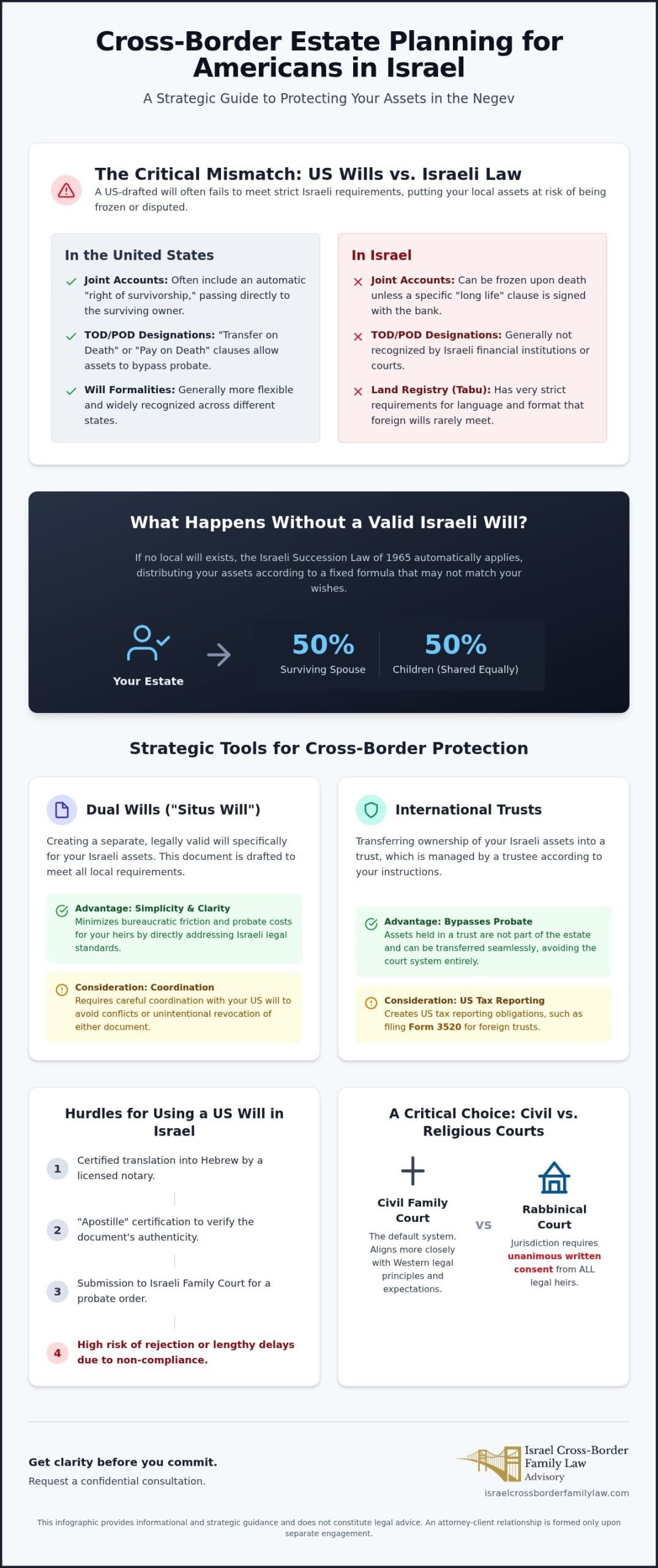
Real estate in Be’er Sheva is registered in the “Tabu,” or Land Registry. This registry is very strict about the language used in foreign documents. A US will often lacks the specific clauses needed to transfer ownership of an apartment in Ramot or Neve Ze’ev. Another common issue is the “right of survivorship” myth. In the US, a joint bank account usually passes automatically to the survivor. In Israel, this is not the case. Banks often freeze joint accounts unless you have signed a specific “long life” clause. Local family courts in the South handle these cases using the 1965 Succession Law, which may not align with your US expectations.
The American Expat Identity in the Negev
Many Americans in the South are faculty at Ben-Gurion University or medical professionals at Soroka. These individuals must manage US federal tax reporting while maintaining their residency in Israel. The US-Israel tax treaty helps prevent double taxation on income, but it does not cover every aspect of an inheritance. You must still account for US estate tax exemptions and foreign asset reporting. Strategic planning helps you balance these two legal worlds. It ensures your residency status does not create unexpected financial burdens for your heirs in the United States.
Conflicts Between Israeli Inheritance Law and U.S. Probate
The foundation of inheritance in Israel is the Succession Law of 1965. This legislation creates a baseline for asset distribution that often surprises Americans accustomed to the flexibility of US probate. For example, US “Transfer on Death” (TOD) or “Pay on Death” (POD) designations, which allow bank accounts to bypass probate in many states, are generally not recognized by Israeli financial institutions. Without a localized strategy, these accounts may be frozen despite your US intentions. Moving your life to the Negev can significantly complicate your estate plan if you rely solely on documents designed for a different jurisdiction.
If an American dies in Be’er Sheva without a valid Israeli will, the state applies strict intestacy rules. Under the 1965 law, the estate is typically split 50/50 between a surviving spouse and children. While this might seem straightforward, the lack of a clear plan can lead to disputes handled by the Registrar of Inheritance or the Family Court. Effective estate planning for Americans in Be’er Sheva prevents these default rules from overriding your actual family needs.
Civil vs. Religious Courts: A Critical Distinction
In Israel, the Rabbinical Court has concurrent jurisdiction with the civil Family Court over inheritance matters. If all legal heirs provide written consent, the estate can be settled according to religious law. However, if even one heir refuses, the case must stay in the civil system. For many Americans, the civil Family Court is the preferred venue because it aligns more closely with Western legal expectations. Maintaining control over which system handles your assets is a key part of strategic planning. It’s often beneficial to discuss your family’s specific dynamics before a crisis occurs to ensure everyone understands the implications of court choice.
Probate Pitfalls for Foreign Documents
Relying on a US will for Israeli assets creates significant bureaucratic friction. To be used in Israel, a US document must be translated into Hebrew by a certified notary and “apostilled” to prove its authenticity. This process is both time consuming and expensive. Even then, a US probate order doesn’t grant automatic access to an apartment in Ramot or a local bank account. You must still apply for an Israeli probate order. Conflicting instructions between a US will and an Israeli will can lead to “clashing” documents, which may result in a court rejecting both versions. Ensuring your global plan is harmonized is essential for a smooth transition of wealth.
Strategic Tools: Dual Wills vs. International Trusts
Effective estate planning for Americans in Be’er Sheva often hinges on the decision to use localized legal tools rather than a single global document. The most common strategy for managing assets across borders is the “Situs Will.” This is a separate, valid will drafted specifically for your assets located in Israel. By isolating your Israeli property, such as a home in the Negev or a local bank account, you ensure that the distribution of these assets follows Israeli law without requiring a court to interpret or validate a foreign US document. This separation reduces the risk of one jurisdiction’s requirements inadvertently invalidating your entire plan.
While wills are the standard, trusts are becoming a more frequent consideration for families with complex cross-border interests. However, Americans must be aware that the Israeli Trust Law and US tax reporting requirements create a heavy administrative burden. Any interest in a foreign trust generally triggers the need for US Form 3520 and 3520-A filings. Failure to meet these reporting standards can result in significant penalties from the IRS, even if no tax is actually owed. Choosing between these tools requires a clear understanding of your long term goals for both privacy and tax efficiency.
When to Choose a Dual-Will Approach
A dual-will approach is often the most efficient path for expats and foreign nationals who want to simplify the Israeli probate process. When an American dies with only a US will, the Israeli court typically requires a formal “expert opinion” on the laws of the specific US state where the deceased lived. This adds significant cost and several months to the timeline. A local “Situs Will” bypasses this requirement because the document is already compliant with the Succession Law of 1965. It provides your beneficiaries with a faster, more predictable path to accessing their inheritance.
Trusts for High-Net-Worth Americans in Be’er Sheva
For those managing high-value assets like technology intellectual property, US brokerage accounts, and Negev real estate, a trust can offer strategic advantages. Modern Israeli trust structures, heavily influenced by the work of practitioners like Alon Kaplan, allow for sophisticated wealth management that remains recognized by local authorities. One primary benefit is privacy; unlike the probate process, which is a matter of public record in Israel, trust administration generally remains private. This is particularly valuable for professionals in Be’er Sheva’s innovation hub who wish to protect sensitive business interests during a generational transfer.
Americans should also approach “Mutual Wills” with caution. While these are a common tool in Israel where spouses sign a joint document, they often contain irrevocability clauses that clash with US estate planning flexibility. Additionally, ensuring guardianship provisions are robust is essential. Your plan must name guardians who are recognized in both the US and Israel to ensure your children are protected regardless of where they are located at the time of a crisis. Making these decisions early prevents the state from stepping in to make them for you.
Practical Steps for Securing Your Negev-Based Assets
Securing your legacy in the Negev requires a methodical transition from US-centric planning to a dual-jurisdiction framework. The first step involves a comprehensive inventory of your global holdings to identify the “Situs” or legal location of each asset. For those engaged in estate planning for Americans in Be’er Sheva, this means distinguishing between US-based brokerage accounts and Israeli-held real estate or pensions. Once your assets are mapped, you must review your existing US estate plan to ensure it doesn’t contain boilerplate language that inadvertently revokes your Israeli documents. Strategic estate planning for Americans in Be’er Sheva prevents conflicts in the Family Court that could freeze your local accounts for months.
Consulting with a cross-border advisor allows you to map out specific jurisdictional risks before they become legal crises. This step leads directly to drafting local documents that satisfy the Israeli Registrar of Inheritance. Finally, you must inform your US-based executors about the Israeli process. Many US executors are unaware that Israeli probate is a separate, mandatory requirement for local assets. They may need guidance on how to coordinate with Israeli representatives to prevent asset freezing or multi-year delays in distribution.
Local Logistics in Be’er Sheva
Residents in the surrounding satellite towns of Omer, Meitar, and Lehavim often hold significant real estate equity that requires precise Southern district registration. Working with local notaries in the South for document verification is a practical necessity that avoids multiple trips to Tel Aviv. Digital assets, including cryptocurrency and online investment platforms, also require a strategy that allows dual-citizen heirs to access passwords and private keys across borders. Ensuring your plan accounts for these technical details is as important as the legal documents themselves.
Updating Your Plan for 2026
As we approach 2026, several regulatory shifts demand attention. The US federal estate tax exemption is verified at $15 million per individual and $30 million for married couples. Estates exceeding these amounts may face tax rates as high as 40 percent on the excess. Simultaneously, Israel has seen advancements in digital signature laws for wills, simplifying the way documents are executed and stored. A regular pricing and strategic review ensures your plan remains compliant with both these tax updates and evolving Israeli probate technologies.
Choosing a Cross-Border Strategy for Your Family’s Future
Selecting the right approach for your estate is a decision that impacts your family for generations. For many expats, the primary challenge isn’t just the law itself, but the lack of coordination between their US and Israeli advisors. Effective estate planning for Americans in Be’er Sheva requires a strategy-first mindset. This means identifying potential jurisdictional conflicts before they result in frozen accounts or lengthy court battles. While a US lawyer is essential for your domestic assets, they cannot navigate the specific requirements of the Israeli Tabu or the local Be’er Sheva family courts. Relying on a single-country professional often leaves gaps that only become visible when it’s too late to correct them.
Determining if your estate is complex enough to require a dual-specialist approach depends on several factors. If you own real estate in the Negev, hold US brokerage accounts, or have heirs residing in both countries, your situation is inherently cross-border. Early decisions are the most powerful tool you have to prevent family litigation. By establishing a clear plan now, you reduce the likelihood of your heirs facing the uncertainty of the Israeli religious court system or the high costs of translating foreign probate orders under pressure.
Clarity Before Commitment
An advisory-first model is often the most secure path because clarity should always precede legal commitment. There’s a significant difference between a generic will and a comprehensive cross-border strategy that accounts for tax treaties and local registry habits. Understanding how the advisory works helps you see the big picture before you begin drafting documents. This stage is about identifying risks and receiving strategic referrals to licensed practitioners who specialize in the nuances of US-Israel inheritance. It’s a proactive way to ensure your plan is built on a foundation of informed choice rather than guesswork.
Next Steps for Be’er Sheva Residents
If you’re ready to move beyond the research phase, the next step is to organize your information for a strategic review. Be’er Sheva residents should prepare a list of all global assets, including their specific locations and current registration details. This preparation is essential for a confidential case review, where we can map out your specific jurisdictional risks. When you approach your first consultation with a clear inventory, you’re better positioned to receive precise guidance on which tools, whether Situs Wills, trusts, or guardianship provisions, are most appropriate for your family’s future.
Securing Your Family Legacy in the Negev
Effective estate planning for Americans in Be’er Sheva requires more than just a standard will; it demands a strategy that bridges two distinct legal cultures. We’ve explored how localized situs wills and an understanding of the 1965 Succession Law can prevent asset freezing and minimize the bureaucratic friction often faced by heirs in both jurisdictions. By addressing US tax reporting requirements and Israeli land registry standards early, you protect your children from the delays of the probate process and the complexities of the religious court system.
Our specialized US-Israel cross-border advisory provides a deep understanding of the Anglo-expat experience in the South. We focus on strategic clarity, offering referrals to multi-qualified practitioners who can implement your plan with precision. Taking these steps today ensures that your property in Be’er Sheva remains a secure asset for your family’s future.
Frequently Asked Questions
Do I need a separate Israeli will if I already have a US will?
Yes, drafting a separate Israeli “Situs Will” is highly recommended for assets located in the Negev. While a US will may be valid under specific conditions, it often lacks the precise language required by the Israeli Land Registry (Tabu). Using a US document in Israel involves expensive translations, apostilles, and expert legal opinions. A local will simplifies the probate process and ensures your intentions are recognized without bureaucratic delays.
Is there an inheritance tax in Israel for US beneficiaries?
Israel does not currently have an inheritance or estate tax; this levy was abolished in 1981. However, US beneficiaries must still consider US federal estate tax obligations on their worldwide assets. As of 2026, the federal exemption is $15 million per individual. While the inheritance itself is tax free in Israel, heirs should prepare for potential capital gains tax (Mas Shevach) if they eventually sell inherited real estate.
Can my American children manage my Be’er Sheva property from abroad?
Yes, American children can manage property in Be’er Sheva from abroad, but they will need to grant a Power of Attorney to a local representative. This allows them to handle utility accounts, rental agreements, or property sales through the Land Registry. Without a localized strategy, distance and language barriers can make simple administrative tasks difficult. Proper estate planning for Americans in Be’er Sheva ensures these transitions are mapped out in advance.
What happens to my Israeli bank account if I don’t have a will?
Without a valid will, your Israeli bank account will likely be frozen immediately upon death. Israel does not automatically recognize the “right of survivorship” common in many US states. If you die intestate, the Succession Law of 1965 dictates how assets are distributed, typically splitting them between a spouse and children. Accessing these funds requires an inheritance order from the Registrar, a process that can take several months to resolve.
How long does the probate process take in Israel for foreigners?
The probate process for foreigners typically takes between six to twelve months depending on document validity and estate complexity. If you rely solely on a US will, the timeline often extends due to requirements for certified translations and expert opinions on foreign law. Early decision making and the use of localized documents can significantly reduce these lead times. This allows your beneficiaries in the US to access assets with less friction.
Are US trusts recognized by Israeli banks and the Land Registry?
Israeli institutions often struggle to recognize US trusts because the concept is handled differently under the Israeli Trust Law. Banks may require extensive documentation and specific Hebrew translations before allowing a trustee to manage accounts. The Land Registry also maintains strict requirements for registering property held in trust. Strategic planning is necessary to ensure your trust structure is compatible with Israeli administrative systems to avoid asset freezing or registration errors.
Can I use an American notary for my Israeli estate documents?
No, documents intended for the Israeli legal system generally require verification by an Israeli notary or a representative at an Israeli consulate. While an American notary is valid for US documents, the Israeli Registrar and the Land Registry expect specific certification formats. If you are in Be’er Sheva, working with a local notary ensures your documents meet the necessary standards for authentication and apostille without causing repeated administrative delays.
What is the difference between a civil will and a religious will in Israel?
A civil will is governed by the Succession Law of 1965 and handled by the Family Court, whereas a religious will falls under the Rabbinical Court. For the Rabbinical Court to preside over an estate, all legal heirs must provide written consent. Many Americans prefer the civil system because its procedures align more closely with Western legal expectations. Effective estate planning for Americans in Be’er Sheva involves choosing the system that best protects your heirs.

Article by
Gabriel Lior
A Personal Journey That Became a Mission
The advisory was founded by an American father Gabriel Lior, LLB, MBA , global entrepreneur, and cross-border advisor who spent more than a decade navigating the Israeli family court system firsthand and now lives in Singapore with his son.
As a divorced parent in a cross-border family, Gabriel faced nearly every legal challenge a foreign parent can encounter in Israel — including child custody disputes, child support proceedings, property matters in Israel and abroad, false accusations, and complex immigration and relocation proceedings.
Over the years, he learned the hard way how difficult it is for non-Israeli parents to understand the system, identify the right legal strategy, and choose the right legal representation — especially when language, culture, and jurisdictional differences are involved. He also witnessed how foreign parents and new immigrants are often disadvantaged or taken advantage of by service providers and institutions simply because they lack local knowledge or fluency.
From Client to Advisor
To truly understand — and survive — the system, Gabriel pursued formal legal education in Israel, completing two Israeli law degrees, alongside a BA and MBA earned in the United States. This was never about becoming a practicing attorney, but about gaining a deep, structural understanding of how the system works — and where it breaks down for foreign parents.
This rare combination of:
Firsthand client experience
Israeli legal and US business education
International business and negotiation training
Decades of commercial execution
created a unique perspective – one that understands both sides of the table.
After years of litigation, persistence, and at times self-representation, he ultimately succeeded in securing custody of his son and relocating abroad through a rare legal victory in the Israeli Supreme Court — becoming one of the first fathers in Israel to do so under these circumstances.
Disclaimer
Important Disclaimer:
The information provided on this website and in its content is for general informational and educational purposes only and does not constitute legal advice, legal opinion, or legal representation.
Gabriel Lior is not licensed to practice law in Israel (nor is he interested in doing so) and does not provide legal services, despite having completed 2 Law Degrees. The services offered are advisory in nature and are intended to provide general guidance, strategic insight, and information regarding cross-border family law considerations.
No attorney-client relationship is formed by accessing this website, reading its content, or communicating with us.
Any decisions made based on this information are at your own discretion and risk. For legal advice specific to your situation, you should consult a licensed attorney in the relevant jurisdiction.
Where appropriate, we may refer clients to independent, licensed attorneys or professionals. Such referrals do not constitute legal representation and no liability is assumed for services provided by third parties.