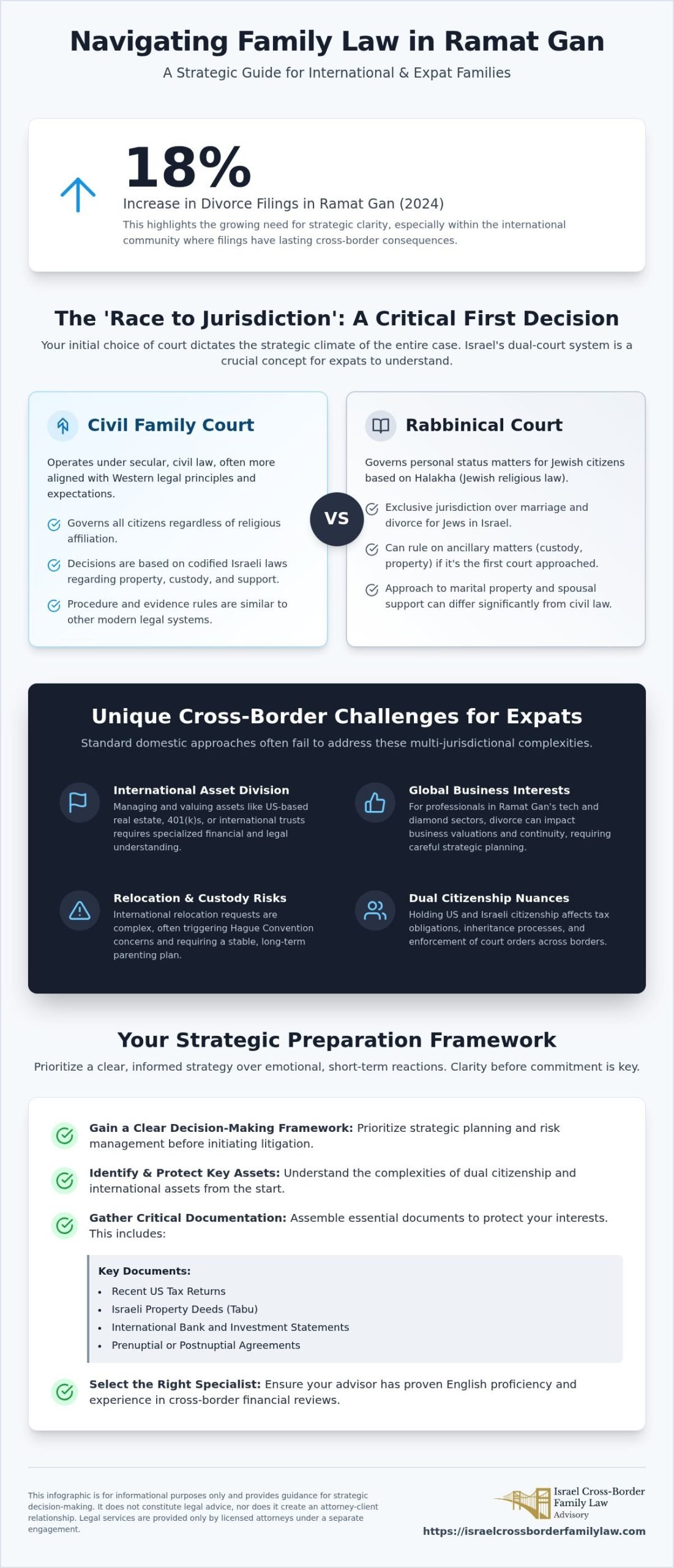
In 2024, Ramat Gan experienced a significant 18% increase in the number of divorces, a statistic that underscores the growing need for strategic clarity within the international community. For expats and international families, these figures reflect a multi-jurisdictional landscape where initial filings carry lasting consequences. Finding a family law specialist Ramat Gan residents can rely on to bridge the gap between foreign expectations and Israeli legal reality is a vital first step. You likely feel the pressure of protecting cross-border assets and parental rights while navigating a system with distinct religious and civil tracks.
It’s understandable to worry about the “race to jurisdiction” between the Rabbinical and Family Courts. We agree that complex international matters require a steady, strategic approach rather than an emotional response. This guide provides a decision-making framework for your family matters, previewing the mandatory dispute settlement process and 2026 updates on court authority. Our goal is to ensure you have the information needed to safeguard your interests before you commit to a legal path. Get clarity before you commit. Request a confidential consultation.
Key Takeaways
- Understand why the initial choice between the Civil Family Court and the Rabbinical Court dictates the strategic climate of your entire case.
- Identify how to manage the unique complexities of dual citizenship and international assets within Ramat Gan’s high-tech and global trade sectors.
- Learn the essential criteria for selecting a family law specialist Ramat Gan who possesses the English proficiency required for cross-border financial review.
- Discover the critical documentation needed to protect your interests, including US tax returns and Israeli property deeds.
- Gain a clear decision-making framework that prioritizes strategic planning and risk management over immediate litigation.
Navigating Family Law in Ramat Gan’s International Landscape
Ramat Gan is a global hub, home to the Israel Diamond Exchange and a surging tech sector. Its residents often maintain lives that span continents. Because of this, Israeli marriage and divorce laws can feel particularly complex for those used to Western civil systems. A family law specialist Ramat Gan professionals consult must understand that a standard domestic approach rarely accounts for the multi-jurisdictional nature of their lives. When assets are spread across the US and Israel, or when a spouse holds dual citizenship, the legal strategy needs to be as sophisticated as the professional lives of the parties involved. Standard local proceedings often fail to address the nuances of foreign-held trusts or international tax obligations.
To better understand how pre-litigation planning can protect your interests, watch this helpful video:
Why Ramat Gan Requires a Specialized Approach
The professional profile of this city involves intricate corporate structures and significant business interests. For those operating within the Diamond Exchange or the many tech hubs, a divorce settlement isn’t just about personal property; it’s about long-term business continuity. Strategic planning must often coordinate with US-Israel M&A strategy, especially for business owners whose company valuations may be impacted by personal legal proceedings. We emphasize a clear decision-making framework that prioritizes the protection of these professional assets through informed choice. This requires a steady, knowledgeable guide who can navigate the challenging intersection of corporate interests and personal status laws.
Common Cross-Border Challenges for Expats
Expats living in Ramat Gan or nearby Givatayim face unique hurdles that local-only frameworks often overlook. Managing assets located in both the US and Israel requires a nuanced understanding of how different jurisdictions interact. Common triggers for seeking an advisory perspective include:
- Cross-border divorce filings involving US-based real estate or retirement accounts.
- International relocation requests that trigger Hague Convention considerations and custody stability fears.
- US-Israel inheritance matters involving complex tax implications and dual-probate requirements.
For deeper context on these issues, visit our page for expats and foreign nationals. An advisory approach serves as a bridge, ensuring your strategy aligns with both Israeli reality and Western expectations. It’s about gaining clarity on risks before making commitments that could affect your global standing.
The ‘Race to Jurisdiction’: Family Court vs. Rabbinical Court
In Israel, personal status issues are governed by a dual-court system that often surprises international residents. You have the choice between the civil Family Court and the religious Rabbinical Court. This concurrent system creates what is commonly known as the “race to jurisdiction.” Essentially, the “race to jurisdiction” is a strategic filing competition where the first spouse to submit a “Settlement of Dispute” application often determines which legal system will oversee the majority of the case. Because the jurisdiction of the Rabbinical Courts and civil courts overlaps on matters like property division and alimony, the choice of venue significantly impacts the eventual outcome.
English speakers who wait too long to consult a family law specialist Ramat Gan often find themselves at a strategic disadvantage. If your spouse files first in the Rabbinical Court and “binds” the financial issues to the divorce claim, you may be forced to litigate property and spousal support under religious law rather than civil statutes. This is particularly risky if you rely on an international prenuptial agreement. While civil Family Courts generally adhere strictly to the terms of a foreign contract, religious courts may interpret these agreements through a different prism, potentially complicating the protection of cross-border assets.
Strategic Implications of the ‘Race’
The differences in how each court approaches alimony and property division are substantial. For instance, the Rabbinical system may view spousal support through traditional religious obligations, which can differ from the civil court’s needs-based approach. Additionally, “Get” (religious divorce) refusal remains a critical risk factor to monitor. A 2025 survey highlighted that national crises can spike divorce filings, making early strategic positioning even more vital. If you find yourself unsure of the next step, you can connect with us via WhatsApp to discuss your strategy.
How Location Impacts Your Case in Central Israel
Living in the Ramat Gan or Tel Aviv district means your case will likely be heard in some of the most sophisticated courtrooms in the country. Local judges in these central districts are often more accustomed to international relocation cases and the nuances of high-net-worth expat lives. However, they still operate within the mandatory mediation framework established by Israeli law. Strategic decisions must be made before the mandatory 45 to 60 day mediation period begins to ensure your jurisdictional preference is secured. Choosing a family law specialist Ramat Gan residents trust for cross-border strategy ensures that these cultural and procedural nuances are factored into your decision-making framework early on.
Criteria for Choosing a Family Law Specialist in Ramat Gan
Selecting a professional to guide your family matters in a foreign country is a high-stakes decision. For the international community in central Israel, a standard directory listing isn’t enough to ensure your global interests are protected. A family law specialist Ramat Gan residents trust must possess more than local credentials. They need a deep familiarity with US legal standards and the ability to operate within an advisory framework. This approach prioritizes strategic planning and risk management over immediate, high-conflict litigation. It’s about finding a guide who understands that your life isn’t confined to a single set of borders.
Native-level English is a non-negotiable requirement for this process. Reviewing cross-border financial documents, US tax returns, and international marriage contracts requires a precision that translation software cannot provide. You need someone who can catch the nuances in a foreign trust document or a corporate filing from the Diamond Exchange. Furthermore, they should demonstrate a proven track record in international child support and custody enforcement. This ensures that any strategy developed locally remains viable and enforceable if you or your children eventually relocate outside of Israel.
Local Knowledge vs. International Expertise
The Israeli “Smadar” system for calculating child support operates on very different principles than many US state guidelines. A professional who can bridge this gap is essential for maintaining your financial stability and protecting your assets. Understanding the interplay of U.S.-Israel cross-border family law ensures that local decisions don’t inadvertently create legal or financial problems abroad. This expertise is particularly important for child support enforcement, where international treaties and local court powers intersect. You deserve a guide who speaks your language and understands the cultural expectations of both jurisdictions.
Red Flags to Avoid When Selecting Representation
Avoid practitioners who push for an “aggressive” stance without first assessing the strategic landscape. In cross-border cases, excessive litigation can quickly drain international assets and damage long-term parental cooperation. Another major red flag is a professional who overlooks the tax implications of US-based assets. Distributing a 401(k) or a US-held property without considering IRS rules can lead to unexpected financial burdens. A one-size-fits-all local approach fails because it doesn’t account for your global footprint. Instead, prioritize a framework that offers clarity on risks and rewards before any formal commitment is made.
Strategic Preparation: Your First Consultation
Entering a consultation without preparation is a common mistake for international families. You need to move from a state of uncertainty to one of informed strategy. A family law specialist Ramat Gan residents consult should help you build a comprehensive overview of your global situation. This involves gathering specific documentation early, such as US tax returns, Israeli property deeds, and original marriage contracts. Preparing for these meetings with a family law specialist Ramat Gan professional ensures you ask the right questions about jurisdictional risks and cross-border enforcement before any filings occur.
Before the meeting, define your primary objectives clearly. Are you prioritizing international relocation, asset protection, or long-term custody stability? Understanding your goals allows for a “clarity before commitment” model. This approach minimizes unnecessary conflict by identifying risks before you commit to a specific legal path. It’s about ensuring your strategy aligns with the reality of both the Israeli and Western systems.
Mapping Your Cross-Border Assets
Identifying cross-border assets requires looking beyond local bank accounts. You must account for complexities like US 401(k) plans, IRAs, and Israeli pension funds or study funds. For those with business interests in the Ramat Gan Diamond Exchange or local tech sectors, financial agreements are essential for protecting professional interests. Asset mapping is the foundation of any divorce strategy because it prevents costly errors in property division that can trigger international tax penalties.
Setting Realistic Expectations for Custody
Custody in an expat context is often viewed through a specific lens by Israeli courts. The “best interests of the child” may include maintaining ties to a foreign culture or extended family living abroad. You should also prepare for the involvement of social workers, known as Pkidot Sa’ad, who play a significant role in local proceedings. It is also vital to review the Hague Convention guidelines if relocation is a potential goal for your family.
The Advisory Approach to US-Israel Family Law
An advisory platform operates differently than a traditional litigation-first law firm. While litigation-first entities often prioritize immediate filing to win the “Race to Jurisdiction,” an advisory model focuses on risk mitigation and informed choice. For international clients, this means having a clear roadmap before entering a courtroom. The How It Works process provides this essential structure. It allows you to evaluate the strategic landscape of your family matters without the pressure of an immediate, high-conflict legal battle. This method ensures you aren’t making decisions based on fear or limited information.
Strategic planning at an early stage is the most effective way to protect your interests. It’s often necessary to consult a family law specialist Ramat Gan families can trust to provide a bridge between Israeli legal reality and Western expectations. By building a strategy that accounts for cross-border asset complexity and multi-jurisdictional custody rules, you avoid common pitfalls. Choosing an advisory path means you’re prioritizing long-term stability over short-term legal maneuvers. It’s about gaining the clarity needed to make decisions that reflect your global footprint.
Bridging the Cultural and Legal Gap
Navigating a foreign legal system requires more than just translation; it requires cultural interpretation. We focus on explaining complex Israeli procedures using familiar US legal concepts. This helps you understand the “why” behind every strategic recommendation. Educational resources, such as those found on the Israel Family Law YouTube channel, empower you with knowledge. When you understand the system, you can make choices that align with your long-term family goals. This educational foundation is vital for families who feel overwhelmed by the dual-court system.
Next Steps for Your Family’s Protection
Protecting your family begins with identifying immediate jurisdictional risks through a confidential review. Strategy should always take precedence over emotional reactions in the early stages of a dispute. A family law specialist Ramat Gan professional can help you determine if your case is better suited for the civil or religious track before the other party makes that choice for you. If you’re ready to explore your options, an advisory call is the best path forward to gain the clarity you need. This proactive step helps you secure your assets and parental rights before the “race” begins in earnest.
Securing Your Global Interests in Ramat Gan
Managing family law in a dual-court system requires a strategic lens that accounts for both local procedures and international obligations. You now understand how the “race to jurisdiction” can impact your future and why mapping cross-border assets is the foundation of any successful strategy. Selecting a family law specialist Ramat Gan residents trust ensures your global footprint is protected through an advisory-first model. This focus on US-Israel cross-border complexity is essential for navigating the Hague Convention and international custody enforcement with confidence.
You don’t have to face these multi-jurisdictional challenges without a clear plan. Prioritizing strategy over emotional reaction allows you to maintain control over your assets and your family’s future. Get clarity before you commit. Request a confidential consultation.
Frequently Asked Questions
Is a US prenuptial agreement enforceable in a Ramat Gan family court?
A US prenuptial agreement is not automatically enforceable in a Ramat Gan family court. It must undergo a formal approval process or be authenticated by an Israeli court to be admissible. While civil courts often respect the terms of foreign contracts, the Rabbinical system may apply different standards. You’ll need to provide notarized Hebrew translations of the document. Strategic planning helps determine which court track offers the best protection for your pre-marital assets.
What is the ‘Race to Jurisdiction’ and how does it affect my divorce in Israel?
The ‘Race to Jurisdiction’ is a strategic competition where the first spouse to file a ‘Settlement of Dispute’ application chooses the court system. This choice determines whether the civil Family Court or the religious Rabbinical Court handles issues like property division. For international residents in Ramat Gan, this decision is critical. It sets the legal climate for the entire case. Waiting too long to decide can lead to your US assets being governed by religious law.
Can I relocate back to the US with my children after filing for divorce in Israel?
You cannot relocate back to the US with your children without either the other parent’s written consent or a specific court order. Israeli courts prioritize the ‘best interests of the child’ and often issue ‘stay of exit’ orders to prevent unilateral relocation during proceedings. If you move without authorization, the Hague Convention on Child Abduction may be triggered. It’s vital to resolve relocation strategy early within the local Ramat Gan or Tel Aviv district framework.
How are US assets like 401(k)s handled in an Israeli divorce settlement?
US assets like 401(k)s and IRAs are typically included in the ‘balancing of resources’ during an Israeli divorce. However, Israeli courts often lack deep familiarity with IRS tax penalties associated with these accounts. A family law specialist Ramat Gan families consult should emphasize the need for a valuation that accounts for these foreign tax liabilities. Without this strategic foresight, you might end up with a settlement that looks fair on paper but carries hidden costs.
How long does a typical cross-border child custody case take in the Israeli system?
A typical cross-border child custody case in the Israeli system can take anywhere from twelve to twenty-four months to reach a final resolution. The process begins with a mandatory forty-five to sixty day mediation period through the court’s Assistance Unit. If mediation fails, the court appoints social workers to provide recommendations. Cases involving the Hague Convention follow an accelerated timeline, though they still require careful strategic coordination to ensure the child’s stability is maintained.
Do I need a lawyer in both the US and Israel for my family law case?
While you aren’t legally required to have a lawyer in both countries, it’s often strategic to have coordination between jurisdictions. An advisory platform acts as a bridge between US expectations and Israeli legal reality. This ensures that your Israeli strategy doesn’t negatively impact your US tax status or future probate needs. Consulting a family law specialist Ramat Gan professional who understands both systems helps you maintain a cohesive global plan for your assets and parental rights.
What is the difference between custody and guardianship under Israeli law?
Guardianship and custody are distinct legal concepts in Israel. Guardianship is almost always shared by both parents and involves major life decisions like medical care, education, and foreign travel. Custody, now often called ‘parental responsibility,’ refers to the day-to-day residence and physical care of the children. Even if one parent has primary residence, the other parent usually retains full guardianship rights. This distinction is crucial for international families planning future relocations.
How can I enforce a US child support order in Israel?
You can enforce a US child support order in Israel through the Law for the Enforcement of Foreign Judgments. This requires a formal application to an Israeli court to recognize and domesticate the US order. Once recognized, the order can be enforced through the Israeli Collection Office. Most US states have reciprocity agreements with Israel. This makes the process more straightforward, provided you have the correct notarized documentation and certified Hebrew translations ready for filing.

Article by
Gabriel Lior
A Personal Journey That Became a Mission
The advisory was founded by an American father Gabriel Lior, LLB, MBA , global entrepreneur, and cross-border advisor who spent more than a decade navigating the Israeli family court system firsthand and now lives in Singapore with his son.
As a divorced parent in a cross-border family, Gabriel faced nearly every legal challenge a foreign parent can encounter in Israel — including child custody disputes, child support proceedings, property matters in Israel and abroad, false accusations, and complex immigration and relocation proceedings.
Over the years, he learned the hard way how difficult it is for non-Israeli parents to understand the system, identify the right legal strategy, and choose the right legal representation — especially when language, culture, and jurisdictional differences are involved. He also witnessed how foreign parents and new immigrants are often disadvantaged or taken advantage of by service providers and institutions simply because they lack local knowledge or fluency.
From Client to Advisor
To truly understand — and survive — the system, Gabriel pursued formal legal education in Israel, completing two Israeli law degrees, alongside a BA and MBA earned in the United States. This was never about becoming a practicing attorney, but about gaining a deep, structural understanding of how the system works — and where it breaks down for foreign parents.
This rare combination of:
Firsthand client experience
Israeli legal and US business education
International business and negotiation training
Decades of commercial execution
created a unique perspective – one that understands both sides of the table.
After years of litigation, persistence, and at times self-representation, he ultimately succeeded in securing custody of his son and relocating abroad through a rare legal victory in the Israeli Supreme Court — becoming one of the first fathers in Israel to do so under these circumstances.
Disclaimer
Important Disclaimer:
The information provided on this website and in its content is for general informational and educational purposes only and does not constitute legal advice, legal opinion, or legal representation.
Gabriel Lior is not licensed to practice law in Israel (nor is he interested in doing so) and does not provide legal services, despite having completed 2 Law Degrees. The services offered are advisory in nature and are intended to provide general guidance, strategic insight, and information regarding cross-border family law considerations.
No attorney-client relationship is formed by accessing this website, reading its content, or communicating with us.
Any decisions made based on this information are at your own discretion and risk. For legal advice specific to your situation, you should consult a licensed attorney in the relevant jurisdiction.
Where appropriate, we may refer clients to independent, licensed attorneys or professionals. Such referrals do not constitute legal representation and no liability is assumed for services provided by third parties.