This article is published on an independent advisory platform and does not imply an attorney-client relationship. Legal services are only provided by licensed attorneys under a separate engagement.
In cross-border litigation, your emotional regulation is just as critical to your legal strategy as the evidence you present in court. It is natural to feel a deep sense of anxiety when facing a trial conducted in Hebrew, especially when the legal standards in Israel differ so sharply from those in the US. The fear of the unknown in a foreign judicial system can make even the most composed person feel a significant loss of control. Learning how to prepare for the emotional stress of a trial is not merely a wellness goal; it is a strategic necessity for navigating the complexities of the Israeli court system.
We understand that the pressure of an international divorce can feel paralyzing. This article offers practical strategies to manage these unique psychological pressures and help you regain your footing. You will learn clear steps to minimize courtroom triggers, gain a better understanding of the process, and discover how to improve communication with your legal team. For further visual guidance, you can also explore resources on our YouTube channel at https://www.youtube.com/@IsraelFamilyLaw. Get clarity before you commit. Request a confidential consultation.
Key Takeaways
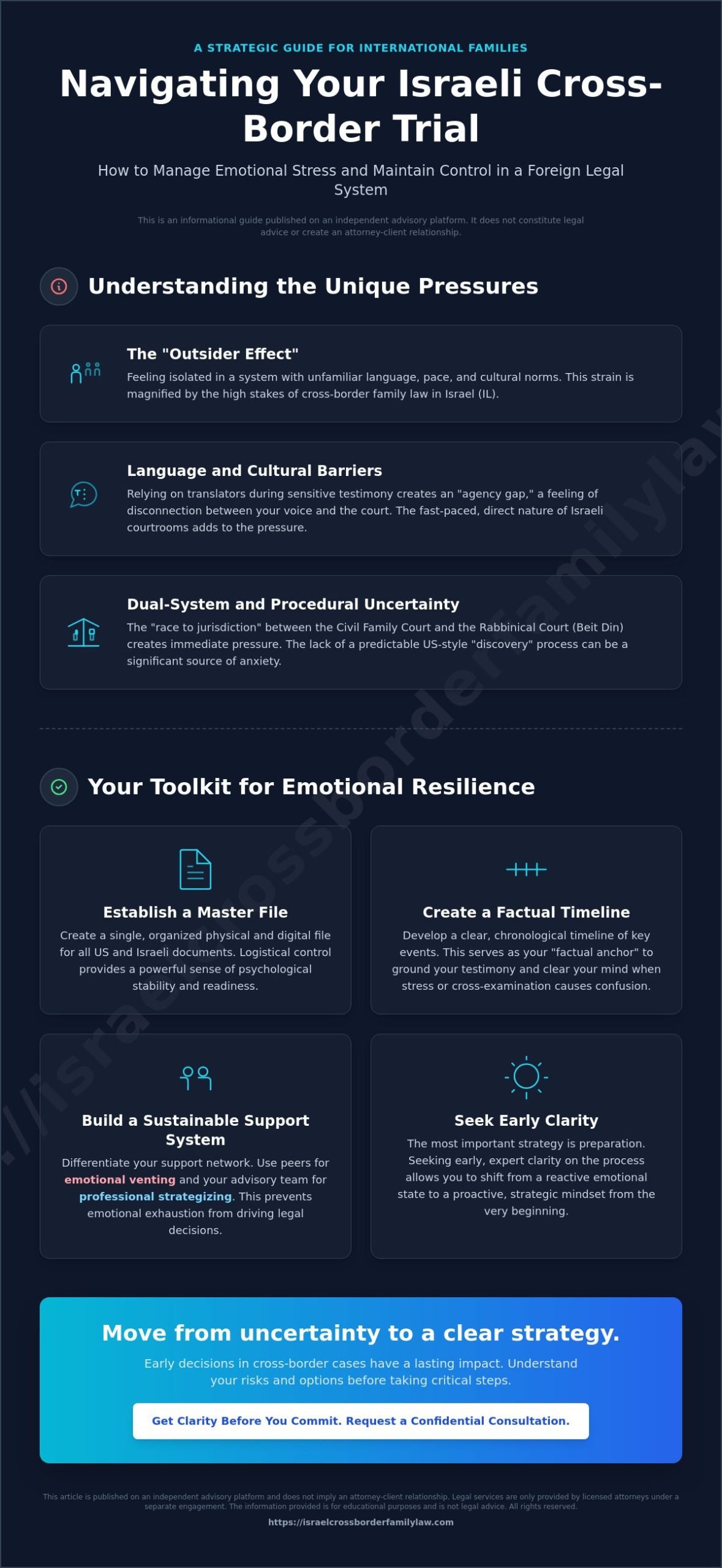
- Identify the unique stressors of the Israeli judicial system, such as the “outsider effect” and the challenges of navigating proceedings conducted in Hebrew.
- Learn how to prepare for the emotional stress of a trial by establishing a Master File and a factual timeline to ground yourself when pressure mounts.
- Develop practical techniques to manage adversarial courtroom triggers and prepare for the psychological intensity of confrontational testimony.
- Establish a sustainable support system by differentiating between emotional venting with peers and professional strategizing with your advisory team.
- Understand the strategic importance of seeking early clarity to prevent emotional exhaustion from driving high-stakes legal and financial decisions.
This article is published on an independent advisory platform and does not imply an attorney-client relationship. Legal services are only provided by licensed attorneys under a separate engagement.
Understanding the Unique Stressors of an Israeli Cross-Border Trial
Litigation stress in the Israeli Family Court, or Beit Mishpat, involves more than the typical anxiety of ending a marriage. It represents the physiological and cognitive strain of managing high-stakes legal proceedings in an environment that feels fundamentally foreign. For Anglos and expats, this often manifests as the “outsider effect.” You aren’t just navigating a divorce; you’re doing so in a system where the language, pace, and cultural assumptions may not align with your background. Understanding the emotional and psychological effects of divorce is the first step in learning how to prepare for the emotional stress of a trial.
To better understand this concept and begin your preparation, watch this helpful video:
The complexity of a cross-border case is amplified by the “dual-system” reality. In IL, the “race to jurisdiction” is a significant factor. The first party to file often determines whether the case is heard in the Civil Family Court or the Rabbinical Court. This creates immediate pressure. Decisions made in the first few days can have long-lasting impacts on asset division or custody. This inherent multi-jurisdictional complexity is why early strategy is vital for divorce and separation for international families.
The Impact of Language and Cultural Barriers
Israeli courtrooms operate at a different tempo than those in the UK or US. The atmosphere is often more direct and intensely fast-paced. Relying on a translator during sensitive testimony can feel like a loss of agency. It creates a barrier between your voice and the judge, which can lead to feelings of helplessness. Recognizing this “agency gap” is essential when considering how to prepare for the emotional stress of a trial. You must account for the time it takes to process information in a second language.
Procedural Uncertainty as a Stress Trigger
In IL, you may face the choice between the Civil Family Court and the Rabbinical Court, known as the Beit Din. Each has its own rules and cultural nuances. Unlike the US system, where “discovery” involves a predictable exchange of documents, the process in Israel can feel less structured to an outsider. This lack of predictability is a valid source of anxiety. It’s helpful to remember that your discomfort stems from the system’s design, not a lack of personal competence. Seeking clarity allows you to move from a reactive emotional state to a proactive strategic one. Get clarity before you commit. Request a confidential consultation.
This article is published on an independent advisory platform and does not imply an attorney-client relationship. Legal services are only provided by licensed attorneys under a separate engagement.
Practical Preparation: Organizing Your Case to Reduce Anxiety
Emotional stability is a strategic asset in any legal proceeding. A chaotic environment often leads to a chaotic mind, which can compromise your ability to make sound decisions. Establishing a physical and digital “Master File” that houses both US and Israeli legal documents ensures you aren’t scrambling during high-pressure moments. It’s vital to get organized to reduce stress, as logistical control often translates into psychological resilience when facing a foreign judiciary.
A chronological timeline of events serves as a factual anchor. When stress clouds your memory during cross-examination, this timeline provides a reliable reference point to ground your testimony. For those navigating divorce and separation for international families, this structural guidance is indispensable. It bridges the gap between your past experiences and the specific requirements of the Israeli court system, allowing you to focus on the facts rather than the friction of the process.
Boundaries are essential for long-term endurance. Set specific “Legal Work Hours” each week to review documents or correspond with your team. Outside these times, don’t engage with case files or legal emails. This prevents the litigation from consuming your personal life and helps you understand how to prepare for the emotional stress of a trial by preserving your mental energy for the actual courtroom appearance. Separating your “legal life” from your “personal life” is a proven method for maintaining perspective.
The Role of Information as an Emotional Buffer
Seeking clarity on Israeli court procedures well before your trial date removes the power of the unknown. Realistically assessing the “worst-case scenario” can actually reduce anxiety by defining the boundaries of your risk. Procedural literacy serves as a tool for emotional grounding by transforming an intimidating foreign process into a series of manageable, predictable steps. When you know what to expect, the system’s ability to trigger a panic response is significantly diminished.
Communication Strategy with Your Advisory Team
Treat updates to your professional team as corporate reports rather than personal vent sessions. Focus on providing concise, factual updates to your lawyer to avoid emotional venting cycles that can cloud legal judgment. Setting clear expectations for response times helps manage “waiting anxiety” between court dates. Additionally, clarify the pricing and cost structure early. Financial transparency eliminates one of the most significant sources of anxiety in cross-border cases. Get clarity before you commit. Request a confidential case review to discuss your strategy.
This article is published on an independent advisory platform and does not imply an attorney-client relationship. Legal services are only provided by licensed attorneys under a separate engagement.
Managing Emotional Triggers in the Courtroom
The courtroom environment is an adversarial one by design. This structure naturally triggers a physical “fight or flight” response, which can impair your ability to think clearly during testimony. In the Israeli system, the judge serves as the sole arbiter of fact and law. Unlike US jury trials, where the goal is often to appeal to the emotions of twelve peers, an Israeli judge focuses on evidence, credibility, and legal precedent. Understanding this shift in audience is a vital part of how to prepare for the emotional stress of a trial.
Adopting the “Neutral Observer” technique allows you to detach from personal attacks. Try to view the proceedings as if you are a corporate consultant reviewing a complex case study rather than a participant in a personal dispute. This mental distance helps you process confrontational questions without a reactive emotional spike. When you treat the trial as a series of factual checkpoints, the opposing counsel’s attempts to trigger you lose their strategic power.
The “Expat Advantage” in Courtroom Presence
Maintaining a composed and authoritative demeanor can be a significant advantage for expats and foreign nationals. Israeli courtrooms can sometimes be boisterous or high-energy. A calm presence often stands out as a mark of credibility and respect for the court. If arguments are being made in Hebrew and you don’t understand every word, don’t panic. Use a deliberate five-second pause before answering any cross-examination question. This provides necessary time for translation and ensures you aren’t reacting out of immediate frustration or confusion.
Handling the Presence of the Opposing Party
Physical positioning within the courtroom is a subtle but effective way to manage anxiety. Minimize direct eye contact with the opposing party; instead, focus your attention on the judge or your own legal team. Recognize that emotional baiting is a common tactic in adversarial litigation. When you choose not to react to a provocative look or comment, you maintain control over the narrative. Having a non-legal support person, such as a trusted advisor or friend, can provide a steadying influence without the pressure of legal strategizing. Get clarity before you commit. Request a confidential consultation.
This article is published on an independent advisory platform and does not imply an attorney-client relationship. Legal services are only provided by licensed attorneys under a separate engagement.
Building a Support System for the Long Haul
Endurance is a requirement for any cross-border legal matter. Litigation in the Israeli family court system often extends over many months, making it essential to view your support system as a long-term infrastructure. For many expats and foreign nationals, this means identifying local Anglo communities or organizations like the AACI that understand the specific cultural friction of living in IL. Connecting with those who have navigated the Beit Mishpat can provide a sense of shared experience that reduces the feeling of isolation.
It is vital to differentiate between “venting” and “strategizing.” While friends provide a necessary outlet for emotional release, they are rarely equipped to offer sound strategic guidance. Relying on social circles for legal interpretation can lead to misinformation and increased anxiety. Instead, focus your emotional energy on trusted peers and reserve your strategic questions for your professional advisors. Self-education is another powerful tool for maintaining control; resources like the Israel Family Law YouTube channel offer clear explanations of the system that can help you understand how to prepare for the emotional stress of a trial without the pressure of a ticking billable clock.
Biological stress buffers are often the first things neglected during a trial, yet they are the most fundamental. Sleep deprivation, poor nutrition, and a lack of physical movement diminish your cognitive capacity and emotional resilience. Treat your physical health as a component of your legal readiness. A well-rested mind is far more capable of processing complex information and remaining calm under cross-examination than one pushed to its biological limits.
Managing Cross-Border Support Networks
Expats face the unique challenge of the “Time Zone Gap.” When you need emotional support after a difficult morning hearing, your primary support network in the US or Canada may still be asleep. This delay can amplify feelings of loneliness. Additionally, explaining the nuances of the Israeli legal system, such as the role of the Rabbinical Court, to loved ones abroad can be exhausting. Set boundaries on these conversations. You don’t have to justify the complexities of a foreign system to everyone in your life; choose one or two “point people” to update and keep the rest of your social interactions focused on life outside the trial.
Professional Emotional Support
Professional coaching or therapy can be a strategic investment during a high-conflict divorce. Seek a therapist who understands expat transitions or the specific nature of litigation trauma. It is important to distinguish this from legal representation. An emotional coach helps you manage the internal response to the case, while your legal team manages the external facts. Ensuring these two systems are aligned with your long-term goals prevents emotional impulses from derailing your legal strategy. Get clarity before you commit. Request a confidential consultation to build your advisory team.
This article is published on an independent advisory platform and does not imply an attorney-client relationship. Legal services are only provided by licensed attorneys under a separate engagement.
The Strategic Value of Early Clarity and Advisory Support
Engaging with the Israeli legal process only when you reach a personal breaking point significantly inflates both the emotional and financial investment required. Proactive engagement allows you to move away from crisis management and toward a structured, risk-based strategy. While the tension of a cross-border divorce is often unavoidable, the long-term damage caused by that stress is manageable through early intervention. Understanding how to prepare for the emotional stress of a trial involves more than just mental exercises; it requires a comprehensive review of your legal position before the pressure of the courtroom begins.
Strategic planning serves as a preventative measure against the “emergencies” that frequently derail international cases. When you have a clear roadmap, you’re less likely to be blindsided by procedural shifts in the Beit Mishpat or unexpected rulings from the Rabbinical Court. This foresight directly reduces the cognitive load on you during the trial. By identifying potential risks early, you can make decisions based on logic rather than the immediate emotional triggers discussed in previous sections. Emotional stability isn’t just a personal goal; it’s a critical component of your courtroom presence and overall credibility.
Seeking an Independent Perspective
An advisory review provides a neutral perspective on the multi-jurisdictional complexities of your case. This independent assessment allows you to gain a realistic view of the Israeli system without the inherent bias of an adversarial environment. You can explore how it works to understand the process of gaining this essential clarity. Knowing the “map” of the Israeli judicial landscape removes the fear of the unknown, transforming an intimidating foreign journey into a series of calculated steps. This procedural literacy acts as a psychological buffer, ensuring you remain the primary driver of your case’s direction.
Next Steps: From Anxiety to Action
The transition from worrying to preparing is a significant milestone in any legal journey. If children are involved, this transition must include a robust international custody and relocation strategy. Addressing these high-stakes issues early prevents them from becoming overwhelming sources of anxiety during the trial itself. Focus on actionable tasks that strengthen your position. Organize your documentation, refine your communication with your legal team, and maintain your physical health as a biological defense against stress. Your emotional stability remains your greatest asset in the courtroom. Get clarity before you commit. Request a confidential consultation.
This article is published on an independent advisory platform and does not imply an attorney-client relationship. Legal services are only provided by licensed attorneys under a separate engagement.
Moving Forward with Strategic Composure
Navigating an Israeli divorce trial requires more than legal knowledge; it demands a high degree of psychological resilience. By establishing procedural literacy and maintaining a structured Master File, you transform a foreign judicial process into a manageable series of strategic steps. We’ve previously examined the importance of the “Neutral Observer” technique and the necessity of building a local support system that accounts for the unique challenges of the expat experience.
Learning how to prepare for the emotional stress of a trial is a vital component of protecting your long-term interests and the well-being of your family. Our advisory platform focuses on the multi-jurisdictional complexity of US-Israel family law. We provide the Anglo community with strategy-based risk assessments that prioritize clarity over conflict. This approach ensures that your decisions are grounded in logic rather than the immediate pressures of the courtroom.
Get clarity before you commit. Request a confidential consultation to discuss your specific circumstances and begin your journey toward a stable resolution. You don’t have to navigate this transition alone.
This article is published on an independent advisory platform and does not imply an attorney-client relationship. Legal services are only provided by licensed attorneys under a separate engagement.
Frequently Asked Questions
Is it normal to feel physically ill before an Israeli court hearing?
It is entirely common to experience physical symptoms like nausea, headaches, or insomnia before a hearing in the Beit Mishpat. The adversarial nature of the Israeli legal system often triggers a “fight or flight” response. You can manage these biological triggers by prioritizing sleep and nutrition in the days leading up to your appearance. Treating your physical health as part of your legal readiness helps buffer the impact of litigation stress.
How can I handle the stress of not understanding everything said in Hebrew during my trial?
You can handle the language barrier by requesting a qualified translator and using the “Five-Second Pause” before answering any questions. This technique gives you the necessary time to process the Hebrew arguments and ensures your English response is measured. Maintaining a calm presence even when you don’t understand every word is a significant mark of credibility in the Israeli system. Get clarity before you commit. Request a confidential consultation.
What should I do if the opposing counsel tries to provoke me emotionally?
The best response to emotional provocation is to adopt the “Neutral Observer” technique. View the opposing counsel’s tactics as a predictable part of their legal strategy rather than a personal attack. By choosing not to react, you maintain control of the narrative and preserve your standing with the judge. Focus your attention on the facts of your Master File rather than the friction of the confrontation.
Can the judge in Israel take my emotional state into account during the trial?
Israeli judges primarily focus on evidence, legal precedents, and the credibility of the parties involved. While they may recognize the difficulty of a cross-border divorce, they don’t typically make rulings based on subjective emotional states. However, your ability to remain composed and factual during your testimony directly influences how the judge perceives your reliability. This is a key reason why learning how to prepare for the emotional stress of a trial is so vital.
How do I manage the stress of a trial that spans across two different countries?
Managing a cross-border trial requires a centralized digital Master File and a clear timeline to anchor your memory. This organization is a fundamental part of how to prepare for the emotional stress of a trial when dealing with multi-jurisdictional complexity. You must also set boundaries with support networks in different time zones to ensure you aren’t constantly discussing the case at all hours of the day or night.
What is the best way to explain the trial stress to my children without oversharing?
Provide your children with simple, age-appropriate facts about the schedule of the trial without discussing the conflict or the opposing party. Focus on reassuring them of their own routine and security within the home. It’s helpful to explain that the “grown-ups are working with professionals” to solve problems. For more guidance on international family dynamics, you can view resources on our YouTube channel at https://www.youtube.com/@IsraelFamilyLaw.
Does the Israeli family court offer any emotional support services for litigants?
The Israeli Family Court system includes a social service unit known as Yechidat Hasiyuah. This unit primarily focuses on short-term crisis intervention, mediation, and assessing the best interests of children. While they provide a helpful bridge between the legal and social aspects of a case, they don’t offer long-term therapy. Most expats find it more effective to engage a private therapist who understands the specific pressures of international transitions.
How can I keep my professional life on track while dealing with a stressful trial in Israel?
You can protect your career by establishing strict “Legal Work Hours” and keeping all case-related correspondence out of your professional workspace. This boundary prevents the trial from consuming your mental energy during the business day. Treat your legal case as a secondary project that requires scheduled attention rather than a constant distraction. Maintaining your professional routine provides a necessary sense of normalcy and achievement outside the courtroom environment.

Article by
Gabriel Lior
A Personal Journey That Became a Mission
The advisory was founded by an American father Gabriel Lior, LLB, MBA , global entrepreneur, and cross-border advisor who spent more than a decade navigating the Israeli family court system firsthand and now lives in Singapore with his son.
As a divorced parent in a cross-border family, Gabriel faced nearly every legal challenge a foreign parent can encounter in Israel — including child custody disputes, child support proceedings, property matters in Israel and abroad, false accusations, and complex immigration and relocation proceedings.
Over the years, he learned the hard way how difficult it is for non-Israeli parents to understand the system, identify the right legal strategy, and choose the right legal representation — especially when language, culture, and jurisdictional differences are involved. He also witnessed how foreign parents and new immigrants are often disadvantaged or taken advantage of by service providers and institutions simply because they lack local knowledge or fluency.
From Client to Advisor
To truly understand — and survive — the system, Gabriel pursued formal legal education in Israel, completing two Israeli law degrees, alongside a BA and MBA earned in the United States. This was never about becoming a practicing attorney, but about gaining a deep, structural understanding of how the system works — and where it breaks down for foreign parents.
This rare combination of:
Firsthand client experience
Israeli legal and US business education
International business and negotiation training
Decades of commercial execution
created a unique perspective – one that understands both sides of the table.
After years of litigation, persistence, and at times self-representation, he ultimately succeeded in securing custody of his son and relocating abroad through a rare legal victory in the Israeli Supreme Court — becoming one of the first fathers in Israel to do so under these circumstances.
Disclaimer
Important Disclaimer:
The information provided on this website and in its content is for general informational and educational purposes only and does not constitute legal advice, legal opinion, or legal representation.
Gabriel Lior is not licensed to practice law in Israel (nor is he interested in doing so) and does not provide legal services, despite having completed 2 Law Degrees. The services offered are advisory in nature and are intended to provide general guidance, strategic insight, and information regarding cross-border family law considerations.
No attorney-client relationship is formed by accessing this website, reading its content, or communicating with us.
Any decisions made based on this information are at your own discretion and risk. For legal advice specific to your situation, you should consult a licensed attorney in the relevant jurisdiction.
Where appropriate, we may refer clients to independent, licensed attorneys or professionals. Such referrals do not constitute legal representation and no liability is assumed for services provided by third parties.