This article is published on an independent advisory platform (not a law firm). This content does not imply an attorney-client relationship, legal representation, or the provision of legal advice. We focus on strategy, risks, and decision-making guidance for international families.
You’ve built a new life in Ashdod, but the financial security you brought from the United States feels increasingly fragile as your alimony payments become irregular or stop entirely. It’s exhausting to manage the transition to a new country while worrying about how to pay for daily essentials. You know you have a valid US court order, but the gap between American law and the Israeli enforcement system can feel like an unbridgeable chasm. Successfully enforcing alimony from the US in Ashdod isn’t an automatic process. The complexity of cross-border law often leaves families feeling financially vulnerable and overwhelmed by language barriers in the local court system.
This guide bridges that gap. You’ll learn the strategic steps required to register your foreign support order and ensure the Israeli legal system recognizes your right to consistent payments. We’ll explore the essential requirements of the Foreign Judgments Enforcement Law, explain how local reciprocity works, and outline the specific path through the Ashdod Family Court. Get clarity before you commit. Request a confidential consultation.
Key Takeaways
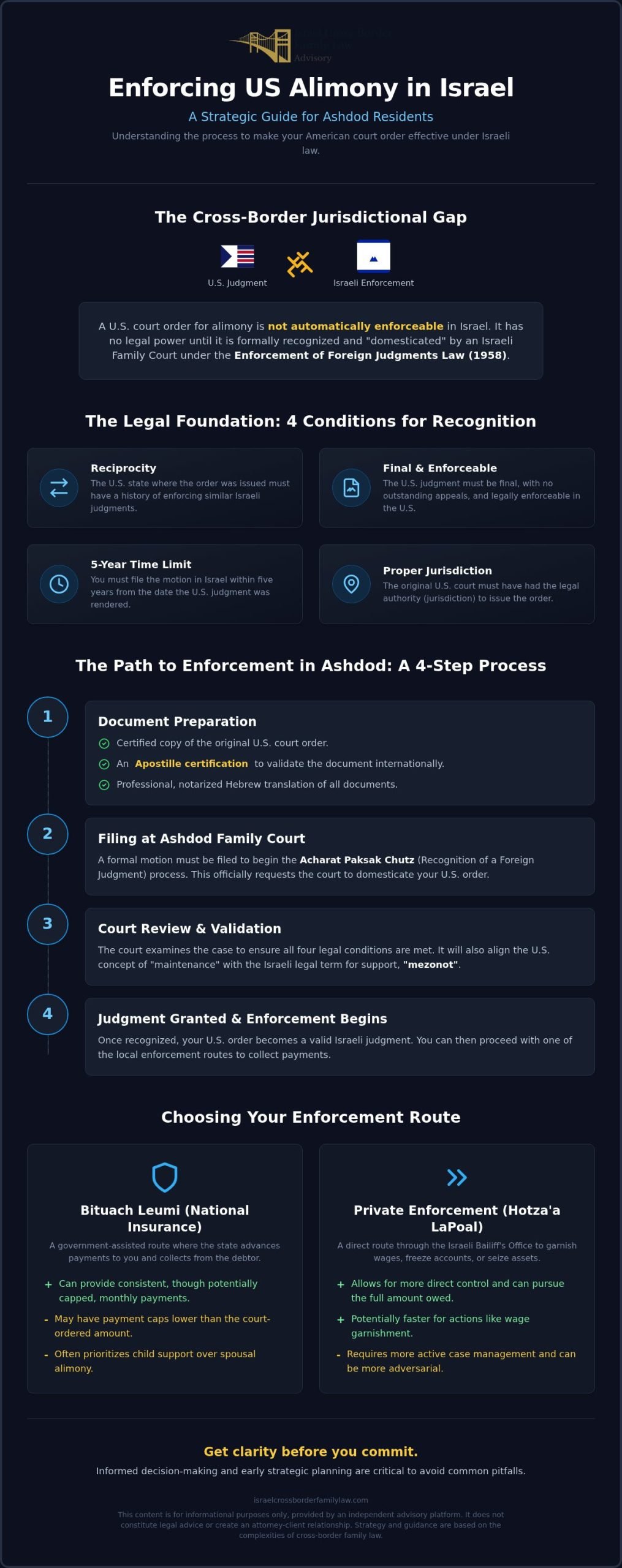
- Understand that a US court order is not automatically valid in Israel and must be formally registered under the Enforcement of Foreign Judgments Law (1958).
- Learn why the principle of reciprocity is a critical legal threshold for successfully enforcing alimony from the US in Ashdod.
- Compare the strategic advantages and limitations of using Bituach Leumi (National Insurance) versus pursuing private enforcement routes.
- Identify the essential documentation, including Apostille certifications and certified Hebrew translations, required by the Ashdod Family Court.
- Discover how informed decision-making and early strategic planning can help you avoid common procedural pitfalls that lead to claim dismissal.
This article is published on an independent advisory platform (not a law firm). Do NOT use language that implies attorney-client relationship, legal representation, or giving legal advice. Focus on strategy, risks, and decision-making guidance. Soft CTA to advisory call / WhatsApp.
Why Enforcing US Alimony in Ashdod Requires a Specialized Strategy
Many expats and returning Israelis assume that a signed divorce decree from a US court is a universally recognized document. However, the Israeli legal system operates under its own strict sovereignty. An Ashdod bank or employer is legally prohibited from garnishing wages or transferring funds based solely on an American order. Without local validation, your US judgment is effectively invisible to the Israeli authorities. To bridge this gap, you must engage with The Legal Framework: Registering a Foreign Judgment in Israel. This process ensures that your rights are protected under Israeli law and that the financial obligations established in the US are actually honored here.
To better understand these complex international dynamics, we recommend reviewing the educational resources and case strategy insights provided on the Israel Family Law YouTube channel. These videos offer visual guidance on the nuances of domesticating foreign orders within the Israeli court system.
Understanding the Jurisdictional Gap
The core of the challenge lies in a procedure known as Acharat Paksak Chutz, or the recognition of a foreign judgment. Israel doesn’t automatically enforce US orders because there’s no bilateral treaty for the reciprocal enforcement of civil judgments between the two nations. Instead, enforcement relies on the principle of reciprocity within Israeli domestic law. It’s also vital to distinguish between child support and spousal alimony. Israeli courts often prioritize child support (mezonot yeladim) due to the immediate needs of the minor, while spousal alimony (mezonot isha) may face different scrutiny regarding its duration and the original jurisdiction’s intent.
The Role of the Ashdod Family Court
For residents of the southern coastal region, the Ashdod Family Court is the primary venue for enforcing alimony from the US in Ashdod. This court requires all foreign documents to be professionally translated into Hebrew and notarized by an Israeli notary. The court will also evaluate how the US-based concept of “maintenance” aligns with the Israeli concept of “mezonot”. Misalignments in these definitions can lead to delays in payment or even the rejection of the registration request.
A specialized strategy is also necessary to handle the financial logistics of cross-border enforcement. You must account for currency fluctuations as the debt is converted from USD to Israeli Shekel (₪). Standard local practitioners might overlook the tax implications of receiving these funds in Israel or the specific interest rates applied to arrears under the Bank of Israel guidelines. Early strategic decisions regarding these technical details are critical to ensuring your monthly payments remain stable. You can learn more about how these moving parts fit together by reviewing our guide on child support cross-border enforcement. Get clarity before you commit. Request a confidential consultation.
This article is published on an independent advisory platform (not a law firm). Do NOT use language that implies attorney-client relationship, legal representation, or giving legal advice. Focus on strategy, risks, and decision-making guidance. Soft CTA to advisory call / WhatsApp.
The Legal Framework: Registering a Foreign Judgment in Israel
The foundation of your case rests on the Foreign Judgments Enforcement Law (5718-1958). This statute dictates how Israeli courts, including the one in Ashdod, validate orders issued by foreign jurisdictions. Under this law, your US judgment isn’t merely a piece of evidence; it’s a legal debt that must be officially “domesticated.” You must file your motion to enforce within five years from the date the original US judgment was rendered. If you miss this window, your claim could be time-barred. Additionally, the order must be final and no longer subject to appeal in its home state. The Ashdod Family Court won’t enforce an interim or temporary order that could still be overturned by a US judge.
Reciprocity is another critical pillar for enforcing alimony from the US in Ashdod. Israeli law requires a “liberal interpretation” of reciprocity, meaning you don’t have to prove that the US state has enforced an Israeli order before. You only need to demonstrate that the US state would likely enforce a similar Israeli judgment if presented with one. This ensures that the legal cooperation is a two-way street, protecting the integrity of both systems.
The Hague Convention and US-Israel Reciprocity
The 2007 Hague Convention on the International Recovery of Child Support and Other Forms of Family Maintenance has simplified the process significantly. It established a network of Central Authorities designed to coordinate support collection across borders. In Israel, the Ministry of Justice acts as this central hub. This Step-by-Step Guide to Enforcing Your US Support Order in Ashdod highlights how these authorities share data and verify the payer’s assets. While there’s no general federal enforcement treaty, the Hague Convention provides a robust mechanism for family support specifically.
Before proceeding, it’s vital to evaluate your state’s specific standing to ensure your documentation meets these international standards.
Necessary Documentation for Ashdod Courts
To begin the process in Ashdod, you’ll need a certified copy of your US decree bearing an Apostille. This certification verifies the document’s authenticity for international use. You also need professional Hebrew translations of every page. The court filing fee is approximately ₪1,300, which must be paid when you submit the motion. Finally, you’ll provide an affidavit confirming the exact debt amount and the payer’s residential or employment address in Ashdod. This local specificity is essential for the court to exercise its jurisdiction and eventually issue a collection order. Missing any of these technical requirements can lead to immediate delays or even the dismissal of your application.
This article is published on an independent advisory platform (not a law firm). Soft CTA to advisory call / WhatsApp.
Comparing Enforcement Routes: Bituach Leumi vs. Private Action
Once your US judgment is formally registered with the Israeli court, the focus shifts from legal recognition to actual collection. In Ashdod, you generally face a choice between two distinct administrative paths. Each route carries different risks regarding the total amount you receive and the speed of the payments. Your decision should depend on the payer’s employment status, their history of cooperation, and your immediate need for financial liquidity. Successfully enforcing alimony from the US in Ashdod requires choosing the mechanism that best aligns with your family’s specific economic reality.
Path A: Bituach Leumi (National Insurance)
Bituach Leumi acts as a social safety net by providing a guaranteed monthly payment to the recipient. They then take on the responsibility of collecting the debt from the payer. This path offers high certainty; you’ll receive funds even if the payer attempts to hide their income. However, there are significant trade-offs. The payments are capped by specific regulations. As of January 2026, the maximum benefit for a woman with two or more children is ₪4,049. If your US order specifies a higher amount, you won’t receive the full balance through this government channel. There are also strict income tests for the recipient, meaning if you earn above a certain threshold, you might be ineligible for this service. Residents can apply at the local Ashdod branch of the National Insurance Institute once their foreign judgment is registered.
Path B: The Execution Office (Hotsaa L’Poal)
If you pursue private enforcement through the Execution Office, you can collect the full amount stipulated in your US decree. This includes any arrears and legal interest. Since the Bank of Israel lowered its benchmark interest rate to 3.5% in July 2026, the interest on judgment debts remains a significant factor in long-term collection. This route is more aggressive and offers several powerful tools to compel payment:
- Bank Account Liens: Freezing the payer’s local Israeli accounts to secure the debt.
- Stay of Exit Orders: Preventing the payer from leaving Israel until the debt is settled or secured.
- Asset Seizure: Placing liens on vehicles or property located within the Ashdod area.
- License Suspensions: Restricting the payer’s ability to hold a driver’s license or professional permits.
While Path B allows for higher recovery, it requires active management and a clear understanding of the payer’s local assets. It’s often the preferred choice when the payer has a stable, high-income job or significant assets in Israel. You can explore how these different strategies impact your long-term planning by reviewing our strategic framework. Get clarity before you commit. Request a confidential consultation.
This article is published on an independent advisory platform (not a law firm). Soft CTA to advisory call / WhatsApp.
Step-by-Step Guide to Enforcing Your US Support Order in Ashdod
Moving from a theoretical legal right to receiving actual monthly payments requires a disciplined, sequential approach. In the Ashdod area, this means coordinating between international standards and local municipal enforcement. Understanding how it works is the first step in aligning your expectations with the timeline of the Israeli court system. Success depends on meticulous local service of process and a clear map of the debtor’s assets within the city. You don’t want to wait until the end of the process to realize the payer has moved their funds or left the jurisdiction.
Step 1: Consultation and Case Review
The process begins with a rigorous audit of your existing US divorce decree. It’s essential to verify that the order is final and that the original jurisdiction had the authority to issue it. A confidential case review serves as the foundation for this strategy. During this phase, it’s critical to identify reachable assets in Ashdod, such as local bank accounts, real estate, or employment income. Identifying these early ensures that once recognition is granted, you can move immediately to secure the funds. We focus on the practical reality of where the money is located before filing any papers.
Step 2: Filing the Petition for Recognition
Once the audit is complete, you’ll submit a formal petition to the Family Court in Ashdod. This is the stage where the US judgment is formally “domesticated.” The debtor will have a specific window to respond to the petition. A common defense involves the debtor claiming they weren’t properly served in the original US proceedings. Overcoming these hurdles requires documented proof that the US case followed due process. The court also checks if the judgment contradicts Israeli public policy. Clear, notarized documentation and professional translations are your best defense against these procedural delays.
Step 3: Opening an Execution File
After the Ashdod court recognizes the order, it must be converted into an active collection file at the Execution Office (Hotsaa L’Poal). This transition is vital for enforcing alimony from the US in Ashdod. You’ll set up an automated payment tracking system that monitors every ₪ transferred. If the payer misses the first payment, the system allows for the immediate initiation of sanctions. This can include travel bans, bank account freezes, or license suspensions. Consistent monitoring ensures that the legal pressure remains high until the debt is satisfied and regular payments resume.
This article is published on an independent advisory platform (not a law firm). Soft CTA to advisory call / WhatsApp.
Navigating Cross-Border Complexity with Professional Strategy
Successfully enforcing alimony from the US in Ashdod requires more than a literal translation of a court order. It demands a nuanced appreciation for the cultural and linguistic differences that define the Israeli legal environment. While the Ashdod Family Court is accustomed to diverse populations, the administrative procedures remain deeply rooted in local Hebrew-speaking bureaucracy. Attempting a “do-it-yourself” approach often results in procedural dismissals. This happens because foreign residents may not understand the specific formatting or evidentiary standards required by Israeli judges. A bridge advisor serves as a critical link, translating not just the language, but the legal expectations between two very different systems.
The US-Israel time difference also creates a significant communication gap. If you aren’t proactive, your US legal team and your Israeli advisors might operate in silos. This lack of coordination can lead to conflicting strategies that confuse the court. Managing a case across eight to ten time zones requires a structured approach to ensure that documents are filed and served according to both jurisdictions’ timelines. Strategic oversight ensures that every action taken in Ashdod strengthens, rather than weakens, your standing in the United States.
Avoiding Common Pitfalls
One major risk involves the technical management of the debt itself. For example, using an incorrect currency conversion rate can lead to protracted legal disputes over the exact balance in ₪. You must also keep the original US court informed of your Israeli collection efforts. Failing to do so can lead to accusations of “double dipping” or contempt of court in your home state. Additionally, the tax implications are often overlooked. While child support is generally not taxed as income, spousal alimony may be treated differently depending on the specific language of your decree and your residency status. Failing to account for these variables can lead to unexpected liabilities with the Israel Tax Authority or the IRS.
Next Steps for Clarity
Taking the first step toward financial stability shouldn’t be overwhelming. Working with an expat-focused advisor ensures that your case is handled with an understanding of the unique challenges facing international families. Before you begin, reviewing the pricing structure for cross-border support cases can provide the transparency you need to make an informed choice. Clarity before commitment is the most effective way to protect your family’s future. Get clarity before you commit. Request a confidential consultation.
This article is published on an independent advisory platform (not a law firm). Soft CTA to advisory call / WhatsApp.
Securing Your Financial Future in Ashdod
Restoring your family’s financial stability requires moving beyond the simple possession of a US court order. You’ve learned that formal registration under the 1958 Law is the essential first step to making your legal rights visible within the Israeli system. Whether you choose the safety net of Bituach Leumi or the full recovery potential of the Execution Office, your success depends on local precision and strategic timing. Our advisory provides the specialized strategic support enforcement that international families need to navigate these hurdles.
Successfully enforcing alimony from the US in Ashdod is a process that rewards clarity and proactive management. By bridging the gap between American legal requirements and Israeli procedural nuances, we help US expats in Israel transform a foreign judgment into a reliable monthly payment. This journey involves managing complex currency conversions, professional translations, and local service of process with authoritative cross-border expertise.
You don’t have to face these jurisdictional challenges alone. With an informed strategy and a clear understanding of the Ashdod court system, you can achieve the consistent financial support your family deserves. Take the first step toward a more predictable future today.
This article is published on an independent advisory platform (not a law firm). Soft CTA to advisory call / WhatsApp.
Frequently Asked Questions
Can I enforce a US alimony order in Israel if my ex-spouse lives in Ashdod?
Yes, you can enforce a US alimony order by domesticating the judgment through the Ashdod Family Court. This procedure requires the order to be final and no longer subject to appeal in the United States. Once the court registers the judgment, it carries the same legal weight as an Israeli court decision. This allows you to pursue local enforcement actions such as bank account liens or wage garnishments within the Ashdod jurisdiction.
How long does the registration process take in the Ashdod Family Court?
The registration process typically spans several months, depending on the court’s current docket and whether the opposing party contests the motion. For a standard case involving enforcing alimony from the US in Ashdod, you should anticipate a timeline of four to eight months. Delays often occur if documentation is incomplete or if the debtor raises procedural defenses regarding service of process in the original American proceedings.
Do I need to travel to Israel to enforce my support order?
Physical presence in Israel is often not required if you engage a professional representative to manage the filing and administrative steps. Most proceedings in the Ashdod Family Court regarding the recognition of foreign judgments are handled through written submissions and affidavits. While a judge might request a hearing in complex or contested cases, many international families successfully manage the entire enforcement process remotely while residing abroad.
What happens if my ex-spouse claims they cannot afford the US-ordered amount?
A claim of financial hardship does not automatically invalidate the registered US order. The debt remains legally binding, and the Execution Office has the authority to investigate the payer’s assets and income in Israel. If the debtor truly lacks the means to pay the full amount, they may request a payment investigation. However, the burden of proof rests entirely on the debtor to demonstrate their lack of reachable assets or income.
Can Bituach Leumi help me collect alimony from a US citizen living in Israel?
Bituach Leumi can facilitate collection if you meet their specific eligibility criteria, including residency and income thresholds. As of January 2026, the maximum monthly benefit for a woman with two children is ₪4,049. While this provides a guaranteed floor payment, it often falls below the original US-ordered amount. Bituach Leumi then pursues the payer, regardless of their citizenship, to recover the funds they have advanced to you.
Will the Israeli court change the amount of alimony set by the US judge?
During the registration phase, the Israeli court does not typically modify the amount specified in the foreign judgment. Its role is limited to verifying the order’s validity and ensuring it doesn’t contradict Israeli public policy. However, once the order is registered, either party may file a new, separate motion to modify the support amount based on a significant change in circumstances, such as a major shift in income.
What documents do I need to start the enforcement process in Ashdod?
You must provide a certified copy of the US divorce decree or support order bearing an original Apostille certification. Additionally, the Ashdod court requires professional Hebrew translations of all documents, which must be notarized in Israel. You will also need to submit an affidavit confirming the current debt balance and providing the payer’s address in Israel. These documents are essential for enforcing alimony from the US in Ashdod.
Can I place a travel ban on my ex-spouse if they refuse to pay alimony?
Yes, a stay of exit order is one of the most effective tools available through the Execution Office. If the payer fails to meet their registered obligations, this order prevents them from leaving Israel until the debt is paid or secured. This is particularly powerful in cross-border cases where the payer may otherwise attempt to relocate to avoid their financial responsibilities. Get clarity before you commit. Request a confidential consultation.

Article by
Gabriel Lior
A Personal Journey That Became a Mission
The advisory was founded by an American father Gabriel Lior, LLB, MBA , global entrepreneur, and cross-border advisor who spent more than a decade navigating the Israeli family court system firsthand and now lives in Singapore with his son.
As a divorced parent in a cross-border family, Gabriel faced nearly every legal challenge a foreign parent can encounter in Israel — including child custody disputes, child support proceedings, property matters in Israel and abroad, false accusations, and complex immigration and relocation proceedings.
Over the years, he learned the hard way how difficult it is for non-Israeli parents to understand the system, identify the right legal strategy, and choose the right legal representation — especially when language, culture, and jurisdictional differences are involved. He also witnessed how foreign parents and new immigrants are often disadvantaged or taken advantage of by service providers and institutions simply because they lack local knowledge or fluency.
From Client to Advisor
To truly understand — and survive — the system, Gabriel pursued formal legal education in Israel, completing two Israeli law degrees, alongside a BA and MBA earned in the United States. This was never about becoming a practicing attorney, but about gaining a deep, structural understanding of how the system works — and where it breaks down for foreign parents.
This rare combination of:
Firsthand client experience
Israeli legal and US business education
International business and negotiation training
Decades of commercial execution
created a unique perspective – one that understands both sides of the table.
After years of litigation, persistence, and at times self-representation, he ultimately succeeded in securing custody of his son and relocating abroad through a rare legal victory in the Israeli Supreme Court — becoming one of the first fathers in Israel to do so under these circumstances.
Disclaimer
Important Disclaimer:
The information provided on this website and in its content is for general informational and educational purposes only and does not constitute legal advice, legal opinion, or legal representation.
Gabriel Lior is not licensed to practice law in Israel (nor is he interested in doing so) and does not provide legal services, despite having completed 2 Law Degrees. The services offered are advisory in nature and are intended to provide general guidance, strategic insight, and information regarding cross-border family law considerations.
No attorney-client relationship is formed by accessing this website, reading its content, or communicating with us.
Any decisions made based on this information are at your own discretion and risk. For legal advice specific to your situation, you should consult a licensed attorney in the relevant jurisdiction.
Where appropriate, we may refer clients to independent, licensed attorneys or professionals. Such referrals do not constitute legal representation and no liability is assumed for services provided by third parties.