This article is published on an independent advisory platform and does not constitute a law firm or an attorney-client relationship. Legal services are only provided by licensed attorneys under a separate engagement.
What if the term you see in online “hotzaa reviews” isn’t just a digital collection tool, but a gateway to Israel’s powerful government enforcement mechanism? For many expats and international families, the Hebrew legal landscape feels like a maze of complex terminology and high-stakes financial risks. It’s common to feel overwhelmed when a simple debt or court order turns into a multi-jurisdictional enforcement case. You aren’t alone in your confusion; many international parties struggle to distinguish between private collection apps and the official Israeli Enforcement and Collection Authority, known as Hotzaa la’Poal.
We understand that securing your financial interests in a foreign country requires more than just a translation; it requires a strategic bridge between legal cultures. In this guide, you’ll gain clarity on the Israeli system, ensuring you can identify legitimate official processes and avoid unofficial scams. We’ll provide a framework for enforcing financial orders in Israel and a clear distinction between the “Hotzaa” app and the official Execution Office to help you manage your cross-border matters with confidence.
Key Takeaways
- Distinguish between private financial apps and the official Israeli Enforcement and Collection Authority to ensure your matters are handled by the correct government body.
- Learn the essential steps for opening an execution file, known as a Tik Hotzaa la’Poal, including the specific documentation required for non-Hebrew speakers.
- Discover how to navigate the intersection of international law and Israeli enforcement when seeking to validate foreign court orders locally.
- Gain context regarding common complaints found in hotzaa reviews by exploring systemic reasons for delays and the legal implications of a Stay of Proceedings.
- Develop a strategic approach to debt collection by evaluating the merits of preliminary asset searches and choosing between direct or attorney-led enforcement paths.
Defining Hotzaa in the Israeli Context: App vs. Authority
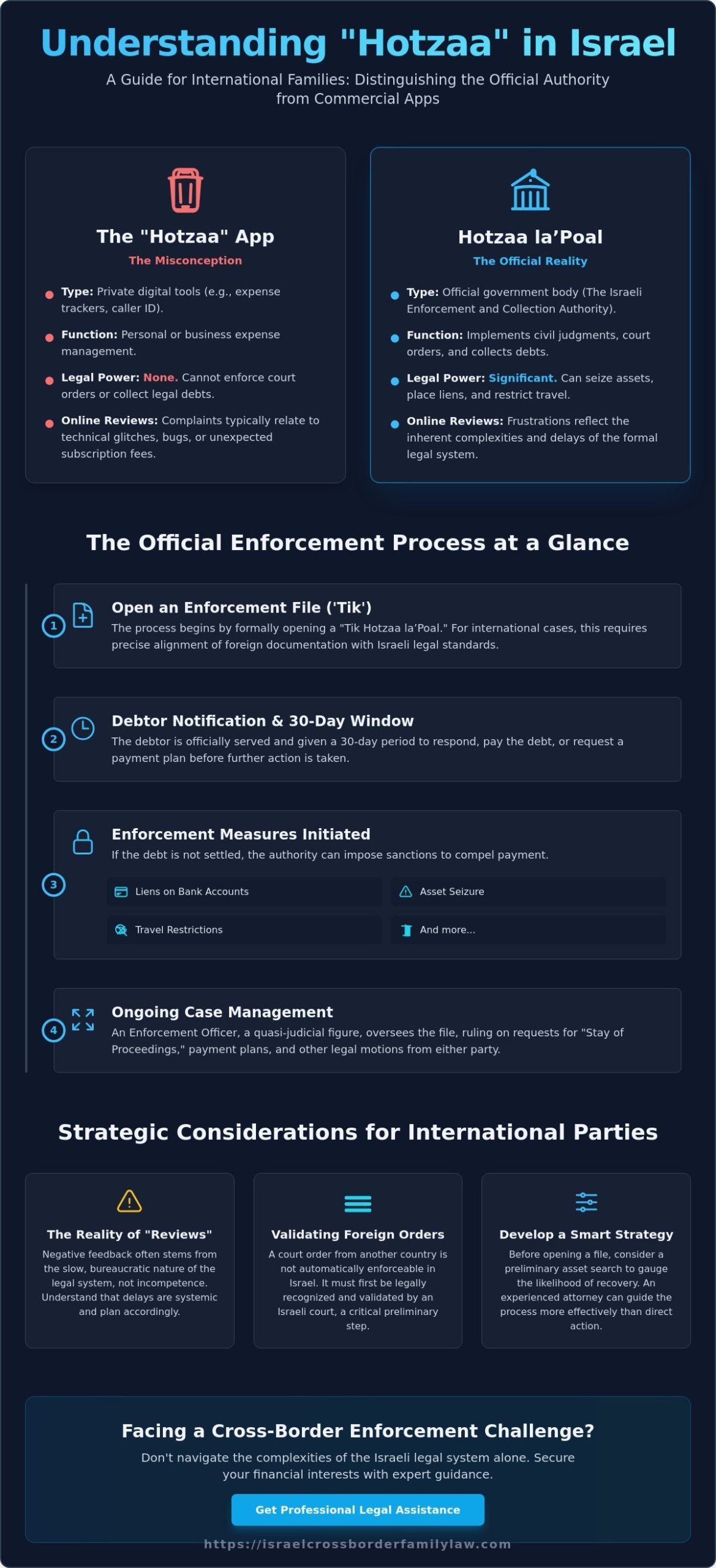
Understanding the term “Hotzaa” is the first step toward resolving any financial dispute in Israel. In Hebrew, the word simply means “expense” or “outlay,” but in a legal context, it’s almost always a shorthand for Hotzaa la’Poal, the national execution office. If you’re searching for hotzaa reviews online, you’ll likely encounter a confusing mix of technical feedback for mobile apps and emotional outpourings regarding legal disputes. This overlap often creates unnecessary anxiety for expats who fear they’re being targeted by a scam or a poorly rated service.
The confusion stems from the fact that “Hotzaa” is a generic term used by both private tech companies and the government. While a private app might help you track your monthly spending in Israeli Shekel (₪), the government authority has the power to seize assets. Distinguishing between these two is essential for anyone dealing with cross-border financial matters. Most negative feedback found in a search for hotzaa reviews actually reflects the inherent friction of the Israeli legal system rather than a failure of a specific software product. The system is designed to be rigorous, which can feel like inefficiency to those used to different legal cultures.
The Digital Side: Hotzaa as a Service
Several mobile applications in Israel use “Hotzaa” in their branding, particularly those focused on caller identification or business expense management. Users often leave scathing reviews on app stores when these tools fail to identify a number or when a subscription fee is charged unexpectedly. These complaints are technical and commercial in nature. It’s important to remember that digital tools are not a substitute for legal enforcement. An app might tell you who is calling, but it cannot provide the legal framework needed to collect a debt or enforce a court order.
The Legal Side: Hotzaa la’Poal (Execution Office)
The Israeli Enforcement and Collection Authority is the official body that handles the implementation of civil judgments. This office is the primary point of contact for creditors seeking payment and debtors facing sanctions. It manages everything from unpaid utility bills to complex alimony payments for international families. Unlike a private company, this authority operates under strict statutory guidelines to balance the rights of the creditor with the basic needs of the debtor. Hotzaa la’Poal is the statutory body responsible for implementing court judgments in IL.
For those living abroad or managing assets in Israel, interacting with this office is a formal legal process. It requires a strategic understanding of how it works to ensure your rights are protected. Whether you’re a creditor trying to recover funds or a debtor looking to resolve a “Tik” (file), the process is governed by law, not by user ratings or commercial terms of service.
How Hotzaa la’Poal Works for International Families
Opening a formal enforcement file, known as a Tik Hotzaa la’Poal, is the primary step for any creditor seeking to implement a court judgment in Israel. For international families, this process is rarely straightforward. It requires a precise alignment of foreign documentation with Israeli procedural standards. If you’ve been reading hotzaa reviews online, you’ve likely noticed a recurring theme of frustration regarding the time it takes to see results. This delay often stems from the initial verification phase, where the system must confirm that the debtor has been properly served and notified in accordance with IL law.
The system operates through local bureaus across the country. Identifying the correct jurisdiction is critical because it determines which Enforcement Officer will oversee the case. Once a file is opened, the debtor is typically granted a 30-day window to respond or settle the debt in Israeli Shekel (₪) before more aggressive measures are taken. These measures can include placing liens on bank accounts or restricting the debtor’s ability to leave the country. The Enforcement Officer acts as a quasi-judicial figure, making decisions on “Stay of Proceedings” requests and payment plans.
Opening an Enforcement File
The initial processing of a file involves a rigorous review of the underlying judgment. For those managing cases from abroad, the challenge lies in the documentation. Every foreign document must be supported by an apostille and a certified Hebrew translation. This is especially true when Enforcing Cross-Border Financial Orders, such as child support or alimony. Without these certifications, the Execution Office will likely reject the application, leading to the perceived “inefficiency” often cited in negative hotzaa reviews.
Special Considerations for Expats
Expats and foreign nationals face a unique hurdle: the official digital portals are almost entirely in Hebrew. While the system has become more digitized, the interface remains inaccessible to those without high-level Hebrew proficiency. This language barrier makes the system feel “unreviewable” or opaque to the international community. Navigating these portals requires a team on the ground that understands both the technical requirements and the cultural nuances of the Israeli bureaucracy. It isn’t just about translating words; it’s about translating the legal intent into a format the Israeli system accepts.
Our advisory focuses on bridging this gap For Expats and Foreign Nationals who need to manage their Israeli legal obligations from a distance. Early strategic decisions, such as conducting a preliminary asset search in Israel, can significantly impact the success of your collection efforts. If you’re unsure how to proceed with an existing file, you may want to request a strategy session to gain clarity before making further commitments.
Enforcing Cross-Border Financial Orders in Israel
Enforcing a financial order across borders requires more than just a valid court judgment; it requires the active involvement of Israel’s Enforcement and Collection Authority. When a US or European court mandates child support or alimony, the order doesn’t automatically trigger payments in Israel. It must first be domesticated through the Israeli legal system before the Execution Office can act. Many people searching for hotzaa reviews are looking for ways to speed up this process, often unaware of the specific legal levers available to them. The intersection between Family Court judgments and the Execution Office is where strategy becomes vital for international families.
Israel is a signatory to various international treaties that facilitate the collection of debts, particularly those related to family maintenance. These treaties allow for a more streamlined recognition of foreign orders, though they still require local filing. Once a judgment is recognized, the Execution Office has a suite of tools to compel payment. These include bank account liens, the seizure of vehicles, and even travel restrictions (Tsav Ikul Yetzia Min HaAretz) that prevent a debtor from leaving the country until the debt is addressed in Israeli Shekel (₪). These measures are powerful, but they must be applied with precision to avoid unnecessary legal pushback.
Child Support and Alimony Enforcement
The Israeli enforcement system prioritizes family-related debts over most commercial obligations. This priority status means that funds collected from a debtor’s bank account are often directed toward child support arrears first. The system can also implement employer-level liens, where a portion of the debtor’s salary is diverted directly to the creditor. Understanding Child Support Cross-Border Enforcement is essential for ensuring that these mechanisms are triggered correctly. Without a proactive approach, these files can languish, leading to the frustrated hotzaa reviews often seen on public forums.
Asset Seizure and Liens (Ikulim)
In the context of an enforcement review, you’ll frequently hear the term “Ikul.” This refers to a lien placed on a debtor’s property to secure the debt. The Execution Office can freeze a wide variety of assets, including bank accounts, investment portfolios, vehicles, and real estate holdings. An “Ikul” is a temporary lien used to prevent the dissipation of assets during litigation. By securing these assets early, you increase the likelihood of a successful recovery. It’s a defensive strategy that ensures the funds remain within the jurisdiction while the legal process unfolds. Proper implementation of an Ikul requires accurate asset mapping, which is often the most challenging part of cross-border collection.
Common Challenges and the Reality Behind Negative Reviews
A search for hotzaa reviews reveals a recurring pattern of dissatisfaction among both creditors and debtors. These negative reviews often stem from a fundamental misunderstanding of how the Israeli legal system functions. While people expect the swift efficiency of a modern tech platform, they’re actually interacting with a government bureaucracy that prioritizes procedural fairness over speed. This deliberate pace is a source of significant stress for international families who need to resolve financial matters quickly across different time zones.
One of the most common hurdles in this process is the “Stay of Proceedings,” known in Hebrew as Ikuv Halichim. Debtors have the legal right to request a stay if they claim they’re unable to pay or if they’re challenging the underlying debt. When an Enforcement Officer grants this stay, the collection process halts immediately. For a creditor, this feels like the system is failing them. However, it’s a standard part of the adversarial process in Israel. Unlike the collection style in the US, which often relies on private agencies and credit reporting, the Israeli system is state-run and highly regulated. This cultural gap often leads to the perception that the system is “broken” when it’s actually just following a specific legal protocol.
The “Slow Motion” Problem
Typical delays within the Israeli Enforcement and Collection Authority are often caused by the sheer volume of cases and the mandatory notification periods. For instance, once a file is opened, a debtor must be legally served and given at least 30 days to respond. In cross-border cases, serving a debtor who lives outside of Israel adds layers of complexity and time. Bureaucratic backlogs can extend these timelines further, contributing to the negative sentiment found in many online hotzaa reviews. Managing expectations is vital; recovery is rarely an overnight event and requires a long-term strategic approach. It’s better to plan for a process that takes several months rather than expecting an immediate resolution in Israeli Shekel (₪).
Avoiding Unofficial “Recovery” Scams
We’ve observed a rise in third-party websites promising “guaranteed” or “instant” debt recovery in Israel. These services often target expats who are frustrated with the official system. It’s critical to verify if a service is a licensed law firm or merely an unregulated agency. Unregulated agencies don’t have the legal standing to represent you before the Execution Office and may even exacerbate your legal risks. Remember that this article is published on an independent advisory platform and does not constitute legal representation. To protect your interests, always ensure you’re working with professionals who understand the bicultural nuances of the Israeli marketplace. If you’re feeling stuck in a cycle of delays, you can request a confidential strategy session to evaluate your options.
Strategic Steps for Navigating the Execution Office
When evaluating hotzaa reviews, it becomes clear that success in the Israeli Execution Office is not a matter of luck but of meticulous preparation. Many creditors fail because they rush into opening a file without first understanding the debtor’s financial landscape within the “start-up nation.” A strategic approach begins with a comprehensive asset search to determine “collectability.” It’s often futile to pursue a file if the debtor has no traceable assets in Israeli Shekel (₪) or has already entered insolvency proceedings. Strategic planning helps you avoid the common pitfalls mentioned in negative hotzaa reviews, such as endless procedural loops or rejected documentation.
Choosing the right enforcement path is your next critical decision. The Israeli system offers a “Direct” track (Maslul Yashir) and an “Attorney-led” track. For simpler, domestic debts under ₪50,000, the “Fast Track” (Maslul Mahir) provides a streamlined, government-managed process designed for efficiency. However, for international families dealing with cross-border family law judgments or high-value commercial debts, the attorney-led track is almost always necessary. This path allows for more aggressive, customized tactics that a standardized government track simply cannot offer.
Preparation and Strategy
Early decisions in the Execution Office dictate your long-term success. For example, deciding whether to involve a private investigator to map out hidden real estate or bank accounts must happen before the debtor is alerted to the file. Once a debtor receives a formal warning, they may attempt to dissipate assets or transfer funds. A bicultural approach is essential here; you need a team on the ground that understands the urgency of an international client while navigating the specific procedural rhythms of the Israeli bureaucracy. Assessing the reality of a debtor’s situation early prevents you from wasting resources on uncollectible files.
Seeking Professional Clarity
Complex cross-border cases require more than a basic app or generic advice from online forums. The inherent differences between the common law expectations of Anglos and the civil-religious hybrid of the Israeli system create friction that only experience can smooth over. We provide a bridge for international families who need to enforce their rights without getting lost in translation. Because every case involves unique multi-jurisdictional challenges, a one-size-fits-all approach is rarely effective. Get clarity before you commit. Request a confidential consultation.
Securing Your Financial Interests in Israel
Navigating the Israeli Enforcement and Collection Authority requires more than a simple translation of Hebrew terms; it demands a strategic understanding of how the system functions for international parties. While online hotzaa reviews often highlight the frustrations of bureaucratic delays, these challenges are manageable with a proactive approach. By distinguishing between private apps and official government bodies, you can avoid common pitfalls and focus on legitimate recovery. Every decision made in the early stages of an execution file has long-term implications for your financial success.
Our advisory serves as a vital bridge between the “start-up nation” and global markets. With a dedicated team on the ground in Tel Aviv and New York, we provide the bicultural and bilingual guidance necessary for complex IL-US cross-border legal complexities. We help international families navigate multi-jurisdictional situations with the corporate formality and expertise they expect. Get clarity before you commit. Request a confidential consultation to discuss your specific strategy. You don’t have to face the Israeli legal system without a knowledgeable guide by your side.
Frequently Asked Questions
What is the difference between the Hotzaa app and Hotzaa la’Poal?
The primary difference is their legal standing; “Hotzaa” apps are commercial software for caller ID or expense tracking, while Hotzaa la’Poal is the official government authority for debt enforcement. While an app tracks data, the Authority has the legal power to seize bank accounts and restrict travel. Many users mistakenly leave negative feedback for the government system on app store pages, which is why hotzaa reviews can be so misleading for international parties.
Can I use the Israeli Enforcement Office to collect child support from a US citizen living in Israel?
Yes, you can collect child support from a US citizen in Israel once the foreign judgment is formally domesticated by an Israeli court. This process requires a bicultural legal strategy to bridge the gap between US and Israeli family law. Once recognized, the Execution Office can implement employer-level liens or bank seizures to ensure payments are made in Israeli Shekel (₪). Our team on the ground helps navigate this multi-jurisdictional process.
How long does the “Hotzaa” enforcement process typically take?
The timeline for enforcement typically spans several months, beginning with a mandatory 30-day warning period after the debtor is legally served. Complex cross-border cases often take longer due to the need for international service and documentation verification. If a debtor files a “Stay of Proceedings,” the timeline can extend while the Enforcement Officer reviews the claims. Managing expectations regarding these bureaucratic timelines is essential for long-term success.
Are Hotzaa reviews online reliable for legal decision-making?
Online hotzaa reviews are generally unreliable for legal decision-making because they often conflate software bugs with systemic legal bureaucracy. Most reviewers are expressing emotional frustration with the slow pace of the Israeli legal system rather than providing objective legal analysis. Relying on these reviews can lead to a misunderstanding of the actual risks and strategic options available in your case. Strategic clarity should come from professional advisory, not public forums.
What happens if a debtor in Israel has no visible assets?
Collection becomes significantly more challenging if a debtor has no visible assets and requires a strategic investigation to uncover hidden funds. You might utilize private investigators to map out hidden real estate, vehicles, or investment portfolios. Without traceable assets in Israeli Shekel (₪), the Execution Office has limited levers to pull. This makes a preliminary asset search a vital first step before committing to the full enforcement process.
Can the Israeli Execution Office prevent someone from leaving the country?
Yes, the Execution Office has the authority to issue a “Stay of Exit” order to prevent a debtor from leaving Israel. This is a powerful tool used when there is a reasonable fear that a debtor will flee the country to avoid their financial obligations. These orders are particularly effective in family law cases where ongoing maintenance or alimony is at stake. The order remains in place until the debt is settled or secured.
Do I need a lawyer to open a file in the Enforcement and Collection Authority?
You aren’t legally required to have an attorney to open a file, but the process is highly complex for non-Hebrew speakers. The official portal is almost entirely in Hebrew, and the procedural requirements for foreign documentation are strict. Most expats find that navigating the Authority without professional guidance leads to significant delays or the rejection of their application. Bilingual support ensures your documentation meets the rigorous standards of the Israeli system.
Is there a fee to open an enforcement case in Israel?
Opening an enforcement case requires paying a government filing fee, which is often calculated based on a percentage of the total debt. There are also fixed minimum fees for specific types of files, such as those related to non-monetary court orders or family maintenance. These costs are standard across all bureaus of the Enforcement and Collection Authority and must be paid in Israeli Shekel (₪) at the time of filing.

Article by
Gabriel Lior
A Personal Journey That Became a Mission
The advisory was founded by an American father Gabriel Lior, LLB, MBA , global entrepreneur, and cross-border advisor who spent more than a decade navigating the Israeli family court system firsthand and now lives in Singapore with his son.
As a divorced parent in a cross-border family, Gabriel faced nearly every legal challenge a foreign parent can encounter in Israel — including child custody disputes, child support proceedings, property matters in Israel and abroad, false accusations, and complex immigration and relocation proceedings.
Over the years, he learned the hard way how difficult it is for non-Israeli parents to understand the system, identify the right legal strategy, and choose the right legal representation — especially when language, culture, and jurisdictional differences are involved. He also witnessed how foreign parents and new immigrants are often disadvantaged or taken advantage of by service providers and institutions simply because they lack local knowledge or fluency.
From Client to Advisor
To truly understand — and survive — the system, Gabriel pursued formal legal education in Israel, completing two Israeli law degrees, alongside a BA and MBA earned in the United States. This was never about becoming a practicing attorney, but about gaining a deep, structural understanding of how the system works — and where it breaks down for foreign parents.
This rare combination of:
Firsthand client experience
Israeli legal and US business education
International business and negotiation training
Decades of commercial execution
created a unique perspective – one that understands both sides of the table.
After years of litigation, persistence, and at times self-representation, he ultimately succeeded in securing custody of his son and relocating abroad through a rare legal victory in the Israeli Supreme Court — becoming one of the first fathers in Israel to do so under these circumstances.
Disclaimer
Important Disclaimer:
The information provided on this website and in its content is for general informational and educational purposes only and does not constitute legal advice, legal opinion, or legal representation.
Gabriel Lior is not licensed to practice law in Israel (nor is he interested in doing so) and does not provide legal services, despite having completed 2 Law Degrees. The services offered are advisory in nature and are intended to provide general guidance, strategic insight, and information regarding cross-border family law considerations.
No attorney-client relationship is formed by accessing this website, reading its content, or communicating with us.
Any decisions made based on this information are at your own discretion and risk. For legal advice specific to your situation, you should consult a licensed attorney in the relevant jurisdiction.
Where appropriate, we may refer clients to independent, licensed attorneys or professionals. Such referrals do not constitute legal representation and no liability is assumed for services provided by third parties.