This article is published on an independent advisory platform, not a law firm, and does not imply an attorney-client relationship. Legal services are only provided by licensed attorneys under a separate engagement.
In Jerusalem, the first court you enter often determines the entire trajectory of your future, your finances, and your family’s stability. If you’re an expat or have assets in the United States, finding a divorce lawyer jerusalem who understands multi-jurisdictional complexities is a strategic necessity. You likely feel confused about the choice between the Rabbinical and Civil systems, particularly as March 2026 legislative changes expanded the powers of religious courts to act as civil arbitrators. It’s natural to worry about losing access to children or assets when the rules seem to change depending on which door you walk through first.
This guide provides a clear framework to help you understand the jurisdictional risks of a cross-border divorce and how to protect international interests. We’ll examine the specific fees set by the Israeli Judicial Authority as of January 2026, the implications of the November 2025 child support rulings, and how to develop a strategy that bridges the gap between legal systems. For more visual insights, visit https://www.youtube.com/@IsraelFamilyLaw. Get clarity before you commit. Request a confidential consultation.
Key Takeaways
- Learn how the “Race for Jurisdiction” determines whether secular or religious law governs your property division and future financial stability.
- Understand why international families require a divorce lawyer jerusalem who can navigate the intersection of Israeli family law and US tax regulations.
- Discover why early strategic planning is more effective than aggressive litigation for protecting assets located in both IL and the United States.
- Gain insight into the unique role of the Jerusalem District Court and the Ministry of Justice in handling complex multi-jurisdictional cases.
- Recognize the importance of an independent advisory review to identify potential risks before you commit to a specific legal path.
This article is published on an independent advisory platform, not a law firm, and does not imply an attorney-client relationship. Legal services are only provided by licensed attorneys under a separate engagement.
Understanding the Jerusalem Family Law Landscape
Jerusalem presents a unique challenge for international families because its legal framework operates on two parallel tracks. The Israeli court system divides family matters between civil Family Courts and religious Rabbinical Courts. This dual authority is overseen by the Ministry of Justice, yet the practical application of law varies significantly between the two institutions. For an expat, this often leads to a sense of legal vertigo where the rules of one’s home country don’t seem to apply. Engaging a divorce lawyer jerusalem who specializes in these cross-border nuances is vital for maintaining a sense of control over your future.
To better understand the risks involved in international family law, particularly regarding children, watch this helpful video:
The Dual Court System: Family Court vs. Rabbinical Court
Civil Family Courts handle matters like property division and child custody based on secular law. However, Rabbinical Courts have exclusive jurisdiction over the marriage and divorce itself for Jewish couples. The Get, or religious divorce decree, is a central requirement. Without it, you aren’t legally divorced in IL, regardless of what a foreign court might say. This intersection creates a strategic bottleneck where early decisions about which court to approach first can dictate your financial future for years. Each system has its own set of rules, and the choice of venue can fundamentally change how your assets are valued or how alimony is calculated.
Why Jerusalem is Unique for Expats and Anglos
Jerusalem has one of the highest concentrations of English-speaking residents in the country. Consequently, the Jerusalem District Court and local family courts are more accustomed to dealing with foreign legal documents and international assets than smaller regional courts. However, this familiarity doesn’t mean the process is simple. Cultural nuances in Jerusalem’s legal practitioners can be jarring for those used to Western litigation styles. You need a strategy that accounts for both the local team on the ground reality and the global nature of your life. Seeking a bicultural perspective is often the difference between a settlement that works and one that leaves you vulnerable.
Before signing any documents or making verbal agreements, it’s essential to understand how these systems interact. You can learn more about divorce and separation for international families to begin building your knowledge base. Get clarity before you commit. Request a confidential consultation.
This article is published on an independent advisory platform, not a law firm, and does not imply an attorney-client relationship. Legal services are only provided by licensed attorneys under a separate engagement.
The “Race for Jurisdiction” in Jerusalem Divorce
The “Race for Jurisdiction” is a foundational concept in IL family law that often catches international families by surprise. It refers to the legal competition between spouses to file their initial petition in either the Family Court or the Rabbinical Court. In a city like Jerusalem, which contributed significantly to the 11,093 divorces recorded in IL during 2025, the court that receives the file first typically gains the authority to decide on crucial matters like property division and alimony. Waiting even a few days to consult with a divorce lawyer jerusalem can shift the entire legal landscape of your case. Early decisions are not just about speed; they are about choosing the legal environment that will govern your family’s future for years to come.
How Meroz Samchuyot Works in Practice
The principle of Meroz Samchuyot involves the technicality of “binding” issues to a divorce claim. If a spouse files for divorce in the Rabbinical Court, they can “bind” matters such as the division of global assets or child custody to that specific suit. If the filing is done correctly and in good faith, the Rabbinical Court assumes jurisdiction over those issues. Pitfalls are common for international residents who assume Western norms apply. For example, a spouse might file a motion for mediation thinking it protects their rights, only to find the other party has already filed a full claim in a different court. This is particularly relevant following the March 2026 law that expanded the authority of Rabbinical courts to serve as arbitrators in civil disputes.
Strategic Filing: Protecting Your Rights
Choosing the right venue requires a calm assessment of your specific financial and personal goals. You must evaluate which court is more likely to respect existing prenuptial agreements or handle the recognition of foreign divorces effectively. Jerusalem judges look closely at “Good Faith” during these initial filings. An overly aggressive “fighter” approach often backfires if the court perceives the filing as a transparent attempt to deprive the other spouse of a fair hearing. Strategic risk management is often more effective than raw litigation for expats and foreign nationals living in Jerusalem.
Early decisions regarding jurisdiction have long-term consequences for your international assets and your children’s stability. If you are unsure which court system aligns with your needs, you should speak with an advisor to understand your options. Get clarity before you commit. Request a confidential consultation.
This article is published on an independent advisory platform, not a law firm, and does not imply an attorney-client relationship. Legal services are only provided by licensed attorneys under a separate engagement.
Key Challenges for US-Israel International Divorces
International families living in Jerusalem face a layer of complexity that local couples rarely encounter. When your life spans two continents, a standard divorce becomes a multi-jurisdictional puzzle involving foreign property, US tax codes, and international treaties. A divorce lawyer jerusalem must look beyond the borders of IL to ensure that a settlement reached in a local court doesn’t create a tax disaster or an unenforceable order in the United States. Managing these competing legal systems requires a strategy that acknowledges the long-term impact of every decision made today.
Asset Division and International Property
Jerusalem courts generally apply the principle of “balancing of resources,” which assumes an equal split of assets acquired during the marriage. However, applying this to US-based 401(k) accounts, IRAs, or real estate in North America requires sophisticated planning. The US-Israel Tax Treaty plays a critical role here; failing to structure the transfer of assets correctly can lead to unintended capital gains or withdrawal penalties. You must disclose all international holdings early in the process. Hidden assets often lead to expensive, prolonged litigation that can drive legal fees toward the 200,000 NIS range for complex cases. Understanding divorce and separation for international families is the first step in protecting your global portfolio.
US Court Orders and Stay of Exit Orders
Expats often mistakenly believe that a US court order will be automatically recognized by the Jerusalem Family Court. In reality, foreign judgments require a formal enforcement process to have any standing in IL. Additionally, dual citizens must be aware of “Stay of Exit” orders (Tzav Ikur Yetzia Min Ha’aretz). These orders can prevent a parent from leaving IL until child support or custodial obligations are secured. It’s a powerful tool used by courts to ensure that one parent doesn’t relocate or move assets permanently before the case is resolved. This can be a source of significant distress for expats who need to travel for work or to visit family abroad.
Child Custody and the Hague Convention
For families contemplating a move back to the US, the rules regarding international custody and relocation are exceptionally strict. The Hague Convention on the Civil Aspects of International Child Abduction protects against the wrongful removal of children across borders. Jerusalem courts prioritize the “best interests of the child” while strictly interpreting the “habitual residence” of the family. Jerusalem courts typically view international relocation requests through a lens of maintaining the child’s existing stability while requiring the relocating parent to prove that the move significantly benefits the child’s welfare. If you’re concerned about these issues, you might want to review information on the hague convention child abduction protocols. Get clarity before you commit. Request a confidential consultation.
This article is published on an independent advisory platform, not a law firm, and does not imply an attorney-client relationship. Legal services are only provided by licensed attorneys under a separate engagement.
Selecting a Strategic Partner in Jerusalem
Choosing the right divorce lawyer jerusalem is the most significant decision you’ll make after the decision to separate. In a city where approximately 35% to 40% of Jewish marriages end in divorce, the legal market is crowded with practitioners who promise aggressive representation. However, international families require a partner who understands that litigation is only one part of a broader cross-border strategy. You need a professional who can manage the sophisticated intersection of local procedures and your specific needs as an expat or Anglo resident. This requires a shift from looking for a “fighter” to identifying a strategic risk manager who can protect your global interests.
Bilingual and Bicultural Expertise
In the Jerusalem legal system, Hebrew is the dominant language of the court, but your life is likely lived in English. Translating documents is only a small part of the challenge. The real value lies in a representative who can translate the cultural expectations of the Israeli judiciary for a US or UK-minded client. A bicultural approach ensures your counsel understands both the “start-up nation” legal reality and the specific concerns of international families. Having a “team on the ground” in Jerusalem means your representative can navigate local nuances while communicating with you in plain English. This clarity prevents the misunderstandings that often lead to costly delays and procedural errors.
Moving from Aggression to Strategy
The “win at all costs” mentality often backfires in cross-border cases, leading to spiraling costs and long-term instability. According to data published in September 2025, hourly rates for divorce lawyers in IL typically range from 150 to 400 USD, while court hearing fees can reach 5,000 NIS per session. A contested, complex case can see total fees ranging between 10,000 and 200,000 NIS. A calm, advisory-led approach focuses on achieving business-like objectives rather than fueling emotional conflict. By prioritizing strategic risk management over raw aggression, you can often reach a settlement that secures your assets and your children’s future without exhausting your resources in the courtroom.
You deserve a strategy that respects your international background and provides a clear path forward. If you are ready to evaluate your options with a professional who speaks your language, you can schedule a strategic review to discuss your situation. For more information on how this process works, you may find it helpful to read about the advisory approach. Get clarity before you commit. Request a confidential consultation.
This article is published on an independent advisory platform, not a law firm, and does not imply an attorney-client relationship. Legal services are only provided by licensed attorneys under a separate engagement.
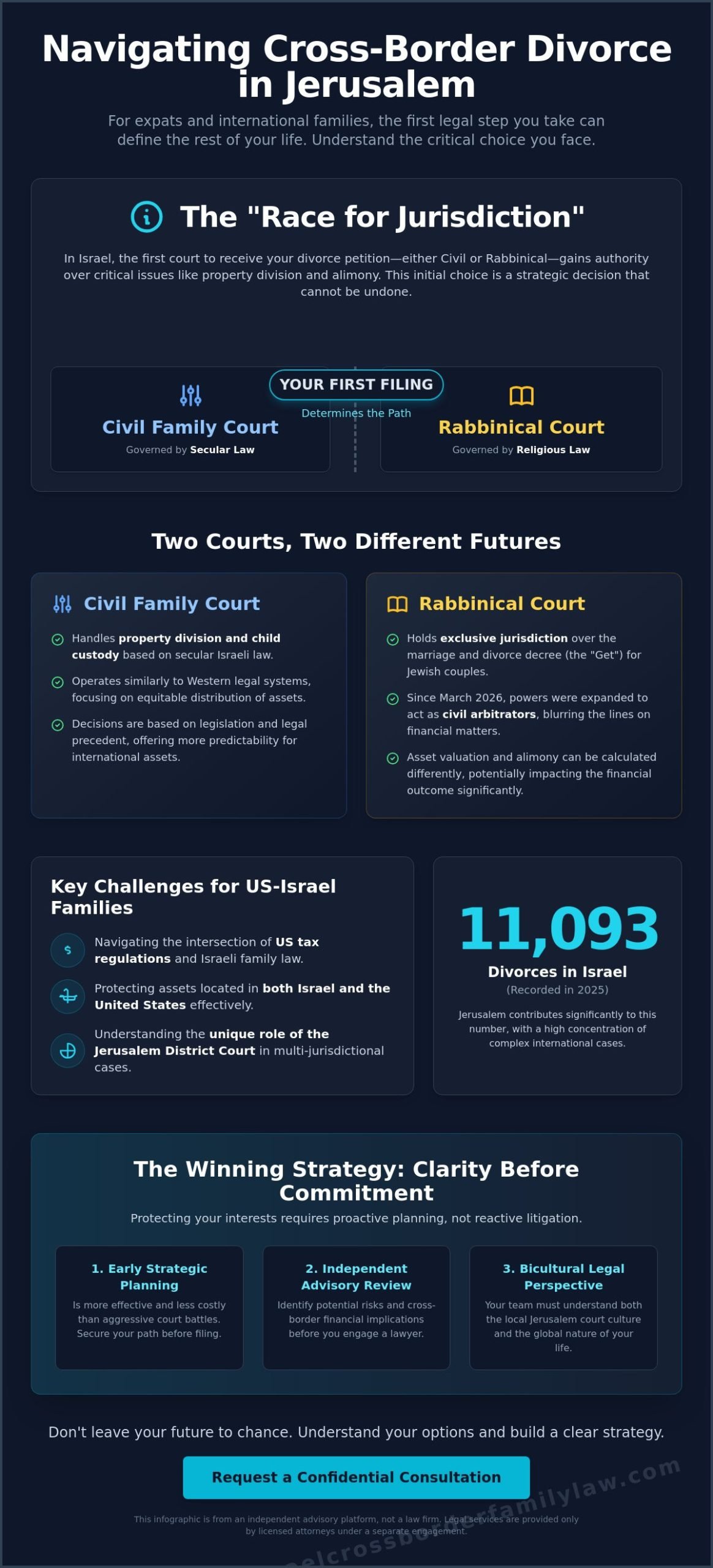
Clarity Before Commitment: The Advisory Approach
Entering the Jerusalem legal system without a comprehensive roadmap is a significant risk for international families. Many expats react emotionally to a crisis, hiring the first divorce lawyer jerusalem they find without assessing how that choice impacts their global interests. An independent advisory approach changes this dynamic by prioritizing strategy over raw litigation. By seeking a confidential case review before filing any documents, you gain a clear-eyed perspective on the jurisdictional risks that could affect your assets in both IL and the United States. This process allows you to move from a state of reactive fear to one of informed, risk-based decision-making.
The goal of an advisory-led strategy is to provide a “seamless Israeli/U.S. professional home” for your legal needs. This means looking at the 35% to 40% divorce rate in the Jewish community not as a statistic of conflict, but as a reason to seek established expertise. Independent platforms serve as a bridge, helping you understand the complex interaction between religious and secular authorities before you commit to a specific path. This ensures that your initial steps in the Jerusalem Family Court or Rabbinical Court are part of a broader plan to maintain your long-term stability.
Risk Assessment and Strategic Planning
A secure strategy begins with identifying the “red flags” unique to cross-border situations. These include the presence of US-based retirement accounts, dual citizenship status, or potential relocation disputes that could trigger the Hague Convention. Understanding the pricing and costs involved is also vital. With complex cases potentially reaching fees of 200,000 NIS, knowing the financial landscape helps you avoid the common expat trap of starting a legal battle you aren’t prepared to finish. A roadmap considering both IL and US legal requirements ensures that your settlement remains enforceable in both jurisdictions.
Taking the Next Step Securely
Moving forward requires a calm and deliberate gathering of documentation. You’ll need to organize international tax returns, property deeds, and existing prenuptial agreements to give your team a clear view of your global portfolio. Maintaining a neutral stance during this transition prevents unnecessary escalation that could lead to a “Stay of Exit” order or other travel restrictions. You can learn more about how the advisory process works to help you prepare for these initial stages. By focusing on a confidential case review, you ensure your strategy is built on facts rather than impulse.
Get clarity before you commit. Request a confidential consultation.
This article is published on an independent advisory platform, not a law firm, and does not imply an attorney-client relationship. Legal services are only provided by licensed attorneys under a separate engagement.
Securing Your Global Interests in Jerusalem
Navigating the intersection of two legal systems requires a deliberate approach that prioritizes long-term stability over short-term conflict. You’ve learned that the choice of court and the timing of your filing are the most critical factors in a Jerusalem divorce. Protecting your US-based assets and ensuring your children’s security depends on a strategy that accounts for both IL regulations and international treaties. These early decisions will dictate your financial and personal reality for years to come.
Choosing a divorce lawyer jerusalem who offers bilingual support and a deep understanding of the Anglo mindset is essential for your peace of mind. Our platform provides specialized expertise in US-Israel cross-border family law, focusing on a calm, advisory-led model that empowers you to make informed choices. By addressing jurisdictional risks before they escalate, you avoid the common pitfalls that many expats face when dealing with the local system.
Get clarity before you commit. Request a confidential consultation to begin building your roadmap. You don’t have to face these complex multi-jurisdictional challenges alone; a secure and informed path forward is within reach.
This article is published on an independent advisory platform, not a law firm, and does not imply an attorney-client relationship. Legal services are only provided by licensed attorneys under a separate engagement.
Frequently Asked Questions
Can I get a divorce in Jerusalem if I was married in the US?
Yes, Jerusalem courts have the authority to divorce couples married abroad if at least one spouse is a resident of IL. If you are Jewish, the Rabbinical Court handles the religious dissolution of the marriage, while the Family Court manages civil aspects. It’s important to coordinate these proceedings with a divorce lawyer jerusalem to ensure the final decree is recognized in the United States and complies with international requirements.
How does the Jerusalem Rabbinical Court affect a US citizen?
The Rabbinical Court has exclusive jurisdiction over the marriage and divorce of all Jewish residents in IL, including US citizens. Under laws passed in March 2026, these courts also have expanded authority to act as arbitrators in civil matters if both parties consent. For a US citizen, this means your religious status and certain financial disputes may be decided under religious law, which differs significantly from American civil law procedures.
What is the “Race for Jurisdiction” (Meroz Samchuyot)?
The “Race for Jurisdiction” is the legal competition to file for divorce first in either the Family Court or the Rabbinical Court. Since the court where the file is opened first often gains authority over property division and alimony, speed and strategy are vital. This is especially true given that 11,093 couples divorced in IL during 2025, many of whom faced this exact conflict over which legal system would govern their future.
Will a Jerusalem court recognize my US prenuptial agreement?
Jerusalem courts generally recognize foreign prenuptial agreements, but they must be formally validated by an IL court to be enforceable locally. The court will examine if the agreement was signed in good faith and if it contradicts local public policy. Having a divorce lawyer jerusalem review the document early is essential, as the court’s interpretation can vary depending on whether the case is heard in the secular or religious system.
Can my spouse stop me from leaving Israel with a “Stay of Exit” order?
Yes, a spouse can request a “Stay of Exit” order (Tzav Ikur Yetzia Min Ha’aretz) to prevent you from leaving IL until legal or financial obligations are secured. These orders are common in international cases to prevent one party from moving assets or children abroad permanently. Because these orders can be issued quickly, it’s necessary to have a clear travel strategy if you need to visit family or work in the US during proceedings.
How is child support calculated for international families in Jerusalem?
Child support is calculated based on the parents’ relative incomes and the children’s specific needs, including education and medical care. In November 2025, legislation granted Rabbinical Courts expanded authority to rule on these financial needs for a two year interim period. For international families, the court may also consider the cost of living in both IL and the US if the children spend significant time in both locations.
Do I need a separate lawyer for my assets in the US?
While your IL representative manages the divorce, you often need a US based professional to handle the technical transfer of 401(k) accounts or real estate holdings. A strategic partner in Jerusalem works collaboratively with your American legal and accounting teams to ensure compliance with the US-Israel Tax Treaty. This dual approach prevents common errors in asset valuation that often occur when only one country’s laws are considered during the split.
How long does a cross-border divorce typically take in Jerusalem?
A mutual consent divorce can be finalized in a few months, but contested international cases often take 12 to 24 months to resolve. Complexities like asset discovery in the US or custody disputes under the Hague Convention naturally extend this timeline. Strategic risk management and mediation, which often costs around 10,000 NIS per party according to 2025 industry data, can significantly reduce the time spent in active litigation.

Article by
Gabriel Lior
A Personal Journey That Became a Mission
The advisory was founded by an American father Gabriel Lior, LLB, MBA , global entrepreneur, and cross-border advisor who spent more than a decade navigating the Israeli family court system firsthand and now lives in Singapore with his son.
As a divorced parent in a cross-border family, Gabriel faced nearly every legal challenge a foreign parent can encounter in Israel — including child custody disputes, child support proceedings, property matters in Israel and abroad, false accusations, and complex immigration and relocation proceedings.
Over the years, he learned the hard way how difficult it is for non-Israeli parents to understand the system, identify the right legal strategy, and choose the right legal representation — especially when language, culture, and jurisdictional differences are involved. He also witnessed how foreign parents and new immigrants are often disadvantaged or taken advantage of by service providers and institutions simply because they lack local knowledge or fluency.
From Client to Advisor
To truly understand — and survive — the system, Gabriel pursued formal legal education in Israel, completing two Israeli law degrees, alongside a BA and MBA earned in the United States. This was never about becoming a practicing attorney, but about gaining a deep, structural understanding of how the system works — and where it breaks down for foreign parents.
This rare combination of:
Firsthand client experience
Israeli legal and US business education
International business and negotiation training
Decades of commercial execution
created a unique perspective – one that understands both sides of the table.
After years of litigation, persistence, and at times self-representation, he ultimately succeeded in securing custody of his son and relocating abroad through a rare legal victory in the Israeli Supreme Court — becoming one of the first fathers in Israel to do so under these circumstances.
Disclaimer
Important Disclaimer:
The information provided on this website and in its content is for general informational and educational purposes only and does not constitute legal advice, legal opinion, or legal representation.
Gabriel Lior is not licensed to practice law in Israel (nor is he interested in doing so) and does not provide legal services, despite having completed 2 Law Degrees. The services offered are advisory in nature and are intended to provide general guidance, strategic insight, and information regarding cross-border family law considerations.
No attorney-client relationship is formed by accessing this website, reading its content, or communicating with us.
Any decisions made based on this information are at your own discretion and risk. For legal advice specific to your situation, you should consult a licensed attorney in the relevant jurisdiction.
Where appropriate, we may refer clients to independent, licensed attorneys or professionals. Such referrals do not constitute legal representation and no liability is assumed for services provided by third parties.