This article is published on an independent advisory platform, not a law firm. This content is for informational purposes and does not constitute legal representation or legal advice. We focus on strategy and decision-making regarding legal guardianship for a child in Eilat to help you manage the Israeli legal system effectively.
What if a simple international move to the Red Sea coast left your parental rights in a state of legal uncertainty? For many expats and global families, the process of securing legal guardianship for a child in Eilat is often clouded by a Hebrew-dominated system and unfamiliar court protocols. It’s natural to feel concerned about how local authorities handle foreign citizens, and you shouldn’t have to guess about your protections during international travel. You need a strategy that bridges the gap between your home country’s expectations and the reality of cross-border legal requirements.
This guide offers a clear roadmap through the Eilat Family Court process, ensuring you understand the complexities of Israeli guardianship. We’ll explore the interaction between international frameworks and local regulations, including how social services in the Southern District handle foreign cases. By the end of this article, you’ll have the clarity needed to make informed decisions and achieve peace of mind regarding your child’s legal safety in Israel.
Key Takeaways
- Learn how the Israeli Capacity and Guardianship Law (1962) defines natural guardians and how the Eilat Family Court applies the “best interests of the child” standard to international families.
- Identify specific scenarios, such as emergency medical care or international business travel, where a formal court order is essential to protect parental rights.
- Master the step-by-step documentation and filing requirements to secure legal guardianship for a child in Eilat, ensuring your foreign birth certificates and passports meet local registry standards.
- Understand why foreign guardianship orders are not automatically recognized in Israel and how to mitigate the risk of conflicting legal rulings between jurisdictions.
- Discover proactive strategies, including drafting a “Letter of Wishes” and coordinating your Israeli Will, to maintain legal continuity across borders.
This article is published on an independent advisory platform (not a law firm).
Understanding Legal Guardianship in the Israeli System (The Eilat Context)
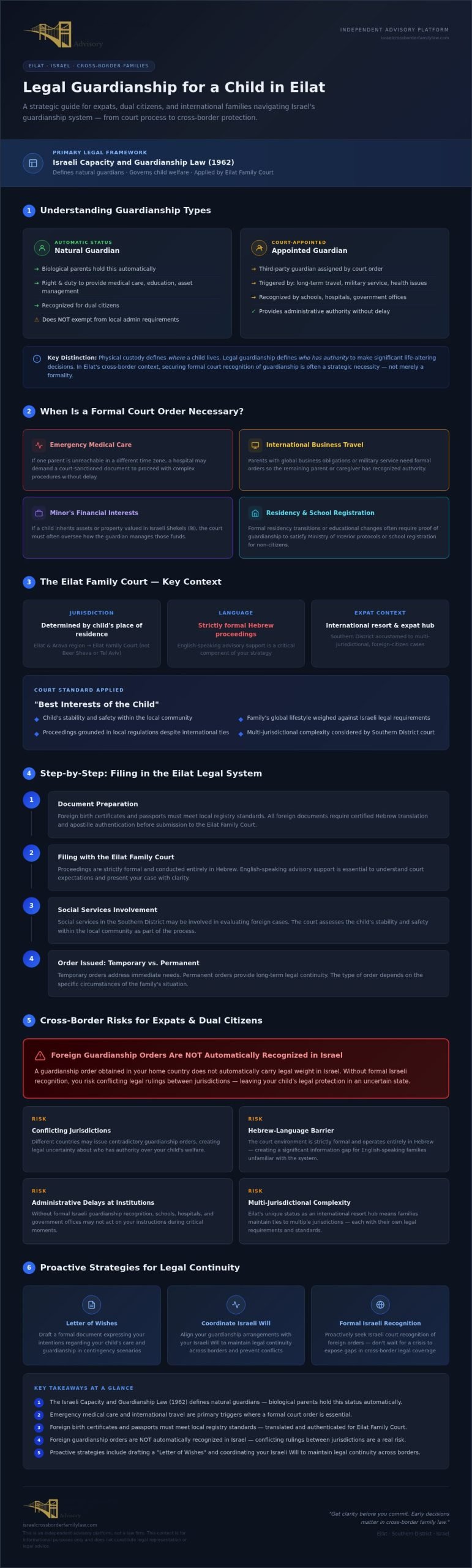
The Israeli Capacity and Guardianship Law (1962) serves as the primary framework for child welfare, establishing that biological parents are the “natural guardians” of their children. This status implies an automatic right and duty to provide for a minor’s needs, including medical care, education, and the management of their assets. It’s essential to distinguish between physical custody, which defines where the child lives, and legal guardianship, which involves the authority to make significant life-altering decisions. In Eilat, the city’s unique status as an international resort and expat hub often complicates local filings, as families frequently maintain ties to multiple jurisdictions.
The Eilat Family Court interprets the “Best Interests of the Child” standard by evaluating the child’s stability and safety within the local community. For international residents, the court must weigh the family’s global lifestyle against the requirements of the Israeli legal system. Because the Southern District often handles cases involving foreign citizens, the court is accustomed to multi-jurisdictional complexity, yet the proceedings remain grounded in local regulations and Hebrew-language protocols.
Natural Guardians vs. Appointed Guardians
While biological parents hold automatic rights in Israel, there are specific circumstances where the court may appoint a “third-party” guardian. This often occurs if parents are unable to fulfill their duties due to long-term business travel, military service, or health issues. For dual citizens, your status as a natural guardian is recognized, but it doesn’t exempt you from local administrative requirements. Formally securing legal guardianship for a child in Eilat is often a strategic necessity to ensure your parental authority is recognized by local schools, hospitals, and government offices without delay.
The Role of the Eilat Family Court
Jurisdiction for family matters is typically determined by the child’s place of residence. If your family is based in Eilat or the surrounding Arava region, your case belongs in the Eilat Family Court rather than the larger district courts in Beer Sheva or Tel Aviv. Entering the local court building can be an intimidating experience for those unfamiliar with the system, as the environment is strictly formal and operates entirely in Hebrew. When establishing legal guardianship for a child in Eilat, having English-speaking advisory support is a critical component of your strategy. This ensures you understand the nuances of the court’s expectations and can present your case with clarity. You can find more information on how these roles are handled for expats and foreign nationals within the Israeli system.
This article is published on an independent advisory platform (not a law firm).
When is a Guardianship Order Necessary for Your Child?
Natural guardianship provides a foundational legal status, but it often lacks the administrative weight required by Israeli institutions during a crisis. In Eilat, the high concentration of families with international business ties or military obligations makes a formal court order a practical necessity. Emergency medical care is a primary trigger. If a child requires urgent treatment at a local facility and one parent is unreachable in a different time zone, the hospital may demand a court-sanctioned document to proceed with complex procedures without delay.
Beyond medical needs, managing a minor’s financial interests requires formal standing. If a child inherits assets or property valued in Israeli Shekels (₪), the court must often oversee how the guardian manages those funds to ensure the minor’s interests are protected. Similarly, formal residency transitions or educational changes often require proof of legal guardianship for a child in Eilat to satisfy Ministry of Interior protocols or school registration requirements for non-citizens.
Temporary vs. Permanent Guardianship
Temporary orders are useful for immediate crises, but they can lead to a “Short-Term Trap” if they expire before a permanent solution is finalized. Lapses in legal status often result in sudden administrative hurdles at government offices or border crossings. A standby guardian is a more stable alternative for many expat families. This designation allows a trusted individual to step in immediately if both parents are unavailable, providing essential continuity for families who don’t have extended relatives living in the Southern District.
Cross-Border Custody and Relocation
A formal guardianship order serves as a critical legal shield regarding international travel. Under the Hague Convention on International Child Abduction, having a court-verified status clarifies the child’s habitual residence and the guardian’s rights. This prevents legal misunderstandings that could lead to claims of unauthorized removal when moving a child across borders. Understanding these risks is vital for any family with a global footprint. You can learn more about these complexities in our guide to Understanding International Custody and Relocation.
Early decisions regarding legal guardianship for a child in Eilat can prevent future litigation and administrative delays. You can review your family’s cross-border strategy to identify potential gaps in your current legal protections.
This article is published on an independent advisory platform (not a law firm).
The Step-by-Step Process in the Eilat Legal System
Filing for legal guardianship for a child in Eilat begins with a formal petition submitted directly to the Eilat Family Court registry. This administrative start requires more than just a signature; it demands a comprehensive package of original documentation. You’ll need to provide birth certificates, current passports, and any existing foreign custody or guardianship orders. The court uses these documents to establish the child’s legal identity and residency status within the Southern District. Once the registry accepts the petition, the case is assigned a file number, and the court notifies the Ministry of Welfare to begin their mandatory review.
The timeline from the initial filing to the issuance of the final “Tzav” (Order) typically takes several months. While the court may issue temporary rulings for urgent matters, the permanent order is only granted after all reports are filed and reviewed. This measured pace ensures that the child’s long-term stability is the priority, though it requires families to plan their administrative needs well in advance of any planned international travel or residency renewals.
Working with the Eilat Social Services (Sa’ad)
A central part of the process involves the “Sa’ad,” a court-appointed social worker who evaluates the family’s situation. Their primary task is to write a “Tazkir,” or social worker’s report, which the judge relies on heavily to make a decision. This involves a home visit in Eilat to observe the child’s environment and daily routine. For English-speaking families, these visits can be stressful due to cultural differences or language barriers. It’s helpful to be prepared for questions about your international lifestyle to ensure the Sa’ad understands your family’s specific context and needs before submitting their final recommendation to the judge.
Documentation and Translation Requirements
The Israeli legal system requires all foreign documents to be authenticated with an Apostille seal from the country of origin. Without this authentication, the Eilat court won’t accept your US birth certificates or foreign decrees as valid evidence. Additionally, every non-Hebrew document must be accompanied by a notarized Hebrew translation. Because accuracy is vital to avoid procedural delays, many families find it helpful to understand How the Advisory Process Works for Expats before they begin the formal petition. Securing legal guardianship for a child in Eilat is a technical process where early attention to paperwork prevents significant hurdles later.
This article is published on an independent advisory platform (not a law firm). Do NOT use language that implies attorney-client relationship, legal representation, or giving legal advice. Focus on strategy, risks, and decision-making guidance. Soft CTA to advisory call / WhatsApp.
Cross-Border Challenges for Expats and Dual Citizens
Families moving from the United States often assume their existing court orders will follow them to the Red Sea coast. However, a US guardianship decree isn’t automatically recognized by Israeli authorities. This gap creates a significant risk of conflicting orders, where two different countries claim jurisdiction over the same child. While one legal system might grant specific rights to a guardian, the Eilat Family Court may apply different standards based on local law. Managing these discrepancies is vital, especially when a child residing in Israel holds assets or inheritance rights in the US. In such cases, the Israeli Ministry of Justice may intervene to ensure that the child’s interests are protected across both jurisdictions.
The complexity increases when financial oversight is required. If a minor in Israel receives funds from a US estate, the Eilat court might require periodic reporting in Israeli Shekels (₪). Aligning these reporting requirements with US tax and probate laws demands a sophisticated strategy. Without proactive planning, families often find themselves trapped between two legal systems that don’t speak the same language. Understanding how to formalize legal guardianship for a child in Eilat is the only way to mitigate these multi-jurisdictional risks effectively.
Recognition of Foreign Guardianship Orders
Validating a foreign judgment in Israel typically involves a process known as “Exequatur.” This is a formal court procedure where an Israeli judge reviews and activates the foreign order. For many international families, relying solely on this process is insufficient. A more robust strategy involves obtaining “Mirror Orders.” These are local Israeli court orders that replicate the terms of your foreign agreement. If you lack local documentation, an Israeli school or hospital might ignore your US order during a crisis. Securing legal guardianship for a child in Eilat through the local court ensures your parental authority remains unquestioned by local institutions.
The Hague Convention and Eilat
Eilat’s unique geographic position near multiple international borders makes the Hague Convention on the Civil Aspects of International Child Abduction a critical consideration. A clear guardianship order acts as a shield, preventing the unauthorized removal of a child from the Southern District. If a custody dispute arises, these documents allow local authorities to act decisively under international treaty protocols. You should review our detailed analysis of Hague Convention and Child Abduction Risks to understand how local orders interact with global enforcement mechanisms.
Navigating cross-border family dynamics requires strategic foresight and careful decision-making. At Israel Cross Border Law Firm, we focus on providing risk mitigation guidance and structural planning for international families. Contact our advisory team today to evaluate your multi-jurisdictional options.
Strategic Planning: Protecting Your Family’s Future
Proactive planning is the only reliable method to ensure your family’s safety within the Israeli legal framework. Waiting for a crisis to occur in the Southern District often leads to reactive, high-stress legal battles that could have been avoided with early intervention. One effective tool is the “Letter of Wishes.” While this document isn’t legally binding in the same way as a court decree, it provides the Eilat Family Court with critical context regarding your values, educational preferences, and specific desires for your child’s upbringing. This document serves as a persuasive guide for a judge who must navigate the “best interests” standard without personal knowledge of your family’s history.
Coordinating your Israeli Will with your guardianship preferences is equally essential. If a parent passes away or becomes incapacitated, the legal system requires immediate clarity. If your documents are not synchronized, the state may step in to make temporary decisions that don’t align with your family’s global lifestyle. Informed choice is the foundation of security. By aligning your local and foreign documents now, you ensure that your intent is clear to authorities on both sides of the ocean. Securing legal guardianship for a child in Eilat shouldn’t be a standalone task but part of a broader, integrated strategy for your family’s future.
The Integrated Estate Plan
Guardianship is a core component of any comprehensive cross-border estate plan. Without a proactive strategy, you face the risk of the “Apotropos Klali” (the Public Guardian) becoming involved in your family’s affairs. This state entity is tasked with managing assets and personal matters when no private guardian is adequately prepared to step in. For international families, this could result in assets held in Israeli Shekels (₪) being managed by state officials who lack an understanding of your multi-jurisdictional needs. You can explore these complexities further in our A Guide to Cross-Border US-Israel Family Law.
Next Steps for Families in Eilat
Families should begin by conducting a “Guardianship Audit” of their current legal documents. This review identifies gaps where foreign orders may not be recognized locally or where temporary status has expired. Choosing the right advisory support for cross-border matters is the first step toward long-term stability. Early decisions regarding legal guardianship for a child in Eilat allow you to maintain control over your family’s legal status rather than leaving it to the discretion of the court during a crisis. Get clarity before you commit. Request a confidential consultation.
Securing Your Child’s Legal Continuity in Israel
This article is published on an independent advisory platform (not a law firm). We focus on strategy, risks, and decision-making guidance to help you manage the complexities of Israeli law effectively.
Securing legal guardianship for a child in Eilat requires more than just filling out local forms; it demands a comprehensive strategy that bridges two legal systems. You’ve seen how the Eilat Family Court prioritizes the child’s best interests and why foreign orders need local validation to be effective in Israeli hospitals or schools. By coordinating your Israeli Will with a clear Letter of Wishes, you prevent the state from making critical decisions on your behalf during a crisis.
Early intervention is the most effective way to manage cross-border risks and ensure your parental rights remain intact. Our independent advisory provides authoritative guidance for Eilat expats, leveraging expertise in US-Israel cross-border family law to help you make informed choices. Clarity before commitment is the key to protecting your family’s future in the Southern District.
This article is published on an independent advisory platform (not a law firm). Soft CTA to advisory call / WhatsApp.
Frequently Asked Questions
Is a US guardianship document valid in Eilat courts?
A US guardianship document is not automatically valid in Israel. To make it enforceable, you must go through a validation process called “Exequatur” or obtain “Mirror Orders” from the Eilat Family Court. These local orders ensure that Israeli schools and hospitals recognize your authority. Without this step, your foreign decree holds no weight with local administrative bodies. Strategic planning helps bridge the gap between your US legal status and Israeli requirements.
How long does it take to get a guardianship order in Eilat?
The timeline for obtaining legal guardianship for a child in Eilat typically spans several months. While an initial hearing may happen sooner, the final order depends on the completion of the “Tazkir” by local social services. The court backlog in the Southern District and the speed of document translation also impact the duration. Early decisions matter because starting the process before a crisis occurs ensures that legal protections are in place when needed.
Can I appoint a guardian who lives outside of Israel?
You can nominate a guardian who lives outside of Israel, but the court often prefers a local appointee for immediate care. If the primary guardian is abroad, the Eilat Family Court may require a co-guardian residing in Israel to handle urgent medical or educational needs. This arrangement provides a safety net for the child. It’s vital to coordinate these preferences within your Israeli Will to ensure the court understands your international family structure.
What happens if both parents are temporarily outside of Israel?
If both parents are temporarily outside of Israel, a formal guardianship arrangement is necessary to authorize a local caregiver. Without a court order or a standby guardian, local authorities might struggle to process medical emergencies or travel permissions. This gap can lead to state intervention. Establishing legal guardianship for a child in Eilat before you travel provides the necessary legal standing for your designated representative to act in your absence.
Do I need to speak Hebrew to file for guardianship in Eilat?
You don’t need to speak Hebrew personally, but the Eilat Family Court conducts all proceedings in Hebrew. All foreign documents must be translated and notarized by a professional familiar with Israeli legal standards. Navigating legal guardianship for a child in Eilat as an English speaker is challenging without advisory support. Having a bridge between the legal systems ensures that your petition is handled accurately and that cultural misunderstandings are minimized during social service reviews.
What is the role of the Israeli Public Guardian in Eilat cases?
The Israeli Public Guardian, or “Apotropos Klali,” oversees the management of assets and the welfare of minors when no private guardian is active. In Eilat cases, this office reviews reports and ensures that guardians act in the child’s best interests. Proactive planning helps you avoid state-mandated management of your family’s affairs. By appointing your own guardians through a formal process, you maintain control over who makes decisions for your children and their inheritance.
Can a guardianship order prevent my child from being taken abroad?
A guardianship order can include specific provisions to prevent a child from being taken abroad without consent. These orders act as a legal shield and are closely monitored at border crossings. In Eilat, where international travel is frequent, these protections are critical for preventing unauthorized removal under the Hague Convention. The court can issue stay-of-exit orders if there is a demonstrated risk of international child abduction.
How much does it cost to establish guardianship in Israel?
The cost of establishing guardianship in Israel involves several components, including court filing fees paid in Israeli Shekels (₪) and mandatory social service evaluations. You must also budget for notarized Hebrew translations of foreign birth certificates and passports. These administrative costs are separate from the fees for strategic advisory services. While specific totals vary based on the complexity of your cross-border situation, obtaining clarity on these expenses before you commit allows you to plan your budget effectively.

Article by
Gabriel Lior
A Personal Journey That Became a Mission
The advisory was founded by an American father Gabriel Lior, LLB, MBA , global entrepreneur, and cross-border advisor who spent more than a decade navigating the Israeli family court system firsthand and now lives in Singapore with his son.
As a divorced parent in a cross-border family, Gabriel faced nearly every legal challenge a foreign parent can encounter in Israel — including child custody disputes, child support proceedings, property matters in Israel and abroad, false accusations, and complex immigration and relocation proceedings.
Over the years, he learned the hard way how difficult it is for non-Israeli parents to understand the system, identify the right legal strategy, and choose the right legal representation — especially when language, culture, and jurisdictional differences are involved. He also witnessed how foreign parents and new immigrants are often disadvantaged or taken advantage of by service providers and institutions simply because they lack local knowledge or fluency.
From Client to Advisor
To truly understand — and survive — the system, Gabriel pursued formal legal education in Israel, completing two Israeli law degrees, alongside a BA and MBA earned in the United States. This was never about becoming a practicing attorney, but about gaining a deep, structural understanding of how the system works — and where it breaks down for foreign parents.
This rare combination of:
Firsthand client experience
Israeli legal and US business education
International business and negotiation training
Decades of commercial execution
created a unique perspective – one that understands both sides of the table.
After years of litigation, persistence, and at times self-representation, he ultimately succeeded in securing custody of his son and relocating abroad through a rare legal victory in the Israeli Supreme Court — becoming one of the first fathers in Israel to do so under these circumstances.
Disclaimer
Important Disclaimer:
The information provided on this website and in its content is for general informational and educational purposes only and does not constitute legal advice, legal opinion, or legal representation.
Gabriel Lior is not licensed to practice law in Israel (nor is he interested in doing so) and does not provide legal services, despite having completed 2 Law Degrees. The services offered are advisory in nature and are intended to provide general guidance, strategic insight, and information regarding cross-border family law considerations.
No attorney-client relationship is formed by accessing this website, reading its content, or communicating with us.
Any decisions made based on this information are at your own discretion and risk. For legal advice specific to your situation, you should consult a licensed attorney in the relevant jurisdiction.
Where appropriate, we may refer clients to independent, licensed attorneys or professionals. Such referrals do not constitute legal representation and no liability is assumed for services provided by third parties.