What if a document you signed in the United States cannot be used for the Ashdod property or bank account you meant to protect? For many people living abroad, a power of attorney for Israeli assets Ashdod involves more than choosing someone they trust. Israeli and US terminology and procedures differ, and a foreign-signed document may need additional authentication before an Israeli institution will accept it.
It’s understandable to want clear answers before authorizing someone to act on your behalf, especially if you’re unsure whether to use a consular appointment, obtain an Apostille, or prepare an Israeli document. This guide explains the main choices and practical steps to consider. It does not treat every Power of Attorney as interchangeable or assume one document will meet every institution’s requirements.
You’ll learn how ordinary and Continuing Powers of Attorney differ, what to clarify about authority over property and bank accounts, and how to plan for signing from the US. You’ll also see why it’s important to check Ashdod Land Registry (Tabu) and bank requirements in advance, so you can make informed decisions and reduce avoidable delays.
Key Takeaways
- Match the type of Power of Attorney to the task, whether it concerns a specific transaction or ongoing decisions if you lose capacity.
- Before signing a power of attorney for Israeli assets Ashdod, identify the exact actions your representative may need to take and confirm the relevant institution’s requirements.
- Compare the consular and Apostille routes before arranging a US signing. The process depends on where and how the document is signed.
- Plan how the document will be delivered, presented, and used in Israel. Signing is not necessarily the final step.
- Review how the authority can be changed or revoked if your circumstances or choice of representative changes.
What is an Israeli Power of Attorney for Ashdod Assets?
A Power of Attorney authorizes another person to act for you within the powers set out in the document. The general concept is explained in this power of attorney overview, but a document used in Israel must be considered in its local context. A US Power of Attorney is not automatically recognized by Israeli institutions, so relying on a US form alone may leave your representative unable to complete a transaction.
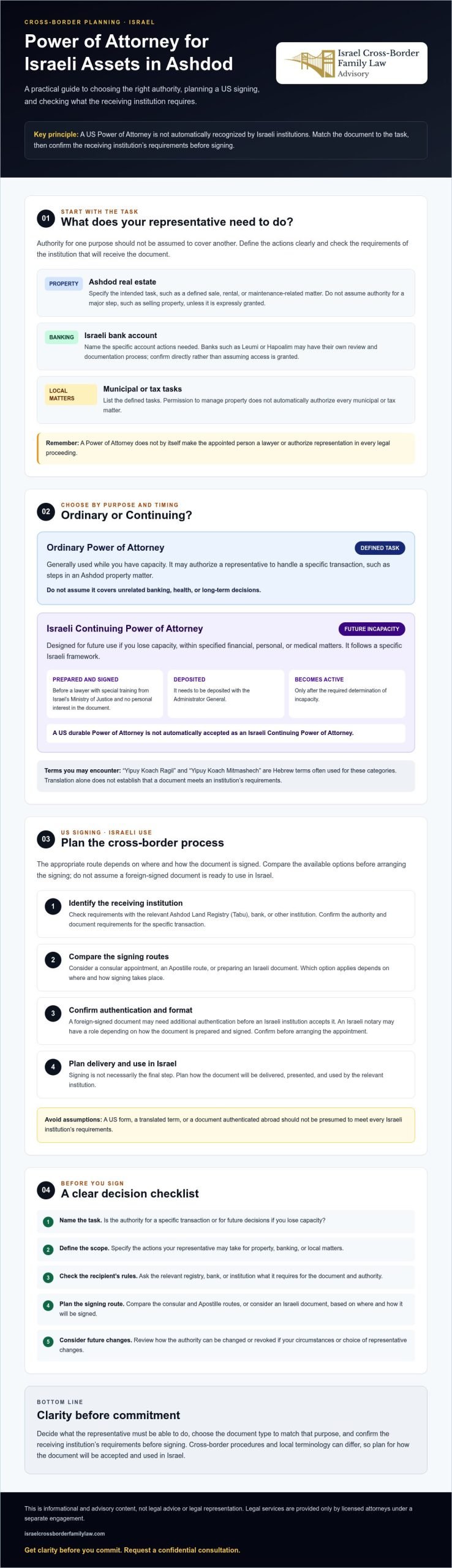
For a power of attorney for Israeli assets Ashdod holders may need, the key question is not only whom you trust, but exactly what that person must be able to do. Authority to manage property, access a bank account, and handle a municipal matter are distinct. A document covering one task should not be assumed to cover the others.
Key Legal Terms You Must Know
An ordinary Power of Attorney is generally used while the person granting it has capacity and can authorize actions such as a specific transaction. A Continuing Power of Attorney is designed for future use if the person loses capacity. Israeli Continuing Powers of Attorney follow a specific local framework. A US durable document is not automatically a substitute accepted in Israel.
“Yipuy Koach Ragil” and “Yipuy Koach Mitmashech” are Hebrew terms often used for these categories. Translation alone does not establish that a document meets an institution’s requirements. An Israeli notary may have a role in notarization or document authentication, depending on how the document is prepared and signed. Confirm the relevant requirements before arranging a signing.
Tabu is the Hebrew name commonly used for Israel’s Land Registry. Rather than assume there is a single Ashdod-specific form or set of terms, confirm the current document and authority requirements for the relevant registry office and transaction. Hebrew-language terminology can make this step less familiar for US-based owners.
Scope of Authority: What Can Your Representative Do?
Describe the authority clearly and match it to the tasks you intend to delegate. Depending on the document and the receiving institution’s requirements, consider whether it covers:
- Real estate: A defined sale, rental, or maintenance-related task for an Ashdod apartment. Do not assume authority for a major step, such as selling property, unless it is expressly granted.
- Banking: Specific actions involving an Israeli account, including an account with Leumi or Hapoalim. Each bank may have its own review and documentation process, so check directly rather than assume the POA grants account access.
- Municipal or tax matters: Defined tasks involving local offices. Permission to manage property does not automatically authorize someone to handle every municipal or tax issue.
A Power of Attorney does not, by itself, make the appointed person a lawyer or grant authority to represent you in every legal proceeding. Decide the intended scope before signing, then verify requirements with the institution that will receive the document.
Choosing a Power of Attorney for Israeli Assets Ashdod
The right document depends on what your representative needs to do and when they may need to act. A Power of Attorney for a one-time apartment sale serves a different purpose from one intended to support future decisions if you lose capacity. For a power of attorney for Israeli assets Ashdod, consider the task, intended duration, and Israeli institution that will receive the document before choosing a type.
When to Use an Ordinary vs. Continuing POA
An ordinary Power of Attorney is generally suited to a defined task while you have capacity, such as authorizing a representative to handle steps in a particular Ashdod property transaction. Its scope can be limited to that purpose. Do not assume it provides authority for unrelated banking, health, or long-term decisions.
An Israeli Continuing Power of Attorney is designed to take effect if you later lack capacity, offering a framework for specified financial, personal, or medical matters. It must be prepared and signed before a lawyer who has completed special training from Israel’s Ministry of Justice and has no personal interest in the document. It also needs to be deposited with the Administrator General, and it becomes active only after the required determination of incapacity. A US durable Power of Attorney is not automatically accepted as an Israeli Continuing Power of Attorney.
The Irrevocable POA in Ashdod Real Estate
An irrevocable Power of Attorney is typically used in Israeli real estate transactions. It may help enable agreed transaction steps to proceed even if the person who granted authority later changes their mind. But “irrevocable” does not mean unlimited authority or make the document suitable for every property-management task. Its purpose and effect depend on the transaction and the document’s wording.
For a transfer involving the Ashdod Land Registry, commonly called Tabu, confirm in advance what form of authority and supporting documents the registry requires. Do not assume that a document accepted for one transaction or institution will meet another’s requirements.
Compare Purpose, Duration, and Practical Steps
- Ordinary POA: A focused option for a specific task while you have capacity. Drafting and signing steps depend on the purpose and where you sign.
- Continuing POA: A more involved framework for specified decisions after incapacity, with special preparation, deposit, and activation requirements.
- Irrevocable POA: Typically tied to a real estate transaction, not a general substitute for ongoing property management.
Costs cannot be compared reliably without knowing the document, signing route, and authentication steps involved. Check current fees and requirements before committing, rather than choosing on price alone. If you’re weighing which approach fits your US-Israel circumstances, request a confidential advisory conversation.
The Cross-Border Signing Process: US vs. Ashdod
Signing in the United States can be practical, but the document and authentication steps must fit its purpose and the Israeli institution that will receive it. For a power of attorney for Israeli assets Ashdod, plan the sequence before signing: confirm the wording, select a signing route, complete any required authentication, and check whether the receiving office needs a Hebrew translation. Requirements can differ by document and institution, so do not assume one route will work for every bank or property matter.
Option A: Ask an Israeli Consulate About Notarial Services
Start with the Israeli consulate responsible for your location and check its current appointment process for notarial services. Confirm whether it can handle the specific document, what identification and original paperwork to bring, and whether you need to provide the final wording in advance. Appointment availability changes, so do not rely on assumed wait times. Consular signing may simplify authentication steps, but it does not guarantee that a bank, Tabu, or another Israeli office will accept the document for your intended purpose.
Option B: Sign Before a US Notary and Obtain an Apostille
If you use the Apostille route, first confirm that the receiving Israeli institution will accept a document signed before a US notary. The usual sequence is to prepare the document for its Israeli purpose, sign it as instructed before a notary, and submit the notarized document to the relevant state authority for an Apostille. The issuing office and submission rules vary by state. An Apostille authenticates the notary’s signature or official capacity. It does not certify that the document’s contents are legally sufficient or accepted by a particular institution.
Before sending the original to Israel, ask whether the bank or registry requires a Hebrew translation and whether that translation must be notarized in Israel. Do not treat “notarial translation” as a universal requirement. Confirm it directly for your document and transaction.
Check the Wording Before You Sign
A standard US template may use terms, powers, or signing formalities that do not match the Israeli purpose. A bilingual Hebrew-English draft can help the signer and representative understand the same authority, but translation alone does not ensure acceptance. The document should clearly identify the person granting authority, the representative, and the authorized actions, using wording suited to the intended Israeli use. Confirm any language requested by the receiving bank or registry before booking an appointment or signing.
- Before signing: Identify the receiving institution and confirm its current document, translation, and authentication requirements.
- After signing: Check that the Apostille or consular authentication is attached correctly and arrange secure delivery of the original if needed.
For help organizing the cross-border questions to clarify before you commit, request an advisory conversation.
Step-by-Step Guide to Activating Your POA in Ashdod
A signed document is not necessarily ready to use. For a power of attorney for Israeli assets Ashdod, check the receiving institution’s requirements before arranging a signature. The process can differ between a bank, the Land Registry (Tabu), and other offices. Use this checklist to identify what to confirm without assuming every institution follows the same steps.
- Define the task and recipient. Identify whether the representative will deal with a bank account, a property matter, or another specific issue. Ask the relevant Ashdod office or institution what authority and supporting documents it needs.
- Prepare the document for its purpose. Check that the wording clearly identifies the person granting authority, the representative, and the actions allowed. For a property sale or mortgage, do not assume general wording is enough. Confirm the required scope with the intended recipient before signing.
- Choose and complete the signing route. If you’re in the US, confirm whether the Israeli Consulate can handle the document or whether the receiving institution accepts a US-notary and Apostille route. If signing in Israel, confirm the applicable local formalities. Requirements depend on the document and its intended use.
- Authenticate and deliver it. A foreign-signed Power of Attorney may need an Apostille for use in Israel. As of January 1, 2026, the Apostille fee from Israel’s Ministry of Foreign Affairs or the courts is 41 NIS per document. Confirm the issuing authority’s current process and whether the original must be delivered to Israel.
- Present it and confirm recognition. Ask the receiving bank or registry how to submit the document and what identification or other paperwork the representative must provide. Follow up to confirm the document has been accepted for the intended action before relying on it.
Dealing with Ashdod Banks
Leumi, Hapoalim, Mizrahi, and other banks may review identity, authority, and transaction details under their compliance procedures. Israeli banks have increased AML reviews, and additional source-of-funds documents may be requested. Do not assume that naming a bank account or branch in the POA is mandatory, or that doing so alone will secure access. Ask the specific bank whether it wants account details in the document and what identification or supporting records it requires. For background on cross-border considerations, see this overview of advisory information for expats and foreign nationals.
Filing with the Ashdod Land Registry
Before sending documents, confirm with the relevant Tabu office whether it requires an in-person or digital submission, the current format, and any translation or authentication steps. Check requirements for foreign signatories directly, since they may depend on the filing and document. Coordination between the signer abroad, representative, and receiving office can help identify missing items before submission.
Strategic Risks and Decision-Making Guidance
A Power of Attorney should give your representative enough authority to carry out the intended task without granting powers you do not mean to delegate. Broad wording may not answer a bank’s questions about a specific account or transaction. The institution may ask for clarification or decline to act on the document. Requirements vary, so confirm them with the relevant bank or office before signing.
For a power of attorney for Israeli assets Ashdod, consider who will act, what they can do, and how you’ll stay informed while living abroad. Choose someone you trust who can communicate with local institutions and understands the practical differences between US expectations and Israel’s Hebrew-centric processes. Familiarity with Ashdod’s local offices and procedures can also help your representative identify what needs to be checked.
Protecting Yourself from Misuse
Set clear limits. For example, authority to pay a specific property expense should not automatically be treated as permission to sell the property or move unrelated funds. If you’re considering safeguards such as requiring updates, keeping records, or adding approval steps for major actions, discuss how to word them and whether they’re workable for your intended use with a licensed Israeli attorney. For information about pricing, see pricing for advisory services.
If circumstances change, do not assume that telling your representative is enough to stop a document from being used. Ask how to revoke it under the applicable Israeli process, then notify the representative and each institution that received or recorded a copy. Confirm what written notice, original documents, or authentication each recipient requires, especially if you’re handling the process from the US.
Why a Cross-Border Perspective Matters
US and Israeli systems may use familiar words differently and may expect different forms, signing steps, or supporting documents. A document that makes sense in one country may not meet the practical needs of a bank or registry in the other. Clarifying those differences early can reduce avoidable follow-up and document revisions. It also helps you make an informed choice about the scope of authority before signing.
Early planning can help prevent delays and repeated work, though no document can guarantee acceptance or eliminate every cost. This article provides general information. For legal advice about your circumstances, consult a licensed attorney.
Get clarity before you commit. Request a confidential consultation.
Plan Your Next Step with Confidence
Putting authority in someone else’s hands is a decision worth making carefully. The right document depends on what you need your representative to do, which Israeli institution will receive it, and whether you’re signing from the US or Israel. For a power of attorney for Israeli assets Ashdod, clarity on those points can help you make an informed choice before you commit.
Cross-border questions can involve different legal terms, signing processes, and local administrative practices. Israel Cross Border Law Firm works on Israel-US legal matters and offers family law, divorce law, and wills and estates services. Its local relevance extends to clients in Tel Aviv, Jerusalem, Herzliya, Ra’anana, Netanya, Haifa, Modi’in, Beit Shemesh, Kfar Saba, Hod Hasharon, Ramat Gan, Givatayim, Petah Tikva, Ashdod, Be’er Sheva, Eilat, Caesarea, and Zichron Ya’akov. If your question concerns a Power of Attorney, confirm whether the firm can assist with your specific matter.
Addressing the right questions early can help you take the next step with greater clarity.
Frequently Asked Questions
Is a Power of Attorney signed in the US valid for a house sale in Ashdod?
It may be usable, but a US signature alone does not establish that the document will be accepted for an Ashdod property sale. Before signing, ask the Israeli professional handling the transaction and the relevant Land Registry what document format, authority, and authentication they require. Check whether they need the original, a Hebrew translation, or other supporting records. Requirements can depend on the specific filing, so confirm them before scheduling the signing.
Do I need to visit the Israeli Consulate to sign a POA for my Ashdod bank account?
Not always. Whether a consular appointment is needed depends on the bank’s requirements and the signing route it accepts. Contact the specific branch or its relevant department before booking, and ask what identification, document wording, and authentication it expects. If you’re considering an Apostille instead, confirm that route with the bank first. Consular appointment availability can change, so check current scheduling information directly with the consulate.
Can I use a US Notary for an Israeli Power of Attorney?
A US notary may be part of the signing process if the Israeli recipient accepts that route and the document is authenticated as required. Ask which state office issues the Apostille for the notarization and how the document should be submitted. Also verify whether the Israeli recipient needs the original or a translation. Notarization and authentication relate to the signature or official capacity. They do not confirm that the document meets the recipient’s requirements.
What is the difference between an Ordinary and Durable Power of Attorney in Israel?
An ordinary POA generally authorizes a representative to act while the person granting authority has capacity, often for a defined purpose. An Israeli Continuing Power of Attorney is intended to address specified decisions if that person later loses capacity. It has its own preparation, deposit, and activation process in Israel. When comparing documents, focus on when authority begins, what decisions it covers, and whether the relevant institution will accept it.
How much does it cost to set up a cross-border POA for Ashdod assets?
The total varies with the document type, preparation, signing route, authentication, and any translation needed. The estimate in this article is ₪2,000 to ₪5,000 for a couple’s full set of documents, including two Continuing Powers of Attorney. It does not necessarily apply to a one-time property or banking POA. Request a current itemized estimate for your specific document and confirm which third-party charges are separate.
How long does the Apostille process take for Israeli documents in 2026?
There is no single confirmed processing time for all US states or submissions. Timing may depend on the relevant state authority’s procedures and workload. Check its current processing information before setting a deadline for a property or banking matter, and allow time for document delivery and any translation requested in Israel. The fee information in this article does not establish a US processing time, so avoid relying on an assumed turnaround.
Can I revoke an Israeli Power of Attorney while living in the US?
The steps depend on the document and whether it has been given to or recorded by an institution. Before sending a revocation, confirm the applicable process and the form of notice each recipient requires. Make a list of the representative, banks, and offices that received the POA, then ask each how it records a revocation and whether it needs an authenticated document. Keep copies of notices and any acknowledgment you receive.
Does the Ashdod Land Registry (Tabu) accept digital signatures on a POA?
Do not assume a digital signature will be accepted. Confirm directly with the relevant Land Registry office whether it accepts an electronically signed POA for the specific filing, and ask about signature format, authentication, and supporting documents. If a representative will submit the paperwork, check whether the office requires an original or another form of verification. Confirm requirements before signing electronically, since a signature method accepted elsewhere may not suit this filing.

Article by
Gabriel Lior
A Personal Journey That Became a Mission
The advisory was founded by an American father Gabriel Lior, LLB, MBA , global entrepreneur, and cross-border advisor who spent more than a decade navigating the Israeli family court system firsthand and now lives in Singapore with his son.
As a divorced parent in a cross-border family, Gabriel faced nearly every legal challenge a foreign parent can encounter in Israel — including child custody disputes, child support proceedings, property matters in Israel and abroad, false accusations, and complex immigration and relocation proceedings.
Over the years, he learned the hard way how difficult it is for non-Israeli parents to understand the system, identify the right legal strategy, and choose the right legal representation — especially when language, culture, and jurisdictional differences are involved. He also witnessed how foreign parents and new immigrants are often disadvantaged or taken advantage of by service providers and institutions simply because they lack local knowledge or fluency.
From Client to Advisor
To truly understand — and survive — the system, Gabriel pursued formal legal education in Israel, completing two Israeli law degrees, alongside a BA and MBA earned in the United States. This was never about becoming a practicing attorney, but about gaining a deep, structural understanding of how the system works — and where it breaks down for foreign parents.
This rare combination of:
Firsthand client experience
Israeli legal and US business education
International business and negotiation training
Decades of commercial execution
created a unique perspective – one that understands both sides of the table.
After years of litigation, persistence, and at times self-representation, he ultimately succeeded in securing custody of his son and relocating abroad through a rare legal victory in the Israeli Supreme Court — becoming one of the first fathers in Israel to do so under these circumstances.
Disclaimer
Important Disclaimer:
The information provided on this website and in its content is for general informational and educational purposes only and does not constitute legal advice, legal opinion, or legal representation.
Gabriel Lior is not licensed to practice law in Israel (nor is he interested in doing so) and does not provide legal services, despite having completed 2 Law Degrees. The services offered are advisory in nature and are intended to provide general guidance, strategic insight, and information regarding cross-border family law considerations.
No attorney-client relationship is formed by accessing this website, reading its content, or communicating with us.
Any decisions made based on this information are at your own discretion and risk. For legal advice specific to your situation, you should consult a licensed attorney in the relevant jurisdiction.
Where appropriate, we may refer clients to independent, licensed attorneys or professionals. Such referrals do not constitute legal representation and no liability is assumed for services provided by third parties.