For families with deep connections to both the United States and Israel, the question of legacy is often fraught with multi-jurisdictional complexity. Concerns over the validity of a U.S. will for Israeli property, the potential for double taxation on your estate, and the navigation of conflicting inheritance laws can create significant uncertainty. A carefully structured plan is paramount. This is where effective cross border estate planning us israel becomes the essential framework for securing your family’s financial future and protecting your assets across continents, ensuring your wishes are honored without subjecting your heirs to a convoluted and costly international probate process.
This comprehensive guide is designed to provide authoritative clarity, demystifying the intricate legal and financial landscape. We will delve into the critical aspects of U.S. and Israeli tax laws, the strategic use of wills and trusts in both nations, and the procedures for a streamlined probate. Our objective is to equip you with the sophisticated knowledge required to develop a seamless strategy, one that minimizes tax liabilities, simplifies the inheritance process for your beneficiaries, and provides you with the ultimate peace of mind knowing your family’s future is secure.
Why Your Standard Estate Plan Fails Across Borders
An estate plan drafted exclusively under the laws of a single country is fundamentally inadequate for individuals with a global footprint, particularly those with assets in both the United States and Israel. Legal frameworks are jurisdictional; a will or trust meticulously prepared in New York may not be recognized or may have unintended consequences when applied to property in Tel Aviv. This divergence creates a complex legal minefield, often governed by principles of Conflict of laws, where competing legal systems clash. Whether you are a US citizen holding Israeli real estate or an Israeli national with US investment accounts, failing to engage in sophisticated, proactive planning exposes your estate to significant legal disputes, financial loss, and familial conflict.
For a deeper understanding of these multi-jurisdictional challenges, the following overview is instructive:
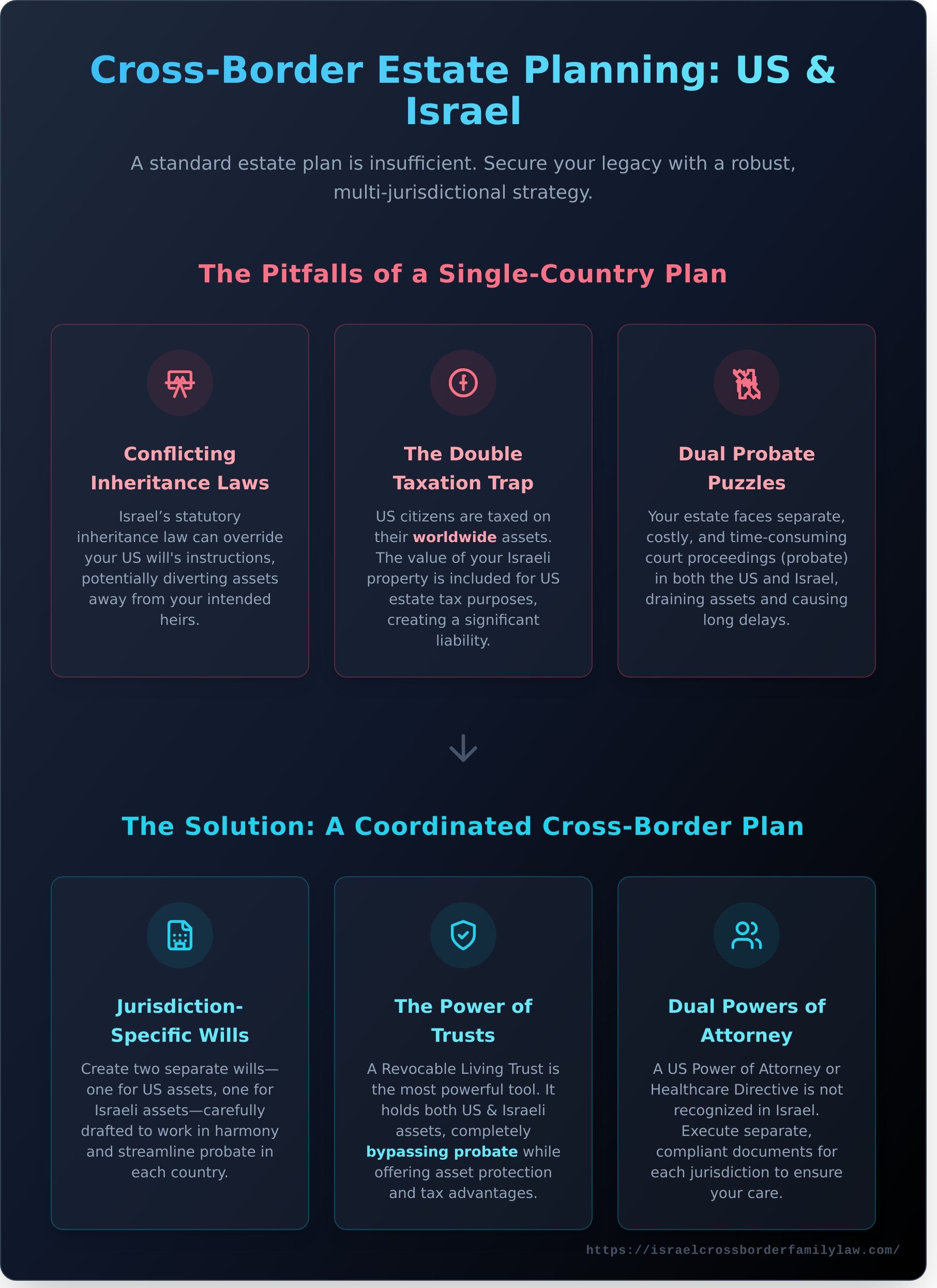
Conflicting Inheritance Laws: US Common Law vs. Israeli Statutory Law
The United States legal system grants significant testamentary freedom, allowing individuals broad latitude to distribute their assets as they see fit through a will. In contrast, Israel’s Succession Law establishes a statutory order of inheritance for spouses and children. While a valid will can override this default, an intestate death (dying without a will) over an Israeli asset will trigger this statutory distribution, potentially diverting assets to heirs you never intended to benefit, irrespective of your wishes expressed elsewhere.
The Double Taxation Trap: US Estate Tax and Global Assets
A common and costly misconception is that Israel’s lack of an inheritance tax provides a complete shield for US persons. The US Internal Revenue Service (IRS) taxes its citizens and Green Card holders on their worldwide assets. This means the value of your Israeli bank accounts, real estate, and other investments is aggregated into your total estate value for US estate tax purposes. Proper cross border estate planning us israel is essential to implement strategies that mitigate this potential for double taxation and preserve wealth.
Probate Puzzles: Facing Legal Proceedings in Both Countries
Probate is the court-supervised process of validating a will and distributing assets. When assets are held internationally, a secondary, often more complicated process known as ancillary probate is required in the foreign jurisdiction. This results in dual legal proceedings, leading to substantial delays and administrative costs that can amount to tens of thousands of shekels (₪). Critically, an Israeli court is not obligated to automatically recognize a US probate order, necessitating separate, and often duplicative, legal efforts in both nations.
Core Components of a Robust US-Israel Estate Plan
Navigating the complexities of multi-jurisdictional asset transfer requires moving beyond identifying problems to implementing sophisticated solutions. A robust plan is not a single document but a coordinated toolkit of legal instruments, each designed to address specific international challenges. Effective cross border estate planning us israel hinges on ensuring these components work in harmony to protect assets, minimize tax exposure, and guarantee your wishes are honored in both countries.
Wills: Should You Have One, Two, or an International Will?
The most common question is whether to use a single will or separate wills for US and Israeli assets. Creating distinct, jurisdiction-specific wills-one for the US and one for Israel-can streamline the probate process in each country. However, this strategy carries a significant risk: conflicting language, particularly revocation clauses, can inadvertently invalidate one of the wills. While the concept of an “international will” exists, its recognition is not universal. The most prudent strategy is to have separate wills that explicitly limit their scope to the assets within their respective jurisdictions, preventing contradiction.
Trusts: The Most Powerful Tool for Cross-Border Control
For individuals with significant assets in both nations, a Revocable Living Trust is often the central and most powerful component of a cross-border plan. A properly structured trust can hold both US and Israeli assets, bypassing the costly and time-consuming probate processes in both legal systems. Beyond probate avoidance, trusts offer superior asset protection and sophisticated tax planning opportunities. The strategic use of trusts is essential for mitigating tax liabilities, which are governed by a complex framework including the U.S.-Israel Tax Treaty. Advanced tools like Irrevocable Life Insurance Trusts (ILITs) can further shield assets from estate taxes.
Powers of Attorney and Healthcare Directives
Incapacity planning is a critical, yet often overlooked, aspect of cross border estate planning us israel. A US-drafted durable power of attorney or healthcare directive will likely be rejected by Israeli financial institutions and medical facilities. It is imperative to execute separate, compliant documents for each jurisdiction. This includes creating an Israeli Enduring Power of Attorney (“Yipui Koach Mitmashech”) for financial and personal matters in Israel. Furthermore, you must appoint agents who can act effectively on the ground in each location, ensuring your affairs are managed seamlessly regardless of where you are.
Navigating Key Tax Issues and Reporting Requirements
For US citizens, residents, and Green Card holders with assets in Israel, a comprehensive understanding of the US tax and reporting framework is not merely advisable-it is mandatory. The United States taxes its citizens on their worldwide assets, creating a complex web of obligations that requires sophisticated guidance. Failure to comply with these multi-jurisdictional rules can result in severe financial penalties, underscoring the critical importance of proactive and informed cross border estate planning us israel.
The US Estate and Gift Tax Exemption Explained
The US federal government imposes a tax on the transfer of significant wealth. For 2024, each US person benefits from a substantial federal estate and gift tax exemption of $13.61 million. This is a unified credit, applying to both lifetime taxable gifts and assets transferred at death. However, transfers to non-citizen spouses are treated differently, with a much lower annual gift exclusion of $185,000 for 2024. The concept of “portability” allows a surviving US citizen spouse to utilize any unused portion of their deceased spouse’s exemption, a vital tool in strategic planning.
Foreign Asset Reporting: FBAR and FATCA Compliance
US persons must maintain transparency regarding their foreign assets through two critical reporting obligations:
FBAR (FinCEN Form 114): This form must be filed annually if the aggregate value of foreign financial accounts, such as those held in Israeli banks, exceeds $10,000 at any point during the calendar year.
FATCA (Form 8938): Filed with your US income tax return, this form reports specified foreign financial assets and has higher, more complex reporting thresholds than FBAR.
These filings are central to US regulatory compliance and carry substantial penalties for non-disclosure.
Leveraging the US-Israel Tax Treaty
A common misconception is that the US-Israel Tax Treaty resolves all estate planning issues. In reality, the treaty primarily addresses income taxes, not estate or gift taxes. It is instrumental in preventing double taxation of income generated by estate assets, such as from an Israeli investment portfolio. While the treaty provides this relief, it does not resolve many of the fundamental Cross-Border Estate Planning Challenges that arise from the divergent legal frameworks of the two nations, nor does it eliminate US estate tax exposure.
[
Download
](https://getautoseo.com/screenshots/getautoseocom_1768437179_prp5o8dV.jpg)
Feedback & Recreate
Delete

Strategic Planning for Common Scenarios and Asset Types
Effective cross border estate planning us israel moves beyond legal theory to address the tangible, real-world complexities faced by international families. Advising clients requires a deep understanding of how multi-jurisdictional laws apply to specific assets and family structures. Below, we address several of the most common and sophisticated scenarios we navigate for our clients.
Owning Israeli Real Estate as a US Citizen
For US citizens holding property in Israel, the method of titling is a critical decision with significant consequences. While holding title individually or as joint tenants is common, placing the property into a properly structured US-based trust often provides superior advantages. This strategy can streamline the administration of your US estate and potentially avoid the lengthy and costly Israeli probate process. However, one must carefully consider Israeli transfer taxes, such as Land Appreciation Tax (Mas Shevach), which can amount to substantial sums in Israeli Shekels (₪) upon the transfer of title.
Planning for Beneficiaries Living in Different Countries
Distributing assets across borders introduces logistical and financial hurdles. An inheritance for a US-based heir from an Israeli estate may face delays due to Israeli probate and banking regulations. Conversely, structuring an inheritance from a US estate for an Israeli beneficiary requires careful planning to leverage the US estate tax exemption and ensure compliance. Utilizing international trusts is a sophisticated strategy to manage these distributions over time, providing asset protection and controlled disbursement for beneficiaries, regardless of their country of residence.
Guardianship for Minor Children Across Borders
For parents with ties to both the US and Israel, nominating guardians for minor children is a paramount concern. It is essential to nominate guardians in parallel legal documents-such as a US will and an Israeli will-to prevent jurisdictional conflicts. The situation becomes exponentially more complex if the parents live in different countries, potentially implicating the Hague Convention on Child Abduction in the event of a dispute. Proactive, clear, and legally sound planning is the only way to ensure your children’s stability is protected. Protect your family’s future. Schedule a consultation.
Why You Need a Specialized Cross-Border Legal Team
Navigating the intersection of United States and Israeli law requires more than just general legal knowledge; it demands a sophisticated, integrated approach that a single-jurisdiction advisor simply cannot provide. For families and individuals with assets in both countries, engaging a specialized legal team is not a luxury-it is a fundamental necessity for preserving wealth, minimizing tax liabilities, and ensuring your legacy is executed according to your precise wishes.
The Dangers of a Single-Jurisdiction Approach
Relying on uncoordinated advice can create significant financial and legal complications. A US-based attorney, while expert in federal estate tax and trusts, may be entirely unaware of Israeli inheritance law, which does not recognize trusts in the same manner. This can lead to a US-drafted trust being treated as an ordinary taxable entity in Israel. Conversely, an Israeli lawyer may not grasp the complexities of US gift tax or the Generation-Skipping Transfer Tax (GSTT), potentially triggering massive tax burdens for US beneficiaries. Such fragmented counsel often results in conflicting strategies, unnecessary probate proceedings, and substantial, avoidable costs that can run into hundreds of thousands of shekels.
Checklist: Choosing Your US-Israel Estate Planning Attorney
When selecting legal counsel, it is critical to verify they possess a unique combination of multi-jurisdictional skills. Your advisory team must demonstrate:
Dual Qualification: Attorneys should be licensed to practice in both the relevant US state(s) and Israel, or be part of a firm with a formal, seamless partnership between its US and Israeli departments.
Deep Tax Treaty Expertise: Profound experience with the US-Israel tax treaty is essential, particularly an understanding of its significant limitations concerning estate and gift taxes.
Bicultural and Bilingual Fluency: True expertise goes beyond language. Your counsel must possess a nuanced, bicultural understanding to navigate the administrative and legal systems of both nations effectively.
A Collaborative Framework: The ability to work cohesively with your existing accountants, financial advisors, and family office is paramount to developing a unified and comprehensive wealth transfer strategy.
Ultimately, successful cross border estate planning us israel is a highly specialized discipline. It requires a legal partner built to serve as a bridge between two distinct legal and financial worlds. Our firm is uniquely structured with dually-qualified attorneys who provide the integrated counsel necessary to protect your multi-jurisdictional assets. To ensure your estate plan is both compliant and optimized on both sides of the Atlantic, contact our cross-border team for a strategic consultation.
Navigating Your US-Israel Estate with Confidence
As this guide has illustrated, the complexities of multi-jurisdictional asset management render standard domestic estate plans dangerously inadequate for US-Israel families. Successfully navigating the disparate tax regimes, reporting requirements, and succession laws of both nations requires a meticulously crafted, forward-thinking strategy. Effective cross border estate planning us israel is not merely a legal formality; it is the essential framework for protecting your wealth, minimizing tax liabilities, and ensuring your intentions are honored seamlessly on both sides of the Atlantic.
Our firm provides the specialized, strategic counsel necessary to master these challenges. With decades of collective experience in the most complex international family and estate matters, our team of dual-qualified attorneys possesses deep, practical expertise in both US and Israeli law. Operating from our fully integrated offices in Tel Aviv and New York, we offer a seamless professional home for your legal needs. Contact our expert attorneys to secure your cross-border legacy. Take the definitive step today to safeguard your family’s future with confidence and clarity.
Frequently Asked Questions About US-Israel Estate Planning
Does Israel have an inheritance tax or estate tax?
Israel abolished its estate and inheritance tax in 1981. Consequently, beneficiaries inheriting assets located within Israel are not subject to Israeli inheritance tax, regardless of their citizenship or residency. However, it is critical for U.S. citizens and green card holders to understand that their worldwide estate, including Israeli assets, remains subject to U.S. federal estate tax. This dichotomy necessitates careful, multi-jurisdictional tax planning to mitigate potential liabilities and ensure compliance.
Will my Last Will and Testament from the U.S. be recognized in Israel?
A Last Will and Testament executed in the United States can be recognized in Israel under the Israeli Succession Law, provided it is valid in the jurisdiction where it was created. Despite this recognition, probating a U.S. will in Israel can be a protracted and complex process, often requiring certified translations and expert legal opinions. To ensure an efficient and predictable transfer of Israeli assets, establishing a separate, compliant Israeli will is frequently the most strategic approach.
How can I avoid the probate process for my assets in both the U.S. and Israel?
Avoiding probate in both jurisdictions requires a sophisticated and integrated estate plan. In the U.S., a Revocable Living Trust is the primary vehicle for bypassing the probate process. For assets in Israel, strategies may include titling property in an Israeli trust or utilizing joint ownership structures for financial accounts. A cohesive plan must be architected by counsel with deep expertise in both legal systems to ensure seamless, non-probate asset succession across borders.
What happens to my Israeli assets if I die without a will?
Should you pass away without a valid will (intestate), the distribution of your Israeli assets is dictated by Israel’s Succession Law of 1965. This statute mandates a specific hierarchy of inheritance, typically dividing the estate between the surviving spouse and the deceased’s children. For instance, a spouse may receive half of the estate, with the remaining half allocated to the children. This statutory distribution may not align with your specific intentions or complex family circumstances.
How does my U.S. citizenship affect my Israeli spouse’s inheritance rights and taxes?
A U.S. citizen’s status significantly impacts a non-U.S. citizen Israeli spouse’s inheritance. The unlimited marital deduction, which shields transfers between U.S. citizen spouses from estate tax, does not apply. Consequently, inheritances exceeding a limited exemption amount can trigger substantial U.S. estate tax liability for the Israeli spouse. Proactive planning, often involving a specialized instrument known as a Qualified Domestic Trust (QDOT), is essential to defer or mitigate this tax exposure.
Can I use a U.S. Revocable Living Trust to manage my property in Israel?
Utilizing a U.S. Revocable Living Trust to manage Israeli property, while theoretically possible, often creates significant practical and legal impediments. Israeli financial institutions and land registry offices may not recognize the authority of a foreign trustee, leading to considerable delays and administrative hurdles. For effective management and transfer of Israeli real estate and other assets, establishing a parallel Israeli trust or utilizing other compliant local instruments is the recommended and more efficient legal strategy.
What are the first steps I should take to start my cross-border estate plan?
The foundational first step is to conduct a comprehensive inventory of your global assets, documenting their nature, value, location, and current titling. Following this critical assessment, you must engage legal counsel with demonstrated expertise in cross border estate planning us israel. This specialized guidance is indispensable for navigating the intricate interplay of U.S. and Israeli succession laws and tax treaties to construct a robust, unified, and legally compliant international estate plan.

Article by
Gabriel Lior
A Personal Journey That Became a Mission
The advisory was founded by an American father Gabriel Lior, LLB, MBA , global entrepreneur, and cross-border advisor who spent more than a decade navigating the Israeli family court system firsthand and now lives in Singapore with his son.
As a divorced parent in a cross-border family, Gabriel faced nearly every legal challenge a foreign parent can encounter in Israel — including child custody disputes, child support proceedings, property matters in Israel and abroad, false accusations, and complex immigration and relocation proceedings.
Over the years, he learned the hard way how difficult it is for non-Israeli parents to understand the system, identify the right legal strategy, and choose the right legal representation — especially when language, culture, and jurisdictional differences are involved. He also witnessed how foreign parents and new immigrants are often disadvantaged or taken advantage of by service providers and institutions simply because they lack local knowledge or fluency.
From Client to Advisor
To truly understand — and survive — the system, Gabriel pursued formal legal education in Israel, completing two Israeli law degrees, alongside a BA and MBA earned in the United States. This was never about becoming a practicing attorney, but about gaining a deep, structural understanding of how the system works — and where it breaks down for foreign parents.
This rare combination of:
Firsthand client experience
Israeli legal and US business education
International business and negotiation training
Decades of commercial execution
created a unique perspective – one that understands both sides of the table.
After years of litigation, persistence, and at times self-representation, he ultimately succeeded in securing custody of his son and relocating abroad through a rare legal victory in the Israeli Supreme Court — becoming one of the first fathers in Israel to do so under these circumstances.
Disclaimer
Important Disclaimer:
The information provided on this website and in its content is for general informational and educational purposes only and does not constitute legal advice, legal opinion, or legal representation.
Gabriel Lior is not licensed to practice law in Israel (nor is he interested in doing so) and does not provide legal services, despite having completed 2 Law Degrees. The services offered are advisory in nature and are intended to provide general guidance, strategic insight, and information regarding cross-border family law considerations.
No attorney-client relationship is formed by accessing this website, reading its content, or communicating with us.
Any decisions made based on this information are at your own discretion and risk. For legal advice specific to your situation, you should consult a licensed attorney in the relevant jurisdiction.
Where appropriate, we may refer clients to independent, licensed attorneys or professionals. Such referrals do not constitute legal representation and no liability is assumed for services provided by third parties.