What if the birth certificate in your hand doesn’t actually make you a legal parent in the eyes of your home country? For many international families, the joy of a successful birth in the US is quickly met with the realization that surrogacy agreements across borders are not automatically recognized by the Israeli Ministry of Interior. You likely already know that the legal path to parenthood is just as critical as the medical one. It’s a complex reality where conflicting laws on citizenship and parentage can leave families in a state of legal limbo if the groundwork isn’t laid correctly.
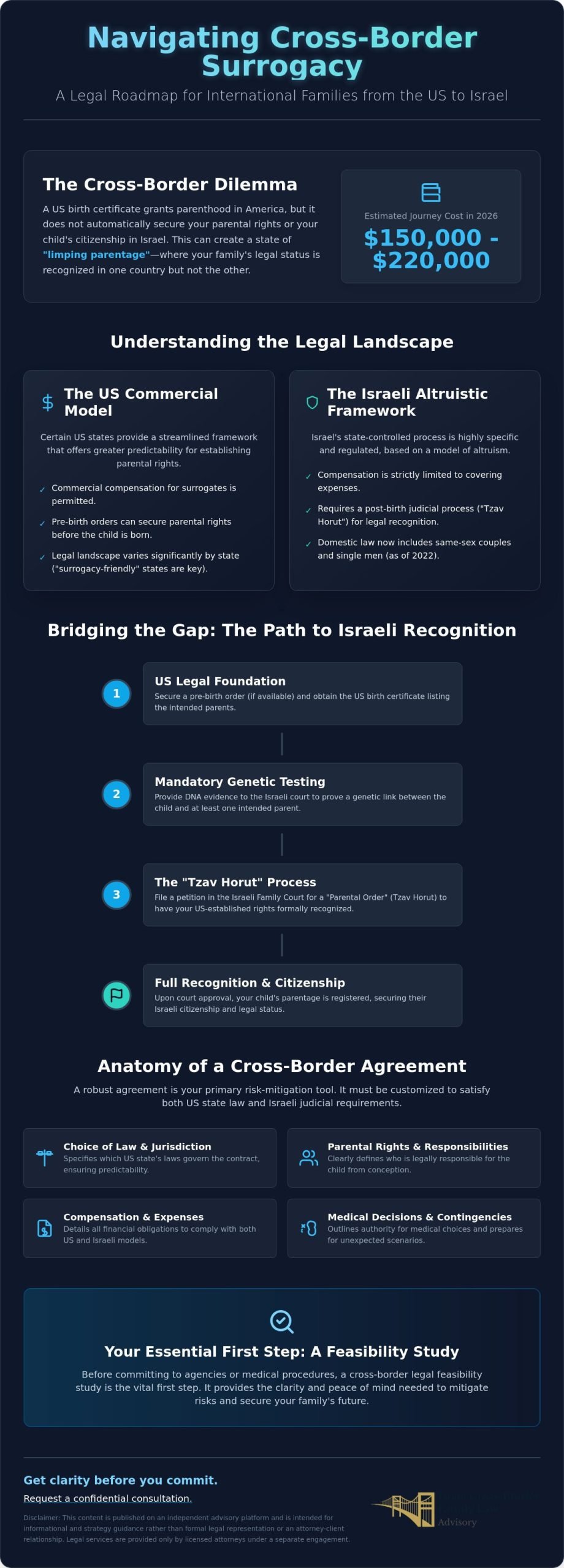
This article provides a clear roadmap to bridge the gap between US state laws and Israeli judicial requirements. You’ll gain a firm understanding of how to structure your contract to mitigate risks, the mandatory Tzav Horut process, and the financial landscape of a journey that often costs between $150,000 and $220,000 in 2026. We will also preview the essential clauses every international agreement needs to ensure your parental rights are secured before you even leave for the hospital. Please note that this content is published on an independent advisory platform and is intended for informational and strategy guidance rather than formal legal representation or an attorney-client relationship.
Key Takeaways
- Grasp the critical differences between the US commercial model and the Israeli altruistic framework to determine the most secure path for your family.
- Learn how to draft surrogacy agreements across borders that include robust choice-of-law clauses to bridge the gap between two sovereign legal systems.
- Explore the “Tzav Horut” process and the requirements for genetic testing to ensure your child’s parental rights and citizenship are fully recognized in Israel.
- Mitigate the risk of “limping parentage” by understanding how US birth certificates interact with the Israeli population registry.
- Discover why a cross-border legal feasibility study is the essential first step to achieving peace of mind before making significant financial commitments.
Understanding the Landscape of Cross-Border Surrogacy
Cross-border surrogacy occurs when intended parents reside in one country while the surrogate mother lives and gives birth in another. For families moving between the US and Israel, this arrangement is rarely a simple choice. It’s often a necessity born from the differences between permissive and restrictive jurisdictions. While Israel’s domestic laws have expanded to include same-sex couples and single men as of early 2022, the state-controlled process remains highly specific and regulated. Many families turn to the United States because certain states provide a more streamlined framework that offers greater predictability for parental rights.
Central to this entire journey are surrogacy agreements across borders. These documents serve as the foundational legal architecture for your family. They don’t just outline medical expectations; they define who is legally responsible for the child from the moment of conception. Gaining clarity on Global Surrogacy Laws is essential because Israel and the US operate on fundamentally different philosophies. Israel utilizes an altruistic model where compensation is strictly limited to expenses, whereas many US states allow for commercial compensation models that are more familiar to international intended parents.
To better understand this concept, watch this helpful video:
The Surge in International Surrogacy
The Fragmented Legal Reality
Legal systems don’t always speak the same language. A “Conflict of Laws” arises when two countries claim jurisdiction over the same child or contract. For example, a US court might issue a birth certificate listing both intended parents, but the Israeli Ministry of Interior may require a separate court order to recognize that relationship. We often call this a “bridge” approach. You must ensure that your legal strategy accounts for the requirements of both locations. For more information on how this applies to international families, you can explore our resources for expats and foreign nationals. Without this foresight, you risk facing significant delays in bringing your child home or securing their citizenship. Decisions made at the agency level in the US can have lasting impacts on your ability to register your child in Israel.
Essential Clauses in International Surrogacy Agreements
The success of a cross-border journey depends on a contract that anticipates the friction between two different legal systems. While a US agency might provide a standard template, surrogacy agreements across borders require deep customization to satisfy both the local state laws in the US and the strict registration requirements in Israel. A well-drafted agreement serves as a risk-mitigation tool, clearly outlining the roles and responsibilities of all parties to prevent future disputes that could complicate the child’s status. Strategic planning at this stage is the only way to ensure that the parental rights established in a US court will be recognized by the Israeli Family Court later.
Every comprehensive international agreement should address these core pillars:
- Choice of Law and Jurisdiction: You must specify which US state’s laws govern the contract. This is critical because US surrogacy law is fragmented at the state level, and your choice determines how easily you can obtain a pre-birth or post-birth parentage order.
- Parental Rights Establishment: The contract must explicitly state the intent for the intended parents to be the sole legal parents. This foundation is necessary for the subsequent Israeli “Tzav Horut” process.
- Financial Transparency: With total US surrogacy costs often ranging from $150,000 to $220,000, the agreement must define escrow management and surrogate compensation, which typically starts at $60,000 and can exceed $110,000.
- Medical Contingencies: The document should clearly outline protocols for selective reduction, emergency care, and the surrogate’s right to medical autonomy.
- Nationality and Travel: Clauses must ensure the surrogate cooperates with passport applications, allowing the child to travel to Israel once the birth is registered.
Establishing Clear Intent
To avoid complications with Israel’s Surrogacy Law, the agreement must confirm a mandatory genetic link between at least one intended parent and the child. This is a non-negotiable requirement for Israeli recognition. Explicitly defining the “Intended Parent” status from the outset helps protect against allegations of “sale of children” by documenting that all payments are for legitimate medical and compensatory purposes rather than the transfer of the child itself.
Financial and Medical Safeguards
Managing insurance across borders is inherently complex. Agreements must account for potential NICU stays or unexpected medical outcomes, which can significantly impact the total financial commitment. It’s also vital to balance the surrogate’s autonomy with the parents’ expectations regarding prenatal care. For those seeking to understand how these complexities affect their specific situation, it’s often helpful to request a confidential review of your strategic plan. Proper drafting ensures that neither party is left vulnerable to the high costs of medical mistakes or legal oversights in a multi-jurisdictional environment.
Conflict of Laws: Establishing Parental Rights and Nationality
One of the most significant risks in international family building is the phenomenon of “limping parentage.” This occurs when a child is legally recognized as yours in the United States but remains a legal stranger to you under Israeli law. Because surrogacy agreements across borders operate without a unifying international treaty, the legal status of your family depends entirely on how well you bridge these two sovereign systems. The Hague Conference on Private International Law suspended its global surrogacy project in March 2026, confirming that parents cannot rely on a universal standard for recognition in the near future.
In the US, the 14th Amendment currently grants automatic citizenship to children born on US soil. However, families should stay informed about potential shifts in birthright citizenship rules following Executive Order 14160 and subsequent judicial reviews expected in mid-2026. For Israeli recognition, the process is judicial rather than administrative. The Ministry of Interior (Misrad HaPnim) will not register a child based solely on a foreign birth certificate. Instead, parents must obtain a “Tzav Horut” (Parenthood Order) from the Israeli Family Court, which requires a court-supervised genetic test to confirm the biological link.
The Path to Israeli Citizenship
Navigating the registration process requires coordination with the Israeli consulate and the Ministry of Interior. While US-born children can obtain a US passport through a Consular Report of Birth Abroad (CRBA), they aren’t recognized as Israeli citizens until the Family Court process is complete. Common pitfalls that lead to delays include failing to pre-coordinate DNA testing or missing specific evidentiary requirements that Israeli authorities demand. These oversights can leave families stranded in the US for weeks or months longer than planned. Understanding the sequence of these steps is essential for a smooth transition. You can learn more about the strategy involved by visiting our page on how the advisory process works.
US State Law Variations
The choice of a “surrogacy-friendly” US state is your first and most impactful strategic decision. States like California or Michigan, which passed the Assisted Reproduction and Surrogacy Parentage Act in April 2025, offer clear pathways to judicial parentage. A judicial order is a formal court ruling that establishes your rights before or shortly after birth. Israeli legal authorities typically place significantly more weight on these court-issued orders than on administrative documents like birth certificates. This distinction is vital because a US court order that explicitly addresses the intent of the parties provides a stronger foundation for the Israeli Parenthood Order. This content is published on an independent advisory platform and provides strategy and risk guidance rather than formal legal advice or representation.
Navigating the US-Israel Regulatory Corridor
Navigating the regulatory corridor between the US and Israel requires an understanding that Israeli domestic law has limited reach once you cross the Atlantic. While the updated “Embryo Carrying Agreements Law” (January 2022) now permits single men and same-sex couples to pursue surrogacy within Israel, these regulations do not provide a protective umbrella for international arrangements. Instead, surrogacy agreements across borders must be designed to withstand the scrutiny of two independent legal systems simultaneously. This makes your choice of agency and legal counsel your most significant early decision. A mismatch between a US agency’s standard practices and Israeli regulatory expectations can lead to registration delays or, in extreme cases, legal complications regarding the legality of the compensation structure.
This content is published on an independent advisory platform, not a law firm. Our focus remains on the strategic risks and decision-making guidance necessary for international families, as legal services are provided only by licensed attorneys under a separate engagement. It is essential to ensure that your foreign agreement does not inadvertently violate local Israeli laws regarding the brokering of surrogacy, which remains a highly sensitive area of regulation.
For Expats and Foreign Nationals
Anglos and expats living in Israel face unique hurdles when pursuing surrogacy in the US. Beyond the immediate parentage orders, families must consider the long-term implications for the child’s inheritance rights and asset management within Israel. Ensuring your child is recognized as a legal heir requires that the surrogacy agreement is drafted with an eye toward Israeli probate and family law. For those navigating these dual identities, seeking legal guidance for expats and foreign nationals is a critical step in the planning phase. It ensures that the bridge you build today supports your family’s future for decades.
Risk Mitigation and Decision-Making
Clarity before commitment is the most valuable asset you can possess. The worst-case scenarios in cross-border surrogacy, such as being unable to bring your child into Israel or facing a denial of parental registration, are almost always the result of a lack of coordination between US and Israeli legal strategies. By conducting a feasibility study before signing an agency contract, you can identify potential conflicts in nationality laws or medical protocols. Understanding how our advisory works for international families can help you navigate these complexities with confidence. If you have questions about your specific roadmap, you may reach out for a confidential discussion about your strategic options.
Strategic Planning: Securing Your Family’s Future
Establishing a family through international surrogacy is a sophisticated legal project that requires a structured, multi-phase strategy. It isn’t enough to simply follow the medical protocol. Success depends on a roadmap that anticipates the requirements of two different governments before the journey even begins. Because surrogacy agreements across borders involve high financial stakes and the fundamental rights of a child, a methodical approach is the only way to ensure peace of mind. This content is published on an independent advisory platform and focuses on strategic guidance; formal legal services are provided only by licensed attorneys under a separate engagement.
A secure strategic plan typically follows these five essential steps:
- Step 1: Conduct a cross-border legal feasibility study. Before committing to an agency or clinic, you must verify that your specific family structure and genetic link meet the current requirements of both the US state and the Israeli Ministry of Interior.
- Step 2: Draft a comprehensive, multi-jurisdictional agreement. Your contract must be customized to satisfy Israeli evidentiary standards while remaining enforceable in the US birth jurisdiction.
- Step 3: Secure pre-birth or post-birth orders. Obtaining a judicial ruling in the US state establishes your parental status early, providing a stronger foundation for recognition in Israel than a birth certificate alone.
- Step 4: Coordinate with the consulate for travel documents. This involves managing the Consular Report of Birth Abroad (CRBA) and ensuring all documents are apostilled correctly for the return to Israel.
- Step 5: Finalize parentage registration in Israel. The process concludes with the “Tzav Horut” in the Israeli Family Court, which officially registers you as the child’s parent in the population registry.
The Importance of Strategy Over Templates
“Off-the-shelf” surrogacy contracts often fail in cross-border cases because they’re designed for domestic US families. They don’t account for the specific clauses required by the Israeli Ministry of Health or the judicial requirements of the Israeli Family Court. For families moving between two systems, the agreement must also address long-term needs like Wills and Estates. Protecting your child’s inheritance rights in Israel requires that your surrogacy documentation aligns with Israeli probate laws. A template doesn’t offer this level of multi-jurisdictional protection.
Next Steps for Intended Parents
The path to parenthood is long, but it doesn’t have to be chaotic. Focusing on the long-term legal security of your child from day one allows you to focus on the joy of the birth when the time comes. We encourage a calm, methodical approach that prioritizes clarity before any financial or emotional commitments are made. If you’re ready to begin organizing your roadmap, you can request a confidential case review to discuss your specific strategic needs. Get clarity before you commit. Request a confidential consultation.
Building a Secure Foundation for Your Family
The path to international parenthood is defined by the strength of your initial strategy. Successful surrogacy agreements across borders require more than medical success; they demand a robust bridge between two distinct legal systems. By prioritizing custom contracts over standard templates and securing judicial parentage orders early, you protect your child’s status in both the US and Israel. This methodical approach ensures that technical requirements, such as court-supervised DNA testing, don’t become roadblocks to your return home.
This content is published on an independent advisory platform (not a law firm) and focuses on strategy and risk guidance. Legal services are only provided by licensed attorneys under a separate engagement. With decades of experience focused on US-Israel family law, we provide tailored support for the expat and Anglo community. Navigating multi-jurisdictional complexity requires foresight to avoid the high cost of legal mistakes. Our advisory is built to guide you through these strategic decisions with authoritative expertise and steady reassurance.
Get clarity before you commit. Request a confidential consultation today. Your family’s future deserves a plan that accounts for every border you cross.
Frequently Asked Questions
Is a US surrogacy agreement legally binding in Israel?
A US surrogacy agreement is not automatically binding in Israel; instead, it serves as essential evidence in the Israeli Family Court. While the contract is enforceable in the US jurisdiction where it was signed, Israeli authorities require their own judicial process to recognize parental rights. This involves obtaining a Parenthood Order, known as a Tzav Horut, to ensure the child is properly registered in the national population registry. This content is published on an independent advisory platform (not a law firm) and focuses on strategy, risks, and decision-making guidance rather than an attorney-client relationship.
How does a child born via surrogacy in the US obtain Israeli citizenship?
Citizenship is granted after the parents successfully obtain a Parenthood Order from an Israeli Family Court. This process requires a court-supervised DNA test to confirm a mandatory genetic link between at least one parent and the child. Once the court recognizes the parentage, the child is registered as an Israeli citizen. This allows for the issuance of an Israeli passport and full recognition of the child’s rights under Israeli law. It’s a structured process that requires coordination with the Ministry of Interior.
What is the “recognition gap” in international surrogacy?
The recognition gap, often called “limping parentage,” occurs when you are the legal parent in the US but a legal stranger to your child in Israel. This discrepancy arises because legal systems have conflicting rules regarding who is a “parent” at birth. Strategic planning for surrogacy agreements across borders is necessary to bridge this gap. You must ensure that your parental status is recognized by both sovereign governments simultaneously to avoid long-term legal complications for your family.
Do I need a lawyer in both the US and Israel for my surrogacy agreement?
You should engage legal counsel in both jurisdictions to ensure your agreement complies with divergent legal standards. A US attorney manages the state-level contract and parentage order, while an Israeli practitioner prepares the ground for the Parenthood Order and registration. Collaborative strategy between these professionals is vital. It prevents administrative delays or conflicts that could leave your family in a state of legal uncertainty during the transition back home.
Can same-sex couples use cross-border surrogacy agreements between the US and Israel?
Same-sex couples are fully eligible to pursue cross-border surrogacy following the January 2022 update to Israel’s Embryo Carrying Agreements Law. This landmark ruling opened the path for same-sex couples and single men to achieve legal parenthood through international arrangements. The US remains a preferred destination for these families. This is due to its long-standing legal protections and established judicial pathways for diverse family structures that align with modern Israeli standards.
What happens if the surrogate changes her mind in a cross-border arrangement?
The outcome depends heavily on the specific US state laws chosen in your agreement. In surrogacy-friendly states like California or Michigan, which passed the Assisted Reproduction and Surrogacy Parentage Act in April 2025, the law clearly establishes the intended parents’ rights before the birth occurs. These legal frameworks are designed to prevent a surrogate from changing her mind. This risk highlights why choosing a jurisdiction with established judicial certainties is the most critical decision in your journey.
How long does the legal process take after the baby is born abroad?
Parents typically stay in the US for three to six weeks after the birth to secure the US passport and initial travel documents. The full Israeli registration process, including the Parenthood Order and DNA testing, can take several months to finalize through the court system. Efficient coordination with the consulate and the Ministry of Interior is necessary to minimize the time spent away from home. Strategic planning before the birth can help streamline these post-birth requirements.
Are there specific US states that are better for Israeli intended parents?
States that allow for pre-birth parentage orders, such as California, Nevada, or Michigan, are generally better for Israeli families. These jurisdictions provide a formal court ruling that Israeli authorities view with higher credibility than administrative birth certificates. Selecting a state with a clear statutory framework for gestational surrogacy reduces the risk of legal friction. It provides a stronger foundation when you eventually apply for recognition in an Israeli court. Get clarity before you commit. Request a confidential consultation.

Article by
Gabriel Lior
A Personal Journey That Became a Mission
The advisory was founded by an American father Gabriel Lior, LLB, MBA , global entrepreneur, and cross-border advisor who spent more than a decade navigating the Israeli family court system firsthand and now lives in Singapore with his son.
As a divorced parent in a cross-border family, Gabriel faced nearly every legal challenge a foreign parent can encounter in Israel — including child custody disputes, child support proceedings, property matters in Israel and abroad, false accusations, and complex immigration and relocation proceedings.
Over the years, he learned the hard way how difficult it is for non-Israeli parents to understand the system, identify the right legal strategy, and choose the right legal representation — especially when language, culture, and jurisdictional differences are involved. He also witnessed how foreign parents and new immigrants are often disadvantaged or taken advantage of by service providers and institutions simply because they lack local knowledge or fluency.
From Client to Advisor
To truly understand — and survive — the system, Gabriel pursued formal legal education in Israel, completing two Israeli law degrees, alongside a BA and MBA earned in the United States. This was never about becoming a practicing attorney, but about gaining a deep, structural understanding of how the system works — and where it breaks down for foreign parents.
This rare combination of:
Firsthand client experience
Israeli legal and US business education
International business and negotiation training
Decades of commercial execution
created a unique perspective – one that understands both sides of the table.
After years of litigation, persistence, and at times self-representation, he ultimately succeeded in securing custody of his son and relocating abroad through a rare legal victory in the Israeli Supreme Court — becoming one of the first fathers in Israel to do so under these circumstances.
Disclaimer
Important Disclaimer:
The information provided on this website and in its content is for general informational and educational purposes only and does not constitute legal advice, legal opinion, or legal representation.
Gabriel Lior is not licensed to practice law in Israel (nor is he interested in doing so) and does not provide legal services, despite having completed 2 Law Degrees. The services offered are advisory in nature and are intended to provide general guidance, strategic insight, and information regarding cross-border family law considerations.
No attorney-client relationship is formed by accessing this website, reading its content, or communicating with us.
Any decisions made based on this information are at your own discretion and risk. For legal advice specific to your situation, you should consult a licensed attorney in the relevant jurisdiction.
Where appropriate, we may refer clients to independent, licensed attorneys or professionals. Such referrals do not constitute legal representation and no liability is assumed for services provided by third parties.