For individuals residing in Israel but bound by a United States child support order, a significant change in financial circumstances presents a formidable legal challenge. The prospect of altering a decree issued by a foreign court raises critical and often daunting questions: Must one return to the U.S. to petition for a change? Will an Israeli court recognize, let alone alter, a U.S. judgment? This multi-jurisdictional complexity can feel insurmountable. The process for modifying US child support in Israel is indeed intricate, demanding a sophisticated understanding of international family law conventions and the interplay between two distinct legal systems.
This comprehensive guide is engineered to provide clarity and strategic direction through this complex legal landscape. We will navigate you through the essential legal framework, authoritatively addressing the pivotal issues of which court holds jurisdiction, the specific legal grounds required to successfully petition for a modification, and the precise procedural steps involved. Our objective is to equip you with the foundational knowledge needed to approach this sophisticated cross-border matter with confidence, ensuring you understand how to protect your financial interests while fulfilling your parental obligations from your home in Israel.
The Core Challenge: Can a U.S. Child Support Order Be Changed from Israel?
The short answer is yes, it is legally possible to alter a U.S.-issued child support order while residing in Israel. However, this is a sophisticated legal undertaking that requires navigating a complex web of international law and multi-jurisdictional regulations. From an Israeli legal perspective, a child support decree from an American court is considered a ‘foreign judgment.’ Its validity and potential for alteration are not automatic; they are governed by specific treaties and principles of comity between the two nations, making expert legal guidance essential.
For a detailed overview of the factors involved in changing existing agreements, the following video provides valuable insights:
Understanding Jurisdiction: The Battle of the Courts
At the heart of any cross-border legal matter is the question of jurisdiction-the legal authority of a court to hear a case and make a binding decision. You cannot simply petition the most convenient court; the law dictates which judicial body has power. The primary determination when modifying US child support in Israel is whether the Israeli Family Court or the original U.S. court retains the authority to change the order. This is a critical first step that dictates the entire legal strategy.
Key International Treaties and Agreements at Play
The relationship between the U.S. and Israeli legal systems in family law matters is not arbitrary. It is structured by international agreements designed to facilitate cross-border cooperation. The primary framework governing these disputes is the Hague Child Support Convention, to which both countries are signatories. This and other bilateral understandings establish the procedural rules for recognizing and acting upon foreign support orders, providing a predictable legal pathway for families living between jurisdictions.
Modification vs. Enforcement: A Critical Distinction
It is vital to distinguish between modifying an order and merely enforcing it. These are two fundamentally different legal actions with distinct requirements:
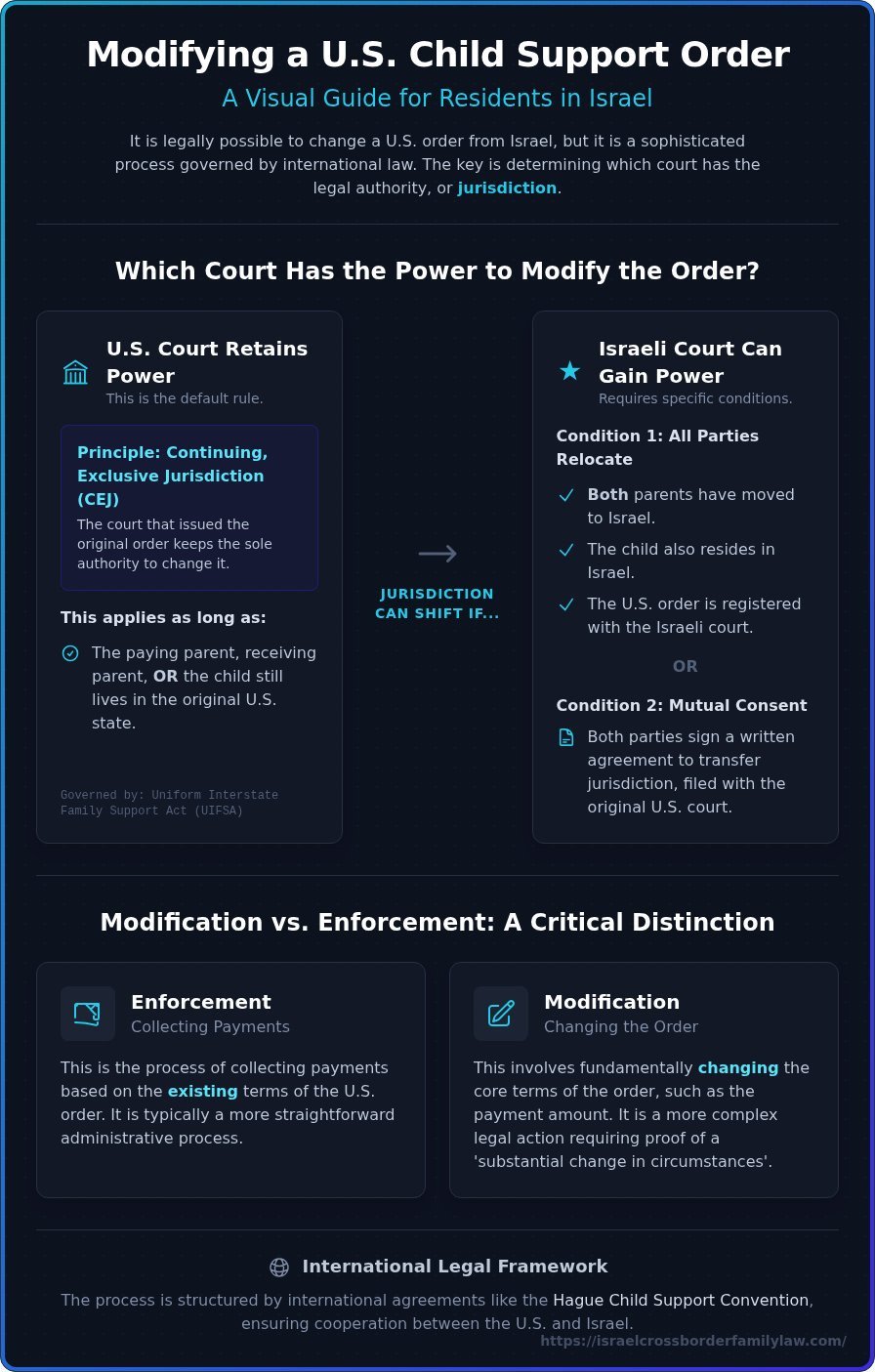
- Enforcement refers to the process of collecting payments based on the existing terms of the U.S. order. This is typically a more straightforward administrative process.
- Modification involves fundamentally changing the core terms of the order, such as the monthly payment amount, due to a significant change in circumstances.
This guide is focused exclusively on the intricate legal process of modification, which is substantially more complex than simple enforcement and requires a robust legal case to be made before the court with proper jurisdiction.
Determining Jurisdiction: Which Court Has the Power to Modify Your Order?
In any international family law matter, the foundational legal question is that of jurisdiction. Before a court can address the substance of a modification request, it must first be established that it possesses the legal authority to hear the case. Navigating the complexities of modifying US child support in Israel begins with a clear understanding of which legal system-American or Israeli-retains control over your original order. This determination is governed by sophisticated legal principles designed to create stability and predictability in cross-border disputes.
The Principle of Continuing, Exclusive Jurisdiction (CEJ)
The United States legal system operates on a core principle known as Continuing, Exclusive Jurisdiction (CEJ). This doctrine dictates that the court that issued the initial child support order generally retains the sole authority to modify it. As long as one of the parties (the paying parent, the receiving parent, or the child) continues to reside in that original U.S. state, that state’s court holds CEJ. This framework is crucial for preventing conflicting orders from different courts and discourages “forum shopping” by parties seeking a more favorable legal environment.
When Can an Israeli Court Assume Jurisdiction?
While the original U.S. court’s authority is strong, it is not absolute. Jurisdiction can shift from the United States to Israel under specific, limited circumstances. The primary condition for such a transfer is when all parties involved have left the original U.S. state. An Israeli court may be able to assume jurisdiction if:
- Both parents have relocated and now reside in Israel.
- The child also resides in Israel.
- The original U.S. child support order is formally registered with the Israeli family court system.
Alternatively, both parties can sign a formal written agreement, filed with the original U.S. court, consenting to transfer jurisdiction to an Israeli court. Without meeting these stringent requirements, the authority to modify the order remains with the U.S. court.
The Role of the Uniform Interstate Family Support Act (UIFSA)
The rules governing CEJ are codified in the Uniform Interstate Family Support Act (UIFSA), a law adopted by every U.S. state to standardize the handling of child support cases across state lines. Critically, the principles of UIFSA extend to international matters with countries that have reciprocal enforcement agreements with the United States, including Israel. This act provides the definitive legal framework that determines which court has the power to hear your case, ensuring that a single, enforceable order is in effect at all times, regardless of where the parents and child reside.
Grounds for Modification: Proving a ‘Substantial Change in Circumstances’
A U.S. child support order cannot be altered merely because a parent desires a different payment amount. U.S. family law courts require a specific legal basis to reconsider the terms of an existing decree. To succeed in modifying US child support in Israel, the petitioning parent must definitively prove that a “substantial and material change in circumstances” has occurred since the last order was issued. The precise legal definition of “substantial” is determined by the statutes of the U.S. state that holds jurisdiction over your case, underscoring the need for sophisticated, multi-jurisdictional legal counsel.
What Constitutes a ‘Substantial Change’?
While each case is unique, U.S. courts consistently recognize certain events as valid grounds for a modification request. These often include:
- Involuntary Loss of Employment or Significant Decrease in Income: A demonstrable, non-voluntary reduction in the paying parent’s earnings, such as a layoff. A voluntary career change may not meet this standard.
- Significant, Long-Term Increase in the Other Parent’s Income: A substantial promotion or new, higher-paying employment for the recipient parent can be grounds for re-evaluation.
- A Change in the Child’s Needs: The emergence of a chronic medical condition requiring expensive treatments, or the need for specialized educational services not anticipated in the original order.
- A Significant Change in Parenting Time: If the child’s residential schedule changes dramatically, the support calculation may need to be adjusted accordingly.
Documenting Your Case: Evidence is Crucial
A claim of changed circumstances is only as strong as the evidence supporting it. A U.S. court will not act on assertions alone; it requires clear, verifiable proof. Preparing a compelling petition for modifying US child support in Israel involves meticulous documentation. This includes providing official, certified English translations of Israeli documents, such as:
- Recent pay stubs (tlushei maskoret) or letters from an Israeli employer.
- A formal termination letter in the event of job loss.
- Israeli tax returns and bank statements (in ₪).
- Medical records and bills from your Kupat Holim or private providers detailing a child’s new healthcare needs.
A robust case is built upon a foundation of undeniable proof that demonstrates the material change in your financial or personal situation.
Cost of Living Adjustments (COLA)
The significant difference in the cost of living between many U.S. locations and major Israeli cities like Tel Aviv or Jerusalem can be a relevant factor. While not always a primary basis for modification on its own, a well-argued Cost of Living Adjustment (COLA) can support a request, particularly when combined with other factors like a change in income. Proving this disparity often requires complex financial analysis and may necessitate the use of an expert witness to provide testimony on economic data to the U.S. court.
The Step-by-Step Process for Modifying a U.S. Order from Israel
Initiating the process for modifying US child support in Israel requires a precise legal strategy dictated by complex, multi-jurisdictional rules. The correct procedural path depends entirely on which court-the original U.S. court or an Israeli Family Court-has the legal authority, or jurisdiction, to hear the case. This determination is the critical first step. Both the United States and Israel have designated Central Authorities under international agreements to assist in the enforcement and modification of such cross-border orders, but navigating the process effectively demands specialized legal guidance.
Pathway 1: Filing in the Original U.S. Court
In the majority of cases, the U.S. state court that issued the initial child support order retains Continuing, Exclusive Jurisdiction (CEJ) to modify it. This is the most common and direct pathway. Our firm manages this complex process remotely for clients residing in Israel. We prepare and file a formal motion to modify in the appropriate U.S. court on your behalf. Crucially, we work with the court to arrange for our clients to appear at hearings via secure video conference, a standard practice in modern international litigation that eliminates the substantial cost and disruption of international travel.
Pathway 2: Registering and Modifying the Order in Israel
This alternative pathway is only available in specific circumstances, typically when the U.S. court has relinquished its exclusive jurisdiction because all parties and the child no longer reside in the issuing state. This is a more intricate, two-stage process. First, the U.S. support order must be formally registered and recognized by the Israeli Family Court. Once recognized, a new claim for modification can be filed in Israel, where the request will be adjudicated under the principles of Israeli law. This route requires a sophisticated command of both U.S. and Israeli legal systems to ensure seamless execution.
Why You Need an Experienced Cross-Border Attorney
Navigating the intersection of U.S. state laws, Israeli family law, and international treaties is a formidable challenge that should not be undertaken without expert legal representation. An attorney with deep multi-jurisdictional experience is essential to correctly analyze jurisdictional issues, build the strongest possible case demonstrating a substantial change in circumstances, and advocate for your interests effectively across borders. The success of your modification request depends on a meticulously executed legal strategy from the outset. Consult with our experts to determine the right strategy for your case.
Common Pitfalls and Strategic Considerations
Navigating the modification of a U.S. child support order from Israel requires a sophisticated understanding of multi-jurisdictional law and financial realities. The process is fraught with potential missteps that can have severe, long-term consequences for both the paying and receiving parent. A proactive, strategic approach is essential to avoid common errors and protect your financial and parental rights.
The Danger of ‘Handshake’ Agreements
One of the most significant risks is relying on informal or “handshake” agreements made outside of the court system. While it may seem expedient to verbally agree to adjust payments, such arrangements are not legally binding. The original U.S. court order remains in full force until it is officially modified by a court with proper jurisdiction. A paying parent who reduces payments based on an informal understanding can accumulate substantial arrears, potentially leading to severe enforcement actions, including wage garnishment and passport revocation.
Navigating Currency Exchange and Payment Methods
Cross-border payments introduce complex financial variables. A properly modified order must explicitly state the currency of payment-whether U.S. Dollars (USD) or New Israeli Shekels (NIS). This decision has significant implications:
- Currency Fluctuation: If payments are set in USD, the amount received in NIS will vary with the exchange rate, creating uncertainty. The modified order can address this by stipulating a fixed exchange rate or a mechanism for periodic adjustments.
- Payment Logistics: The order should also clarify the method of international transfer to ensure payments are timely and traceable, accounting for bank fees and processing times.
Impact on Child Custody and Visitation
A petition for modifying US child support in Israel can sometimes act as a catalyst for a broader review of parental rights and responsibilities. The opposing party may respond by filing their own motion to alter existing child custody or visitation arrangements. It is imperative to be prepared for this possibility. Any discussion about financial support is fundamentally linked to the child’s welfare, making it essential to develop a comprehensive legal strategy that anticipates and addresses potential disputes over parenting time and decision-making authority. Failing to do so can jeopardize not only your financial position but also your relationship with your child.
Effectively managing these intricate legal and financial challenges requires experienced counsel. For guidance on developing a robust legal strategy, contact our firm for a consultation.
Secure Your Financial Future with Expert Legal Guidance
Successfully navigating a U.S. child support modification from Israel requires a sophisticated understanding of multi-jurisdictional law. As we have explored, the path forward hinges on correctly establishing which court holds the power to act and demonstrating a substantial change in circumstances. The intricate process of modifying us child support in israel demands meticulous preparation and strategic execution to avoid common procedural pitfalls. These complexities underscore the necessity of specialized legal counsel to protect your rights and financial interests across international borders.
Our firm provides that specialized expertise. With extensive experience in navigating the international treaties and jurisdictional disputes inherent in U.S.-Israel family law, we offer comprehensive guidance through every step of this complex modification process. Do not face this challenge alone. We invite you to Schedule a Confidential Consultation to Discuss Your Cross-Border Child Support Case and take the first step toward achieving a fair and updated arrangement that reflects your current reality.
Frequently Asked Questions About Modifying U.S. Child Support Orders in Israel
Do I have to travel back to the U.S. to modify my child support order?
In the majority of cases, you are not required to travel to the United States to petition for a modification. International legal frameworks and reciprocal agreements, such as the Uniform Interstate Family Support Act (UIFSA), facilitate these cross-border proceedings. Our firm is structured to represent clients living in Israel before U.S. courts, managing all filings, communications, and appearances remotely to ensure a seamless process without the substantial expense and disruption of international travel.
How long does the international child support modification process take?
The timeline for a multi-jurisdictional child support modification is highly variable, often ranging from several months to over a year. The duration is contingent upon factors such as the complexity of the financial circumstances, the level of cooperation from the other party, and the specific docket of the U.S. court with jurisdiction. Our experienced counsel provides strategic guidance to navigate these procedural hurdles, proactively managing the case to mitigate delays and achieve a resolution as expeditiously as possible.
What happens if my ex-spouse ignores the request for modification?
Should your former spouse fail to respond to a properly served petition for modification, the legal process does not halt. The U.S. court can proceed with the hearing and may enter a “default judgment” in your favor, granting the modification based on the evidence you have presented. Our legal team is proficient in pursuing these procedural remedies, ensuring that a non-cooperative party cannot unilaterally obstruct your right to seek a fair and necessary adjustment to your support obligations.
How much does it cost to hire a lawyer for a cross-border modification case?
The legal fees associated with the complex process of modifying US child support in Israel are contingent upon the specific parameters of your case. For a straightforward, uncontested modification, legal costs may start in the range of ₪15,000 to ₪25,000. However, for more sophisticated matters involving contested litigation or complex financial discovery, fees will be higher. We provide a transparent and detailed fee structure following an initial consultation to assess your unique situation.
Can an Israeli court apply Israeli child support standards to my U.S. order?
Generally, no. An Israeli court lacks the jurisdiction to modify a U.S. child support order using Israeli legal standards. Under established international legal principles, the U.S. state that issued the original decree retains “continuing, exclusive jurisdiction” to modify its own orders. Therefore, any modification must be adjudicated based on the laws and child support guidelines of that specific U.S. jurisdiction, a critical distinction our dual-qualified attorneys are equipped to navigate.
What if I lost my job? Can I stop paying child support immediately?
You must not unilaterally cease or reduce child support payments, even after a significant change in circumstances like job loss. The existing U.S. court order remains in full legal effect until it is formally modified by a judge. Failure to pay can lead to the accumulation of arrears and severe enforcement actions. It is imperative to immediately retain legal counsel to file a formal petition for modification, as any relief granted is typically retroactive only to the date of filing.

Article by
Gabriel Lior
A Personal Journey That Became a Mission
The advisory was founded by an American father Gabriel Lior, LLB, MBA , global entrepreneur, and cross-border advisor who spent more than a decade navigating the Israeli family court system firsthand and now lives in Singapore with his son.
As a divorced parent in a cross-border family, Gabriel faced nearly every legal challenge a foreign parent can encounter in Israel — including child custody disputes, child support proceedings, property matters in Israel and abroad, false accusations, and complex immigration and relocation proceedings.
Over the years, he learned the hard way how difficult it is for non-Israeli parents to understand the system, identify the right legal strategy, and choose the right legal representation — especially when language, culture, and jurisdictional differences are involved. He also witnessed how foreign parents and new immigrants are often disadvantaged or taken advantage of by service providers and institutions simply because they lack local knowledge or fluency.
From Client to Advisor
To truly understand — and survive — the system, Gabriel pursued formal legal education in Israel, completing two Israeli law degrees, alongside a BA and MBA earned in the United States. This was never about becoming a practicing attorney, but about gaining a deep, structural understanding of how the system works — and where it breaks down for foreign parents.
This rare combination of:
Firsthand client experience
Israeli legal and US business education
International business and negotiation training
Decades of commercial execution
created a unique perspective – one that understands both sides of the table.
After years of litigation, persistence, and at times self-representation, he ultimately succeeded in securing custody of his son and relocating abroad through a rare legal victory in the Israeli Supreme Court — becoming one of the first fathers in Israel to do so under these circumstances.
Disclaimer
Important Disclaimer:
The information provided on this website and in its content is for general informational and educational purposes only and does not constitute legal advice, legal opinion, or legal representation.
Gabriel Lior is not licensed to practice law in Israel (nor is he interested in doing so) and does not provide legal services, despite having completed 2 Law Degrees. The services offered are advisory in nature and are intended to provide general guidance, strategic insight, and information regarding cross-border family law considerations.
No attorney-client relationship is formed by accessing this website, reading its content, or communicating with us.
Any decisions made based on this information are at your own discretion and risk. For legal advice specific to your situation, you should consult a licensed attorney in the relevant jurisdiction.
Where appropriate, we may refer clients to independent, licensed attorneys or professionals. Such referrals do not constitute legal representation and no liability is assumed for services provided by third parties.