Did you know that filing for divorce in the “wrong” Israeli court could unintentionally jeopardize your rights to a US-based 401k or pension? For many expats, the realization that getting divorced in Israel as an American involves two overlapping legal systems is often met with a mix of confusion and genuine anxiety. You might be concerned about the mandatory “Get” process in the Rabbinical Court or feel pressured by the “race for jurisdiction” where the first person to file often dictates the legal landscape for the entire case. These fears are valid because the decisions you make in the first 30 days can have permanent financial and personal consequences.
This article, published on an independent advisory platform, offers a clear roadmap to help you navigate these multi-jurisdictional complexities with strategic foresight. We’ll explain how to protect your American assets, what to expect from the mandatory dispute resolution process, and how child custody works across borders under the Hague Convention. By understanding the fundamental differences between the Family Court and the Rabbinical Court, you can approach this transition with the clarity required to protect your future and your family.
Key Takeaways
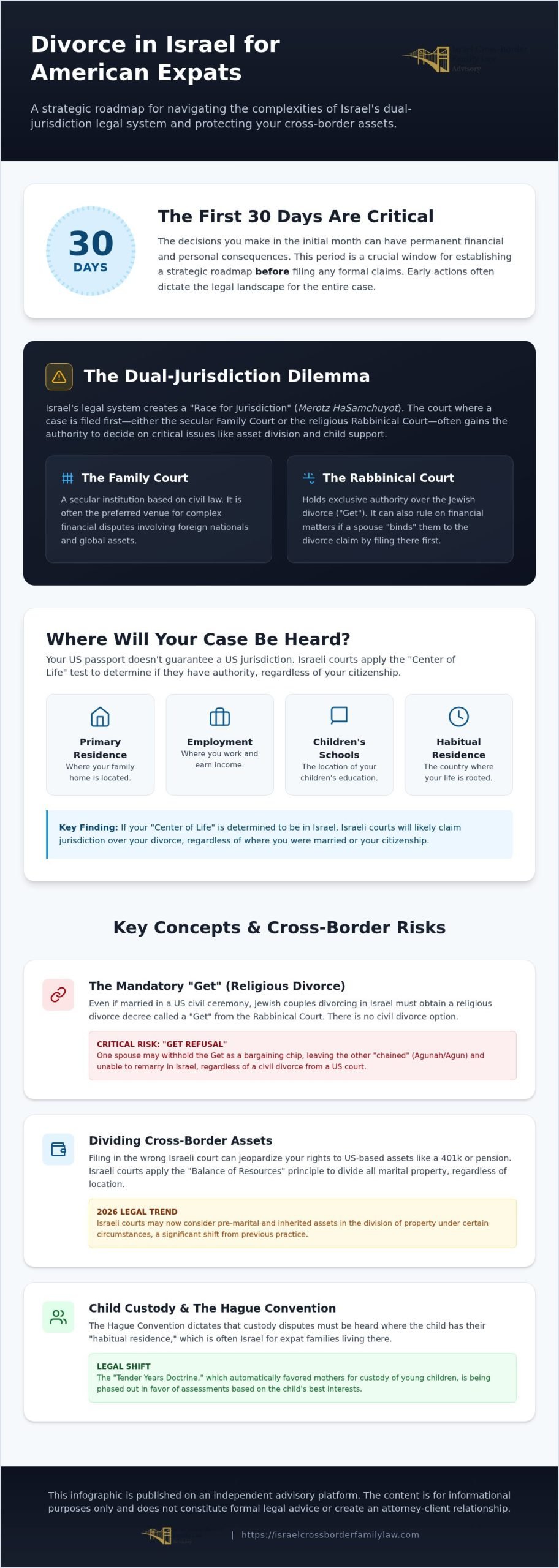
- Learn how the “Center of Life” test and the “Race for Jurisdiction” determine whether your case proceeds in the US or Israel, regardless of your passport.
- Discover why getting divorced in israel as an american requires navigating the Rabbinical Court’s “Get” process, even for couples who consider themselves secular.
- Gain insight into the “Balance of Resources” principle and why 2026 legal trends may now include pre-marital assets in the division of property.
- Understand the phasing out of the “Tender Years Doctrine” and how Israeli courts apply the Hague Convention to protect children in cross-border disputes.
- Identify why the first 30 days are the most critical period for establishing a strategic roadmap before filing any formal claims.
The Dual-Jurisdiction Reality: Where Americans File for Divorce
The legal landscape in Israel is unique because it operates under a dual-jurisdiction system. This framework creates a phenomenon known as the “Race for Jurisdiction,” or Merotz HaSamchuyot. Essentially, the court where a case is filed first often gains the authority to decide on critical issues like asset division and child support. As of 2026, the Family Court has implemented updated digital systems and streamlined procedures to better serve foreign nationals, making it a highly efficient venue for resolving complex civil disputes. However, the speed of filing remains a decisive factor in determining which legal principles will apply to your life.
When you are getting divorced in israel as an american, you might assume your US passport grants you an automatic right to file in your home state. This is a common misconception. Israeli courts apply the “Center of Life” test to determine if they have the authority to hear a case. If your primary residence, employment, and children’s schools are located in Tel Aviv or Jerusalem, an Israeli court will likely claim jurisdiction even if you maintain a permanent residence in New York or California. Understanding this reality is the first step toward building a cross-border strategy that protects your interests in both nations.
A principle known as “Comity” allows US state courts to recognize and enforce Israeli divorce judgments. While US courts are not legally bound to follow Israeli rulings, they often do so if the Israeli process met basic standards of fairness and notice. This recognition is critical for the enforcement of alimony or property orders across borders. For expats and foreign nationals, ensuring that an Israeli decree is drafted with an eye toward US enforceability is a vital strategic move.
The Family Court vs. The Rabbinical Court
The Family Court is a secular institution based on civil law. It handles all auxiliary matters, such as the division of global assets and child custody arrangements. In contrast, the Rabbinical Court holds exclusive authority over the “marriage bond” for Jewish couples. This means the actual act of divorce, the Get, must happen there. A significant risk for Americans is the “binding” of civil issues to a divorce claim in the Rabbinical Court. If one spouse files for divorce in the Rabbinical Court first, they can sometimes force that court to decide on financial matters that might otherwise be handled in the secular Family Court. Recent changes in March 2026 have even expanded the Rabbinical Court’s ability to arbitrate civil matters when both parties provide consent.
The “Center of Life” and Jurisdictional Hurdles
Determining the correct forum is rarely simple when assets or residences exist in multiple countries. Israeli judges look at where your life is actually rooted. If you have lived in Israel for several years, the court will likely view it as your “habitual residence.” This term is also central to the Hague Convention on the Civil Aspects of International Child Abduction, which governs where custody disputes must be heard. Even if both spouses are Americans, living in Israel usually subjects the marriage to Israeli jurisdiction. This makes the first 30 days of the process a critical window for establishing where your case will proceed and which laws will govern your future financial stability.
The Jewish Divorce (Get) and the Secular American
In Israel, the Rabbinical Court maintains exclusive authority over the termination of the marriage bond for Jewish citizens and residents. This means that even if you were married in a civil ceremony in New York or California, getting divorced in israel as an american requires a religious decree known as a Get. Within the state, there is no civil divorce option for Jewish couples. For many secular expats, this realization comes as a significant cultural and legal shock. Without the Get, the State of Israel won’t recognize you as single, which prevents you from remarrying locally and can lead to complications regarding your legal status and inheritance rights.
One of the most complex risks in this process is “Get Refusal.” This occurs when one spouse withholds the religious divorce document as a bargaining chip during civil negotiations. While a US court might grant a civil divorce decree, a Jewish American living in Israel remains “chained”, known as an Agunah or Agun, without the Get. This status doesn’t just impact your life in Tel Aviv; it can affect your standing within Jewish communities globally and create legal friction if you attempt to resolve financial matters in different jurisdictions. This article is published on an independent advisory platform to help you understand these strategic risks before they escalate. Seeking a confidential case review early can help you mitigate these hurdles and maintain your future freedom.
Navigating the Rabbinical Process
The Rabbinical hearing is a procedural event overseen by three judges, known as Dayanim. While the atmosphere is formal, it’s generally predictable if both parties have reached an agreement. The process involves a scribe preparing the Get, a hand-written parchment, which the husband then delivers to the wife in the presence of witnesses. It’s a technical ritual, yet the legal implications are profound. Having professional representation ensures your rights are protected during these hearings, particularly if the court attempts to discuss financial matters that should remain in the secular Family Court.
Non-Jewish and Interfaith Divorces
For couples of different faiths or those where neither spouse is Jewish, the process is called the “Dissolution of Marriage.” This is handled through the Family Court rather than a religious tribunal. If you were married in a civil ceremony abroad, the President of the Family Court typically determines which court has the authority to dissolve the union. While this path is often more aligned with Western legal expectations, it still requires a sophisticated Understanding How Assets Get Divided to ensure your international interests, including US-based holdings, remain secure during the transition.
Financial Complexity: Dividing Assets Across Borders
When you are getting divorced in israel as an american, the financial stakes are often higher due to the transnational nature of your holdings. Israel operates under the “Balance of Resources” principle, known as Izun Mashabim. This system generally dictates that assets acquired during the marriage are totaled and divided equally. However, 2026 has introduced a significant shift in how courts handle pre-marital property and inheritances. While these were historically excluded from the marital pot, recent Supreme Court precedents suggest that long-term marriages now create a stronger presumption of shared ownership, even for assets owned before the wedding.
This evolution in the “Financial Partnership” doctrine means that if a couple has lived in a pre-marital home or used an inheritance to fund their collective lifestyle, an Israeli court may rule that those assets have been “absorbed” into the shared estate. For Americans with family wealth or property in the US, this creates a critical need for “Transnational Discovery.” Finding and valuing assets across borders, such as interests in US-based LLCs or brokerage accounts, requires a sophisticated approach to ensure the Israeli court has an accurate picture of the global marital estate.
US Pensions, 401ks, and Social Security
US-based retirement accounts present a unique enforcement hurdle. While an Israeli court can order the division of a 401k or pension, US plan administrators are not legally required to honor an Israeli judgment directly. To actually access these funds, you typically need a “Qualified Domestic Relations Order” (QDRO) issued by a US state court. This requires a “mirror order” process that bridges the two legal systems. Additionally, while Social Security benefits are governed by US federal law and cannot be divided by any court, an Israeli judge may consider the disparity in future Social Security income when balancing other marital resources.
Real Estate and the 2026 Property Shift
The 2026 legal landscape emphasizes that the longer the marriage, the less likely pre-marital real estate will remain separate property. If you own a home in the US, the court will look at whether marital funds were used for mortgage payments or renovations. Managing the sale of US real estate while residing in Israel involves complex logistics, including tax implications in both jurisdictions and the coordination of foreign closing agents. Our Expats and Foreign Nationals Guidance provides a framework for managing these multi-jurisdictional financial interests without triggering unnecessary litigation or tax penalties. Strategic planning before the “Race for Jurisdiction” begins is the best way to protect your long-term financial stability.
Child Custody and the Hague Convention
When getting divorced in israel as an american, child custody is often the most emotionally charged and legally rigid aspect. The Israeli court’s primary benchmark is the “Best Interest of the Child.” While this sounds subjective, 2026 standards have shifted toward a more data-driven approach, prioritizing psychological continuity and the child’s established routine in their current environment. A significant change in the 2026 legal landscape is the accelerated phasing out of the “Tender Years Doctrine.” Historically, this doctrine created a legal presumption that mothers should receive custody of children under age six. Today, courts increasingly favor shared parental responsibility, reflecting a modern understanding of a child’s need for both parents.
Relocating children back to the United States is one of the most difficult legal battles in the Israeli system. Courts are generally hesitant to allow a child to move away from their established “habitual residence” unless it can be proven that the move is overwhelmingly in the child’s interest. This creates a high evidentiary bar for the parent wishing to leave. If you are considering a move or fear your spouse might attempt one, discussing your situation in a confidential review is a vital step toward protecting your parental rights.
Custody and Visitation Plans
Creating a functional parenting plan for families split between the US and Israel requires meticulous detail. These “long-distance” plans must account for time zone differences, “Virtual Visitation” through digital platforms, and the high costs of international travel. Israeli courts now routinely include specific clauses for summer vacations in the US and rotating holiday schedules. These plans ensure that the child maintains a meaningful connection with their American heritage and extended family. For more on managing these transitions, view our guide on International Custody and Relocation.
Preventing International Parental Abduction
The “Stay of Exit” order, or Tsav Ikuv Yetzia, is a common preventive measure in cross-border cases. It prevents a child from leaving Israel until a final custody agreement or court order is in place. This is a critical tool because of the Hague Convention on the Civil Aspects of International Child Abduction. If a parent removes a child under age 16 from Israel without consent, the other parent can file a Hague petition. In Israel, these hearings are typically set within 15 days of filing to ensure a swift resolution and the child’s prompt return to their country of residence. Learn more about these protections at The Hague Convention and Abduction.
Strategy and Next Steps: Clarity Before Commitment
This article is published on an independent advisory platform to provide strategic guidance rather than formal legal representation. The first 30 days of getting divorced in israel as an american represent the most critical window for your future financial and personal security. This period is when jurisdictional boundaries are often set; once a case is filed in a specific court, it becomes significantly harder to move it. Engaging in a “Strategic Advisory” before taking any formal legal action provides the foresight needed to evaluate how Israeli law will interact with your US-based interests. This proactive approach helps you avoid the “Race for Jurisdiction” and ensures that your first move is not a tactical error that lasts a lifetime.
Selecting your legal team requires a nuanced understanding of your specific needs. While a local Israeli attorney handles the immediate court filings, they may not be familiar with the intricacies of US tax law or the division of American retirement accounts. Conversely, a US-based lawyer might lack the cultural and legal context of the Israeli Rabbinical system. A cross-border specialist serves as a vital bridge, coordinating between jurisdictions to ensure nothing is lost in translation. Mediation also plays a central role in this strategy. It offers a way to resolve disputes in a neutral setting, potentially saving tens of thousands of shekels in litigation costs and avoiding the rigid outcomes of a contested trial.
Drafting a Global Divorce Agreement
For an agreement to be truly effective, it must speak the language of two different legal systems. This is where the “Mirror Order” strategy becomes indispensable. By ensuring your Israeli decree is drafted to meet the specific requirements of US courts, you can have that judgment formally recognized in the United States. This is particularly important for the division of 401k plans or the sale of American real estate. Learning how the advisory works will give you a clearer picture of how these cross-border agreements are structured to provide lasting protection in both countries.
Final Checklist for US Citizens
The conclusion of your divorce is the beginning of your new financial identity. For US citizens, this transition requires several administrative updates to remain compliant with federal regulations. You should prioritize updating your US Will and Estate plan, as your previous designations may no longer reflect your wishes. It’s also necessary to notify the Social Security Administration and the IRS of your status change to ensure your tax filings and future benefits are accurate. Staying informed is key; the Israel Family Law YouTube Channel provides regular updates on these and other legal shifts affecting Americans in Israel.
Get clarity before you commit. Request a confidential consultation.
Securing Your Future Across Borders
The intersection of the Israeli and US legal systems presents unique challenges that require a proactive and informed approach. The decisions you make in the initial stages of getting divorced in israel as an american will dictate your financial and personal trajectory for years to come. Success in these matters depends on understanding how the “Center of Life” test impacts your case and how 2026 shifts in property division laws might affect your global assets. Protecting your US retirement accounts and ensuring a stable future for your children requires a strategy that bridges both nations.
This independent advisory platform offers specialized expertise in US-Israel cross-border strategy specifically for international families. By prioritizing strategy and risk management before engaging in the “Race for Jurisdiction,” you can avoid the pitfalls of a fragmented legal process. You don’t have to face these multi-jurisdictional complexities without a roadmap. Get clarity before you commit. Request a confidential consultation.
Frequently Asked Questions
Is a divorce granted in Israel legally recognized in the United States?
US courts generally recognize an Israeli divorce decree through the legal principle of comity. While no federal law mandates this recognition, state courts usually honor the judgment if the process was fair and both parties received proper notice. It is essential to ensure the Israeli decree is drafted with specific language that makes it enforceable in your specific home state.
Can I file for divorce in the US if I am currently living in Israel?
Filing in the US while residing in Israel depends on the residency requirements of your home state. Most states require at least one spouse to have lived there for six months to a year before filing. If both spouses have established their primary “Center of Life” in Israel, a US court may decline to hear the case because it lacks a sufficient connection to the jurisdiction.
What happens to my American 401k or IRA during an Israeli divorce?
Your American retirement accounts are considered marital assets under the Israeli principle of “Balance of Resources.” While an Israeli court can order their division, you will likely need a mirror order or a QDRO in a US court to execute the actual transfer of funds. Getting divorced in israel as an american requires coordinating between these two systems to avoid significant tax penalties or plan administrator rejection.
Do I have to go to the Rabbinical Court if I am not religious?
Yes, all Jewish citizens and residents in Israel must go through the Rabbinical Court to obtain a “Get,” regardless of their personal level of religious observance. The Rabbinical Court holds exclusive authority over the marriage bond itself. While you can resolve financial and custody matters in the secular Family Court, the religious ceremony is the only way to be legally recognized as single by the State of Israel.
How does the ‘Stay of Exit’ order work for Americans traveling back to the US?
A “Stay of Exit” order, known as a Tsav Ikuv Yetzia, is a legal directive that prevents an individual or child from leaving Israel. In cross-border cases, a spouse may request this order to ensure the other party doesn’t relocate assets or children to the US during the proceedings. These orders are powerful tools and can typically only be lifted with a court’s permission or by providing a significant financial guarantee.
Can I take my children back to the US permanently after the divorce starts?
You cannot permanently remove children from Israel without either the written consent of the other parent or a specific relocation order from the court. Doing so without authorization can trigger an immediate application under the Hague Convention. Israeli courts take these matters seriously and prioritize maintaining the child’s status quo in their current residence until a final decision is reached.
How long does the divorce process typically take for expats in Israel?
The timeframe for an expat divorce varies based on the level of cooperation between the spouses. An uncontested, mutual agreement can often be finalized within 3 to 6 months. However, a contested case involving complex international assets or custody disputes can take 2 to 4 years to resolve in the Israeli court system, particularly when multiple hearings are required.
What is the difference between an Israeli Family Court and a Rabbinical Court?
The Family Court is a secular institution that handles civil matters like property division and custody based on civil law. The Rabbinical Court is a religious tribunal with exclusive authority over the act of divorce for Jews. When getting divorced in israel as an american, you often navigate both systems to ensure the religious divorce is granted while civil assets remain protected under secular legal standards.

Article by
Gabriel Lior
A Personal Journey That Became a Mission
The advisory was founded by an American father Gabriel Lior, LLB, MBA , global entrepreneur, and cross-border advisor who spent more than a decade navigating the Israeli family court system firsthand and now lives in Singapore with his son.
As a divorced parent in a cross-border family, Gabriel faced nearly every legal challenge a foreign parent can encounter in Israel — including child custody disputes, child support proceedings, property matters in Israel and abroad, false accusations, and complex immigration and relocation proceedings.
Over the years, he learned the hard way how difficult it is for non-Israeli parents to understand the system, identify the right legal strategy, and choose the right legal representation — especially when language, culture, and jurisdictional differences are involved. He also witnessed how foreign parents and new immigrants are often disadvantaged or taken advantage of by service providers and institutions simply because they lack local knowledge or fluency.
From Client to Advisor
To truly understand — and survive — the system, Gabriel pursued formal legal education in Israel, completing two Israeli law degrees, alongside a BA and MBA earned in the United States. This was never about becoming a practicing attorney, but about gaining a deep, structural understanding of how the system works — and where it breaks down for foreign parents.
This rare combination of:
Firsthand client experience
Israeli legal and US business education
International business and negotiation training
Decades of commercial execution
created a unique perspective – one that understands both sides of the table.
After years of litigation, persistence, and at times self-representation, he ultimately succeeded in securing custody of his son and relocating abroad through a rare legal victory in the Israeli Supreme Court — becoming one of the first fathers in Israel to do so under these circumstances.
Disclaimer
Important Disclaimer:
The information provided on this website and in its content is for general informational and educational purposes only and does not constitute legal advice, legal opinion, or legal representation.
Gabriel Lior is not licensed to practice law in Israel (nor is he interested in doing so) and does not provide legal services, despite having completed 2 Law Degrees. The services offered are advisory in nature and are intended to provide general guidance, strategic insight, and information regarding cross-border family law considerations.
No attorney-client relationship is formed by accessing this website, reading its content, or communicating with us.
Any decisions made based on this information are at your own discretion and risk. For legal advice specific to your situation, you should consult a licensed attorney in the relevant jurisdiction.
Where appropriate, we may refer clients to independent, licensed attorneys or professionals. Such referrals do not constitute legal representation and no liability is assumed for services provided by third parties.