Facing a divorce as an American in Israel introduces a complex matrix of cross-border legal questions, creating significant uncertainty and financial anxiety. The critical issue of securing spousal support for a US citizen in Israel often becomes the focal point of this distress, complicated by concerns over which country’s laws will govern the outcome, how US-based assets will be evaluated, and whether a judgment can be enforced internationally.
This comprehensive guide serves as an authoritative resource to navigate these sophisticated challenges. We provide a detailed analysis of your rights and obligations under Israeli law, clarifying eligibility for alimony, the methodology for determining its amount and duration, and the strategic pathways for cross-border enforcement in both Israel and the United States. Our objective is to equip you with the clarity and confidence required to make informed decisions that safeguard your financial future during this transitional period.
Foundations of Spousal Support (Alimony) in Israeli Law
Navigating the requirements for spousal support in Israel requires a sophisticated understanding of a unique legal framework. Known in Hebrew as Mezonot Isha (literally, “wife’s sustenance”), spousal support is a distinct legal concept separate from child support, or Mezonot Yeladim. This financial provision is intended to maintain the dependent spouse’s standard of living following a separation. For international couples, understanding the nuances of spousal support for a US citizen in Israel is the first critical step in developing a sound legal strategy.
To better understand the core principles of alimony within the Israeli context, the following video offers a valuable overview:
The Dual Legal System: Religious vs. Civil Courts
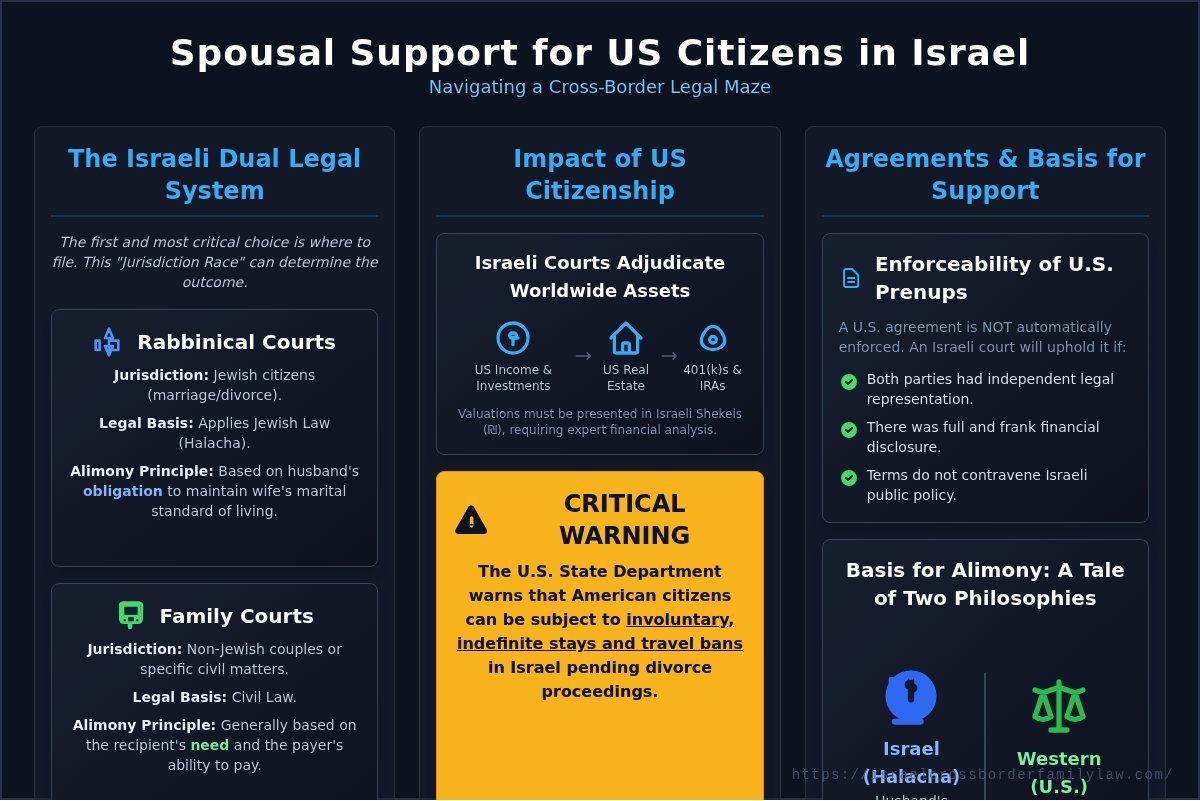
Israel operates a parallel legal system for family law, a critical factor that directly impacts any case involving spousal support for a US citizen in Israel. Matters of marriage and divorce for Jewish citizens fall under the exclusive jurisdiction of the Rabbinical Courts, which apply Jewish Law (Halacha). In contrast, the Family Courts handle family law matters for non-Jewish couples or specific issues not exclusively under Rabbinical Court jurisdiction. The strategic choice of which court to file in first-a concept known as the “jurisdiction race”-can profoundly impact the outcome of a case. This is a crucial consideration when seeking spousal support for a US citizen in Israel, as it influences everything from the amount awarded to the division of assets.
Basis for Alimony: Need vs. Obligation
Unlike in many Western jurisdictions where alimony is based purely on need, the Israeli framework for determining spousal support for a US citizen in Israel (for Jewish couples) is rooted in a husband’s religious obligation. According to Halacha, a husband is required to support his wife at the standard of living to which she became accustomed during the marriage. The court’s primary objective is to uphold this obligation. It will conduct a thorough assessment of the dependent spouse’s monthly needs, considering expenses such as housing, food, and personal care, to ensure the marital standard of living is maintained until the final divorce decree (Get) is issued. This obligation is a central tenet of the Foundations of Spousal Support (Alimony) and the primary basis for rulings on spousal support for a US citizen in Israel in the Rabbinical Court.
How US Citizenship Uniquely Impacts Spousal Support Cases
For American citizens residing in Israel, divorce proceedings transcend national borders, creating a complex multi-jurisdictional legal landscape. Your U.S. citizenship introduces critical layers of legal, financial, and procedural considerations that demand sophisticated, cross-border counsel. Navigating these challenges effectively is paramount to securing a fair outcome in matters of asset division and spousal support.
Jurisdiction: Filing for Divorce in Israel vs. the United States
The initial and most consequential decision is determining the proper jurisdiction. Courts in both Israel and the United States will consider factors such as the habitual residence of the spouses and children, the location of significant assets, and where the marriage was centered. This strategic decision carries significant weight, as Israeli religious courts have jurisdiction over all citizens and residents in matters of marriage and divorce. A U.S. State Department travel advisory even warns that U.S. citizens can be subject to involuntary, indefinite stays in Israel and travel bans pending divorce proceedings. This creates a potential “race to the courthouse,” where filing first in a preferred jurisdiction can fundamentally alter the case’s trajectory.
Treatment of US Assets and Income
A primary challenge in cases involving spousal support for a US citizen in Israel is the comprehensive discovery and valuation of American assets. Israeli family courts have the authority to adjudicate worldwide assets. This includes:
- U.S. retirement accounts like 401(k)s and IRAs.
- Real estate holdings within the United States.
- Dollar-denominated income streams, investments, and business interests.
Obtaining accurate valuations, which must be presented to the court in Israeli Shekels (₪), requires expert financial analysis and a deep understanding of both U.S. financial instruments and Israeli legal standards.
Recognition of Foreign Agreements
A properly drafted U.S. prenuptial or postnuptial agreement can be a powerful tool, but its enforceability in Israel is not automatic. An Israeli court will typically uphold a foreign agreement if it is satisfied that both parties had independent legal representation, there was full and frank financial disclosure, and the terms do not contravene Israeli public policy. In the absence of a valid agreement, Israeli law-specifically the Spouses’ Property Relations Law-will generally govern the division of all marital assets, regardless of where they are located.
Calculating the Amount and Duration of Spousal Support
Unlike jurisdictions with rigid formulas, Israeli courts determine spousal support through a discretionary and holistic analysis of each couple’s unique financial and personal circumstances. This nuanced approach ensures the outcome is equitable but also underscores the necessity of sophisticated legal guidance. For international couples, securing a fair determination of spousal support for a US citizen in Israel requires a comprehensive presentation of evidence related to both parties’ global assets and earning potential.
Key Factors Influencing the Support Award
The Family Court or Rabbinical Court weighs several critical factors in a multi-faceted evaluation. The objective is to balance the recipient’s needs against the payer’s ability to provide support, while encouraging eventual self-sufficiency. Key considerations include:
- Length of the Marriage and Standard of Living: Longer marriages often result in longer, more substantial support awards, as the court seeks to allow the dependent spouse to maintain a lifestyle reasonably comparable to the one enjoyed during the marriage.
- Earning Capacity, Age, and Health: The court assesses each spouse’s potential to earn, not just their current income. A significant disparity, particularly where one spouse sacrificed career advancement for the family, is a pivotal factor.
- Division of Marital Property: A significant asset distribution, such as one party receiving an income-producing property valued at ₪3,000,000, can reduce or eliminate the need for ongoing alimony.
- Minor Children and Custody: While child support is a separate matter, the responsibilities of being a primary caregiver can impact a spouse’s ability to work, which the court considers in its spousal support decision.
Types of Alimony: Temporary, Rehabilitative, and Long-Term
Israeli law provides for several types of support. Temporary support, or Mezonot Zmaniyim, is often ordered during the divorce proceedings to maintain the financial status quo. The most common form is rehabilitative support, a time-limited award designed to enable a dependent spouse to acquire the education or skills needed to re-enter the workforce and become financially independent. In cases involving long-term marriages where a spouse has limited prospects for self-sufficiency due to age or health, the court may award long-term or, in rare instances, permanent support.
Modification and Termination of Support
A spousal support order is not immutable. It can be modified upon a showing of a “material change in circumstances,” such as an involuntary job loss for the paying spouse or a significant increase in the recipient’s income. Furthermore, the obligation to pay spousal support automatically terminates upon certain events, most commonly the remarriage of the recipient spouse, their cohabitation with a new partner in a marriage-like relationship, or the death of either party. These provisions ensure that support obligations remain fair and relevant to the parties’ current situations.
Enforcing Spousal Support Orders Across US-Israel Borders
Obtaining a spousal support order is a significant legal milestone, but the true challenge often lies in its enforcement, particularly when the paying spouse resides in a different country. The complexities of cross-border collection require a sophisticated understanding of international treaties and domestic legal frameworks in both the United States and Israel. A judgment without a clear enforcement strategy provides little practical security.
Successfully navigating these multi-jurisdictional challenges is essential to ensuring financial stability. Whether you hold a US court order for a spouse living in Israel or an Israeli judgment for a spouse in the US, a proactive and knowledgeable approach is paramount to compelling compliance.
How to Enforce a US Support Order in Israel
A spousal support judgment issued by a US court is not automatically enforceable in Israel. The order must first be recognized, or “domesticated,” by an Israeli Family Court under the Enforcement of Foreign Judgments Law. Once recognized, the order can be submitted to Israel’s Collection and Enforcement Office (Hotza’a LaPoal), which has broad powers to garnish wages, freeze bank accounts, and impose travel restrictions to compel payment from a debtor spouse in Israel.
How to Enforce an Israeli Support Order in the US
For an Israeli support order to be enforced in the United States, the primary legal instrument is the Uniform Interstate Family Support Act (UIFSA). This act, adopted by all US states, provides a streamlined process for registering a foreign support order. The Israeli judgment is filed with a court in the US state where the non-paying ex-spouse resides, granting it the same legal authority as a domestic order. Engaging US legal counsel is critical to manage this state-specific registration and enforcement process effectively.
The Role of the National Insurance Institute (Bituah Leumi)
Israel provides a unique state-backed safety net for residents holding a valid Israeli support order. If the debtor spouse defaults, the entitled spouse may apply to the National Insurance Institute (Bituah Leumi) for payments. Bituah Leumi will then provide monthly payments up to a legally determined amount and assume the responsibility of collecting the debt from the defaulting spouse. While this is a valuable resource, it should be viewed as a secondary measure, not a primary collection strategy.
Navigating these disparate legal systems requires precise legal action and strategic guidance. Our firm possesses the dual expertise necessary to manage the complexities of securing spousal support for a US citizen in Israel, ensuring your rights are protected across borders. For a confidential consultation on your enforcement options, we invite you to contact our cross-border legal team.
Why You Need a Specialized Cross-Border Law Firm
Navigating a divorce as a US citizen in Israel introduces a layer of legal and financial complexity that most domestic family law attorneys are unequipped to handle. The intersection of US federal and state laws with Israeli family law creates a multi-jurisdictional minefield where a single misstep can have profound and lasting consequences. Relying on counsel unfamiliar with both legal systems exposes you to significant risks, including unfavorable rulings, unenforceable agreements, and severe tax penalties. The strategic advantage of retaining a law firm with licensed practitioners in both the United States and Israel cannot be overstated.
Avoiding Critical Errors in Jurisdiction and Asset Division
The initial decision of where to file for divorce-be it in a US state or in the Israeli Family Court-is a critical strategic choice that dictates which laws will govern asset division and support. A cross-border firm provides sophisticated guidance on this crucial first step. Furthermore, accurately valuing and dividing international assets, from a US-based 401(k) and stock portfolio to an Israeli Keren Hishtalmut and real estate holdings, requires deep expertise in both financial systems to protect your rights comprehensively.
The Value of a Unified Legal Strategy
A unified approach from a single, dual-licensed firm eliminates the communication gaps and conflicting advice that often arise when coordinating separate legal teams in different countries. This integrated strategy is essential when structuring long-term spousal support for a US citizen in Israel, ensuring the agreement is both tax-efficient and fully enforceable in both jurisdictions. Key benefits include:
- Seamless Coordination: One team manages all facets of your case, aligning US and Israeli legal requirements without friction.
- Holistic Financial Planning: Expert navigation of complex tax treaties and financial regulations to preserve marital assets.
- Bicultural Negotiation: Attorneys fluent in the legal and cultural nuances of both countries can bridge divides and achieve more effective resolutions.
Protecting your financial future requires a legal team that operates fluently across borders. Schedule a consultation to discuss the specifics of your multi-jurisdictional situation.
Expert Guidance for Your Complex Cross-Border Spousal Support Case
Navigating the complexities of spousal support for a US citizen in Israel demands a sophisticated understanding of two distinct legal frameworks. As this guide has illustrated, factors such as the interplay between religious and civil law, the valuation of international assets, and the critical challenge of cross-border enforcement require highly specialized legal expertise. These multi-jurisdictional challenges are not merely procedural hurdles; they are fundamental to securing a fair and sustainable outcome for your financial future.
Our firm is uniquely positioned to manage these sophisticated cases. With attorneys licensed in both Israel and the United States and decades of experience in complex international family law, we possess a deep, integrated understanding of both the US and Israeli financial and legal systems. To ensure your rights are protected throughout this intricate process, we invite you to contact our experienced cross-border attorneys for a confidential consultation. Let us provide the clarity and strategic representation you need to move forward with confidence.
Frequently Asked Questions About Spousal Support in Israel
Can I receive spousal support in Israel if my marriage took place in the US?
The venue of your marriage, whether in the United States or elsewhere, does not preclude you from seeking spousal support under Israeli law. Israeli Family Courts primarily assert jurisdiction based on the couple’s ‘center of life’ at the time of separation. Our firm is adept at navigating these complex jurisdictional determinations, ensuring your rights are protected regardless of where your marriage was solemnized. We provide strategic counsel to establish the necessary legal grounds for your claim in Israel.
What happens if my spouse tries to hide assets in the United States to avoid paying support?
Our firm possesses extensive cross-border capabilities to address sophisticated asset concealment tactics. Should your spouse attempt to hide assets in the United States, we can initiate multi-jurisdictional legal actions. This includes leveraging international treaties and collaborating with our U.S. legal network to conduct discovery, obtain court orders to freeze assets, and ensure these holdings are properly disclosed and considered in the Israeli court’s spousal support determination. We are committed to ensuring full financial transparency and accountability.
How is spousal support taxed for a US citizen receiving payments from Israel?
The taxation of spousal support in a cross-border context is a complex matter requiring sophisticated analysis. While support payments are generally not considered taxable income for the recipient under Israeli law, U.S. tax regulations are determinative for a U.S. citizen. For divorce agreements executed after 2018, U.S. federal law dictates that alimony is not taxable to the recipient. Our team advises on structuring support agreements to ensure full regulatory compliance and optimal financial outcomes.
Does my immigration status in Israel affect my right to spousal support?
Your immigration status in Israel does not fundamentally alter your entitlement to spousal support. The Israeli Family Court’s decision is predicated on the financial circumstances of the marriage, the parties’ respective earning capacities, and established need, rather than visa classifications. Securing spousal support for a US citizen in Israel is a right derived from the marital relationship itself. We provide robust representation to ensure your legal standing is upheld, guiding you through the process irrespective of your residency status.
How long does the process of getting and enforcing a spousal support order take?
The timeline for obtaining and enforcing a spousal support order is contingent upon the complexity of the case and the level of cooperation between parties. An amicable agreement can be ratified by the court relatively quickly, often within weeks. However, contested proceedings, particularly those involving multi-jurisdictional asset valuations or disputes, can extend for several months to over a year. Our strategic approach is designed to expedite the process while vigorously protecting your financial interests at every stage.
Is mediation a viable option for settling spousal support in a US-Israel divorce?
Mediation is a highly effective and strategic alternative for resolving matters of spousal support for a US citizen in Israel. This collaborative process often facilitates a more efficient and cost-effective resolution than protracted court litigation. A successfully mediated agreement, which addresses all financial particulars, can be submitted to the Israeli Family Court for ratification, granting it the full legal authority of a court order. We frequently guide our clients through this process to achieve favorable, confidential, and durable outcomes.

Article by
Gabriel Lior
A Personal Journey That Became a Mission
The advisory was founded by an American father Gabriel Lior, LLB, MBA , global entrepreneur, and cross-border advisor who spent more than a decade navigating the Israeli family court system firsthand and now lives in Singapore with his son.
As a divorced parent in a cross-border family, Gabriel faced nearly every legal challenge a foreign parent can encounter in Israel — including child custody disputes, child support proceedings, property matters in Israel and abroad, false accusations, and complex immigration and relocation proceedings.
Over the years, he learned the hard way how difficult it is for non-Israeli parents to understand the system, identify the right legal strategy, and choose the right legal representation — especially when language, culture, and jurisdictional differences are involved. He also witnessed how foreign parents and new immigrants are often disadvantaged or taken advantage of by service providers and institutions simply because they lack local knowledge or fluency.
From Client to Advisor
To truly understand — and survive — the system, Gabriel pursued formal legal education in Israel, completing two Israeli law degrees, alongside a BA and MBA earned in the United States. This was never about becoming a practicing attorney, but about gaining a deep, structural understanding of how the system works — and where it breaks down for foreign parents.
This rare combination of:
Firsthand client experience
Israeli legal and US business education
International business and negotiation training
Decades of commercial execution
created a unique perspective – one that understands both sides of the table.
After years of litigation, persistence, and at times self-representation, he ultimately succeeded in securing custody of his son and relocating abroad through a rare legal victory in the Israeli Supreme Court — becoming one of the first fathers in Israel to do so under these circumstances.
Disclaimer
Important Disclaimer:
The information provided on this website and in its content is for general informational and educational purposes only and does not constitute legal advice, legal opinion, or legal representation.
Gabriel Lior is not licensed to practice law in Israel (nor is he interested in doing so) and does not provide legal services, despite having completed 2 Law Degrees. The services offered are advisory in nature and are intended to provide general guidance, strategic insight, and information regarding cross-border family law considerations.
No attorney-client relationship is formed by accessing this website, reading its content, or communicating with us.
Any decisions made based on this information are at your own discretion and risk. For legal advice specific to your situation, you should consult a licensed attorney in the relevant jurisdiction.
Where appropriate, we may refer clients to independent, licensed attorneys or professionals. Such referrals do not constitute legal representation and no liability is assumed for services provided by third parties.